What Is Vibe Coding, Really? The Shift From Worker to Conductor
PART 2 OF 11 · THE VIBE CODING COURSE
New here? Start at Part 1 →
In February 2025, Andrej Karpathy — formerly of Tesla and OpenAI — described a way of working where you “fully give in to the vibes” and almost forget the code exists. You say what you want in plain English; the model writes it; you steer.
He named something people were already doing. Eighteen months later, 92% of US developers work this way at least some of the time, and roughly 60% of new code written in 2026 is AI-generated.
The short version
Vibe coding is describing intent in plain language and letting an agent produce the implementation. What actually changes is your role: you stop being the worker and become the conductor. The bottleneck moves from can you write it to can you specify it — and then to can you tell whether what came back is any good. That last one is where most people are still weak.
What it is, precisely
It is not “AI writes code for you.” Autocomplete did that years ago.
The difference is what you hand over. With autocomplete you still hold the design in your head and the tool finishes your sentences. With vibe coding you hand over the implementation entirely and hold onto something else: the intent, the judgement, and the decision about whether the result is acceptable.
That is why the useful comparison is not old-coding versus new-coding. It is the difference between an assistant and an agent — one hands you output, the other pursues the outcome.
The worker and the conductor
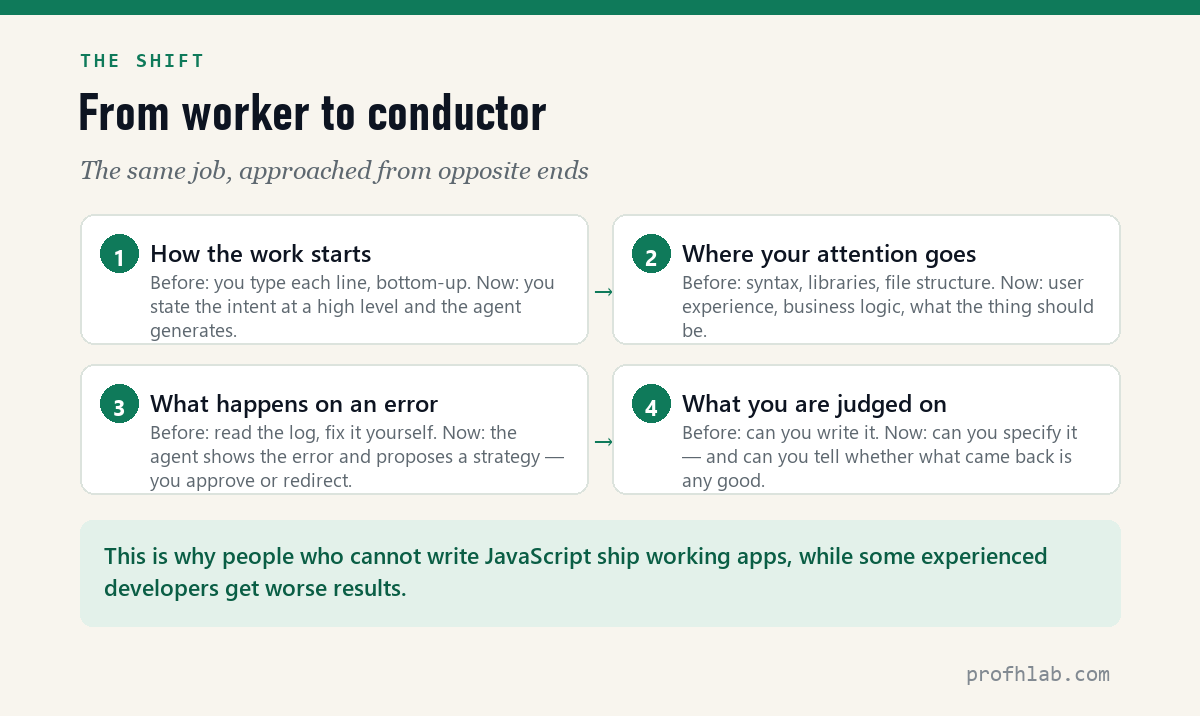
Here is the comparison I use when teaching this, because it survives contact with a room full of beginners.
| Traditional coding | Vibe coding | |
|---|---|---|
| How work starts | Type each line yourself — bottom-up | State intent at a high level — top-down |
| When something breaks | Read the log, find it, fix it | The agent surfaces the error and proposes a strategy; you approve or redirect |
| Where attention goes | Syntax, libraries, file structure | User experience, business logic, design |
| What you are judged on | Can you write it | Can you specify it — and can you tell good output from bad |
The right-hand column is not easier. It is a different skill, and it explains something that confuses people: designers and teachers who cannot write a line of JavaScript are shipping working applications, while some experienced developers get worse results than they used to.
The people doing well are the ones who can describe precisely what they want. That was always a rare skill. It just used to be hidden behind the ability to type code.
Andrej Karpathy, who coined the phrase, on the shift itself — recorded at Y Combinator (2.34M subscribers). 2,515,871 views as of 11 August 2026.
How big this actually is
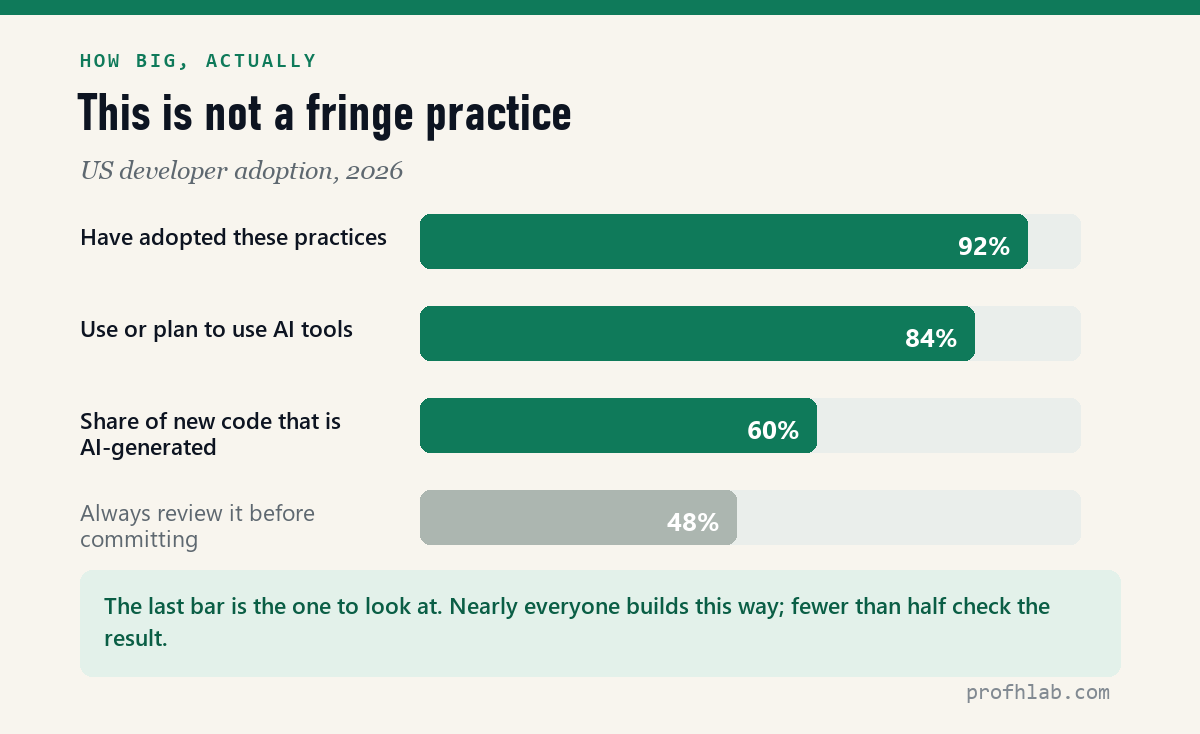
- 92% of US developers have adopted these practices; 84% use or plan to use AI tools, up from 76% in 2024.
- GitHub Copilot reports 20 million all-time users and 4.7 million paid subscribers. Cursor reports around 7 million monthly active users.
- And the number that matters most: 96% do not fully trust that the generated code is correct — but only 48% always review it before committing.
Sit with that last pair for a moment. Nearly everyone doubts the output. Fewer than half check it. That gap is not a tooling problem, and no model release will close it.
Your first ten minutes
The fastest way to understand this is to do it once. You do not need to install anything.
- Open any capable chatbot. Gemini, Claude and ChatGPT all work for this.
- Describe a page rather than requesting code. Say what it should feel like, not how to build it.
- Take what it gives you and run it. Save as
index.html, double-click, look at it in a browser. - Now change it with words. “Make the heading bigger.” “Add a button that fades in.” Watch it edit its own work.
Build me a single-page personal introduction site.
Minimal, white background, in the spirit of Apple’s homepage.
A greeting centred on the screen, and one button that animates on hover.
Give me a complete HTML file I can save and open.
That prompt is a minute of typing and it produces something that looks deliberate. Notice what it does not contain: no colour codes, no font names, no CSS. You described a feeling — the vibe — and got a professional-looking result.
That is the whole idea in one exercise. It is also where the ceiling appears: ask vaguely for something specific and you get the average of everything the model has seen. Fixing that is the next article.
What vibe coding is not
Three honest limits, because the enthusiastic version of this article is everywhere already.
- Not a substitute for knowing what good looks like. The model will happily produce something that runs and is wrong. If you cannot evaluate the result, you have automated the production of confident mistakes.
- Not maintenance-free. Code you did not write is code you do not know. When it breaks in six months, you will be reading it for the first time.
- Not a licence to skip the review. See the 96%/48% gap above. The highest-leverage habit in this entire field is reading what came back.
What I saw teaching this
A room of beginners, one semester, the same tools. The ones who got the best results were not the ones who wrote the cleverest prompts. They were the ones who checked the output and asked for changes until it was right. Persistence in reviewing beat talent in prompting, every time.
Tina Huang (1.28M subscribers) walks the fundamentals in 33 minutes, if you would rather watch than read. 978,882 views as of 11 August 2026.
Do you need to code first, and is vibe coding a fad?
Who coined “vibe coding”?
Andrej Karpathy, in February 2025. He described giving in to the vibes and almost forgetting the code exists.
Do I need to learn programming first?
To produce something that works, no — people with no coding background ship real applications. To judge whether it is any good, some understanding helps a great deal. Start by building, and let the questions you hit tell you what to learn.
Is this just for websites?
No, but websites are the best place to start because you see the result instantly. That immediate feedback is what makes the skill click.
Will this replace developers?
It has already changed what the job is. Writing the implementation is worth less; specifying and verifying it is worth more. The people struggling are not the ones who type slowly.
Is vibe coding dead, or just a fad?
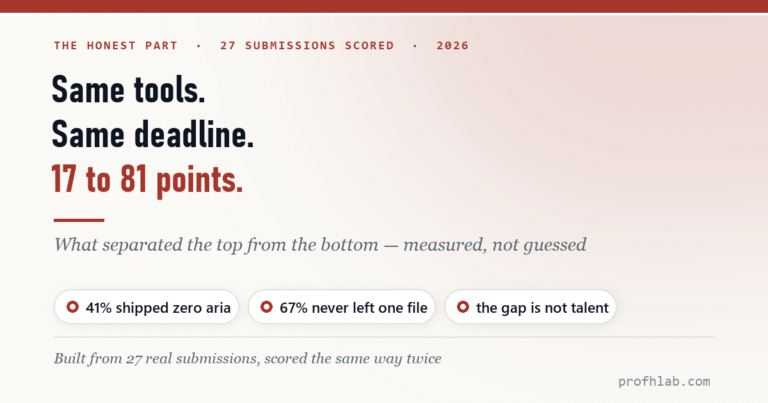
The phrase may be; the practice is not. “Vibe coding is dead” and “is vibe coding bad” are both common searches, and the criticism behind them is usually fair — people ship things they cannot verify. That is an argument for the verification habit, not against the method. In a cohort of 27 beginners using it on the same brief, scores ran from 17 to 81 out of 100. A fad does not produce that spread. A skill does.
Where to go next
If you ran the ten-minute exercise, you now have a working page and a specific complaint about it. That complaint is the reason for the next piece: a four-box structure for saying exactly what you want, which is the single change that most improves what comes back.
Sources: Andrej Karpathy’s February 2025 description of the term; published 2026 developer-adoption surveys; GitHub and Cursor user figures as reported in 2026. Verified August 11, 2026.
THE AGENTIC AI SERIES
Eleven articles, in order
- 1. Generative AI vs Agentic AI — One writes the answer, the other does the job.
- 2. What Is Vibe Coding, Really? — The shift from worker to conductor. (you are here)
- 3. The IAFA Prompt Framework — Four boxes between a grey button and a great one.
- 4. Your First Page in Ten Minutes — No install, no account, one file.
- 5. From a File to a Live URL — Three routes, and which ones survive a year.
- 6. An Honest Agent Benchmark — 76 seconds to a draft, then two failures.
- 7. Verify Before You Ship — Four passes, with three failures I actually hit.
- 8. The 100-Point Scorecard — Grade your own site before anyone else does.
- 9. Adding a Database — A file cannot remember anything.
- 10. When Vibe Coding Fails — Same tools, same deadline, 17 to 81 points.
- 11. Teaching Vibe Coding — A 15-week course, and what I would change.
Start at the Agentic AI library.
Prof.’s H Newsletter
One short email a month, with the numbers in it
What actually moved in AI hiring, AI prices, and the scams aimed at older Americans. Counted here, dated, and linked to the source. One email a month, and your address goes nowhere else.