Same Tools, Same Deadline, Scores From 17 to 81: When Vibe Coding Fails
PART 10 OF 11 · THE VIBE CODING COURSE
New here? Start at Part 1 →
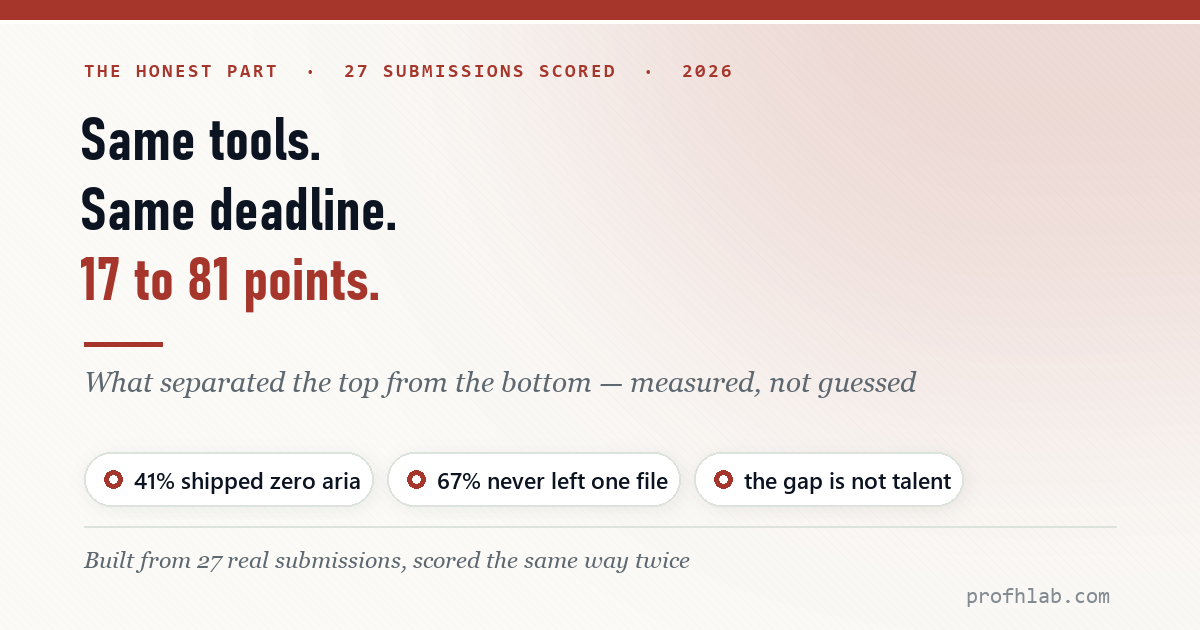
Twenty-seven people. The same tools, the same deadline, the same amount of help available. The scores ran from 81.4 to 17.3 out of 100.
That spread is the most useful thing I have to offer about vibe coding, because it kills the two comfortable stories at once. It is not that AI makes everyone equally capable. And it is not that only people who could already code got results.
The finding
The categories where the gap was widest were the ones the model does not do for you. Technical functionality: 3.6× between the top group and the bottom. Design: 3.2×. Accessibility: 2.6×. Content — the writing, the thing everyone assumes AI levels — was only 1.7×.
AI levelled the words. It did not level the working.
Where the gap opens
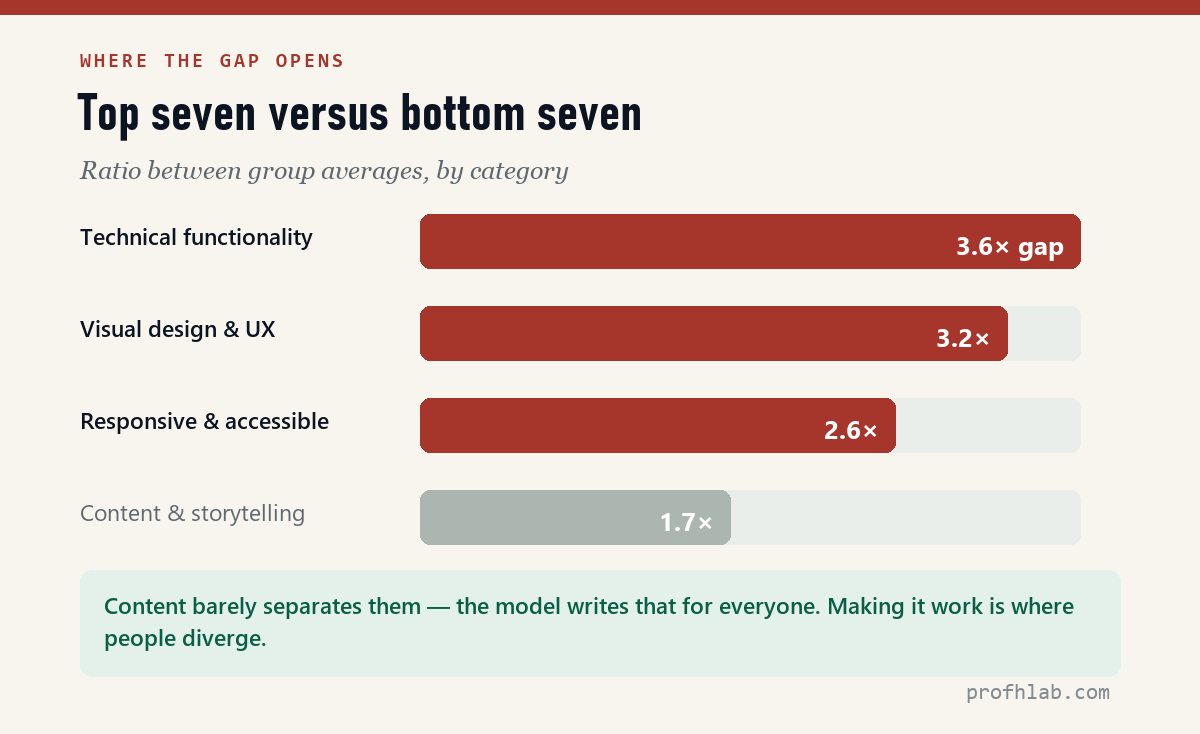
| Category | Top 7 avg | Bottom 7 avg | Gap |
|---|---|---|---|
| Technical functionality | 16.8 / 20 | 4.7 | 3.6× |
| Visual design & UX | 22.4 / 30 | 6.9 | 3.2× |
| Responsive & accessible | 12.6 / 20 | 4.8 | 2.6× |
| Content & storytelling | 18.9 / 30 | 11.0 | 1.7× |
If you want one sentence to take away: the parts of the work that a model can complete without you being present are the parts where everybody looks similar. Everything else is still yours.
Five patterns in the bottom half
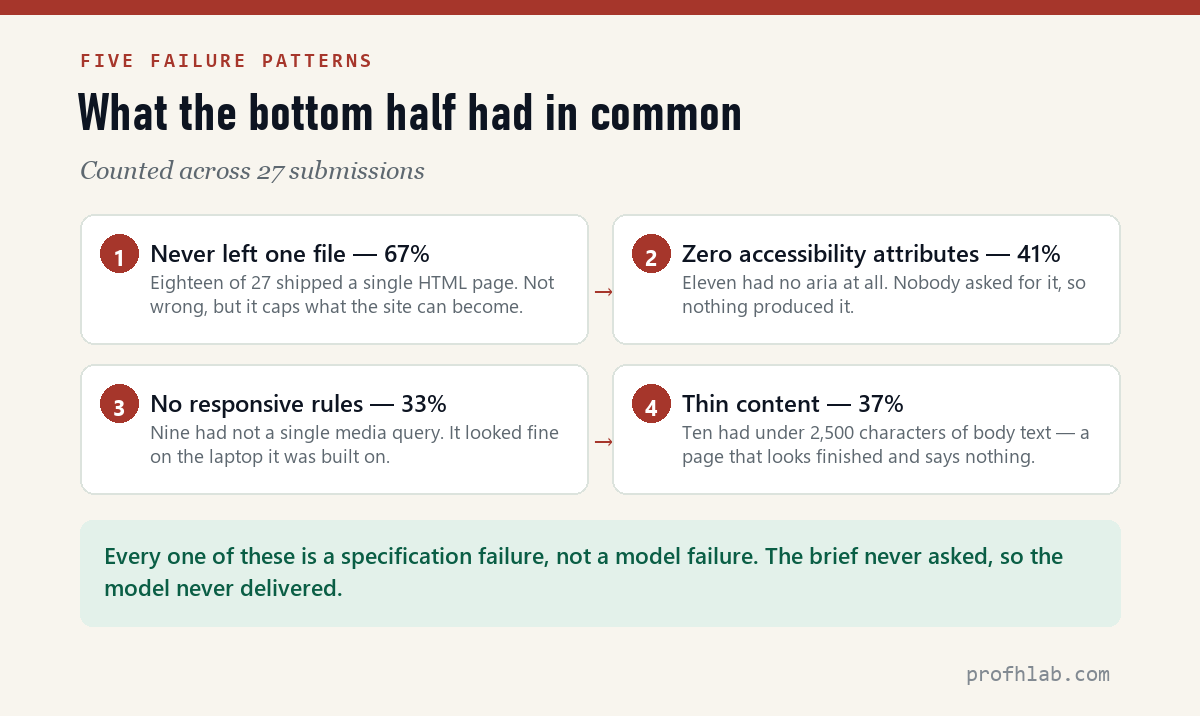
- Never left one file — 67%. Eighteen of 27 shipped a single HTML page. Not wrong in itself, but it caps what the site can ever become, and it usually means the structure was never designed.
- Zero accessibility attributes — 41%. Eleven sites had no
ariaanywhere. Nobody asked for it, so nothing produced it. - No responsive rules at all — 33%. Nine had not a single media query. They looked fine on the laptop they were built on, which is the only device that was ever consulted.
- Thin content — 37%. Ten had under 2,500 characters of body text: a page that looks finished and says nothing.
- Nothing stored — 44%. Twelve stayed entirely static. Fine as a choice, expensive as a default — and it is what dragged the functionality score down hardest.
Every one of those five is a specification failure, not a model failure. Ask for keyboard operability and you get semantic buttons. Ask for a phone layout and you get media queries. The model did not refuse; it was never asked.
The strongest version of the case against, from Modern Software Engineering (264K subscribers). Worth watching precisely because it disagrees with the framing here. 223,202 views as of 11 August 2026.
What the top group did differently
I went back through the highest-scoring work looking for a common technique. There is one, and it is duller than anyone wants.
- They asked for behaviour, not appearance. The top site’s brief clearly specified what things had to do. It came back with a 3D model viewer and a working robot simulation on a separate page — because someone asked for those in the first place.
- They kept going after it worked. The bottom half stopped at the first result that rendered. The top half treated that as a draft.
- They built structure. Six pages with a separate module for the message board, rather than one file with everything in it. That is a decision made before the first prompt.
- They tested on something other than their own laptop. This shows up as media queries and as
aria, and it is almost perfectly correlated with the final score.
The uncomfortable part
None of that is talent, and none of it is coding ability. It is persistence and specificity. The people who did best were not the ones who wrote the cleverest prompts — they were the ones who looked at the result, decided it was not good enough yet, and said so again. Repeatedly.
So when does vibe coding actually fail?
- When you cannot tell whether the result is good. This is the real ceiling. You can build far beyond your ability to write code; you cannot build beyond your ability to judge.
- When you stop at the first version that runs. The first draft is the model’s guess at the average of your vague request. Its whole value is as something to react to.
- When nobody wrote down what it must do. Function is the box people skip, and the one the scores punish hardest.
- When it has to be maintained. Code you did not write is code you do not know. In six months you will read it for the first time, in a hurry.
If you are at the bottom of that range
The distance from 17 to 81 sounds like a chasm. In practice it is four habits, and each one is available today:
- Fill the Function box. Write what it must do before what it must look like. The four boxes are here.
- Open it on your phone before you call it finished. One minute; recovers most of a category.
- Ask once more. Whatever came back, say what is wrong with it and get the next version. The gap between one round and three is enormous.
- Run the five-minute check. Drive it, break it, check what you never asked for.
DevForge (13.4K subscribers) on what experienced developers notice in beginner output. 363,728 views as of 11 August 2026.
Skill, experience or rounds: what really separated 17 from 81
Were the low scorers just less experienced?
Not in a way that predicted the outcome. The strongest work came from people who could not have written it by hand, and some of the weakest came from people who could have. What predicted the score was how many rounds they went and whether they checked on a second device.
Is a 50-point site a failure?
No — it was the average, and it usually means one category collapsed while the others held. The rubric’s value is that it tells you which one.
Does this mean AI is overrated?
The opposite. Everyone in that room produced a working, deployed website, and 94% of those sites were still online a year later. The floor moved enormously. It is the ceiling that still belongs to the person.
Is vibe coding a skill, or just typing?
The 27 scores answer this. Same tools, same brief, same deadline, and a spread from 17 to 81. If it were only typing, the results would cluster. What the top group had was not talent — it was persistence past the first working version, and specificity in what they asked for.
Is vibe coding hard?
Getting something on screen is easy, and that is the trap. The measured difficulty is all downstream: 44% never got a database working, 41% shipped nothing for accessibility, 33% never made the page survive a phone. None of those are hard problems. They are problems nobody asked the model to solve.
The one line
AI levelled the writing. It did not level the working. The difference between 17 and 81 was not who could code — it was who kept asking, and who checked.
Method: 27 submissions from one university course, scored from source code against a four-part rubric in August 2026. Individual work is not identified, and no student is named.
THE AGENTIC AI SERIES
Eleven articles, in order
- 1. Generative AI vs Agentic AI — One writes the answer, the other does the job.
- 2. What Is Vibe Coding, Really? — The shift from worker to conductor.
- 3. The IAFA Prompt Framework — Four boxes between a grey button and a great one.
- 4. Your First Page in Ten Minutes — No install, no account, one file.
- 5. From a File to a Live URL — Three routes, and which ones survive a year.
- 6. An Honest Agent Benchmark — 76 seconds to a draft, then two failures.
- 7. Verify Before You Ship — Four passes, with three failures I actually hit.
- 8. The 100-Point Scorecard — Grade your own site before anyone else does.
- 9. Adding a Database — A file cannot remember anything.
- 10. When Vibe Coding Fails — Same tools, same deadline, 17 to 81 points. (you are here)
- 11. Teaching Vibe Coding — A 15-week course, and what I would change.
Start at the Agentic AI library.
Prof.’s H Newsletter
One short email a month, with the numbers in it
What actually moved in AI hiring, AI prices, and the scams aimed at older Americans. Counted here, dated, and linked to the source. One email a month, and your address goes nowhere else.