New AI Phone Scams: The Fake Official Now Appears on Video (AI Scam Watch, October 2026)
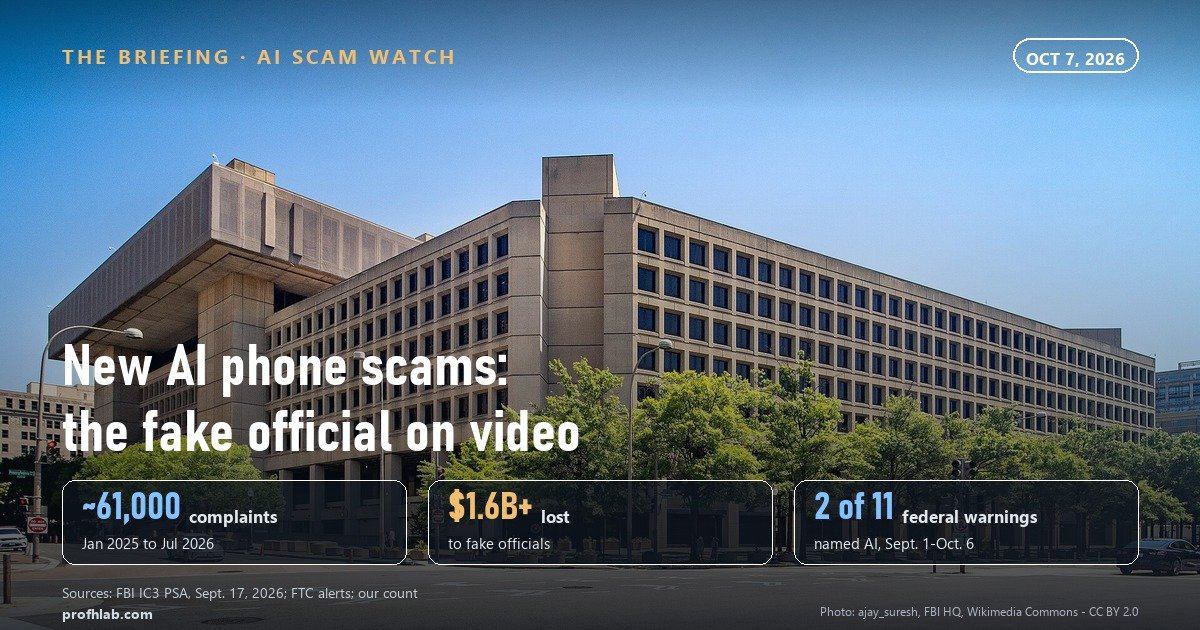
The newest AI phone scam in the federal record is the fake official who moves your call to video: on September 17, 2026 the FBI warned that impersonators now use artificial intelligence to appear as police and government officials on video calls. That scam family drew nearly 61,000 complaints and more than $1.6 billion in reported losses from January 2025 to July 2026.
Picture the call the FBI describes. The phone rings. A caller says your name is tied to a crime, or a missed jury summons, and will not let you hang up. Then comes a video call, with a uniform, a badge and an office behind it. The FBI’s warning says some of those offices are mock sets, and that AI lets scammers appear as officials on video.
What we checked on October 7, 2026. We read every consumer warning two agencies published from September 1 to October 6, 2026: 9 FTC consumer alerts and 2 FBI IC3 public service announcements. 2 of the 11 name AI as a scam tool. We also put the FBI’s new impersonation warning side by side with its March 7, 2022 version, line by line.
Every dollar figure is quoted from an agency page or is our own arithmetic on those figures, and we say which. Averages are approximate because the FBI rounds (“nearly,” “more than”).
Written and checked by Prof. H. An AI assistant helped draft and run the page reads; every quote was read on the source’s own page on the date shown. This edition runs October 7, not the October 1 date the September edition promised: AI Scam Watch now publishes on the first Wednesday of each month.
What are the new AI phone scams this month?
One stands out, because the FBI put it in writing on September 17, 2026: the government impersonator who adds video. The public service announcement says “new technologies, such as artificial intelligence” let scammers “appear as law enforcement and government officials on video calls with victims.”
The phone is still the front door. The same warning says scammers “primarily contact victims through unsolicited phone calls,” spoof real agency numbers and employee names, and keep the victim on the line for the whole scam. The AI video call is an added layer, not a replacement for the phone call.
The second AI item of the month came from the FTC on September 1. Its consumer alert on fake car dealers says scammers clone a real dealer’s website, “often using AI to do so,” down to logos, listings and photos, then ask for payment up front by wire. That one starts on a web page, not a call.

How much have fake officials taken since January 2025?
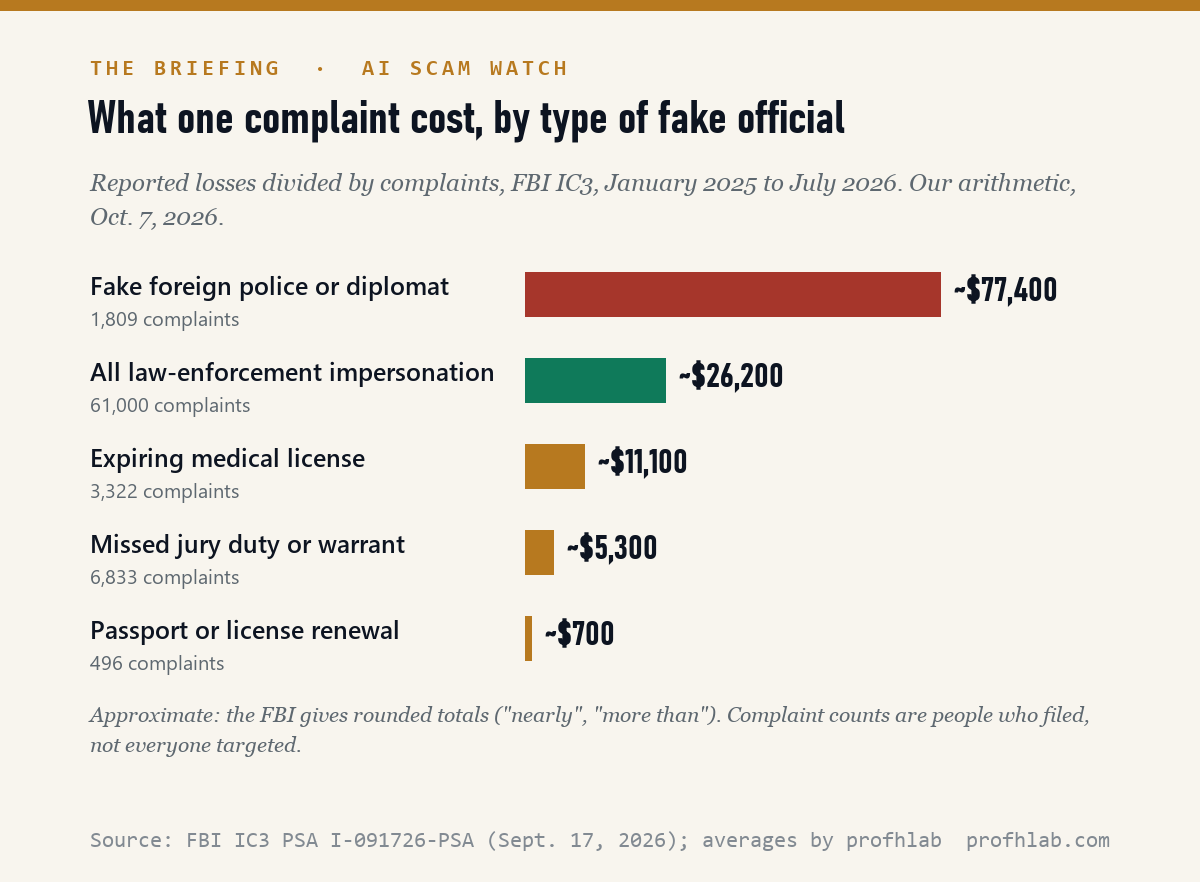
More than $1.6 billion across nearly 61,000 complaints between January 2025 and July 2026, the FBI said on September 17, 2026. That works out to roughly $26,000 per complaint and about 3,200 complaints a month, by our arithmetic over those 19 months.
The FBI breaks out four kinds of story. They are not the biggest share: together they cover about 12,460 complaints, one in five. The FBI says the majority of complaints are the plainest version, where the caller accuses you of a crime and threatens arrest.
| Story the caller tells | Complaints | Reported losses | Per complaint (our math) |
|---|---|---|---|
| Foreign police or diplomat threatens extradition or your passport | 1,809 | More than $140 million | ~$77,400 |
| Your medical license is expiring or was used in a crime | 3,322 | More than $37 million | ~$11,100 |
| You missed jury duty, or there is a warrant | 6,833 | Nearly $36 million | ~$5,300 |
| Your passport or driver’s license needs a paid renewal | 496 | More than $348,000 | ~$700 |
| All law-enforcement and government impersonation | Nearly 61,000 | More than $1.6 billion | ~$26,200 |
Source: FBI IC3 PSA I-091726-PSA, September 17, 2026, January 2025 to July 2026. Per-complaint figures are profhlab arithmetic on rounded totals, October 7, 2026.
Read the top row twice. The foreign-official story is about 3% of complaints and close to 9% of the money. It is also the version where the FBI mentions fake uniforms and mock offices, and the one it calls hard to verify, because the officials are said to be overseas.
What changed between the FBI’s 2022 and 2026 warnings?
Three things were added and one was removed, when we read the March 7, 2022 announcement against its September 17, 2026 update on October 7, 2026. The new version runs about 908 words to the old one’s 657, by our count of the page text.
Added: artificial intelligence and video calls, which the 2022 text never mentions. Couriers, now on the list of payment methods next to prepaid cards and crypto kiosks. And a warning about look-alike web addresses, “.com instead of .gov.” The old version had no dollar figures at all; the new one has five.
Removed: the 2022 version said “any legitimate investigation or legal action will be done in person or by official letter.” That sentence is not in the 2026 text. The FBI does not explain the cut. Our reading, and it is only that: once a fake officer can appear on a screen, “in person” is a harder line to hold, and the new text leans on a simpler rule instead.
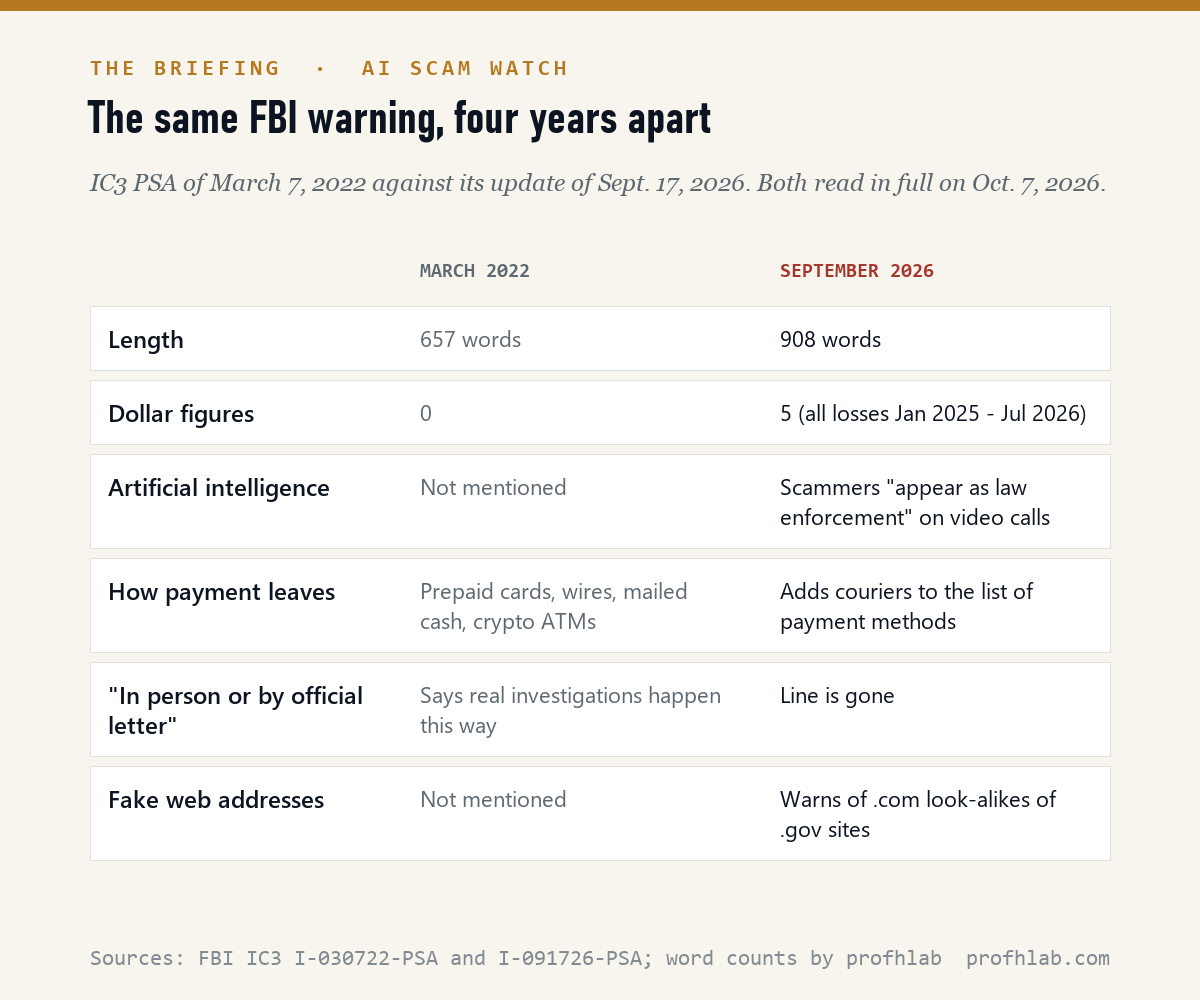
The rule that survived both versions. In the FBI’s 2026 words, law enforcement and government authorities “will never contact members of the public by telephone or text message to demand any form of payment.” A video call does not change that. A uniform on a screen does not change that.
How many September warnings from the FTC and FBI named AI?
Two of eleven. We read all 9 FTC consumer alerts dated September 1 to October 1, 2026 and both IC3 announcements from September 1 and September 17. Only the FBI’s impersonation warning and the FTC’s car-dealer alert name AI as a tool scammers use.
| Date | Agency and warning | Names AI as a scam tool? | How the scam reaches you |
|---|---|---|---|
| Sept. 1 | FTC: spoofed car dealership websites | Yes | Cloned website |
| Sept. 1 | FBI IC3: consent phishing | No | Messaging apps, fake officials |
| Sept. 3 | FTC: fake QR codes on parking meters | No | Sticker on a meter |
| Sept. 9 | FTC: preparedness month scams | No | After a disaster |
| Sept. 10 | FTC: intimate images shared without consent | No (mentions deepfakes) | Not a scam alert |
| Sept. 15 | FTC: fake farm equipment sellers | No | Social media ad |
| Sept. 17 | FTC: platforms that fail to take images down | No | Not a scam alert |
| Sept. 17 | FBI IC3: fake law enforcement and officials | Yes | Phone call, then video |
| Sept. 23 | FTC: reporting a platform | No | Not a scam alert |
| Sept. 28 | FTC: open enrollment insurance scams | No | Paid search ad |
| Oct. 1 | FTC: talking to kids about deepfakes | No (mentions deepfakes) | Not a scam alert |
All 11 read and classified by profhlab.com on October 7, 2026. Dates are the byline dates on each page.
Four of the nine FTC alerts are about the Take It Down Act and intimate images, not fraud. Two mention deepfakes in that sense. We did not count them as naming AI as a scam tool, because they describe abuse, not a money scam.
Our September edition promised two checks. First, the FBI’s July 20 warning about scammers posing as IC3 itself is no longer on the IC3 home page; on October 7 it listed five newer announcements. The warning lives on inside the September 17 text, which names IC3 among the agencies scammers spoof. Second, paid ads: 2 of the 5 September scam alerts name an ad as the way in, down from 4 of 8 in August. Five alerts is too few to call that a trend.
Where else did AI show up in the federal record this month?
In an investor bulletin. On October 5, 2026 the SEC, CFTC, FINRA, NASAA, NFA and SIPC issued a World Investor Week bulletin saying tools such as AI “have made impersonation of individuals and organizations by fraudsters more convincing.” It gives no AI-specific number.
Not on robocalls. The FCC’s biggest phone action in the window, on September 2, 2026, cut off 14 voice providers from U.S. networks for failing robocall rules. Its 339-word release does not mention AI. The FCC news pages refused our requests, so a smaller AI-voice item may exist that we could not see.
The yearly baseline has not moved. The FBI’s 2025 Internet Crime Report counts 22,364 complaints reporting AI-related information and losses of $893,346,472. Distress calls, where a cloned voice imitates a relative, account for “over $5 million” of that. We read page 39 again on October 7 to confirm.
What should you do when a caller says they are the police?
- Hang up, even if they move to video. A face on a screen is not proof. The FBI says AI can make one.
- Call the agency back on a number you look up yourself. Not the number on caller ID, which can be spoofed, and not one the caller gives you.
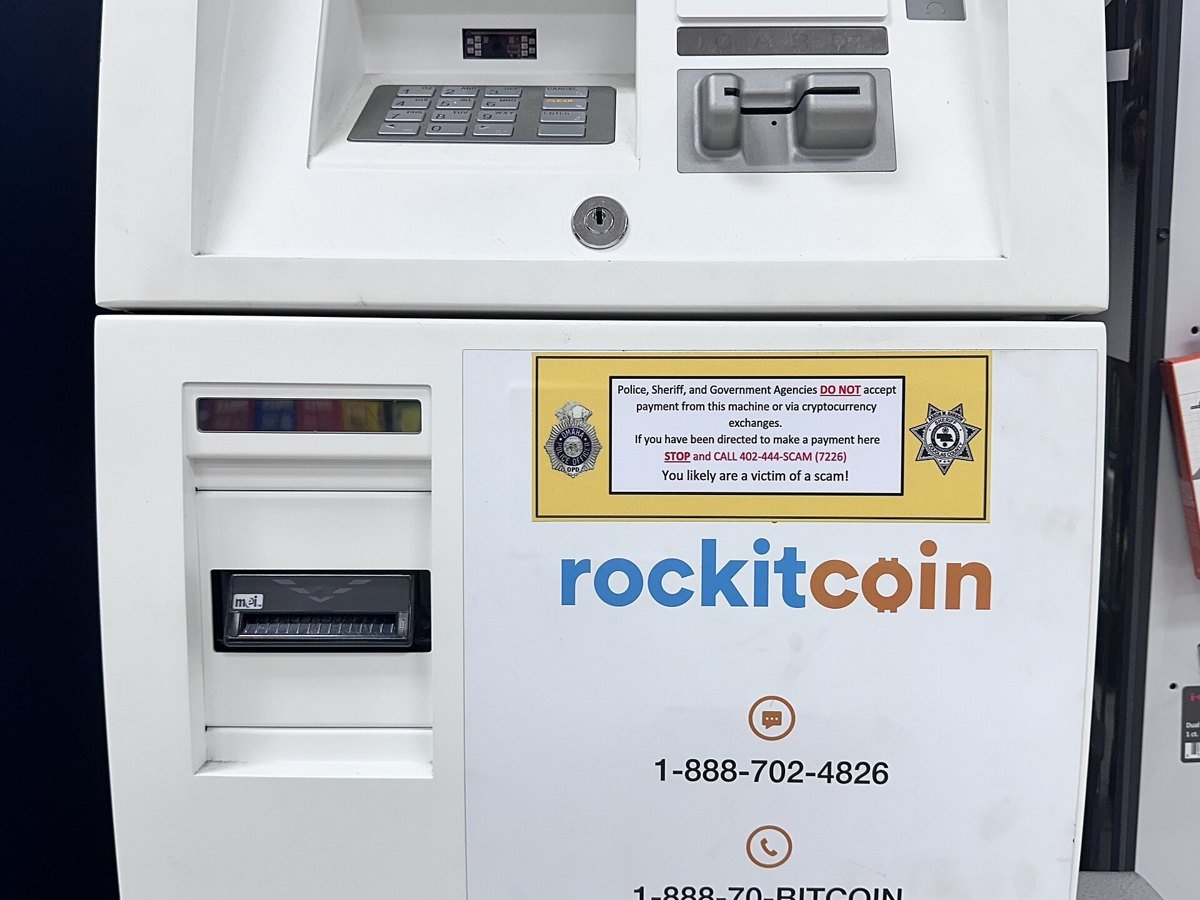
- Never pay by kiosk, prepaid card or courier. The FBI says officials “will never request payment” those ways.
- Tell someone. Fake officials urge you not to tell family, friends, your bank or the police, the FBI says. That request is the tell.
- Report it. File at ic3.gov, call local police, and if money moved, call your bank the same day. The FTC takes reports at ReportFraud.ftc.gov.
For a relative who might get the call, agree on a family code word now. Our safe word examples page has ones that are hard to guess, and how to tell if a phone call is AI covers the voice side. If you already said yes to a caller, read what happens if you say yes on a scam call.
What do local newsrooms show when the caller is a deepfake?
We picked two local stations with plain titles and 2026 dates. We did not find a 2026 clip on this scam from the FBI, FTC or AARP channels, so these are newsroom reports, not agency videos.
Where to go next if a fake official already called
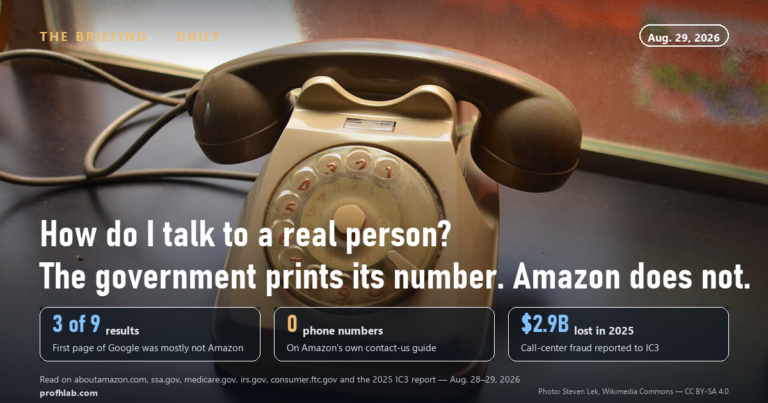
- The caller wanted you to talk to a person at a company. How do I talk to a real person?
- You want fewer unknown calls. iPhone call screening, on and off.
- It came as an ad, not a call. Why do I keep getting scam ads on YouTube? and how to tell if a Facebook ad is fake.
- It came as a video. How to tell if a video is AI on YouTube and how to tell if a picture is AI.
- It came by email. How to tell if an email is written by AI.
- You typed personal details into a chatbot. Is it safe to give ChatGPT my personal information? and your credit card.
- It was a job offer. Are AI training jobs legit? and our AI jobs tracker.
Kiosks, couriers and video badges, taken one question at a time
What are the new AI phone scams?
The newest one in the federal record is the fake official on video. On September 17, 2026 the FBI said impersonators use artificial intelligence to appear as police and government officials on video calls. The call usually starts as an ordinary phone call, the FBI says. Government and police impersonation drew nearly 61,000 complaints and more than 1.6 billion dollars in reported losses from January 2025 to July 2026.
Do police ever call and ask for money?
No. The FBI public service announcement of September 17, 2026 says law enforcement and government authorities will never contact the public by telephone or text message to demand any form of payment, and will never ask for payment by prepaid card, cryptocurrency or courier.
Can a scammer really appear as a police officer on a video call?
The FBI says yes. Its September 17, 2026 warning says new technologies such as artificial intelligence allow scammers to appear as law enforcement and government officials on video calls with victims. It also says some scammers wear fake police uniforms and use mock sets of government offices.
How do I check if a caller is really from the government?
Hang up and look up the agency yourself. The FBI advises using official, publicly available contact information and never the number, link or email the caller gives you. Check that any web address ends in the real agency domain, because the FBI warns of look-alike sites that use .com instead of .gov.
Where do I report a fake police or government call?
File a complaint at ic3.gov, report it to your local police, and if you paid anything, call your bank or card issuer the same day. You can also report it to the FTC at ReportFraud.ftc.gov. Include phone numbers, payment details and any texts or emails.
How much do people lose to AI voice cloning scams?
The FBI 2025 Internet Crime Report gives one figure: victims reported losses of more than 5 million dollars in 2025 to distress scams, the family emergency calls where voice cloning is used. That counts only victims who noticed and reported it, so it is a floor.
Why did the FBI add numbers to its impersonation warning?
The FBI does not say why. What we can show is the difference: its March 2022 warning on the same scam had no dollar figures, and the September 2026 update has five, covering January 2025 to July 2026.
Cite this:
Of 11 consumer warnings the FTC and the FBI’s Internet Crime Complaint Center published between September 1 and October 6, 2026, two named artificial intelligence as a scam tool; the FBI’s September 17 warning says impersonators use AI to appear as officials on video calls, in a scam family with nearly 61,000 complaints and more than $1.6 billion in reported losses from January 2025 to July 2026. Source: profhlab.com, AI Scam Watch, October 2026, counted October 7, 2026.
The pages this edition was built from, with dates
- FBI IC3, “Scammers Impersonating Law Enforcement and Government Officials in Fraud Schemes,” I-091726-PSA, September 17, 2026
- FBI IC3, “FBI Warns of the Impersonation of Law Enforcement and Government Officials,” I-030722-PSA, March 7, 2022
- FBI IC3, “Malicious Cyber Actors Gain Access to Victim Accounts Through Consent Phishing,” September 1, 2026
- FBI IC3, 2025 Internet Crime Report (PDF), AI section page 39
- FTC consumer alert, “Scammers are spoofing car dealership websites,” September 1, 2026
- FTC consumer alert, open enrollment health insurance scams, September 28, 2026
- FTC consumer alert, farm equipment impersonators, September 15, 2026
- SEC and partners, World Investor Week 2026 Investor Bulletin, October 5, 2026
- FCC, “FCC Cuts Off Providers for Violating Robocall Rules,” September 2, 2026
- All 11 FTC and IC3 warnings in the table above, read in full October 7, 2026. Counts, word counts and per-complaint averages are ours. Method: how we count.
What we will check before the November edition
The next AI Scam Watch publishes Wednesday, November 4, 2026. We will look for three things: whether the FTC’s yearly report to Congress on fraud against older adults has a 2026 edition, whether any October FTC or IC3 warning names AI, and whether the FBI adds numbers for the video-call version on its own.
Earlier editions and companions: AI Scam Watch, September 2026 · AI scams targeting seniors · AI tools for seniors · ChatGPT for beginners over 50 · The Briefing · Start here · Resources · FAQ · Ask a question. One short email a month, if you want the next edition when it lands.
About the author. Prof. H teaches robotics and AI and writes The Briefing and AI Scam Watch, a monthly read of what federal fraud agencies actually published. Every document here was fetched and read on the date shown. This is general consumer information, not legal or financial advice. Corrections and questions: ask here.
Prof.’s H Newsletter
One short email a month, with the numbers in it
What actually moved in AI hiring, AI prices, and the scams aimed at older Americans. Counted here, dated, and linked to the source. One email a month, and your address goes nowhere else.