When Do Faculty Jobs Get Posted? We Dated All 45 Open Listings (Sept. 5, 2026)
Right now — the last week of August through October is when most of them appear. On Saturday, September 5, 2026 we opened every listing active on the Computing Research Association’s job board, the board American computer science departments use to advertise faculty searches, and read the date on each one. There were 45. 37 of them went up on or after August 1, 15 in the last fourteen days, and the median listing is 17 days old.
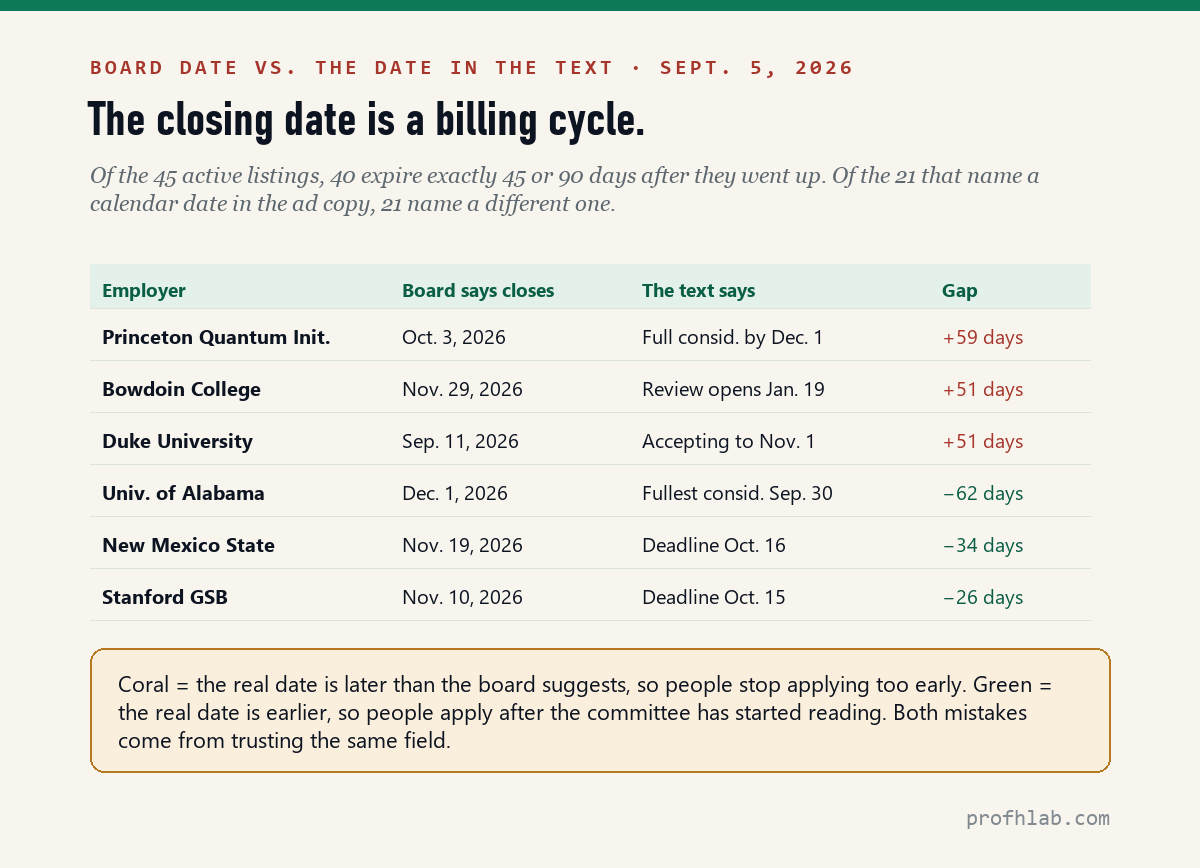
Then we read the fine print, and found the part that costs people interviews. The date the board shows as the closing date is almost never the date the department cares about. Of the 21 listings that name a calendar date in their own text, 21 name a different one — from 62 days earlier to 59 days later.
At a glance · counted September 5, 2026
- 45 faculty listings active; 39 in the United States, 8 naming artificial intelligence, machine learning or data science in the title.
- 37 of 45 posted since August 1. Four working days at the start of September produced 11 — as many as the busiest full week of August.
- 40 of 45 expire exactly 45 or 90 days after they went up. That is a purchased advertising slot, not a deadline.
- 21 of 21 listings that name a date in the ad copy name one that differs from the board’s closing date. 14 also say the search stays open until filled.
- 13 of 45 publish a salary. On the twenty AI company boards we count every morning, 2,188 of 3,001 US postings do — 72.9%.
- 20 of 45 are assistant professor roles. Only 2 are postdocs; this board is where the permanent jobs go.
Bruegel painted August as a field half cut: some of the wheat down, some still standing, and the workers who finished their row asleep under the pear tree. That is the American faculty market this week. The listings that will define this hiring year are going up now, a few a day, and almost nobody outside a search committee is watching them arrive.
How we counted. On September 5, 2026 we pulled the Computing Research Association board’s public sitemap of active jobs, opened all 45 listings, and read the structured job data each page publishes: posting date, expiry date, employer, location, salary, and the full advertisement text. Then we searched every advertisement for words like “review of applications,” “full consideration” and “deadline” and pulled out the calendar dates. Numbers below are our own count of that one board on that one morning. The daily company-side counts live on our AI jobs tracker.
So when do faculty jobs actually get posted?
Grouped by the week each listing went live, the shape is unambiguous. One straggler from July 20. Six in the last week of July. Then four, seven, eleven, four across August — and eleven more in the four working days between August 31 and September 3.
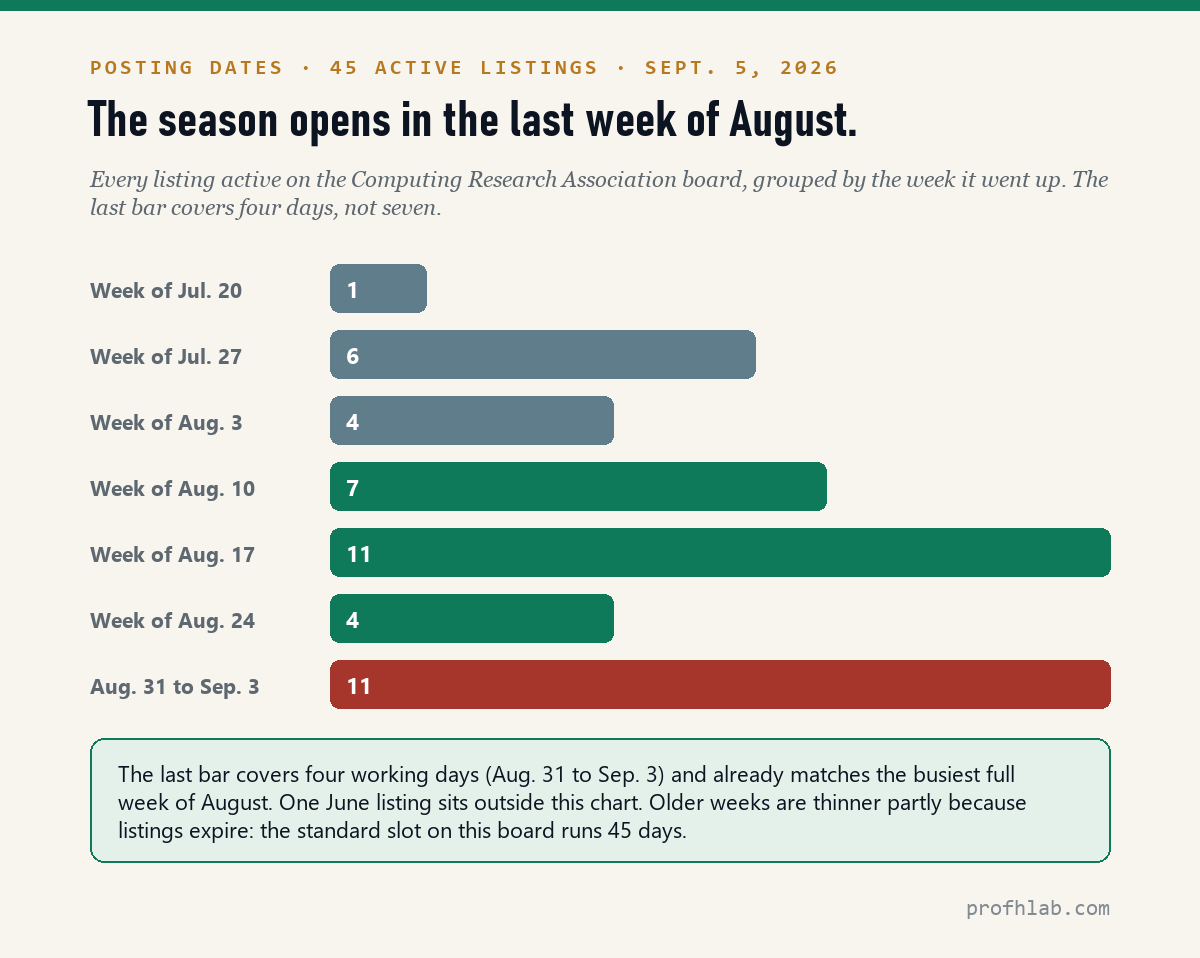
One honest caveat, because it changes how you read that chart. A live board is a survivor list: the older weeks look thin partly because their listings have already expired or been pulled. The standard slot on this board runs 45 days, so nothing posted before about July 22 would still be visible unless the department paid for a longer run.
What the chart can tell you is that the board’s live inventory is young — median age 17 days — and that the newest four days are as busy as any full week behind them. What it cannot tell you is what October will look like. We will keep counting.
The practical reading: if you are waiting for the market to open, it opened. If you have a packet you are still polishing, the departments you want are advertising this week, and their earliest internal review dates are three to four weeks out.
The closing date on the listing is a billing cycle
This is the finding we did not expect, and the one worth your attention. Every listing carries an expiry date, and search engines render it as “closes on.” We measured the gap between the posting date and that expiry date on all 45. It takes exactly five values: 45 days on 29 listings, 90 days on 11, and five odd runs of 75, 106 and 120 days.
Application deadlines do not cluster on two numbers. Advertising packages do. The board’s own help pages confirm it from the employer’s side: to keep a job visible, a department logs in and buys a “Boost” — the “Additional 30-days” upgrade — and checks out. The price of the ad, the same page says, “is generated for you bas[ed] on the final word count.” And a department that fills a job cannot delete the listing at all: “Jobs cannot be deleted. To remove a job from the active list, select Suspend.”
So the date you are reading is the day the advertisement stops being paid for. It is set by a purchase, not by a committee.
The errors run in both directions, and they hurt differently.
When the real date is later, you stop too early. Duke’s advertisement for four tenure-track assistant professor positions in AI and machine learning for biology says, under a heading it labels “Important Dates,” that “review of applications will begin October 1, 2026, but we will continue accepting applications through November 1, 2026.” The board says the listing closes September 11 — fifty-one days before the department stops reading. Bowdoin’s lecturer post is stranger still: the board runs it to November 29, and the text says review begins January 19, 2027.
When the real date is earlier, you arrive after the reading has started. The University of Alabama runs two listings to December 1, and both say applications received by September 30 get “fullest consideration.” New Mexico State’s AI institute posting runs to November 19 and names an application deadline of October 16. Stanford’s Graduate School of Business runs to November 10 with a hard deadline of October 15, at 9:00 PM Pacific Time. A candidate pacing off the board date submits three or four weeks after the committee began sorting.
What “review of applications will begin” means
Three phrases do almost all the work in these advertisements, and they are not synonyms.
“Review of applications will begin [date]” is the date the committee starts reading, not the date it stops. Files that arrive after it are usually still accepted and are usually read second, which in a search with two hundred applicants is a real disadvantage. “For full consideration, apply by [date]” is the same idea in the language of a promise the department is willing to make. “Until the position is filled” or “on a rolling basis” means there is no cliff at all — and it appears in 14 of our 45.
Twenty-one listings name a date. Twenty-one others say nothing at all about timing in the advertisement, which means the date is either on the department’s own application page or nowhere. Harvard’s two statistics listings, tenure-track and tenured, both say review begins November 1 and then continues “on a rolling basis until the position is filled” — a formulation that tells you the committee will not close the door, and also that being in the November 1 pile is the whole game.
The one habit worth building. Open the listing itself, search the text for the word “review,” and put that date in your calendar — not the date the board or the search result shows you. On the 45 listings we read, that habit would have moved a date by more than three weeks in nine cases.
Do faculty job postings list salary? Usually not
Thirteen of the 45 publish a number — 13 of the 39 US listings, or 33.3%. On the same morning, of the 3,001 US openings we counted on twenty AI, robotics and self-driving company boards, 2,188 published a pay band: 72.9%. Universities are more than twice as likely to advertise a professorship without saying what it pays.
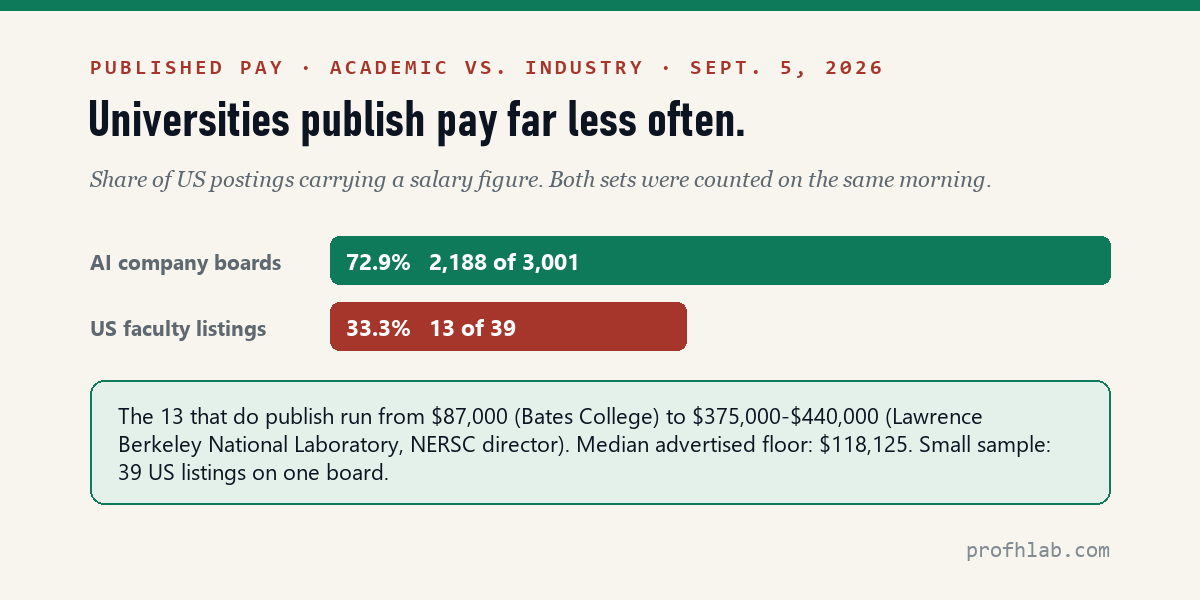
Here is every one of the thirteen, exactly as advertised. It is a small sample from a single board, and it is not a salary survey — but it is thirteen real numbers attached to thirteen real institutions, which is thirteen more than most articles on this subject contain.
| Institution | Role | Advertised pay | Location |
|---|---|---|---|
| Bates College | Professor of Africana and Digital and Computational Studies | $87,000–$120,000 | Lewiston, ME |
| Bowdoin College | Lecturer in Computer Science | $94,000–$100,000 | Brunswick, ME |
| Harvard University | Tenure-Track Professor in Statistics | $110,000–$165,000 | Cambridge, MA |
| Harvey Mudd College | Segal Endowed Professorship of Artificial Intelligence | $115,000–$135,000 | Claremont, CA |
| Northwestern University | Assistant Professor / open rank, Statistics and Data Science | $115,000–$150,000 | Evanston, IL |
| University of Chicago | Senior Instructional Professor, Data Science Clinic | $115,000–$200,000 | Chicago, IL |
| Hamilton College | Assistant Professor of Computer Science | $118,125–$125,500 | Clinton, NY |
| Bowdoin College | Tenure-Track Assistant Professor of Computer Science | $122,000–$128,000 | Brunswick, ME |
| Northwestern University | Faculty Position, Industrial Engineering & Management Sciences | $135,000–$145,000 | Evanston, IL |
| Columbia University | Assistant Professor of International and Public Affairs | $165,000–$175,000 | New York, NY |
| Princeton University | Assistant Professor, Princeton Quantum Initiative | $170,000–$200,000 | Princeton, NJ |
| Harvard University | Tenured Professor in Statistics | $200,000–$380,000 | Cambridge, MA |
| Berkeley Lab | Director, National Energy Research Scientific Computing Center | $375,000–$440,000 | Berkeley, CA |
All 13 US listings that published pay, of 39 US listings active on the Computing Research Association board on September 5, 2026. Ranges as advertised, annual. Median advertised floor: $118,125.
Two things fall out of that column. The floor of an American assistant professorship in a computing field, when it is stated at all, sits between roughly $87,000 and $170,000 — and the liberal arts colleges that publish are at the bottom of it while publishing the tightest bands, which is the opposite of the pattern we found on company boards, where the widest bands sit on the biggest salaries. The other is that the highest number on the board is not a professorship at all. It is a national laboratory division director, and it closes tomorrow.
What is closing in the next seven days
Four listings hit their board expiry within a week of this reading. Read the last column before you panic about the third one.
| Employer | Role | Board expiry | What the advertisement says |
|---|---|---|---|
| Berkeley Lab | NERSC Director, $375,000–$440,000 — jobs.lbl.gov | Sept. 6, 2026 | No review date given; apply through the lab’s own system |
| Northwestern | Assistant Professor, Management & Organizations — apply | Sept. 10, 2026 | “For full consideration, all application materials must be received by September 15, 2026” |
| Univ. of Chicago | Senior Instructional Professor, Data Science Clinic — apply | Sept. 11, 2026 | Review began August 26 and “continue[s] until the position is filled” |
| Duke University | Four tenure-track Assistant Professors, AI/ML for biology — apply | Sept. 11, 2026 | Review begins Oct. 1; “we will continue accepting applications through November 1, 2026” |
Read on the employers’ and the association board’s own pages on September 5, 2026. Listings can be suspended or extended without notice — the department’s own page always wins.
Put the review date on your calendar, not the closing date
- Calendar the review date, not the closing date. Open the listing, search for “review,” “consideration” and “deadline,” and use what you find. If the text is silent, the date lives on the department’s own application page.
- Check the board this week and next. Eleven listings appeared in four working days at the start of September. Whatever your field, the September wave is arriving now.
- Apply before the review date, not before the expiry date. “Until filled” is not an invitation to be late; it is a promise that the door stays open after the pile has already been sorted.
- Expect no salary. Two thirds of these listings do not publish one, so plan to ask — and see what the thirteen that do publish suggest about the floor in your kind of institution.
- Watch the four closing this week in the table above, and confirm on the employer’s page before you spend an evening on the packet.
Industry posts year-round; these 45 faculty jobs all but require a PhD
“Is the industry side hiring at the same time?” It never stops: the twenty AI company boards we count every morning held 3,788 open roles on September 5, up 16 from the day before, and they post continuously rather than seasonally. If you are weighing both paths, our counts of which AI companies are hiring right now and which AI company pays the most are the industry-side mirror of this article.
“Do I need the doctorate?” For these 45 listings, effectively yes. For the industry roles, we read 2,954 postings and found the answer is much softer than people assume — as is the case for certificates, which zero of 2,974 postings required. The technician and laboratory routes are their own world: see national laboratory jobs without a degree, robotics technician requirements and data center technician roles.
“What about the federal and lab side?” Those run on statutory hiring rules rather than search-committee calendars — start with how federal hiring actually works. And if you are pointing an application at a specific company instead, we have read the postings at OpenAI and Anthropic, checked whether Anthropic is hiring right now, and counted what xAI publishes in Memphis.
Two people who have sat on the other side of the table
Questions people ask about faculty job timing
When do faculty jobs get posted?
Mostly from late August through the fall. Of the 45 faculty listings active on the Computing Research Association board on September 5, 2026, 37 went up on or after August 1 and 15 in the previous fourteen days; the median listing was 17 days old. Four working days at the start of September produced 11 new listings, matching the busiest full week of August.
When do most academic jobs get posted for the following year?
For tenure-track searches, the advertisement usually appears in the autumn before the appointment starts, with reading beginning between October and January and offers in the winter and spring. In our September 5, 2026 read, the earliest review date named was August 26, 2026 and the latest was January 19, 2027 — a five-month spread among listings visible on the same day.
How long do job postings stay up?
On this board, as long as the employer paid for. Of 45 active listings, 29 were set to expire exactly 45 days after posting and 11 exactly 90 days; the board’s own help pages describe renewal as a “Boost” purchase of an “Additional 30-days” upgrade. That expiry date is a billing date, not an application deadline.
What does “open until filled” mean on a job posting?
It means the employer will keep accepting applications with no fixed cutoff, and it almost always sits next to a review date that does matter. Fourteen of the 45 listings we read used this language, and most of them paired it with a first-review date — the practical deadline. Applying after the review date is allowed; being read first is not guaranteed.
How long after a job is posted is too late to apply?
For faculty searches, the meaningful clock is the review date rather than the posting date. In our sample, the median gap from posting to first review was 52 days, and 14 of 45 listings never close at all. The costly mistake is not applying late by a few days; it is trusting the board’s closing date, which differed from the date in the advertisement in all 21 cases where both existed.
What is a tenure-track position?
A faculty appointment, usually at assistant professor rank, that carries a defined probationary period ending in a tenure decision. Twenty of the 45 listings we read were assistant professor roles; the rest were open-rank, associate, full professor, chair, lecturer and, in only two cases, postdoctoral. Boards like this one carry the permanent jobs; postdoctoral positions cluster on discipline-specific feeds instead.
Do faculty job postings list salary?
Usually not. Thirteen of the 39 US listings active on September 5, 2026 published a figure — 33.3%, against 72.9% of the 3,001 US openings on twenty AI company boards counted the same morning. Where pay was published, the advertised floors ran from $87,000 to $375,000, with a median floor of $118,125.
How much do computer science professors make?
We can only report what is advertised, not what people earn. Among the 13 US listings publishing pay on September 5, 2026, liberal arts college assistant professorships and lectureships advertised roughly $87,000 to $128,000, research university assistant professorships $115,000 to $200,000, a tenured statistics professorship $200,000 to $380,000, and a national laboratory division directorship $375,000 to $440,000. Those are single postings, not a survey.
Send us the listing you are staring at
If an advertisement has you stuck — a closing date you do not trust, a review date you cannot find, a field where you are not sure the season has started — send it to the Jobs Desk. We read the employer’s own page, say plainly when a market is thin, and publish the answer. We are not recruiters, we take no money from employers, and listings can be suspended or extended without notice — the department’s own page always wins.
One short email a month, if you would rather have the count in your inbox.
Cite this: profhlab.com, “When Do Faculty Jobs Get Posted? We Dated All 45 Open Listings,” September 5, 2026. 45 faculty listings active on the Computing Research Association board; 37 posted on or after August 1; 40 of 45 expiring exactly 45 or 90 days after posting; 21 of 21 listings naming a calendar date named one different from the board’s closing date; 13 of 39 US listings publishing pay, against 72.9% of 3,001 US postings on twenty AI company boards the same morning. Daily company-side counts: profhlab.com/ai-jobs-tracker/. More from this desk: profhlab.com/jobs/.
Prof.’s H Newsletter
One short email a month, with the numbers in it
What actually moved in AI hiring, AI prices, and the scams aimed at older Americans. Counted here, dated, and linked to the source. One email a month, and your address goes nowhere else.