What to Put for Start Date on a Job Application: 1,523 AI Job Forms Ask (Nov. 1, 2026)
On November 1, 2026, 1,523 of the 3,831 application forms we opened on 19 AI company career boards asked when you could start, and the best answer was the earliest real date you could show up after an offer, your notice and any move. 877 of those forms gave you only a calendar to pick from, with no room to explain.
So the date is not small talk. On most of these forms, it is the only thing the recruiter sees about your timing.
Here is what surprised us. Not one of the 3,831 forms asked how much notice you owe your current employer. The question everyone worries about, two weeks or not, has to live inside the date you pick.
What we checked on November 1, 2026
- Forms: the application form behind every open job on 19 AI company boards (OpenAI, Anthropic, xAI, Scale AI, Waymo, Mercor and 13 more), 3,831 forms in all, read through the employers’ public Greenhouse and Ashby feeds. All 3,831 opened without an error.
- Start-date questions: we matched every question label about starting, then read each distinct wording by eye. Internship “confirm my availability” checkboxes and timeline questions are counted separately, not as start-date questions.
- Field type: each form’s own data says whether the answer box is a date, free text or a menu. For menus we read the choices. We did not submit any application, so we have not seen what happens after you press send.
- Not counted: Google DeepMind’s US board, the 20th on our daily list, returned an error. Questions a recruiter asks later by phone or email are outside this count.
Written and checked by Prof. H. An AI assistant helped draft this piece and run the page reads; every quote was read on the source’s own page on November 1, 2026.
What should you put for start date on a job application?
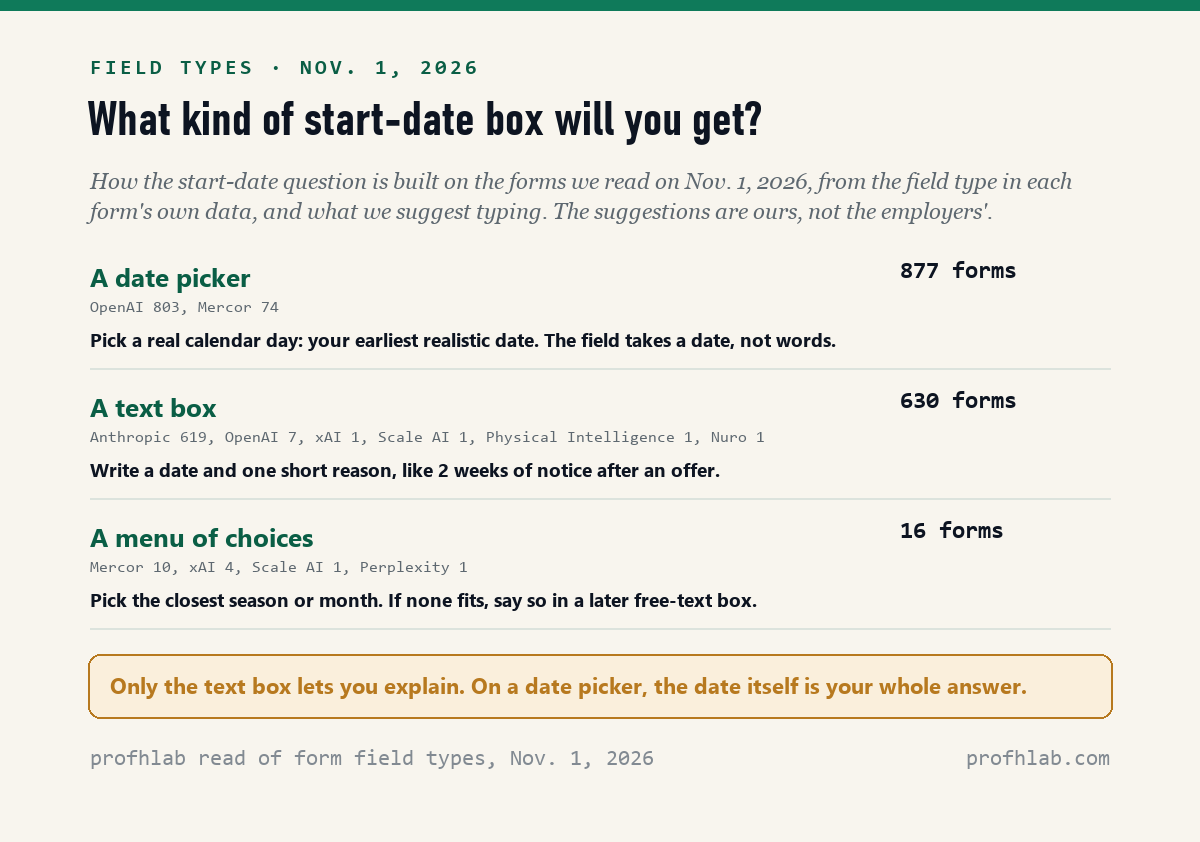
Put the earliest date you could really start if an offer came, counting your notice and any move, because on November 1, 2026, 877 of 1,523 AI company forms asking the question would accept nothing but a calendar date. A date you can keep is worth more than an early date you later walk back.
The arithmetic is simple. Take the day an offer could plausibly arrive, add the notice you owe, and add a few days to breathe. If you are not working, a date about a week out is reasonable. These are our suggestions, not any employer’s rule.
| Your situation | What we would put | Why |
|---|---|---|
| Working now and will give notice | Likely offer date + your notice + a few days. Two weeks is a common custom; use your real number. | No form we read asked about notice, so the date has to carry it. |
| Not working right now | A specific date about a week out, or the first Monday after it. | A real date reads as more ready than a vague word on a date picker. |
| Student or new grad | Your last exam or graduation date, or the season the menu offers. | Mercor, xAI and Perplexity give seasons or months to pick from. |
| Moving for the job | Offer date + notice + moving time. Say so in a text box if there is one. | Relocation can add weeks; see what relocation assistance covers. |
| Contract or lease ending | The day after it ends, if you cannot leave early. | A firm date you can keep beats an early one you must walk back. |
If the job asks you to move, read what relocation assistance means for a job before you count the weeks. If you are still choosing between employers, whether companies hire in November and December covers the season you are applying in.
How many job applications ask when you can start?
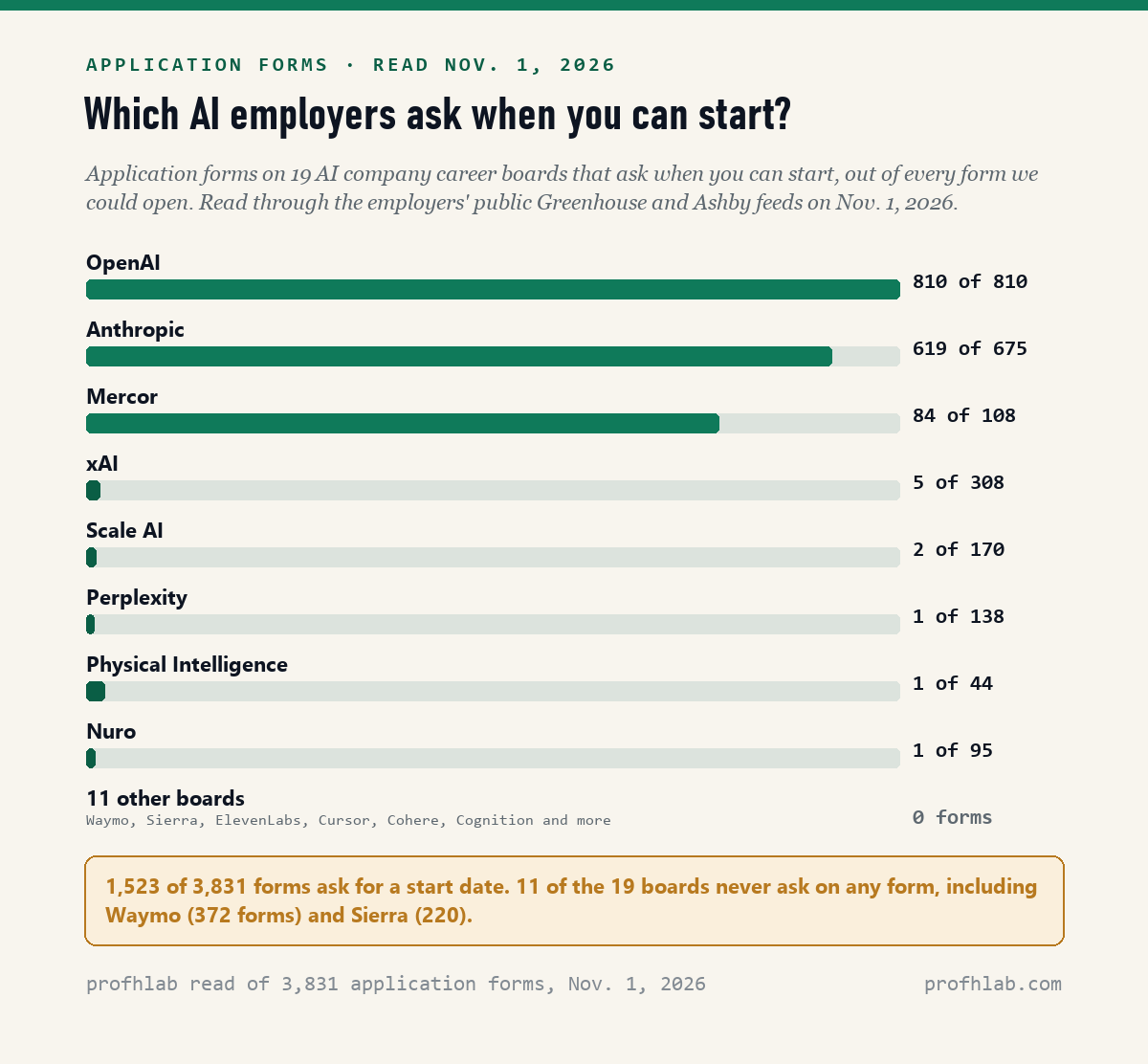
On November 1, 2026, 1,523 of 3,831 application forms on 19 AI company boards asked for a start date, but the question came from only 8 of the 19 employers. 11 boards never asked on any form, including Waymo across all 372 of its forms and Sierra across 220.
Three employers account for almost all of it: OpenAI on 810 of 810 forms, Anthropic on 619 of 675 and Mercor on 84 of 108. Everyone else asked on a handful of forms, mostly internships.
So whether you see this question depends far more on the company than on the job. The same desk has counted the other boxes on these forms: the sponsorship question, references and rules on using AI to apply.
What does OpenAI’s “When can you start a new role?” box want?
OpenAI asked “When can you start a new role?” on all 810 of its forms on November 1, 2026, made it required on every one, and stored the answer as a date on 803 of them. On the other 7 forms, the same question took free text.
A date field means you choose a day, not a sentence. That is our reading of the field type in the form’s own data; we did not press submit to watch the calendar. In practice, the day you choose has to carry your notice, your move and anything else.
Mercor works the same way on most forms: “What is your earliest potential start date?” appeared as a required date on 74 of its 108 forms. If you are aiming at either company, how to get a job at OpenAI or Anthropic walks through the rest of their process.
Why does Anthropic ask when you would want to start?
Anthropic’s forms asked “When is the earliest you would want to start working with us?” on 617 of 675 forms on November 1, 2026, as an open text box, and only 5 of all its start-date questions were required. It is the softest version of the question we found.
The wording asks about your wish, not just your ability, and a text box lets you add context. 610 Anthropic forms also asked, “Do you have any deadlines or timeline considerations we should be aware of?” That is the place for a competing offer or a fixed end date.
Two Anthropic forms used a stricter wording: “If you received and accepted an offer, how soon could you start? Please note anything work-related that affects your timing.” Our reading is that it treats your answer as an estimate tied to an offer, which is how we suggest you think about every version.
What if the menu has no start date that fits you?
On November 1, 2026, 16 forms offered a menu instead of a box, and on Mercor’s 10 new-grad menus two of the five choices were seasons that had already passed: “Winter 2025” and “Spring 2026 (upon graduation).” That menu appears only after you answer yes to “Are you a Student or New Grad?”
The other menus were current. xAI’s four Spring and Summer 2027 internship forms offered months: January to March on three, April to June on one. One Scale AI form, for a Forward Deployed Product Manager, offered start weeks from Nov 27 to Dec 18, then “Afterwards.” Perplexity’s research fellowship offered November 2026 through June 2027.
If no choice fits, pick the closest honest one and explain in any free-text box later in the form, or to the recruiter. For more on the student side, see why entry-level jobs ask for experience.
Can you put “immediately” or “ASAP” as your start date?
Only on a text box, and only if it is true: on November 1, 2026, 877 of the 1,523 forms that asked would not take a word at all, only a date. On those, “immediately” becomes the nearest day you could really arrive.
On a text box, a date is still clearer than a word. “Available from November 16; two weeks’ notice after an offer” tells a recruiter more than “ASAP.” That example is ours. If you are between jobs, “Available now” is fine, as long as it holds.

Is the start date you put on an application binding?
Not on any form we read on November 1, 2026: none of the 1,523 start-date questions came with a note calling the date a commitment, and one Anthropic wording framed it as how soon you could start after accepting an offer. In most hiring, the date that counts is the one in the offer you accept.
That last point is general practice, not something these forms state. If your situation changes after you apply, tell the recruiter before the offer stage rather than after. A changed date said early is a scheduling note. Said late, it can look like a broken promise.
Applying to several roles at once? See whether you can apply to multiple jobs at the same company, and keep the same date on each form.
How should you give notice so the start date holds?
Since none of the 3,831 forms we read on November 1, 2026 asked about notice, plan it yourself: decide your notice before you apply, and resign only after you have a written offer. That keeps the date on your form honest.
The steps we would take: check your contract or handbook for a required notice period. Count it from a likely offer date, not from today. Then write the date down and use it on every form, so two applications never disagree.
Before you type a date this November, four checks
These checks come from the 3,831 forms we read on November 1, 2026; they are our suggestions, not employer rules.
- Look at the box type. A calendar means the date is your full answer. A text box lets you add a reason in one line.
- Count from the offer, not today. Offer date, plus notice, plus a few days. Write it down once.
- Use the timeline box if there is one. Anthropic’s deadlines question is where a competing offer belongs.
- Keep every form the same. Two different dates for one company invite a question you do not need.
Find open roles on our jobs board, where you can browse every open role and apply on the employer’s site. Daily counts for all 19 boards are on the AI jobs tracker, and which AI companies are hiring right now ranks them. Stuck on your own timing? Ask the Jobs Desk.
We are not recruiters. We take no money from employers, and postings can close at any time; the employer’s official page wins. Never pay anyone for a job, never deposit a check and send money back, a text message is not a job offer, and apply only on the employer’s own site. More at the Jobs Desk sources.
Sponsorship, AI rules and screening: the other boxes on these forms
The start date is one box. These pieces read the others on the same 19 boards:
- Will you now or in the future require sponsorship — the visa question.
- Can you use AI on job applications — which employers set rules.
- Can you opt out of AI resume screening — what the policies say.
- Do job applications still ask for references — counted form by form.
- What 25% travel means for a job — the travel line in postings.
- What Associate means in a job title — the level word.
- Is Mercor jobs legit — one of the three boards that ask most.
Can you put immediately as a start date? Five questions people search
What should I put for available start date on a job application?
Put the earliest date you could really start after an offer: the offer, plus any notice you owe, plus a few days. On November 1, 2026, 1,523 of 3,831 AI company application forms we read asked for it, and 877 of them took only a calendar date, so the date is often your whole answer.
Can I put immediately as my start date?
Only if it is true. On a text box you can write it, but a specific date is clearer. On a date picker, the kind 877 of the forms we read on November 1, 2026 used, you have to choose a day anyway, so pick the nearest one you can keep.
Should I put two weeks from today as my start date?
Not quite. Two weeks from today assumes an offer today. Count from when an offer could realistically arrive, then add your notice. That is our suggestion, not an employer rule; none of the 3,831 forms we read on November 1, 2026 asked about notice.
Is the start date on a job application binding?
We found nothing on the forms that says so. One Anthropic form version asks how soon you could start if you received and accepted an offer, which treats it as an estimate. The real date is usually set when you accept the offer, so tell the recruiter if yours changes.
What should I put for start date if I am still in school?
Use the day after your last exam or your graduation date. Some forms give you a menu instead: on November 1, 2026, xAI internship forms offered months and a Perplexity fellowship form offered November 2026 through June 2027.
Sources
- Application form questions for every open job on 19 AI company boards, read through the employers’ public Greenhouse and Ashby feeds on November 1, 2026. Example forms: OpenAI Research Engineer, Mercor Software Engineer, Agents, Perplexity Research Fellowship, Scale AI Forward Deployed Product Manager, Enterprise, xAI Spring 2027 Software Engineering Internship.
- “How to answer when can you start working”, Big Interview, published May 15, 2024; “How to Quit a Job: Leaving on Good Terms”, Indeed, published January 6, 2020; both checked November 1, 2026.
- Photos: tear-off day calendar (george ruiz, CC BY 2.0), clocking off, 1940 (Ministry of Information, public domain), Petaluma and Santa Rosa Railroad calendar (Visitor7, CC BY-SA 3.0); featured image, John F. Peto, Office Board, 1885, The Met, CC0; all via Wikimedia Commons, read November 1, 2026.
Next check: we will read these forms again in early February 2027 and note whether Mercor has updated its new-grad seasons and whether any form starts asking about notice.
Prof.’s H Newsletter
One short email a month, with the numbers in it
What actually moved in AI hiring, AI prices, and the scams aimed at older Americans. Counted here, dated, and linked to the source. One email a month, and your address goes nowhere else.