Can You Use AI on Job Applications? 2 of 19 AI Employers Put a Rule on the Form (Oct. 25, 2026)
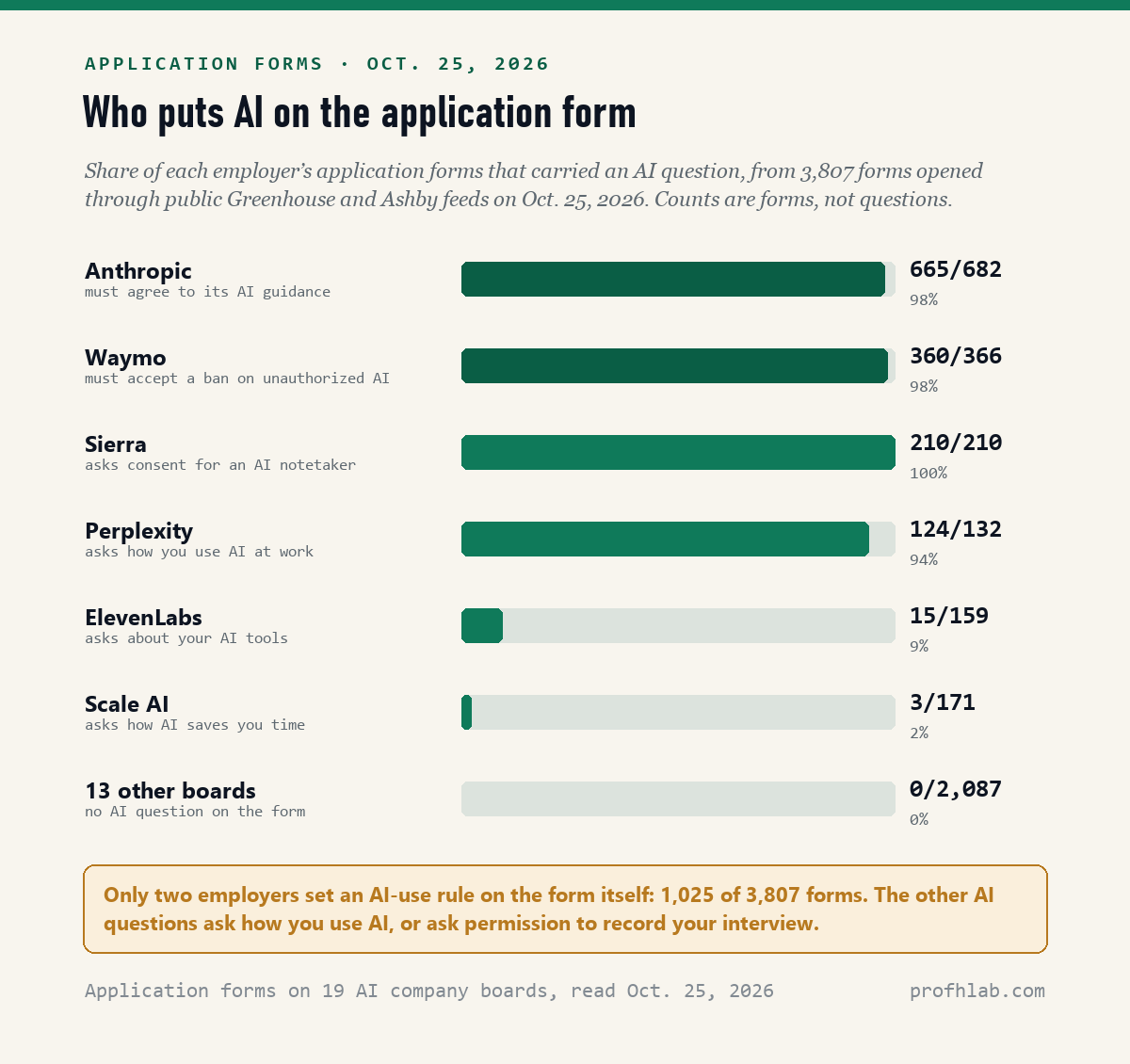
At most AI companies the application form sets no rule at all: on October 25, 2026, we opened 3,807 application forms on 19 AI company boards and only 2 employers put an AI-use rule on the form: Anthropic (665 of 682 forms) and Waymo (360 of 366).
The two rules point in different directions. Anthropic invites you to use Claude to refine an application you drafted yourself. Waymo makes you accept that unauthorized AI tools are banned during its interviews. A third employer, Perplexity, bans AI-written answers on one application, its research fellowship.
What we read on October 25, 2026
- 3,807 application forms, one for every open job on the 19 boards behind our AI jobs tracker: OpenAI, Anthropic, xAI, Scale AI, Mercor, Perplexity, Cohere, Sierra, ElevenLabs, Cursor, Cognition, Replit, Figure AI, Apptronik, Agility Robotics, 1X, Physical Intelligence, Waymo and Nuro. The 20th board, Google DeepMind’s US board, returned an error (HTTP 404) and is not counted; we did not read it.
- We pulled each form’s question list from the employers’ public Greenhouse and Ashby feeds, the same questions you see when you click Apply, and read every question that mentions AI by eye.
- We also read the full text of all 3,807 job postings for sentences that pair AI with applicants, interviews or applications, and Anthropic’s candidate guidance page, last updated July 10, 2025.
- We did not apply to any job or contact any employer. How employers enforce these rules is not on any page we read, so we do not guess at it.
Written and checked by Prof. H. An AI assistant helped draft this piece and run the page reads; every quote was read on the source’s own page on October 25, 2026.
Do AI companies let you use AI on a job application?
Mostly they say nothing: on October 25, 2026, 17 of the 19 AI employers we checked had no AI-use rule on their application forms, and the two that did, Anthropic and Waymo, covered 1,025 of 3,807 forms, about 27%. OpenAI’s 794 forms, xAI’s 298 and Cursor’s 126 asked nothing about AI at all.
Silence is not permission in writing, and it is not a ban either. It leaves the choice to you. The rules that do exist are worth reading closely, because they are the clearest statement any of these employers has made about what they expect.
Four other employers put AI on the form in a different way. They ask how you use AI, or ask to record your interview with an AI notetaker. Those are covered further down.
What does Anthropic’s candidate AI policy allow and ban?
Anthropic’s guidance, last updated July 10, 2025 and read on October 25, 2026, tells applicants to “create your first draft yourself, then use Claude to refine it,” and to do take-home tests and live interviews without AI unless told otherwise. 665 of its 682 forms asked applicants to confirm they understood it, and 682 of its 682 postings linked to it.
The page splits the process into four stages. Two are open to AI and two are closed by default:
| Stage | What Anthropic says | AI allowed? |
|---|---|---|
| Application and resume | Draft it yourself, then use Claude to refine it | Yes, to refine |
| Preparing for interviews | Use Claude to research the company and practice answers | Yes, encouraged |
| Take-home assessments | Complete them without Claude unless told otherwise | No, unless allowed |
| Live interviews | No AI assistance unless told otherwise | No, unless allowed |
The line it draws is between polishing and inventing. Its own example of what is not allowed is asking Claude to write your application answers, which it says yields “experiences you haven’t actually had.” Its example of what is encouraged starts from your own sentence and asks Claude to help quantify the result.
The guidance also says how Anthropic uses Claude in hiring: writing job descriptions, drafting interview questions, transcribing interviews and finding candidates to source. It says it does not let Claude make hiring decisions. We could not check that claim from the outside.

Where does Waymo draw the line on AI tools?
At the interview: 360 of the 366 Waymo application forms we opened on October 25, 2026 required you to accept that Waymo “prohibits the use of unauthorized outside assistance during the interview process,” naming AI tools and generative software. The question is marked required, so the form will not submit without an answer.
Read the wording closely. It covers the interview process and adds “unless explicitly authorized by the hiring team.” It says nothing about drafting your resume with AI. Waymo’s 366 postings, all of which we read, add no other rule on applicant AI use.
So by the wording, a resume polished with a chatbot is outside the rule, and an AI tool feeding you answers in an interview is inside it. If you are applying there, our is Waymo hiring piece covers what the board looks like.

Which application bans AI-written answers outright?
The Perplexity Research Fellowship: its posting, read on October 25, 2026, says “You should write your application without assistance from other humans or AI models,” and that doing otherwise “will result in permanent disqualification from employment at Perplexity.” It was the only outright ban on AI-written applications we found in 3,807 postings.
That is a fellowship for early-career researchers, not Perplexity’s regular jobs. Its regular forms go the other way: 124 of 132 Perplexity forms asked how you use AI in your day-to-day work and what the pain points of your favorite tools are.
The two positions fit together. Perplexity wants to know you use AI well, and on the one application meant to test your own writing, it wants your own writing.

Why do some job applications ask how you already use AI?
On October 25, 2026, Perplexity asked how you use AI on 124 forms, ElevenLabs on 15 and Scale AI on 3, 142 of 3,807 forms in all; our reading is that these employers want to see how you already work with AI. ElevenLabs adds, on one version of the question, “There is no right answer here.”
Scale AI’s version asks for one way AI genuinely saves you time during a busy workday. These are invitations to show judgment, so a generic answer pasted from a chatbot would miss the point. Name a real tool, a real task and what changed.
Two more AI items concern the employer’s side, not yours. All 210 Sierra forms asked whether its AI notetaker, Metaview, may record and summarize your interviews. And 113 of 116 Cohere postings said it “may use AI-enabled tools to screen and assess applicants.” Our can you opt out of AI resume screening piece covers that side.
One ElevenLabs posting, for a Talent Operations role, lists an “AI Interview” as the first step of its interview process. The posting does not describe what that step involves, and we did not verify it.

How should you use AI on an application when the employer says nothing?
The 3 written rules we found on October 25, 2026 share one pattern: write the first draft yourself, use AI only to refine it, and do assessments and interviews unaided unless told otherwise. That is Anthropic’s policy almost word for word, and it stays inside Waymo’s interview rule. It is our suggestion for employers that say nothing, not a rule any of them wrote.
- Search the posting and the form for “AI” before you start. On these 19 boards the rule, when there was one, sat in the posting text or a required form question.
- Write your own first draft. Every fact, number and project in it should be yours. Then ask a chatbot to tighten wording, flag unclear sentences or compare it with the job description.
- Check every claim the AI adds. If it inserted a skill or result you cannot explain in an interview, delete it.
- Answer “how do you use AI” questions with a real example. One tool, one task, one result.
- Close the AI tools during take-home tests and interviews unless the employer says in writing that they are allowed. If you need an accommodation, ask the recruiter early, as Anthropic’s page suggests.
Where an application bans outside help outright, as Perplexity’s fellowship does, skip step 2’s chatbot pass entirely. The same draft-first habit helps on the questions we counted before: why do you want to work here, desired salary and whether you need a cover letter.
We are not recruiters. We take no money from employers, and postings can close at any time; the employer’s official page wins. Never pay to apply, never deposit a check and send money back, a text message is not a job offer, and apply only on the employer’s own site. Be careful with any paid “auto-apply” service that asks for your passwords to job sites; more at the Jobs Desk sources.
What BBC News and Indeed show about AI in hiring right now
BBC News’s report on job seekers using AI had 348,215 views and Indeed’s guide to AI interviews had 432,851 when we checked on October 25, 2026. Neither is about these 19 employers. The first shows why employers are starting to write rules; the second shows what an AI-run interview step can look like.
Earlier reads of the same forms, one application question at a time
- Do job applications still ask for references — 5 of 3,807 forms asked, on October 24, 2026.
- Do you need a LinkedIn to apply for jobs — what the LinkedIn field really requires.
- Do job applications ask for GPA — GPA and transcript fields.
- Should I answer voluntary self-identification — the demographic questions and what skipping them means.
- Should I put ChatGPT on my resume — listing AI tools on the resume itself.
- Is Anthropic hiring — the full picture at the company with the most detailed AI rule.
- Are AI training jobs legit — roles where the work is grading or training AI.
- Entry-level AI jobs with no experience — jobs you can start without a track record.
Every open role on these boards is on our jobs board, where you can filter and apply on the employer’s own site. Daily counts are on the AI jobs tracker. Have a question about an application? Ask the Jobs Desk.
Can you use AI on job applications?
Usually yes, unless the employer says otherwise. On October 25, 2026, 2 of 19 AI employers put an AI-use rule on their application forms: Anthropic allows AI to refine a draft you wrote yourself, and Waymo bans unauthorized AI during interviews. The other 17 forms set no rule.
Is it bad to use AI for job applications?
Not by the rules we read. The one detailed employer policy, Anthropic’s, encourages using Claude to polish and prepare but does not allow letting it invent experience or answer take-home tests and live interviews for you.
Can employers tell if you used AI on your application?
We could not verify that, and none of the 19 employers says how it checks. What the pages do show: Perplexity says submitting AI writing as your own on its research fellowship application means permanent disqualification.
Can you use AI during a job interview?
Not unless the employer says so. Anthropic’s guidance says live interviews are “all you,” and 360 of 366 Waymo forms we read on October 25, 2026 said unauthorized AI tools are prohibited during the interview process.
Do companies use AI to screen job applications?
Some say so. On October 25, 2026, 113 of 116 Cohere postings said it may use AI-enabled tools to screen applicants, and Anthropic says it uses Claude to transcribe interviews and find candidates but not to make hiring decisions.
Pages we read on October 25, 2026, with their dates
- Anthropic, “How to collaborate with Claude during our hiring process”, last updated July 10, 2025; read October 25, 2026.
- Perplexity Research Fellowship posting, posted September 20, 2026; read October 25, 2026.
- ElevenLabs Talent Operations posting, posted October 22, 2026; read October 25, 2026.
- Waymo careers; Waymo’s application questions read through its public Greenhouse feed on October 25, 2026.
- Application forms and postings for all 19 boards, read through the employers’ public Greenhouse and Ashby feeds on October 25, 2026.
- “Everyone’s using AI to get hired”, BBC News, published September 18, 2026; “AI Interview Tips”, Indeed, published March 24, 2026; both checked October 25, 2026.
Prof.’s H Newsletter
One short email a month, with the numbers in it
What actually moved in AI hiring, AI prices, and the scams aimed at older Americans. Counted here, dated, and linked to the source. One email a month, and your address goes nowhere else.