How to Get a Federal Job With No Experience: What 102 Open AI and Engineering Listings Actually Require (August 2026)
Two announcements were open on USAJOBS this morning for the same job. Same title — Data Scientist. Same grade — GS-7. Both open to the public. One of them will qualify you on the strength of your college transcript and nothing else. The other will not look at you without a year of federal-equivalent work already behind you.
Nothing on the search-results page tells you which is which. You have to open them.
Search how to get a federal job with no experience and you get the same four sentences everywhere: build a USAJOBS profile, write a long résumé, use keywords, be patient. Nobody counts. So on August 25, 2026 we pulled every tech and engineering opening on USAJOBS that was graded 9 or below and marked open to the public — 102 of them, across 38 agencies — and read the qualification text on each one.
Two findings changed how we would advise a first-time applicant, and neither appears in the guides.
How we counted
Every announcement returned by the USAJOBS Search API on August 25, 2026 for eleven engineering and IT job series — IT specialist (2210), computer science (1550), data science (1560), computer engineering (0854), electronics engineering (0855), electronics technician (0856), engineering technician (0802), operations research (1515), mathematical statistics (1529), mechanical engineering (0830) and general engineering (0801) — filtered to grade 9 and below with the hiring path public. That is 102 announcements from 38 agencies. Pay figures are the ranges the agency printed. Grade and pay-plan codes are read from the announcement, not inferred. The 2026 salary table comes from OPM.
Start with the GS-4 trap, then the no-experience door
- The trap: a “grade 4” job is usually not a GS-4
- The door that opens with no experience at all
- What counts as experience when you have none
- What these grades actually pay in 2026
- The openings that are live right now
- Direct hire: a third of these skip the queue
- What to do this week
- Questions people actually search
The trap: a “grade 4” job is usually not a GS-4
The standard first move is to open USAJOBS, set the pay-grade filter to something low, and read what comes back. It is a reasonable instinct. It also produces a list that quietly mixes six unrelated pay systems.
Of the 102 openings we pulled, 57 were General Schedule. The other 45 ran on fourteen different pay plans — and in every one of them the number after the grade means something else.
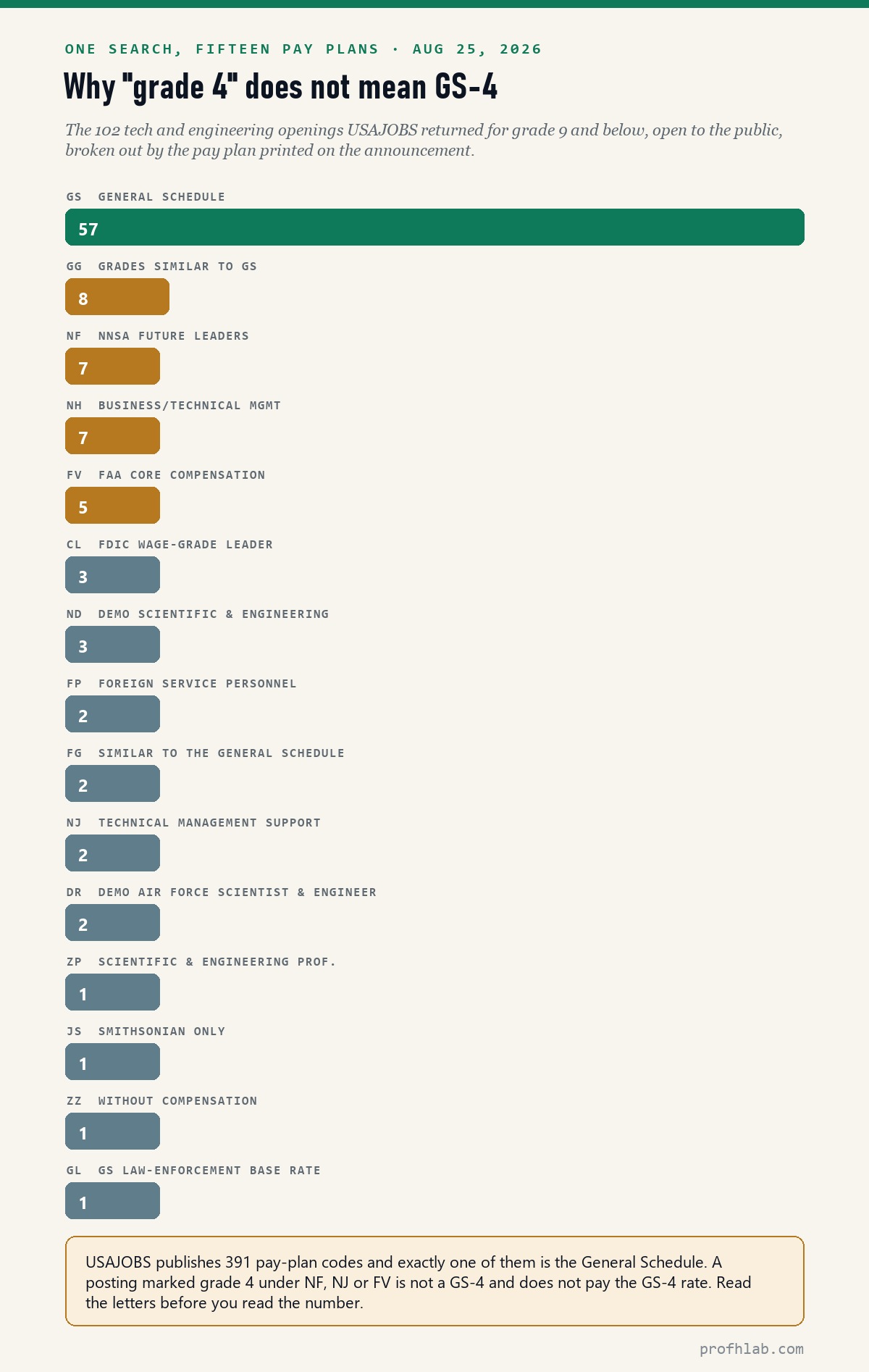
USAJOBS publishes 391 pay-plan codes, and exactly one of them is the General Schedule. An Air Force posting we found is graded 3 under plan NJ, “technical management support”, and advertises $61,722–$97,087. A GS-3 in 2026 starts at $27,708. Same number, different universe.
The practical rule is small and it will save you a wasted evening: read the two letters before you read the number. If they are not GS, the qualification standards and the pay table you have been studying do not apply to that announcement.

The door that opens with no experience at all
Here is the part the guides skip. Federal qualification standards contain an explicit substitution: for many two-grade-interval professional jobs, education can stand in for the work history entirely. Not “helps”. Replaces.
The mechanism has a bureaucratic name — Superior Academic Achievement, S.A.A. in the announcements — and OPM defines it three ways: class standing in the upper third of your graduating class, a qualifying grade-point average, or membership in a recognised national scholastic honour society.
The announcements print the actual numbers. From the Air Force Civilian Career Training data scientist posting, verbatim: “Grade Point Average 2.95 or higher out of a possible 4.0 … OR 3.45 or higher out of a possible 4.0 based on the average of the required courses completed in your major field.”
A 2.95 is not a distinction. It is a B minus. And it is the whole qualification for a GS-7 professional job with zero days of work history.
Now the contrast that made us write this article. Both announcements below were open on the morning of August 25.
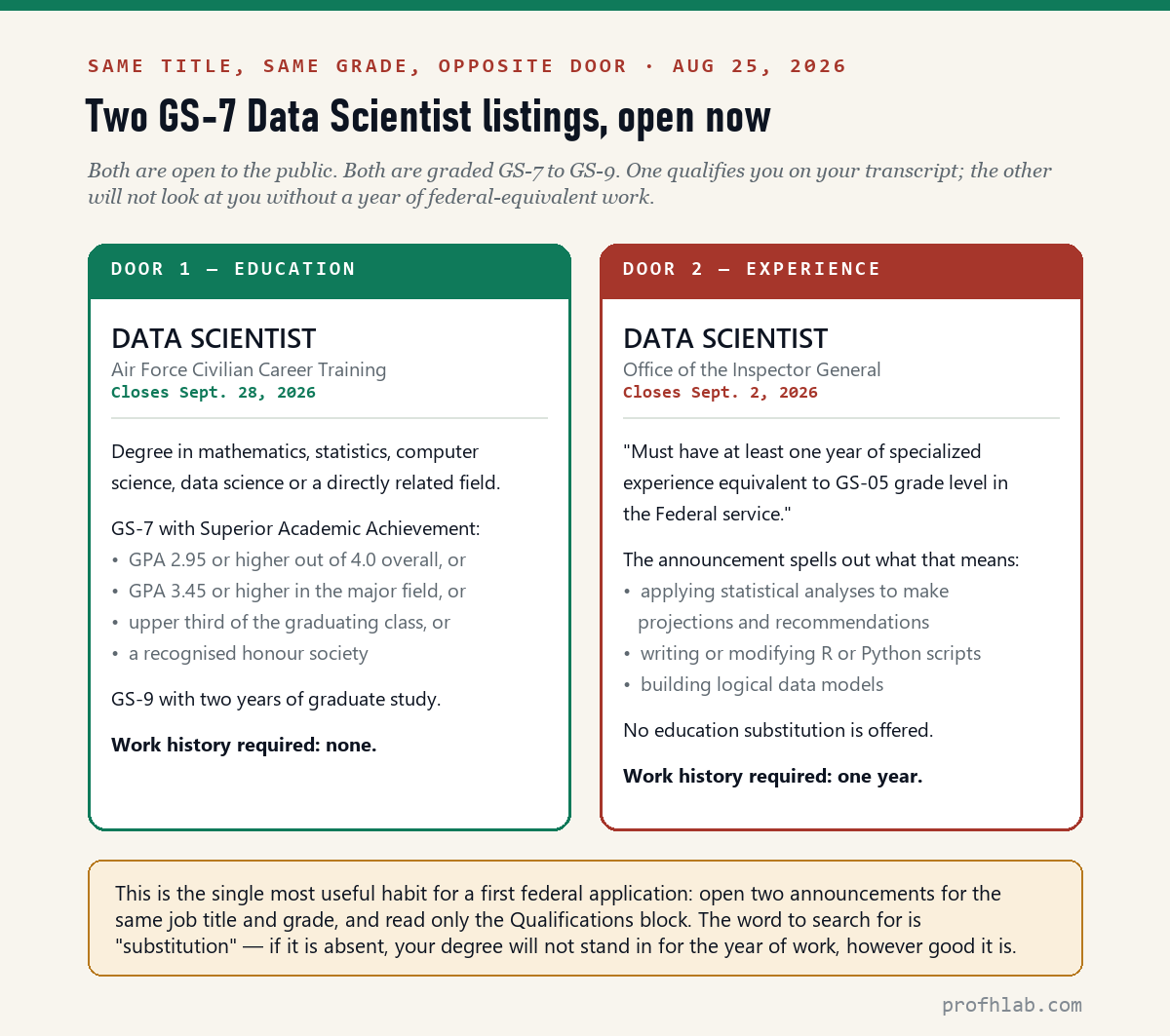
Across the 57 General Schedule announcements, 18 spell out an education door and 26 require specialized experience with no education path named at all. That is close to a coin flip, and it is invisible from the results page. The only way to know is to open the announcement and read the Qualifications block.
If you are applying with a degree and no work history, that single habit — open two, compare the Qualifications blocks, search the page for the word substitution — is worth more than any résumé template.
What counts as experience when you have none
The second finding is gentler and applies to people without a degree.
27 of the 102 announcements state in writing that unpaid work counts. The Indian Health Service phrases it about as broadly as English allows: “Experience refers to paid and unpaid experience, including volunteer work done through National Service programs (e.g., Peace Corps, AmeriCorps) and other organizations (e.g., professional; philanthropic; religious; spiritual; community; social). You will receive credit for all qualifying experience, including volunteer and part time experience.”
That is not a courtesy sentence. It means the two years you spent maintaining equipment for a community organisation is qualifying experience, provided you write it down the way the announcement asks — duties, responsibilities, and total hours per week. Federal résumés are scored on hours, which is why the ordinary one-line job entry fails.
Certification counts too, in places. The Social Security Administration’s IT Specialist announcement — 25 openings, open until February 2027 — puts it plainly: “the experience may be demonstrated by paid or unpaid experience and/or completion of specific, intensive training (for example, IT certification), as appropriate.”
Same announcement, four sentences earlier, is the line that should reset what you think you know about federal résumés: “Resumes exceeding two pages in length will not be considered.” Four other announcements in our set say the same thing. The five-page federal résumé is a genuine convention in some agencies and an automatic rejection in others, and the only way to tell is to read.

The lowest GS door we found sits at the Indian Health Service: an Engineering Technician (Civil) at GS-4, closing September 14. Its requirement is six months of general work experience plus six months of specialized — or, in the alternative, “completion of 2 years of post secondary study that included at least 12 semester hours” in engineering, construction, physics, drafting, surveying, physical science or mathematics. Twelve semester hours is four community-college courses.
What these grades actually pay in 2026
Everyone quotes GS figures from memory and almost everyone quotes the wrong ones, because the base table and the advertised salary are different numbers.
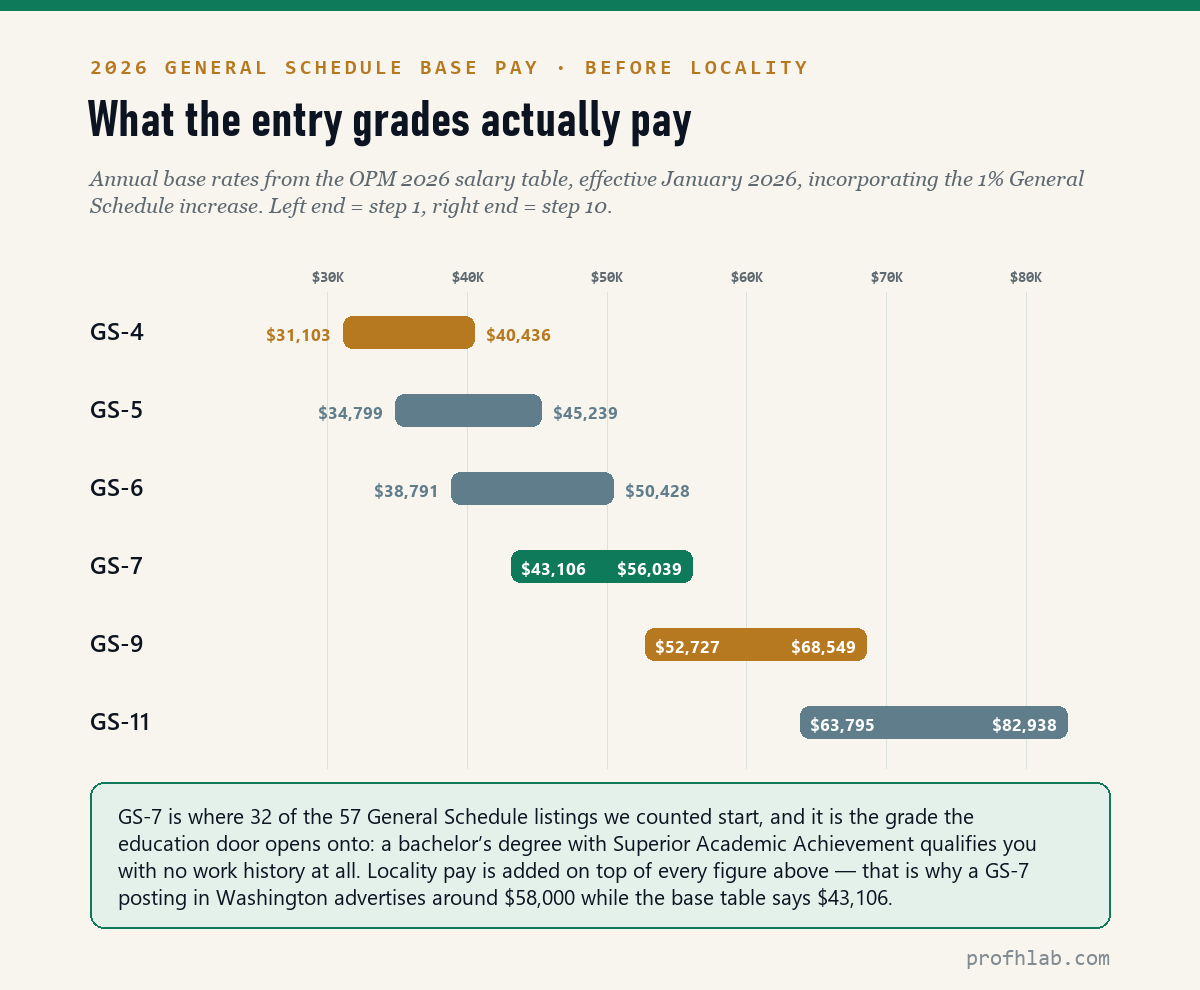
GS-7 step 1 on the base table is $43,106. The GS-7 announcements in our set advertise $50,460 and up. The gap is locality pay, which is set by where the job sits, not by you — and it is the reason a posting can say $58,193 for a grade whose table rate is $43,106.
GS-7 is also where the crowd is: 32 of the 57 General Schedule openings start there. That is not an accident. GS-7 is precisely the grade the education door opens onto, which is why a bachelor’s degree with a B-minus average is the single most efficient federal qualification a beginner can hold.
The openings that are live right now
A selection from the 102, chosen for relevance to AI, data and technical work, and for having enough runway left to actually apply. Door tells you whether the announcement names an education substitution or demands specialized experience.
| Role | Agency | Grade | Advertised | Door | Closes |
|---|---|---|---|---|---|
| IT Specialist (APPSW) · 25 openings | Social Security Administration | GS-7 to 12 | $58,193–$133,142 | Experience, but certification and unpaid work count | Feb 13, 2027 |
| Data Scientist | Air Force Civilian Career Training | GS-7 to 9 | $49,960–$99,314 | Education — GPA 2.95 | Sep 28, 2026 |
| Computer Scientist | Air Force Civilian Career Training | GS-7 to 9 | $56,763–$88,225 | Education — S.A.A. | Sep 30, 2026 |
| IT Specialist | Air Force Civilian Career Training | GS-7 to 9 | $56,763–$88,225 | Education — 24 semester hours | Sep 30, 2026 |
| Operations Research Analyst | Air Force Civilian Career Training | GS-7 to 9 | $49,960–$115,213 | Education — S.A.A. | Sep 30, 2026 |
| Data Scientist | Office of the Inspector General | GS-7 to 9 | $50,460–$100,315 | Experience — one year | Sep 2, 2026 |
| Engineering Technician | US Pacific Fleet, Pearl Harbor | GS-4 | $38,011–$49,417 | Experience — volunteer work counts | Nov 30, 2026 |
| Engineering Technician (Civil) | Indian Health Service | GS-4 | $36,409–$47,581 | Either — 12 semester hours | Sep 14, 2026 |
| Engineering Technician (Civil), Drill Crew | Federal Highway Administration | GS-7 to 9 | $50,460–$80,243 | Either | Sep 11, 2026 |
| IT Specialist (Disaster Operations) | Small Business Administration | GS-9 to 11 | $52,727–$82,938 | Experience | Aug 28, 2026 |
All rows verified open on the agency’s own USAJOBS announcement on August 25, 2026. Advertised figures are the ranges the agency printed, and they span every grade in the announcement, not just the entry grade. Announcements close early when the application cap is hit.
Two things about that table are worth saying out loud. The Air Force Civilian Career Training cluster is the closest thing to a front door for AI work in government right now — twelve separate announcements, every one graded GS-7 to GS-9, every one on the education path, all closing on September 28 or 30. Miss that fortnight and the cluster is gone.
And not one of the 102 openings was marked remote. Forty-five were flagged telework-eligible, which is a different promise: telework means some days at home from a duty station you must live near, not a job you can do from anywhere. If a fully remote federal AI job is the plan, this month’s data says the plan needs a location.

Direct hire: a third of these skip the queue
37 of the 102 announcements are Direct Hire Authority — you can see it in the announcement number, which usually ends in DHA, or in the title itself. It matters more than the acronym suggests.
A normal competitive announcement rates and ranks applicants, applies veterans’ preference, and refers a short certificate of the highest-scoring names to the hiring manager. Direct hire suspends the rating and ranking. If you meet the qualifications, the agency can hire you.
For a first-time applicant with a thin file, that is the difference between competing on points and being read by a human. When two announcements look similar, the DHA one is usually the better use of an evening.
What to do this week
- Today, ten minutes: open any two announcements with the same title and grade, scroll to Qualifications, and use your browser’s find function on the word substitution. You will see the two doors for yourself, and you will never again apply blind.
- If you have a degree and no work history: pull your transcript and compute both numbers — overall GPA and major GPA. If either clears 2.95 or 3.45 respectively, you qualify for GS-7 professional announcements today. The Air Force data scientist announcement closes September 28.
- If you have no degree: aim at engineering technician and IT specialist announcements, and count your unpaid hours. Write every entry with duties, responsibilities and hours per week — 27 of the 102 announcements say in writing that volunteer work counts, and none of them will infer it.
- Before you write five pages: search the announcement for the word pages. Five of ours cap the résumé at two, and one says outright that a longer one “will not be considered”.
- Check the letters: confirm the pay plan is GS before you plan around GS pay. Forty-five of our 102 were not.
- Track the market: our AI Jobs Tracker re-reads twenty private AI and robotics job boards every day, with entry-level counts and published pay bands — the private-sector companion to this federal scan.
Lower entry pay and slower hiring, but the rules are published
“Is the federal route better than applying to AI companies?” Different trade. Federal entry pay is lower and the process is slower, but the qualification rules are published, and that is genuinely rare — a private employer never tells you the exact GPA that qualifies you. We counted the private side in which AI companies are hiring right now.
“What about the national labs?” They hire on their own systems, not always through USAJOBS, and their rules about who may apply differ — we went through those announcements in national laboratory jobs with no degree.
“I want the hands-on version of this.” The nearest private-sector equivalent to a GS-4 engineering technician is the data centre floor, where the same trade-plus-hours logic applies — how to become a data center technician with no experience.
What we are and what we are not
We are not recruiters and we are not employment lawyers. We take no money from any employer, and there are no affiliate links in this article. Every announcement linked here is on usajobs.gov, the government’s own system, and every one was live on August 25, 2026 — announcements close without notice, often early when an application cap is reached, and the official page always wins. Nobody legitimate will ever ask you to pay to apply for a federal job, and no federal agency recruits by text message.
Watch the desk work
Two videos worth the time if the federal résumé itself is where you are stuck. The mechanics have not changed in the two years between them.
How a degree can stand in for experience at GS-7
How do you get a federal job with no experience?
Through the education substitution written into the qualification standards. For two-grade-interval professional jobs at GS-7, a bachelor’s degree with Superior Academic Achievement qualifies you with no work history at all; at GS-9, two years of graduate study does the same.
For technician jobs, post-secondary coursework substitutes instead — one Indian Health Service engineering technician announcement open on August 25, 2026 accepts two years of study including twelve semester hours in engineering, construction, physics, drafting, surveying, physical science or mathematics. The catch is that the substitution is not universal: of 57 General Schedule announcements we read that day, 18 named an education door and 26 required specialized experience with no education path offered.
What is Superior Academic Achievement for a federal job?
It is OPM’s provision for qualifying at GS-7 on a bachelor’s degree alone, and it is met three ways: class standing in the upper third of your graduating class or major subdivision; a grade-point average of 2.95 or higher out of 4.0 overall, or 3.45 or higher in the required courses of your major field; or membership in a national scholastic honour society recognised by the Association of College Honor Societies.
Any one of the three is enough. Announcements abbreviate it S.A.A., and it applies to applicants who have completed, or will complete within nine months, all requirements for the degree.
What GS level is entry level?
GS-7 in practice, for professional work. Of the 57 General Schedule tech and engineering announcements open to the public at grade 9 or below on August 25, 2026, 32 started at GS-7 — more than all other grades combined. GS-4 through GS-6 exist but are thin and are mostly engineering technician rather than professional roles; we found four GS-5s, two GS-4s and one GS-6 in the whole set. GS-7 base pay in 2026 is $43,106 at step 1 before locality, which is why announcements at that grade advertise around $50,000 to $58,000 depending on the city.
How many pages should a federal resume be?
It depends on the announcement, and the common advice to write four or five pages is dangerous. Of 102 federal tech announcements we read on August 25, 2026, five imposed a hard two-page limit. The Social Security Administration’s IT Specialist announcement states that “Resumes exceeding two pages in length will not be considered”, and four Army Installation Management announcements say resumes “must be two pages (or less)”.
The rest set no limit, in which case longer is safer, because federal résumés are scored on detail — duties, responsibilities and hours worked per week for every position. Search the announcement for the word “pages” before you write anything.
What is direct hire authority on USAJOBS?
It is an authority that lets an agency hire anyone who meets the published qualifications, without the usual rating, ranking and certificate process. Announcements using it typically carry DHA in the announcement number or the job title. Of the 102 announcements in our August 25, 2026 scan, 37 were direct hire. For an applicant with a thin file it is generally the better bet than a competitive announcement, because you are being assessed against a standard rather than against a scored pool.
Does volunteer work count for federal jobs?
Frequently, and the announcements say so explicitly. Twenty-seven of the 102 announcements we read on August 25, 2026 contain a clause crediting unpaid work. The Indian Health Service wording is representative: experience “refers to paid and unpaid experience, including volunteer work done through National Service programs (e.g., Peace Corps, AmeriCorps) and other organizations”, with credit given for volunteer and part-time experience alike. To be counted it has to be written up like a job — duties, responsibilities, and the total number of hours per week.
What does “open to the public” mean on USAJOBS?
It is a hiring path indicating that United States citizens who are not current federal employees may apply. Announcements can carry several hiring paths at once — an announcement open to the public may also be open to students, recent graduates, veterans or federal employees in transition — but if “public” is absent, a first-time applicant cannot apply no matter how well qualified. Every one of the 102 announcements counted in this article carries the public hiring path, which is why we filtered on it.
Ask the desk
Want this run for your state, your degree, or a job series we did not scan today? Tell us what you are looking for and we will go read the announcements and publish the answer.
Next check: the Air Force Civilian Career Training cluster closes September 28 and 30. The number to watch is whether a second cohort opens in October — six education-path announcements for AI work in one place is unusual, and if it repeats it is a hiring channel rather than a one-off.
Sources: USAJOBS Search API and the linked announcements on usajobs.gov (read Aug. 25, 2026); USAJOBS pay-plan code list; OPM General Schedule Qualification Policies (Superior Academic Achievement); OPM Salary Table 2026-GS. Photographs credited in each caption. Written by Prof. H for The Jobs Desk.
Prof.’s H Newsletter
One short email a month, with the numbers in it
What actually moved in AI hiring, AI prices, and the scams aimed at older Americans. Counted here, dated, and linked to the source. One email a month, and your address goes nowhere else.