How to Tell If a YouTube Video Is AI Generated: We Checked 17, and Ten Had No Label
The video has 4.3 million views. Its own title contains the words Sora Ai. The animals in it do things animals cannot do, and they do them in flawless daylight with convincing fur.
On August 25, 2026, we opened it and looked for YouTube’s AI label. There isn’t one. No chip under the title. The panel that is supposed to tell you how a video was made says exactly one thing: Auto-dubbed.
That is not an AI disclosure. It means the audio was machine-translated into other languages. But it sits in the same box, in the same typeface, under the same heading — and if you are scanning for reassurance, it reads like a system that is on top of things.
This is the gap between what people are told to look for and what is actually there. So we did the boring version of the question: we took 17 YouTube videos that are AI-generated footage by their own title or channel, and we read the disclosure panel on every one of them.
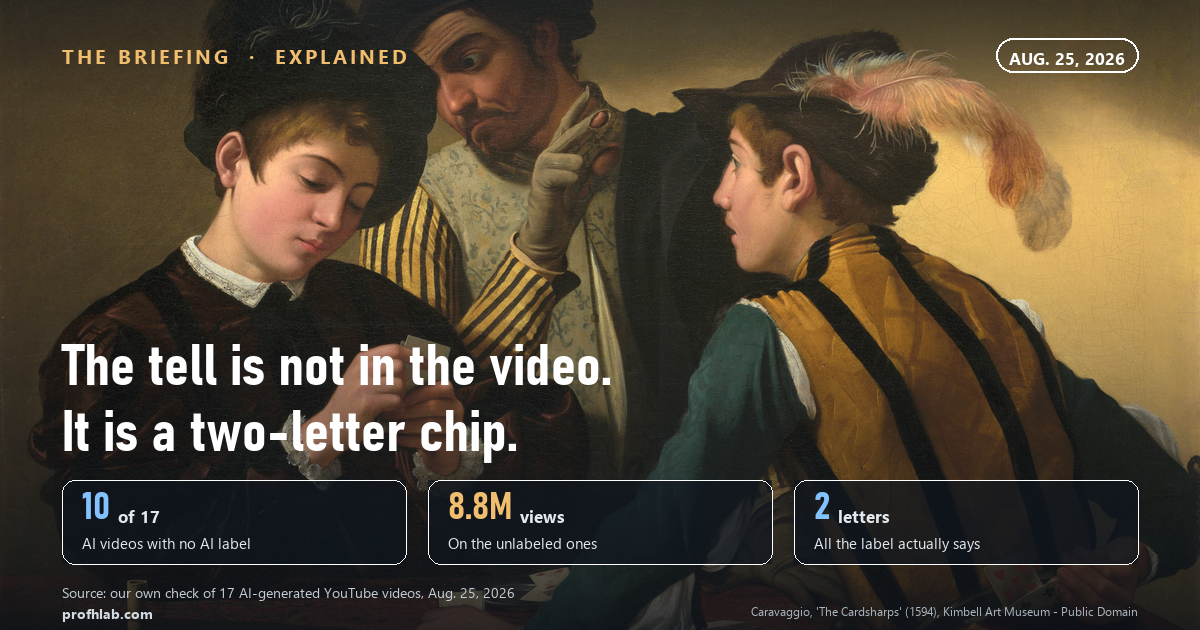
Ten of the 17 carried no AI label. Those ten have 8.8 million views between them.
The short answer. The label is real, it is new, and it is worth checking — but it is a floor, not a test. A label means AI. No label means nothing at all. The four checks that still work are further down, and none of them involve counting fingers.
What changed in May, and why the advice you remember is stale
For two years the answer to how to tell if a YouTube video is AI generated was a list of visual tells: hands with too many fingers, text that dissolves into gibberish, lips out of sync, a gait like a marionette. That advice was written against 2023 and 2024 models, and it has been quietly overtaken.
Meanwhile the platform side moved. On May 27, 2026, YouTube announced it would begin applying AI labels automatically, using internal signals rather than waiting for creators to disclose. It also moved the label out of the collapsed description and up under the player for long-form video, with an overlay on Shorts. Two months later, on August 2, 2026, the European Commission’s AI Act transparency obligations took effect, which makes labeling a legal question in Europe rather than a policy preference.
So there is now a system. The question is how much of the water it actually catches.
What does the AI tag on YouTube videos mean?
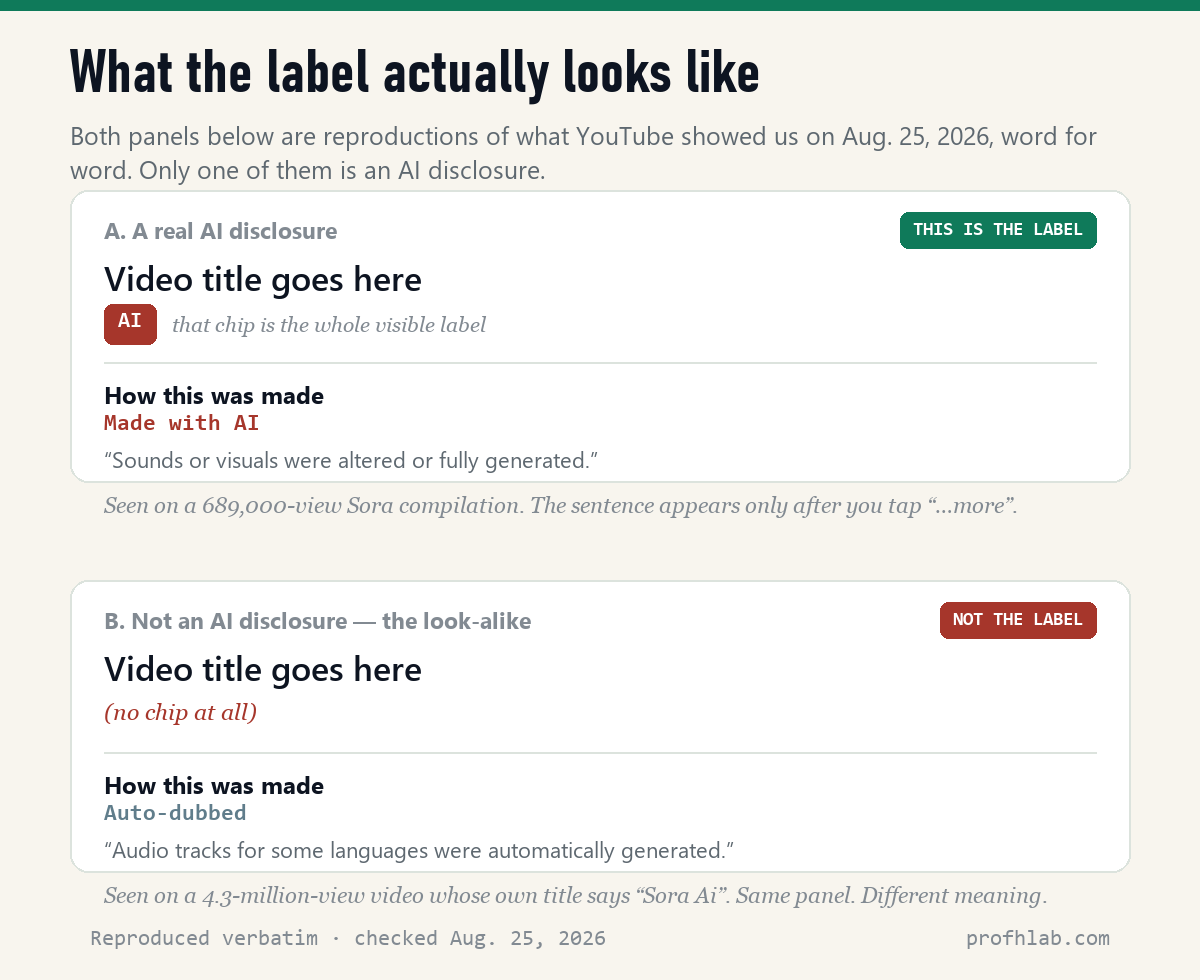
Concretely: it is a chip containing two letters. AI. It sits just below the video title. That is the entire visible label on a desktop browser.
The sentence that explains it lives one tap away. Open the description, tap …more, and near the bottom you find a section headed How this was made. On a labeled video it reads:
Made with AI
“Sounds or visuals were altered or fully generated.”
That is the disclosure. Everything else in that panel is something different.
The auto-dubbing trap
Three of the 17 videos we checked showed a How this was made panel that contained only this line:
“Audio tracks for some languages were automatically generated.”
That is about dubbing. It tells you a machine translated the narration into Spanish or Hindi. It says nothing whatsoever about whether the pictures are real.
One of those three is the 4.3-million-view Sora animal compilation. A viewer who has been taught to “check the description for the disclosure” will open that panel, see a disclosure-shaped sentence about something being automatically generated, and close the tab satisfied. The design does not distinguish the two for you. You have to read the words.
What we found across 17 videos
Method, plainly stated so you can repeat it: we ran five YouTube searches (sora 2 ai video, ai generated animals, ai generated video, veo 3 ai video, realistic ai video), kept only the results whose footage is itself AI-generated — compilations, AI short films, generated fantasy scenes — and discarded tutorials, reviews and commentary about AI, which are real screen recordings and correctly carry no label. Then we read the panel on each survivor, in English, on August 25, 2026.
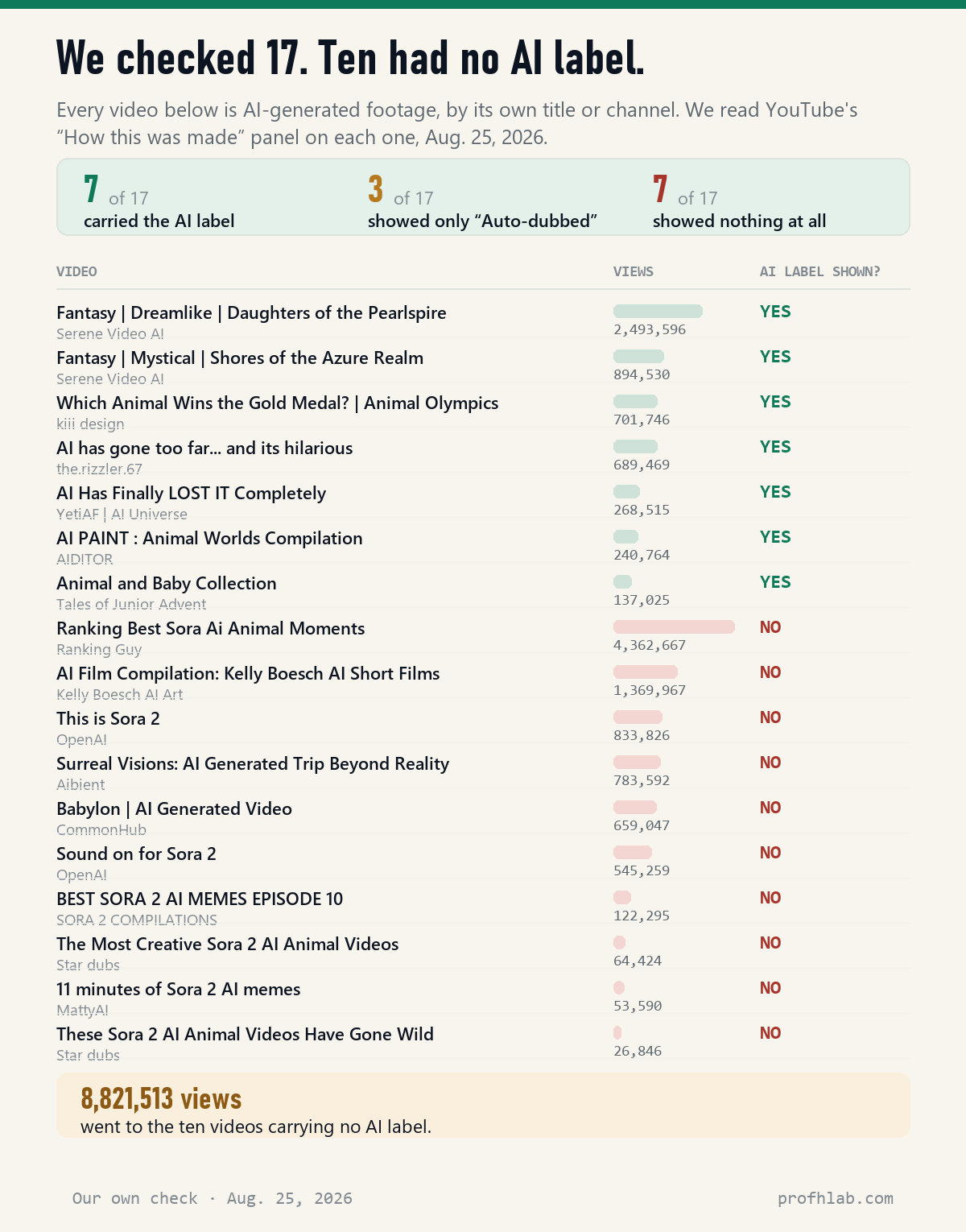
Two details in that table are worth sitting with.
The largest video in the set — 4.36 million views, the word Sora in its own title — is unlabeled. And two of the unlabeled videos were uploaded by OpenAI itself, showcasing Sora 2. That last one is not hypocrisy; it is the policy working as written, which is the whole point of the next section.
Can YouTube detect AI generated videos?
Partly, and the boundaries are public. YouTube’s own policy page says labels are applied automatically in three situations: when the content was made with YouTube’s own generative tools, when the file carries C2PA metadata declaring its provenance, and when YouTube’s internal systems detect that the content is AI-generated or altered.
The first two are deterministic. The third is a detector, and detectors have a recall problem. Nothing in the policy claims it catches everything, and our small sample suggests it does not.
There is a second, quieter mechanism most guides skip. Some cameras and editing tools write C2PA Content Credentials at capture time, and YouTube surfaces those as a “Captured with a camera” line in the same How this was made section. It is genuinely useful when present. But YouTube states the caveat itself: the line only appears if the creator used C2PA-capable tools with no edits to sound or visuals, and its absence does not mean the footage was altered. Almost nothing on YouTube has it.
About that free AI video detector you were going to use.
Google’s SynthID does watermark output from its own models — images, audio, text and video — and the watermark is built to survive cropping, filters, frame-rate changes and lossy compression. But the SynthID Detector portal is not open to the public. Google’s own page says it is in limited testing with journalists and media professionals, with a waitlist. It also only reads Google’s watermark; it has nothing to say about a Sora clip. The third-party “AI video detector” sites that rank for that search are not running SynthID, and none of them publish an audited error rate.
One step deeper: why no label proves nothing
This is the part that changes how you should use the label, so it is worth being precise.
YouTube requires disclosure for realistic synthetic content — making a real person appear to say something they didn’t, altering footage of a real event or place, generating a realistic scene that never happened. It explicitly does not require disclosure for content that is clearly unrealistic or fantastical. Its own example is someone riding a unicorn through a fantasy world. Beauty filters, color grading and cloning your own voice for a voiceover are exempt too.
So an AI-generated dragon needs no label, and correctly has none. Which means the absence of a chip carries two completely different messages that look identical from the outside: this was exempt and this slipped through. You cannot tell which from the video page.
That asymmetry is the practical rule. A label is evidence. No label is not evidence. Any method built on the second half will fail exactly when it matters — on the photorealistic clip that is pretending to be a news event, which is precisely the category with the strongest incentive to stay unlabeled.
Four checks that still work
Ranked by how much they catch per second spent.
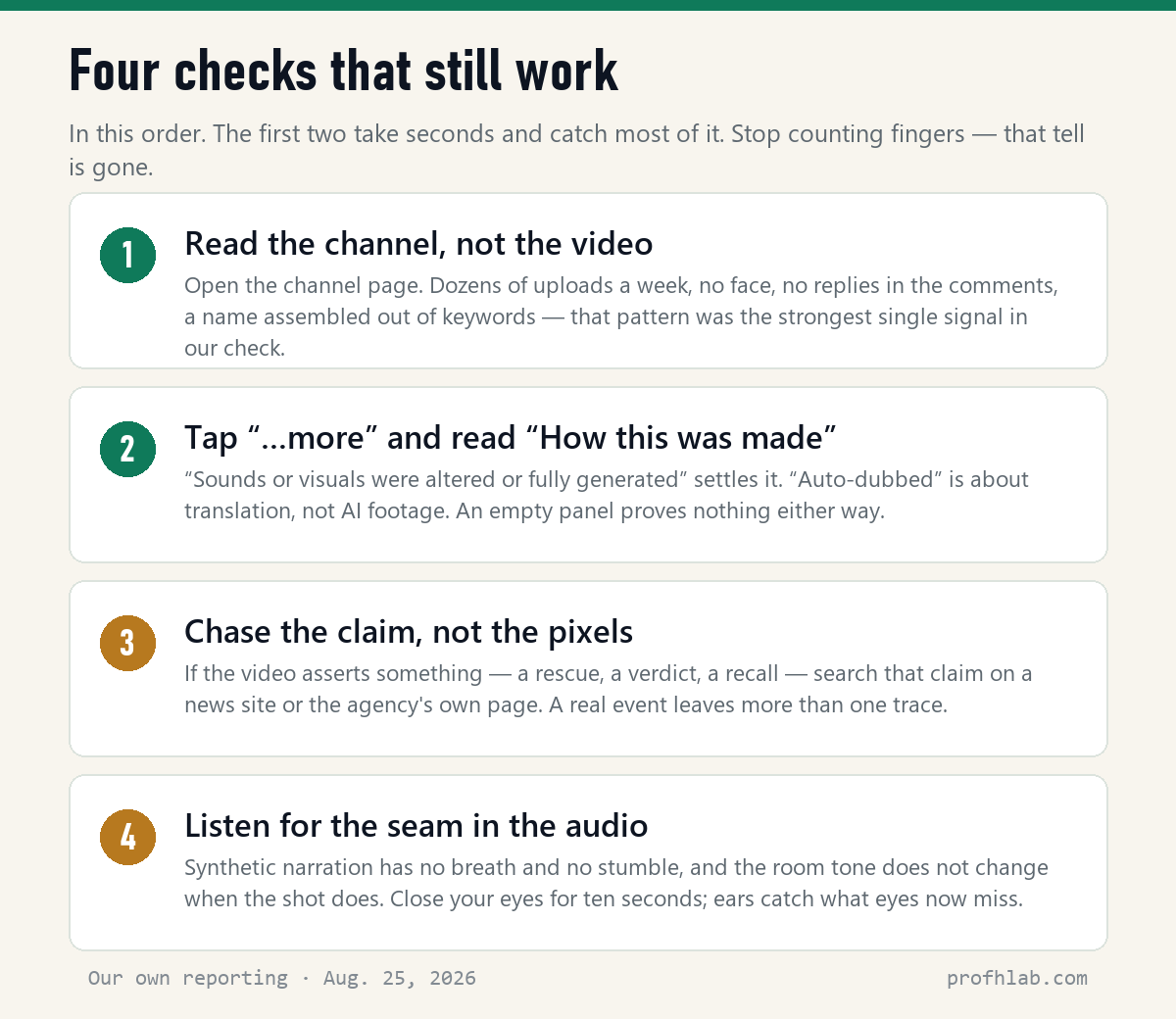
1. Read the channel, not the video. This was the strongest signal in our sample and it costs one click. Open the channel page. Uploads every few hours, no human face anywhere, comments never answered, a name assembled out of search keywords — that operation is running a generator, and the individual clip barely matters.
2. Open How this was made and read the actual words. “Sounds or visuals were altered or fully generated” settles it. “Auto-dubbed” does not. An empty panel settles nothing.
3. Chase the claim, not the pixels. If a video asserts that something happened — a rescue, a recall, a court ruling, a celebrity endorsement — stop examining the footage and search the claim. Real events leave more than one trace: a wire story, an agency press page, a local outlet. A fabricated one leaves a cluster of near-identical uploads and nothing else.
4. Listen with your eyes closed. Synthetic narration still has no breath, no stumble, no self-correction, and the room tone does not change when the shot does. Ten seconds of listening catches things the picture no longer gives away.
Learn the chip under the title, and never act on a video alone
A short pass you can actually run, and one you can hand to a parent.
- Learn the two-letter chip by sight. It is directly under the video title. Once you know where it is, checking costs nothing. Just remember what its absence does and does not mean.
- Make “…more” a habit on anything that surprised you. The disclosure sentence, the auto-dub notice and the “Captured with a camera” line all live in that one collapsed panel.
- Never act on a video alone. No sending money, no clicking a link in a description, no forwarding, until the claim itself is confirmed somewhere that is not YouTube. The FTC reported that Americans lost about $16 billion to fraud in 2025, the highest on record, with $3.5 billion of it to imposter scams — nearly one in three fraud reports. Synthetic video is a delivery mechanism for exactly that category.
- Agree on a family code word now. If a voice or a face asks for money urgently, hang up and call the person back on a number you already have. We wrote the longer version of this in AI scams targeting seniors, including what to say when it happens.
- If it came from a Facebook feed rather than YouTube, the tells are different and mostly commercial. How to tell if a Facebook ad is fake covers those.
- To report an AI video of a real person — including yourself — use YouTube’s privacy complaint process rather than a normal flag. Synthetic likeness falls under privacy, not spam.
No AI filter exists, so push back on channels, not videos
“How do I stop seeing AI videos on YouTube entirely?” You can’t switch them off, and there is no filter for it. What works partially: use Don’t recommend channel on the offenders rather than Not interested, since the channel is the unit of production, and prune your watch history — a few minutes of AI compilations reshapes the home feed fast.
“Are AI videos even allowed?” Yes. AI content is permitted and monetizable; YouTube’s May 2026 update states the labels do not affect recommendations or monetization eligibility. What is not allowed is undisclosed realistic synthetic content, and mass-produced repetitive material has separate monetization rules.
“Do all AI videos have a watermark?” No. Google’s models embed SynthID; other generators may embed nothing, and metadata is trivially stripped by re-encoding. Treat a watermark as a bonus, never as a gate.
Want the wider version of this problem? The same logic applies to every AI feature quietly switched on in your own devices — see how do I get rid of AI on my phone, where we read twelve official help pages and found exactly one real off switch.
A plain primer, then Hany Farid on why the old tells stopped working
Two we checked before linking. The first is the mainstream, plain-language version; the second is the expert account of why the old visual tells stopped working.
Does the AI tag prove anything, and do free detectors work?
How can I tell if a YouTube video is AI generated?
Check three things in order. Look for the two-letter AI chip directly under the video title. Open the description with the “more” link and read the “How this was made” section — the AI disclosure reads “Sounds or visuals were altered or fully generated,” while “Auto-dubbed” refers only to translated audio. Then look at the channel itself, since high-volume faceless channels are the strongest single signal. Treat a label as proof of AI, but never treat its absence as proof of authenticity.
What does the AI tag on YouTube videos mean?
It means the video has been disclosed or detected as containing altered or synthetic content. The full sentence in the description panel is “Sounds or visuals were altered or fully generated.” YouTube applies it automatically when the video was made with its own AI tools, when the file carries C2PA provenance metadata, or when its internal detection systems flag it. Creators can also add it themselves, and it does not affect recommendations or monetization.
Does YouTube label AI videos reliably?
No. We checked 17 AI-generated videos on August 25, 2026 and only seven carried the label. Three showed only an auto-dubbing notice, and seven showed nothing at all; those ten videos had 8.8 million combined views. Some of those gaps are legitimate, because YouTube does not require disclosure for clearly unrealistic or fantastical content. That is exactly why an absent label tells you nothing.
Can YouTube detect AI generated videos?
Sometimes. YouTube began automatic labeling on May 27, 2026 using internal detection signals, in addition to labeling anything made with its own generative tools or carrying C2PA metadata. Detection is not comprehensive, YouTube publishes no accuracy figure, and re-encoding a video strips most metadata.
Is there a free AI video detector that actually works?
Not one you can rely on. Google’s SynthID watermarks content from Google’s own models and survives cropping and compression, but the SynthID Detector portal is not open to the public — Google says it is in limited testing with journalists and media professionals, with a waitlist. It also only reads Google’s own watermark. Third-party detector sites do not publish audited error rates.
How do I avoid AI videos on YouTube?
There is no filter or setting for it. The most effective lever is “Don’t recommend channel” rather than “Not interested,” because these videos are produced by channels at volume, and removing AI compilations from your watch history, since a short viewing session shifts the home feed quickly.
Are AI videos allowed on YouTube?
Yes. AI-generated content is permitted and can be monetized, and YouTube has said the AI labels do not affect recommendations or monetization eligibility. What is prohibited is failing to disclose realistic synthetic content — particularly anything showing a real person saying or doing something they did not do.
Sources
- YouTube Help, “Disclosing use of altered or synthetic content” — disclosure requirements, label placement, automatic labeling triggers, and exemptions (checked August 25, 2026).
- YouTube Help, “Understanding ‘How this content was made’ disclosures” and “Captured with a camera” — C2PA provenance and its stated limits (checked August 25, 2026).
- Google DeepMind, “SynthID” — watermarking scope, durability, and the limited-testing status of the SynthID Detector portal (checked August 25, 2026).
- TechCrunch, “YouTube will now automatically label AI videos,” May 27, 2026 — automatic labeling and the move of the label below the player.
- European Commission — AI Act transparency obligations, applicable August 2, 2026.
- Federal Trade Commission — 2025 Consumer Sentinel data: about $16 billion in reported fraud losses, $3.5 billion to imposter scams, nearly one in three fraud reports.
- Our own check of 17 AI-generated YouTube videos and their “How this was made” panels, August 25, 2026.
Same test, other screens: scam calls, Facebook ads, phone settings
- AI scams targeting seniors: the voice on the phone, and the one question that stops it
- How to tell if a Facebook ad is fake
- How do I get rid of AI on my phone? Twelve places, one real off switch
Written by Prof. H, who would rather count the labeled videos than count the fingers. Every quoted line above was read on YouTube and on the official help pages on August 25, 2026, and the 17-video table is our own check from the same day. This is not legal or financial advice.
Prof.’s H Newsletter
One short email a month, with the numbers in it
What actually moved in AI hiring, AI prices, and the scams aimed at older Americans. Counted here, dated, and linked to the source. One email a month, and your address goes nowhere else.