Estimated Taxes Due September 15: The $1,000 Rule and the Withholding Fix Most People Miss
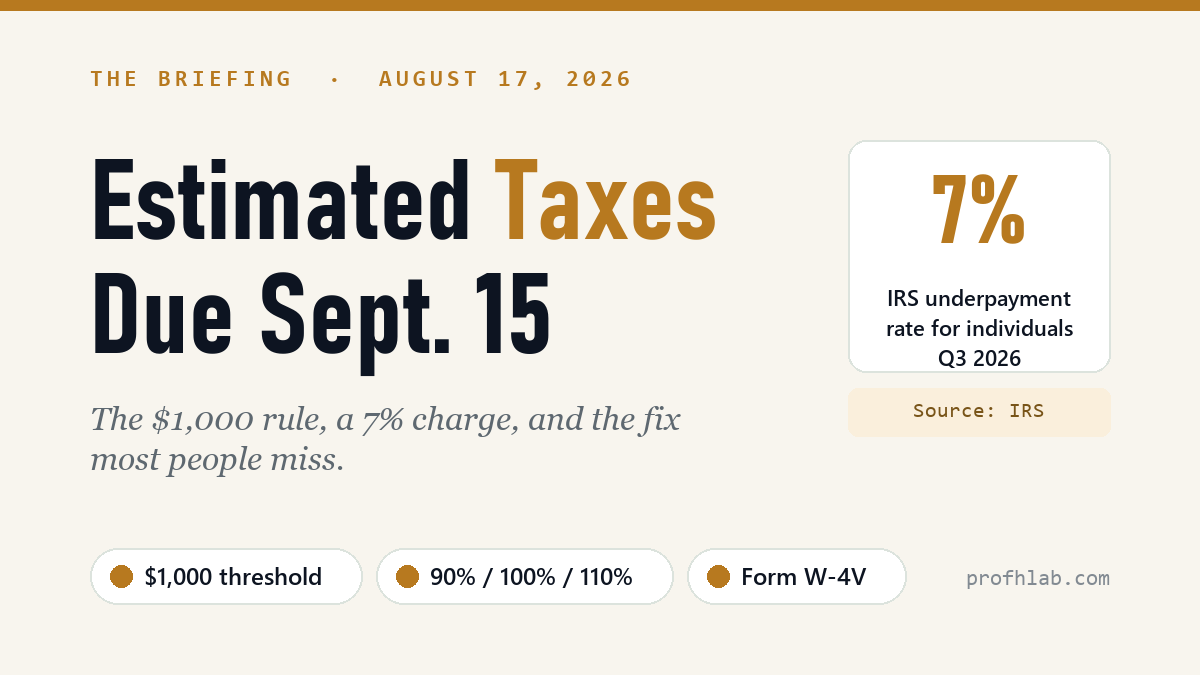
There is a federal tax deadline on Tuesday, September 15, 2026, and no form arrives to remind you. It is not a filing deadline — it is simply the date the IRS expects a payment from anyone whose income arrives without tax taken out of it first: retirees drawing on an IRA, anyone with a pension set up without withholding, freelancers, landlords, and small business owners.
Miss it and nothing happens in September. The cost shows up next April as an extra line on your return. This briefing covers who actually owes something on the 15th, what missing it costs in dollars, and one rule buried in the IRS instructions that can fix a payment you already missed back in April — something a September payment cannot do.
Who actually has to pay on September 15
The test is narrower than most people assume. Form 1040-ES for 2026 says you must pay estimated tax only if both are true: you expect to owe at least $1,000 for 2026 after withholding and refundable credits, and your withholding and credits will fall under one of the safe harbors below. Clear either safe harbor and you owe no penalty at all — even if you write a large check in April.
| The test | What it means | Where to find your number |
|---|---|---|
| The $1,000 gate | You expect to owe under $1,000 for 2026 after withholding → you are done. No estimated tax required. | Your own estimate |
| Safe harbor A — current year | Withholding + credits will cover 90% of your 2026 tax | Requires projecting 2026 |
| Safe harbor B — prior year | Withholding + credits will cover 100% of the tax shown on your 2025 return | 2025 Form 1040, “total tax” line |
| Safe harbor B, higher income | 110% instead of 100%, if your 2025 AGI was over $150,000 ($75,000 if married filing separately) | 2025 Form 1040, AGI line |
Safe harbor B is the practical one, because it needs no forecasting. Find total tax on last year’s return, multiply by 1.0 (or 1.1), compare against what 2026 has already collected, and split the difference across the payments left. Your 2025 return must cover all 12 months for this to apply.
What skipping it actually costs
The charge is not a flat fine. It works like interest — compounded daily at a rate the IRS resets quarterly, running from each installment due date until the money is paid or the return comes due. For the quarter that began July 1, 2026, the underpayment rate for individuals is 7%. That produces smaller numbers than most people fear, and the earlier misses are the expensive ones, because they accrue longer:
| Installment you underpaid | Days running to April 15, 2027 | Cost per $1,000 short |
|---|---|---|
| Q1 — April 15, 2026 | 365 | $72.50 |
| Q2 — June 15, 2026 | 304 | $60.03 |
| Q3 — September 15, 2026 | 212 | $41.49 |
| Q4 — January 15, 2027 | 90 | $17.41 |
How solid is that table? The 7% rate is official, published by the IRS for the quarter beginning July 1, 2026. The dollar figures are our projection, calculated at a constant 7% compounded daily. The IRS has only published rates through Q3 2026 — if the rate moves for Q4 2026 or early 2027, these numbers move with it. Treat them as the right order of magnitude, not a bill.
The fix most people miss: withholding is treated as if it were paid evenly
An estimated payment counts on the day you make it, so a check on September 15 does nothing for a shortfall back in April — that gap keeps accruing. Withholding works differently. The IRS instructions for Form 2210 state that for withheld income tax, “you are considered to have paid one-fourth of these amounts on each payment due date unless you can show otherwise.”
That is unusual enough to reread: tax withheld in November is treated as though a quarter of it was paid on April 15. Withholding is the only tool that reaches backward. If you have been short all year, raising it now plugs earlier quarters in a way no September check can.
The forms that do it, all given to the payer rather than the IRS:
| Income source | Form | Give it to | Rates available |
|---|---|---|---|
| Social Security benefits | W-4V | SSA | 7%, 10%, 12%, or 22% |
| Pension or annuity payments | W-4P | Plan administrator | Set on the form |
| IRA and other nonperiodic distributions | W-4R | IRA custodian | Set on the form |
| Wages (yours or a spouse’s) | W-4 | Employer | Extra amount per paycheck |
The classic version for a retiree: take a needed IRA distribution late in the year with a large share withheld, instead of sending four separate payments. One transaction, and the IRS treats the tax as spread evenly across all four due dates. (If counting withholding on the dates it was actually withheld would help you more, the instructions allow that too — check box D in Part II of Form 2210 and attach the form.)
Before you pay: you may owe less than you think
Three deductions stack for people 65 and older in 2026, and the newest is easy to miss because it did not exist before 2025: an enhanced deduction for seniors of up to $6,000 per eligible person ($12,000 if both spouses qualify), running for tax years 2025 through 2028. The IRS states it is available whether or not you itemize. Stacked together, for someone taking the standard deduction:
| 2026 filing status | Standard deduction | Extra for age 65+ | Enhanced senior deduction | Total subtracted from AGI |
|---|---|---|---|---|
| Single, 65+ | $16,100 | $2,050 | $6,000 | $24,150 |
| Head of household, 65+ | $24,150 | $2,050 | $6,000 | $32,200 |
| Married filing jointly, one spouse 65+ | $32,200 | $1,650 | $6,000 | $39,850 |
| Married filing jointly, both 65+ | $32,200 | $3,300 | $12,000 | $47,500 |
The rules are strict, so check them before counting on the money. For 2026 you must have been born before January 2, 1962, you and your spouse need valid Social Security numbers, and married filers must file jointly. The $6,000 also shrinks once modified AGI passes $75,000 ($150,000 joint) — on the 2025 Schedule 1-A the reduction is 6% of every dollar above that line, zeroing out at $175,000 for a single filer. The 2026 schedule is not published yet.
One clarification on that table: it shows deductions subtracted from adjusted gross income, not a ceiling on what you can receive. Much of a typical Social Security benefit may never enter AGI at all, so many households land below these lines without trying.
Paying it, in about fifteen minutes
- Find last year’s total tax. On your 2025 Form 1040, read the total tax line — not the refund, not what you paid in April. Multiply by 1.10 instead of 1.00 if your 2025 AGI topped $150,000.
- Subtract what 2026 has collected. Withholding to date plus any estimated payments. Your IRS Online Account at IRS.gov/account shows what has posted.
- Pick the route. If the gap opened recently, one estimated payment is fine. If you have been short since spring, raise withholding instead — the only path that reaches back to April and June.
- Pay by the 15th. IRS Direct Pay at IRS.gov/directpay draws from a bank account with no fee; cards carry a processor fee. Select “estimated tax” and tax year 2026.
- Unsure of the amount? The IRS Tax Withholding Estimator at IRS.gov/W4App does the arithmetic and tells you what to put on a W-4 or W-4P.
Nobody from the IRS is going to call you about this. The FTC’s guidance is blunt: the IRS’s first contact comes by mail, not by phone — hang up on unexpected calls saying you owe back taxes. Be wary too of firms promising to settle tax debt for “pennies on the dollar.” In June 2026 the FTC and the State of Nevada settled charges against one such operation, whose principals surrendered more than $8 million in cash plus additional assets.
If you do owe back taxes, the real help is free and comes from the IRS. More on how these calls are built: The 2026 Guide to AI Scams.
Free places to get an actual answer.
IRS individual help line: 800-829-1040. The Taxpayer Advocate Service, an independent organization inside the IRS for problems normal channels cannot resolve: 877-777-4778. Free return preparation through VITA and Tax Counseling for the Elderly — TCE specializes in pension and retirement questions for filers 60 and older — runs mainly January through April: site locator 800-906-9887, or AARP Tax-Aide at 888-227-7669. Worth noting now so you can book early rather than in March.
Where this article stops. This is general information, not tax advice, and it does not account for state estimated taxes, farming and fishing income, or the annualized income method that can help if your income arrives unevenly through the year. Your facts may change the answer. For anything with real money attached, use the free channels above or a credentialed preparer.
Do you owe on September 15, and what a missed payment costs
Do I have to pay estimated taxes on September 15, 2026?
Only if both IRS conditions apply: you expect to owe at least $1,000 for 2026 after withholding and refundable credits, and your withholding plus credits will fall short of 90% of your 2026 tax or 100% of your 2025 tax (110% if your 2025 AGI exceeded $150,000). Clear either safe harbor and no estimated payment is required.
What happens if I miss the September 15 estimated tax payment?
Nothing in September. The IRS adds an interest-style charge on the shortfall, computed from September 15 and compounded daily at a rate reset quarterly — 7% for the quarter that began July 1, 2026. At that rate, a $1,000 shortfall left until the April 15, 2027 filing deadline works out to roughly $41. Earlier missed installments cost more because they accrue longer.
Can I increase withholding instead of making estimated tax payments?
Yes, and it is often the better move. The IRS instructions for Form 2210 treat withheld tax as though one-fourth was paid on each installment due date, no matter when it was actually withheld — so raising withholding late in the year can cover shortfalls from spring, which an estimated payment cannot. Use Form W-4V for Social Security (7%, 10%, 12%, or 22%), W-4P for a pension, W-4R for IRA distributions, or a new W-4 with an employer.
How much can someone over 65 deduct in 2026?
Three amounts stack. A single filer 65 or older takes the $16,100 standard deduction, an extra $2,050 for age, and up to $6,000 from the enhanced senior deduction — $24,150 in all. A married couple filing jointly with both spouses 65 or older reaches $47,500. The $6,000 requires being born before January 2, 1962, a valid Social Security number, joint filing if married, and it phases out above $75,000 of modified AGI ($150,000 joint).
Do I have to pay estimated tax on Social Security benefits?
There is no automatic withholding on Social Security, so if benefits push you into owing $1,000 or more and no safe harbor covers you, the tax has to reach the IRS somehow. Most people find it simpler to file Form W-4V with the Social Security Administration and pick 7%, 10%, 12%, or 22% withholding than to send quarterly payments. Depending on your total income, part of your benefit may not be taxable at all.
Sources
- IRS, 2026 Form 1040-ES — the $1,000 rule, the 90%/100%/110% safe harbors, the $150,000 higher-income threshold, 2026 standard deduction and age-65 amounts, and the enhanced senior deduction (born before January 2, 1962)
- IRS, Instructions for Form 2210 — withholding treated as one-fourth paid on each due date; the box D election
- IRS, Quarterly interest rates — 7% underpayment rate for individuals, quarter beginning July 1, 2026; compounded daily
- IRS, Schedule 1-A (Form 1040), Part V — the 6% phase-out arithmetic for the enhanced deduction for seniors (2025 form)
- IRS newsroom, “Check your eligibility for the new enhanced deduction for seniors” and the Working Families Tax Cuts fact sheet — $6,000/$12,000 amounts, age and SSN rules, available to itemizers and non-itemizers
- IRS, Form W-4V (Rev. January 2026) — the 7%/10%/12%/22% withholding options for Social Security benefits
- IRS, Free tax return preparation for qualifying taxpayers — VITA and TCE, site locator numbers
- FTC — consumer alert on unexpected back-taxes calls (January 2026); FTC and State of Nevada tax-relief settlement (June 2026)
Next year’s Social Security raise and a Medicare appeal letter
- Your 2027 Social Security Raise, and What Medicare Takes Back — the other number that moves your income next year.
- Have ChatGPT Write the Letter — including the Medicare appeal, with 2026 win-rate numbers.
- The 2026 Guide to AI Scams — the family safe word and the first-60-minutes plan.
About the author
Prof. H is a professor of AI and robotics, a former Samsung researcher, and the author of dozens of textbooks on AI and automation. He writes hands-on, no-hype guides. More about the author →
Prof.’s H Newsletter
One short email a month, with the numbers in it
What actually moved in AI hiring, AI prices, and the scams aimed at older Americans. Counted here, dated, and linked to the source. One email a month, and your address goes nowhere else.