Will AI Take My Job? The Honest August 2026 Answer in 7 Numbers, Plus a 5-Minute Test for Yours
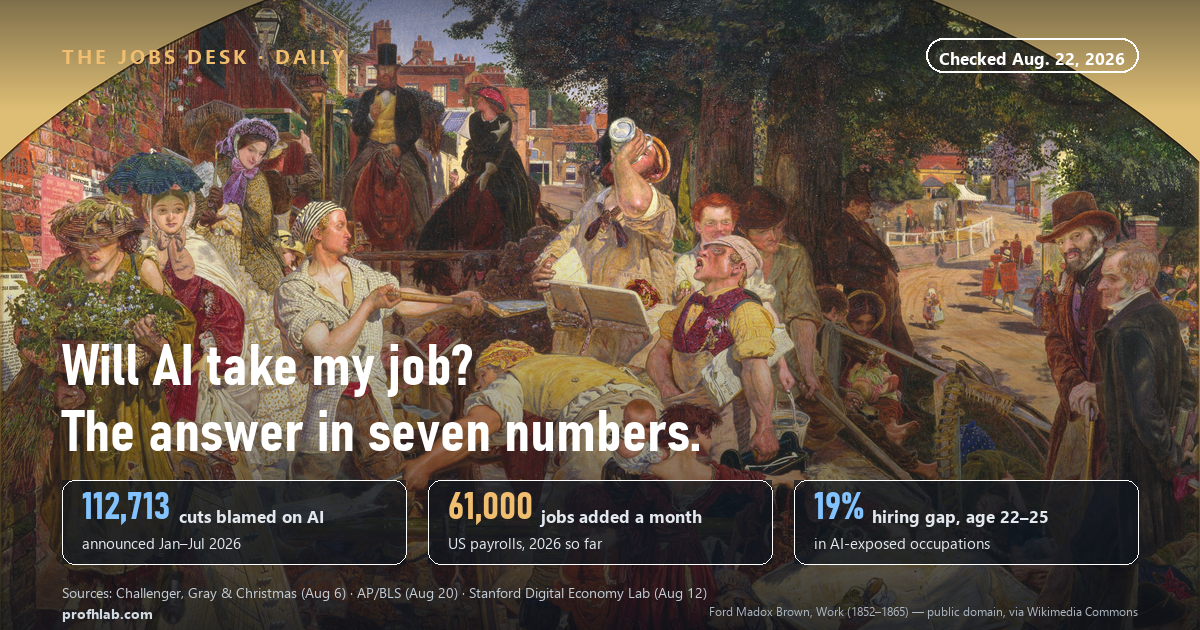
Short answer, as of Aug. 22, 2026. AI is not taking jobs from the economy as a whole: employers are adding about 61,000 jobs a month, unemployment is 4.1%, and announced layoffs just hit a two-year low. But AI is taking one very specific job from one very specific person: the first job, in an AI-exposed desk job, from someone aged 22 to 25. For that person the hiring gap is now 19% and widening. And the number almost nobody searches for is 29 — the share of employers who cut people for AI and have already hired them back.
Everything below is built from seven published numbers. You can check each one at the link. Then there is a five-minute test for your own job, because “will AI take my job” is not a question about the economy. It is a question about your Tuesday.
Jump to what you need
- The seven numbers, with sources
- Is AI taking jobs? Which ones, from the layoff filings
- Who it is actually hitting: 22-to-25-year-olds in entry-level white-collar jobs
- Which jobs are most exposed — and why exposure is not replacement
- The rehiring nobody searches for
- Will AI take my job? The 5-minute test
- Jobs AI can’t replace, from the job boards
- If it already happened to you
- FAQ
Web story · 60 seconds
Will AI Take My Job? A 5-Question Test — the same five questions, one per screen. Score yourself, then come back here for the numbers behind them.
The seven numbers, with sources
| # | The number | What it actually measures | Source, date |
|---|---|---|---|
| 1 | 112,713 | Job cuts announced Jan–Jul 2026 in which the employer named AI as the reason — 24% of all announced cuts. These are announcements, not confirmed separations. | Challenger, Gray & Christmas, Aug 6 |
| 2 | 33,429 | Total job cuts announced in July 2026, the lowest month in two years, down 46% from July 2025. AI was the #1 stated reason for the fifth month running (10,970). | Challenger, Aug 6 |
| 3 | 107,500 | Hiring plans announced Jan–Jul 2026, up 25% on 2025. July alone: 16,095, up 47%. | Challenger, Aug 6 |
| 4 | 61,000 | Jobs added per month in 2026 so far, against 9,700 a month in 2025. Unemployment 4.1%; jobless claims 206,000 in the latest week, a four-week average of 204,000. | AP / Labor Department, Aug 20 |
| 5 | 19% | How far employment of 22-to-25-year-olds in AI-exposed occupations now sits below where it would be if it had kept pace with less-exposed peers. It was 15% when first measured in mid-2025. Payroll data through June 2026. | Stanford Digital Economy Lab, Aug 12 |
| 6 | 75% | Observed AI exposure for computer programmers — the share of their tasks where AI is already being used to do the work. Data-entry keyers 67%. About 30% of all workers have zero: cooks, mechanics, lifeguards, bartenders, dishwashers. | Anthropic Economic Index, Mar 5 |
| 7 | 29% | Share of employers that cut jobs for AI-related reasons and had already rehired into those positions. Forrester separately expects 55% of executives who replaced people with AI to regret it within 18 months. | Robert Half survey, via Forbes, May 21 |
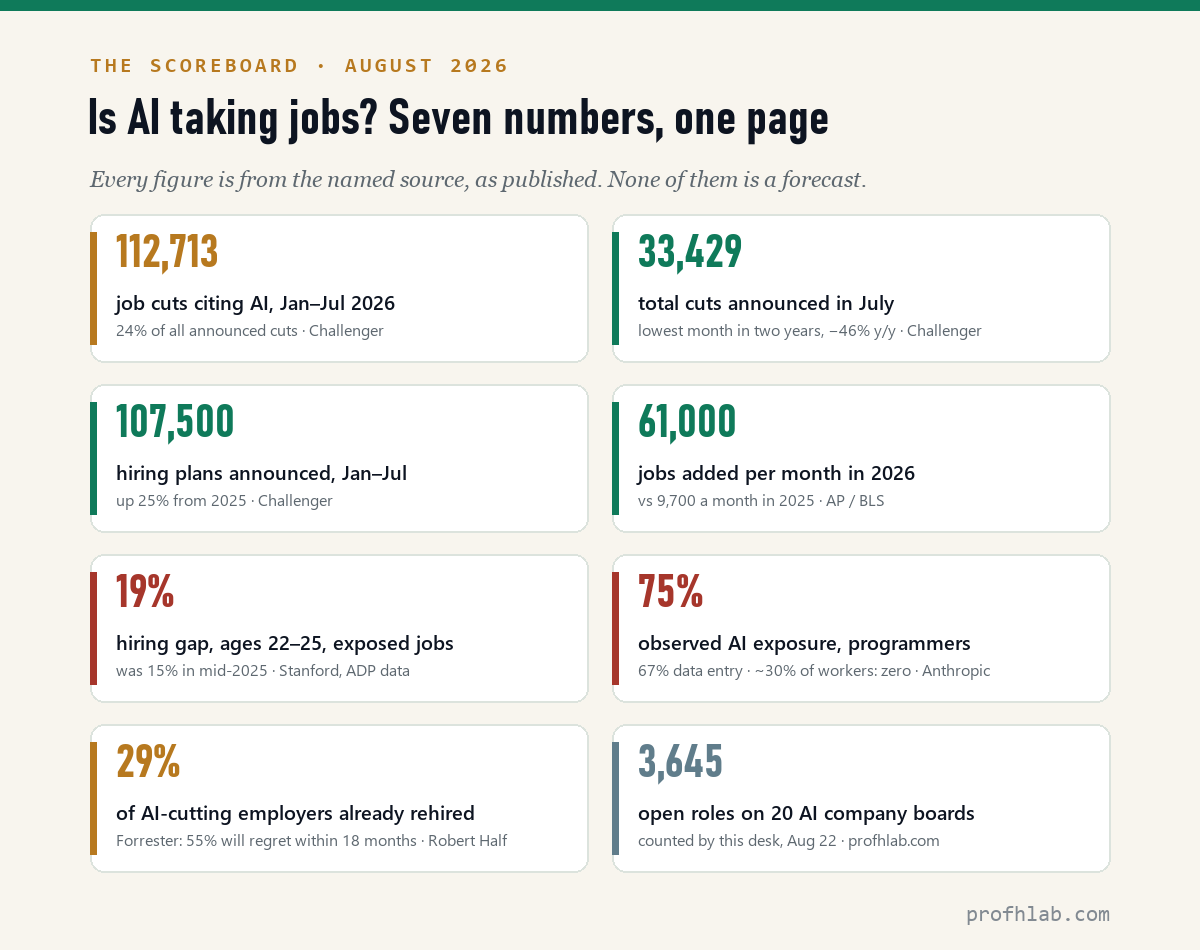
The layoffs that cite AI are real. So is the hiring that does not cite anything. Both are at record highs for this cycle, and that is the whole story.
Is AI taking jobs? Which ones, from the layoff filings
Challenger, Gray & Christmas has counted announced job cuts by stated reason since the 1990s. In July 2026, for the fifth consecutive month, the reason employers gave most often was artificial intelligence: 10,970 of 33,429 cuts, or 33%. Year to date, AI has been named in 112,713 announced cuts, about one in four.
| Stated reason, July 2026 | Announced cuts |
|---|---|
| Artificial intelligence | 10,970 |
| Market / economic conditions | 7,960 |
| Closings | 6,060 |
| Restructuring | 2,815 |
| Loss of contract | 2,003 |
Two things keep that table honest. First, it counts what companies say. A company that would rather say “AI” than “we over-hired in 2021” is counted under AI; a company that automates quietly and never announces it is not counted at all. Second, the total is falling: July’s 33,429 is the lowest monthly figure in two years, down 46% from July 2025. The technology sector is the exception — 149,023 cuts this year, up 67% — which is why software engineers feel this differently from nurses.
Challenger’s own line on it: “Hiring has also increased over last year by 25%, so while AI is shifting the labor market, it is not dismantling it.”
Who it is actually hitting: 22-to-25-year-olds in entry-level white-collar jobs
The sharpest evidence is not in the layoff counts at all. It is in payroll records. Stanford’s Digital Economy Lab — Erik Brynjolfsson, Bharat Chandar and Ruyu Chen — has been tracking millions of workers in ADP’s payroll data since late 2022. Their August 12 update, with data through June 2026, says six things, and the first one is the one the headlines skip: there is no evidence of economy-wide displacement.
The second is the one that should change how a 23-year-old plans the next year. Employment of workers aged 22 to 25 in the occupations most exposed to AI now sits about 19% below where it would be if it had kept pace with their peers in less-exposed occupations. When the team first measured it, in mid-2025, the gap was 15%. It has widened every quarter since. Experienced workers in the same occupations show no comparable gap.
How it happens matters as much as how much. The gap works through hiring, not firing: fewer first jobs are being offered, not more people being let go. Anthropic’s own labor-market research, using a different method, lands in the same place — job-finding rates for 22-to-25-year-olds entering exposed occupations are down about 14% relative to 2022, while the unemployment effect for everyone already in those occupations is, in their words, indistinguishable from zero.
If you are 22 to 25 and you work a desk job
Which jobs are most exposed — and why exposure is not replacement
Anthropic’s Economic Index measures something narrower and more useful than “could AI do this”: it measures observed exposure, the share of an occupation’s tasks where people are already using AI to do the work, weighting automated use more heavily than assisted use. The March 2026 report puts computer programmers at the top at 75%, with data-entry keyers at 67% and customer-service representatives close behind. At the other end, roughly 30% of the workforce has zero observed coverage: cooks, motorcycle mechanics, lifeguards, bartenders, dishwashers, dressing-room attendants.
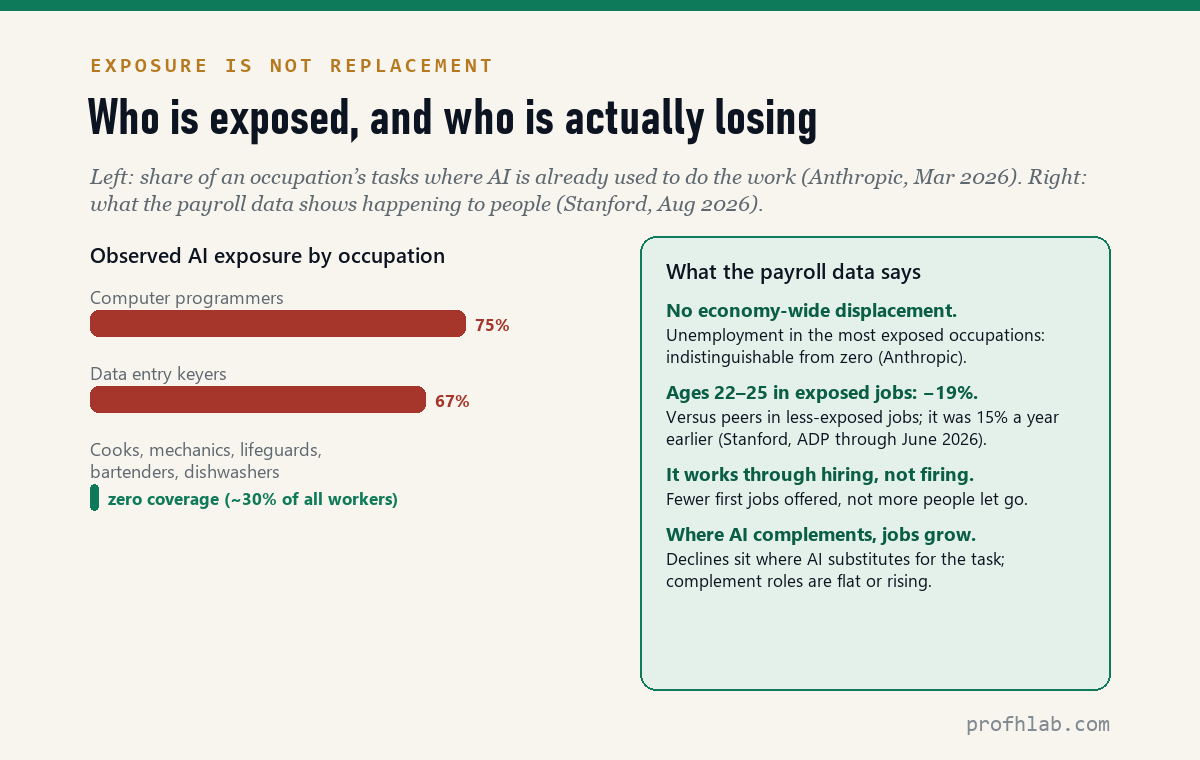

Stanford’s fifth fact explains why exposure and replacement are different things. Employment declines are concentrated where AI substitutes for the task; where AI complements the worker, employment is flat or rising, especially for experienced workers. A programmer whose job is to turn a ticket into code is exposed.
A programmer whose job is to decide what the code should do, and to tell when the AI’s version is subtly wrong, is the person the company is trying to keep. We wrote a whole piece on that line — if a machine can check the result, the machine gets the task — and it turns out to be a career rule, not just a tooling rule.

The rehiring nobody searches for
Here is the number that was missing from every “AI took my job” thread we read this week. A Robert Half survey, reported by Forbes in May, found that 29% of organizations that cut employees for AI-related reasons had already rehired into the positions they cut. Forrester predicts that 55% of the executives who replaced employees with AI will regret the decision within 18 months. Gartner expects that by 2027 at least half of the companies that cut customer-service jobs for AI will be hiring for similar roles again.
- Ford installed roughly 900 AI cameras to catch defects on its lines and then hired, promoted or brought back about 350 experienced technical specialists over three years when the cameras could not match a trained eye — the rehired engineers now retrain the AI, and Ford credits the reversal for its climb to the top mainstream brand in J.D. Power’s initial-quality survey (reported by Motor1 and Yahoo Finance).
- Commonwealth Bank of Australia announced in July 2025 that a voice bot would replace 45 customer-service roles, then reversed the cuts in August and admitted the assessment was an “error” after call volumes rose instead of falling (ABC News, Bloomberg).
- Klarna, the company that bragged about replacing support staff with AI, said service quality suffered and began bringing people back into customer-facing roles.
The rehired workers are not coming back at the old price. The Forbes piece gives the typical shape: a $55,000 role eliminated, then refilled at $75,000 by someone who does the same job and manages the AI tools. That is the quiet, unglamorous answer to “what jobs will AI create” — the same jobs, with the machine in the room, paid more.
Nobody announces a rehire. That is why the layoff number is famous and the 29% is not.
Will AI take my job? The 5-minute test
The top autocomplete suggestions for this question include “calculator” and “website.” We did not build a calculator, because the honest inputs are not numbers anyone has about your job. We built five questions that map onto what the 2026 evidence actually says predicts risk: how much of your work is text in, text out (exposure); whether a machine can check it (substitution versus complement); whether you have to be physically present; whether someone must be accountable; and whether you are early in the occupation (the Stanford finding). Score them honestly, add them up.
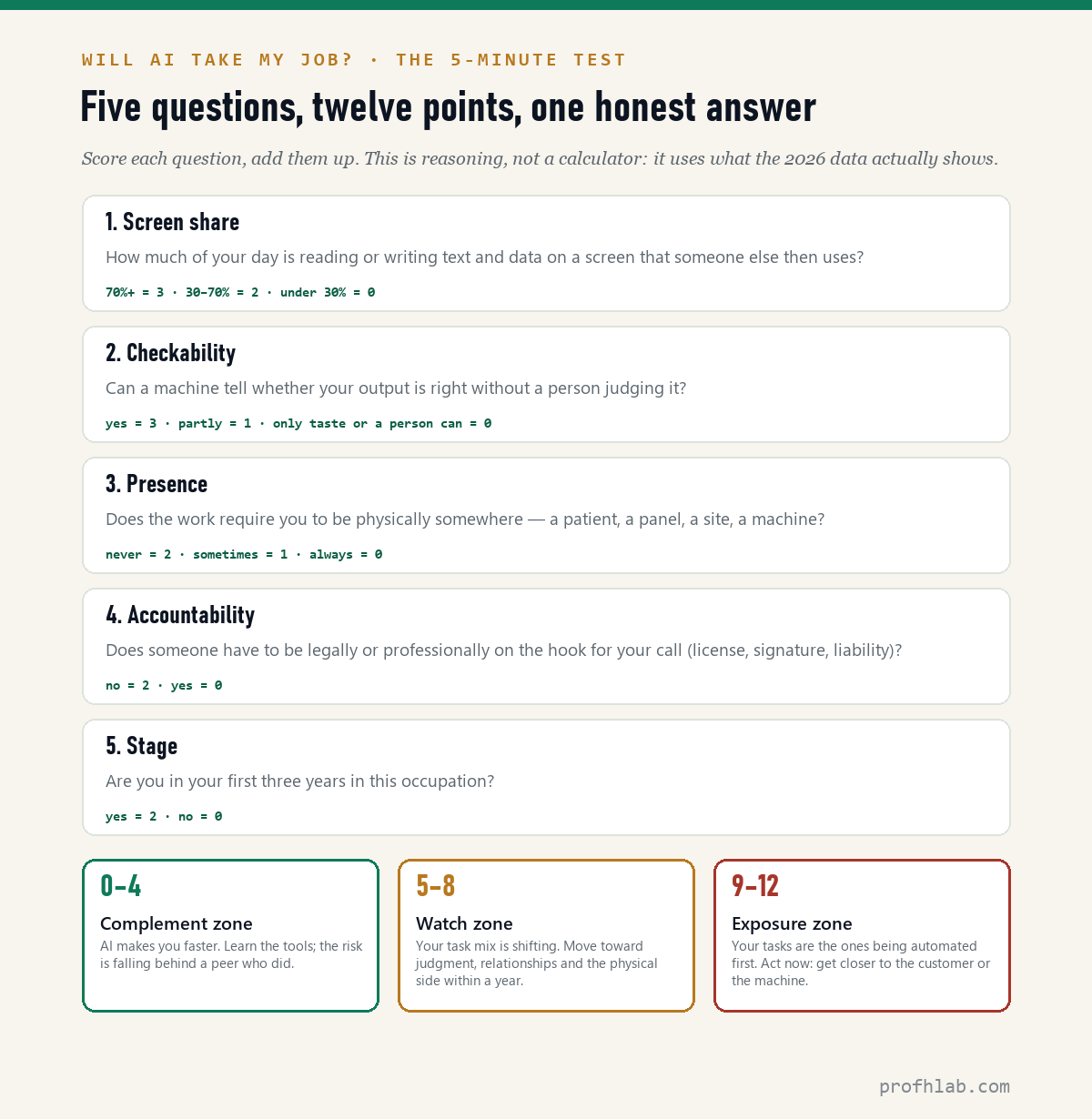
- Screen share. How much of your day is reading or writing text and data on a screen that someone else then uses? 70% or more = 3 points; 30–70% = 2; under 30% = 0.
- Checkability. Can a machine tell whether your output is right without a person judging it? Yes = 3; partly = 1; only taste or a person can = 0.
- Presence. Does the work require you to be physically somewhere — a patient, a panel, a site, a machine? Never = 2; sometimes = 1; always = 0.
- Accountability. Does someone have to be legally or professionally on the hook for your call — a license, a signature, liability? No = 2; yes = 0.
- Stage. Are you in your first three years in this occupation? Yes = 2; no = 0.
| Score | Zone | What the data says about you | What to do in the next 12 months |
|---|---|---|---|
| 0–4 | Complement | AI makes you faster; your employment is flat or rising in the payroll data. | Learn the tools seriously. The risk is not AI; it is the colleague who learned them. |
| 5–8 | Watch | Your task mix is shifting under you. Not a layoff signal, a drift signal. | Move toward judgment, relationships and the physical side of your field. Make your review of AI output a visible part of the job. |
| 9–12 | Exposure | Your tasks are the ones being automated first, and if you are early-career, the hiring gap applies to you. | Act now, not next year: get closer to the customer or the machine, document outcomes not activity, and open the technician, apprentice and federal doors in parallel. |
A caveat we mean: this is reasoning, not measurement. It will not tell you the month. It will tell you which of the three stories above is yours, which is more than most of the calculators do.
The Prof H Lab Letter
Keep the numbers coming — one short email a month
The Jobs Desk reads twenty company boards every morning and the federal feed every Monday. Once a month we send the moves that matter: which boards grew and shrank, the pay bands that changed, the federal roles closing soon — and anything we got wrong and fixed. No hype, no daily drip, unsubscribe in one click.
Get the monthly letter →One short email a month. Unsubscribe anytime.
Jobs AI can’t replace, from the job boards
Every “jobs safe from AI” list recycles the same dozen occupations. We have a different source: what the companies building AI are hiring for. On Aug. 22 we counted 3,645 open roles on the boards of twenty AI and robotics companies. The physical side is where the no-degree doors are: xAI’s data-center technicians in Memphis (high-school diploma or equivalency), OpenAI’s site-operations technicians in San Francisco ($157K–$221K, associate’s degree or equivalent experience), Figure AI’s apprentice robot-service technicians in San Jose. Every link is in yesterday’s count.
Add the Bureau of Labor Statistics’ own projections and the picture inverts the headline: computer and information research scientists are projected to grow 20% from 2024 to 2034 and data scientists 34%, both “much faster than average.” The occupations closest to the machine are growing fastest. The occupations farthest from any screen — Anthropic’s zero-coverage list — are untouched. The squeeze is in the middle: routine white-collar work, early career, where the output can be checked by another machine.
If it already happened to you
- Check whether you were owed notice. The federal WARN Act requires employers with 100 or more employees to give 60 calendar days’ written notice of plant closings and mass layoffs; many states go further (California’s threshold is 75). Your state’s labor department posts WARN notices publicly. The Department of Labor’s overview is here.
- File for unemployment in the first week. The reason on your separation letter does not change your eligibility. “AI” is not a disqualification.
- Ask about the rehire clause before you sign anything. With 29% of AI-cutting employers already rehiring, the question “if this role comes back, am I first on the list?” is not naive; it is the statistically likely scenario.
- Keep the door open, on paper. The boomerang hires in the Forbes reporting came back at a premium because they could run the tools that replaced them. Spend the gap learning exactly the system that was supposed to do your job.
- If you are the parent of the 23-year-old: the gap is in first jobs, so the most useful thing you can do is help them take an imperfect first door — technician, apprentice, federal development program — rather than wait for the perfect one.
Ask the desk
Laid off this month? Graduating into a desk job? Tell us your occupation, your city and what you are worried about. We look it up against the boards and the federal feed and post what we find, usually within a day.
Score your job with a colleague; self-scores are usually wrong
- Take the five-question test with a colleague, not alone. The scores people give themselves on “checkability” are the ones that are usually wrong.
- If you scored 9 or more and you are under 26, open the no-degree table today and the federal table tomorrow. The NSA program closes Aug. 26.
- If you manage people: the 29% is your number too. Before you cut for AI, price the rehire.
- Bookmark the Challenger report date: the August count lands in the first week of September. If AI leads for a sixth month, we will say so; if the rehiring shows up in the hiring-plans line, we will say that too.
The live numbers
Every figure in this article comes from a count we run each morning. The current reading — open roles by company, published pay bands, US locations and the entry-level list — is on one page, updated daily and free to cite.
Why no one can say how many jobs AI has actually cost
- Is AI taking jobs or creating jobs? Both, in different places: 112,713 announced cuts citing AI versus 107,500 announced hiring plans and 61,000 net jobs a month. The creation is quieter because nobody issues a press release for a rehire.
- How many jobs have actually been lost to AI? Nobody knows, and anyone who gives you a single number is counting announcements (Challenger) or modeling exposure (Anthropic, Stanford). The payroll data, which counts people, shows a hiring gap for the young and no unemployment effect for the rest.
- What should I learn? The tool that replaced the role you want. The rehired workers in the surveys came back as the people who run it: here is what that costs per month, and here is the decision rule for which work to hand to it.
Which jobs go first, which are safe, and are AI layoffs backfiring?
Will AI take my job?
Not this year for most people, and probably not ever in the sense the question implies. As of August 2026 the US is adding about 61,000 jobs a month and announced layoffs are at a two-year low. The measurable harm is narrower: workers aged 22 to 25 in AI-exposed white-collar occupations are being hired about 19% less than their peers. Take the five-question test in this article to see which story applies to your job.
Is AI taking jobs or creating jobs?
Both. Employers named AI in 112,713 announced job cuts from January to July 2026 (24% of all cuts), but announced hiring plans were up 25% to 107,500, and 29% of the employers who cut for AI had already rehired into those roles. The creation side is quieter because rehires are not announced.
How many jobs have been lost to AI so far?
There is no verified count of actual job losses. The closest thing is Challenger, Gray & Christmas’s tally of announced cuts that cite AI: 112,713 in the first seven months of 2026. Payroll-based research from Stanford and Anthropic finds no economy-wide displacement, only a hiring slowdown for the youngest workers in exposed occupations.
What jobs will AI replace first?
By observed usage, the most exposed occupations are computer programmers (75% of tasks), data-entry keyers (67%) and customer-service representatives, according to Anthropic’s March 2026 Economic Index. Exposure is not replacement: these are also the occupations where rehiring after AI cuts is most common.
Which jobs are safe from AI?
Anthropic finds about 30% of workers in occupations with zero observed AI usage: cooks, motorcycle mechanics, lifeguards, bartenders, dishwashers, dressing-room attendants. On the job boards, the AI companies themselves are hiring technicians, field-service and facilities staff in Memphis, San Jose and San Francisco, often without a degree requirement.
Are AI layoffs backfiring?
Often. A Robert Half survey found 29% of organizations that cut jobs for AI-related reasons had already rehired into them; Forrester expects 55% of executives who replaced staff with AI to regret it within 18 months; Ford brought back about 350 experienced engineers after 900 AI cameras fell short; Commonwealth Bank of Australia reversed 45 AI-driven cuts and called them an error.
Is there a “will AI take my job” calculator?
Several websites offer one, but they score occupations, not your job. This article’s five-question test scores the things the 2026 evidence says actually predict risk: screen share, machine-checkability, physical presence, accountability and career stage. It takes five minutes and gives you a zone, not a percentage.
The Prof H Lab Letter
If this page helped, the monthly letter is the same thing, shorter
One email a month from the lab: the jobs numbers that moved, the AI price changes worth knowing, and the scams to watch. Written by the same person, with the same sources. Nothing sold, nothing forwarded, unsubscribe anytime.
Get the monthly letter →One short email a month. Unsubscribe anytime.
Sources
- Challenger, Gray & Christmas, July 2026 Job Cuts Report (Aug. 6, 2026).
- AP (Paul Wiseman), “US unemployment claims dropped to 206,000” (Aug. 20, 2026).
- Stanford Digital Economy Lab, “Canaries in the Coal Mine?” August 2026 update (Brynjolfsson, Chandar, Chen; Aug. 12, 2026).
- Anthropic, “Labor market impacts of AI: a new measure and early evidence” (Mar. 5, 2026).
- Forbes, “Companies fired workers for AI. Now they want them back” (May 21, 2026) — Robert Half, Forrester, Gartner figures.
- Motor1 and Yahoo Finance on Ford’s rehired engineers; ABC News on Commonwealth Bank’s reversal.
- BLS Occupational Outlook Handbook (2024–34 projections); U.S. Department of Labor, WARN Act.
- Company job-board counts: this desk, Aug. 22, 2026. Photographs as credited in captions.
Once you know your score: who is hiring and what AI costs
- Which AI companies are hiring right now? We counted 3,645 open jobs on 20 boards
- When to use agentic AI, and when not to: the decision matrix
- The real monthly cost of AI, by the job you actually do
- The AI scams to watch this year, with the first-60-minutes plan
What this desk is, and is not
Prof.’s H Newsletter
One short email a month, with the numbers in it
What actually moved in AI hiring, AI prices, and the scams aimed at older Americans. Counted here, dated, and linked to the source. One email a month, and your address goes nowhere else.