Robotaxi Las Vegas: The Airport Is Still Off Limits — and Only One Company Takes Your Money
You land at Harry Reid on a Saturday night, and somewhere between the gate and baggage claim your phone shows you the headline: Nevada just approved thousands of robotaxis for Las Vegas. So you do the reasonable thing. You stand under the Ground Transportation sign, open an app, and look for the driverless car.
It is not there. Not for Tesla, not for Waymo, not for Uber. On August 22, 2026, no autonomous vehicle company holds approval to pick you up commercially at the Las Vegas airport — and the vote everyone reported on August 20 did not change that, because it was not the vote that decides it.
Here is what the permits actually bought, what you can genuinely ride this weekend, and what it costs.
Jump to what you need
What Nevada actually approved · Can you get one at the airport? · What you can ride today, and the fare · Approved vs. running · How Tesla went from 10 to 5,000 · What to do with this · FAQ
What Nevada actually approved on August 20
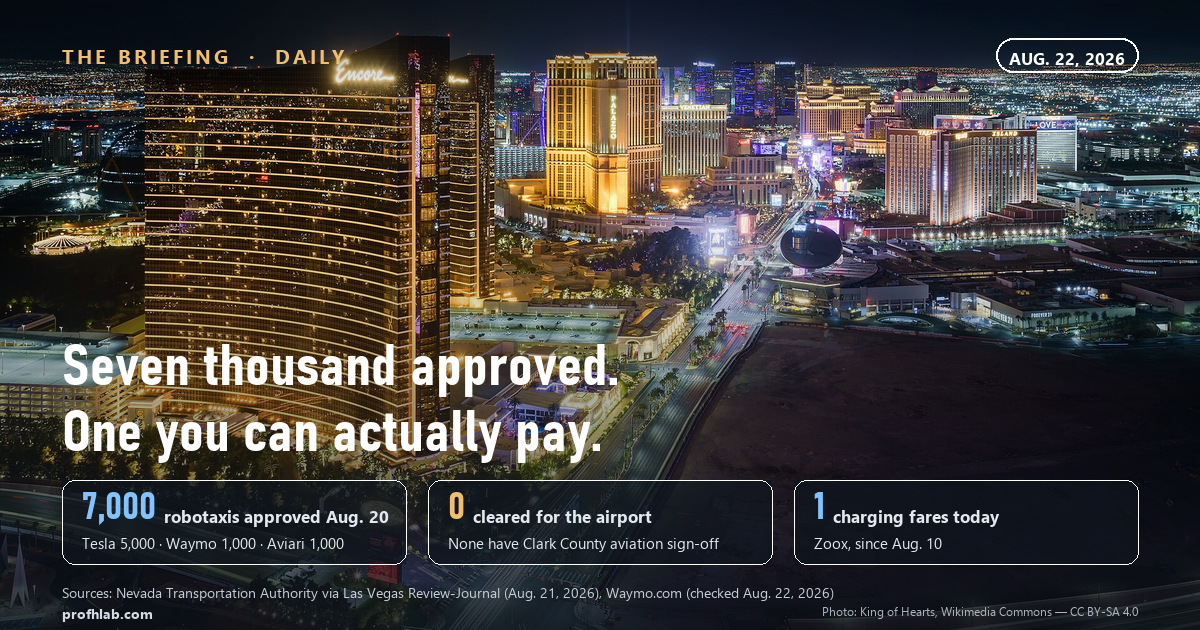
The Nevada Transportation Authority voted Thursday, August 20, to let three companies run autonomous vehicles for hire in Clark County. The Las Vegas Review-Journal reported the ceilings: Tesla up to 5,000 vehicles, Waymo up to 1,000, and Aviari — a ride-hailing company owned by Uber — up to 1,000.
That is 7,000. You may have seen 8,000. The difference is Amazon’s Zoox, which holds a separate, earlier permit for 100 vehicles and was not part of this vote; add it and the arithmetic gives 7,100, not 8,000. It is a small thing, but it is the first sign of how loosely this story has been handled.
The approval came with conditions that tell you more than the headline number does. Each company must file vehicle inspection documents, carry insurance, hand over its customer-facing app information for regulatory review, and — this is the important one — submit its rates to the Authority before it may carry a paying passenger.
“Nevada has established a regulatory framework for autonomous vehicle network companies that is intended to provide a clear process for innovation while maintaining regulatory oversight,” said Kristopher Sanchez, director of the Nevada Department of Business and Industry.
Read that condition list again. A company that has not yet filed a rate sheet is a company that cannot legally charge you tomorrow. Permission to operate arrived before the paperwork that makes operating possible.
Can you take a robotaxi from the Las Vegas airport?
No. Not from any of them, as of August 22, 2026.
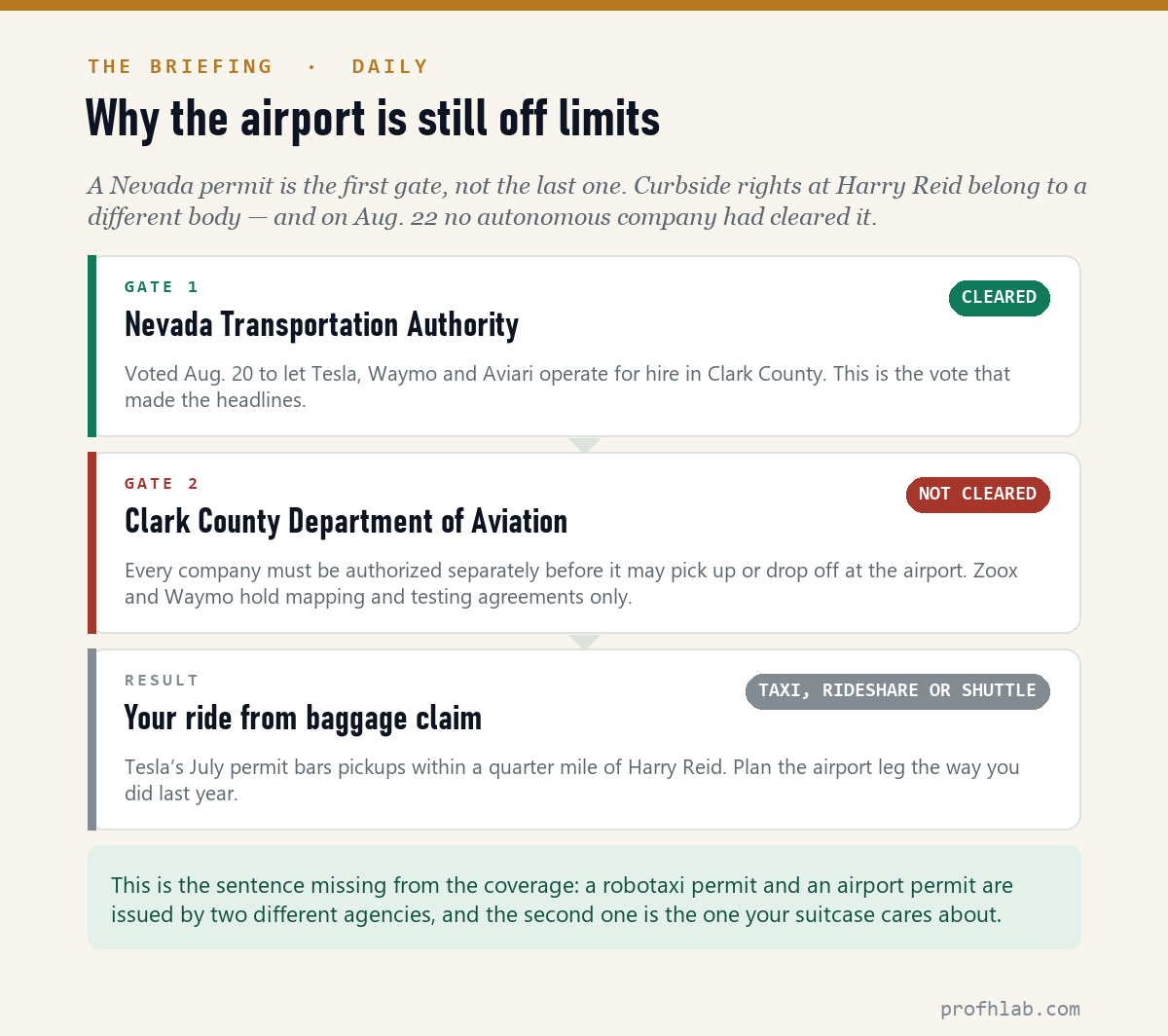
This is where nearly every write-up of the August 20 vote goes wrong, and the reason is structural: a robotaxi permit and an airport permit come from two different agencies.
The Nevada Transportation Authority decides who may operate for hire on Clark County roads. The Clark County Department of Aviation decides who may work the curb at Harry Reid International. Clearing the first does nothing for the second. The Review-Journal put it plainly: all three companies may eventually operate to and from the airport, but each must be authorized by the Department of Aviation first — and no autonomous vehicle company currently has approval to provide commercial rides there. Zoox and Waymo hold mapping and testing agreements only.
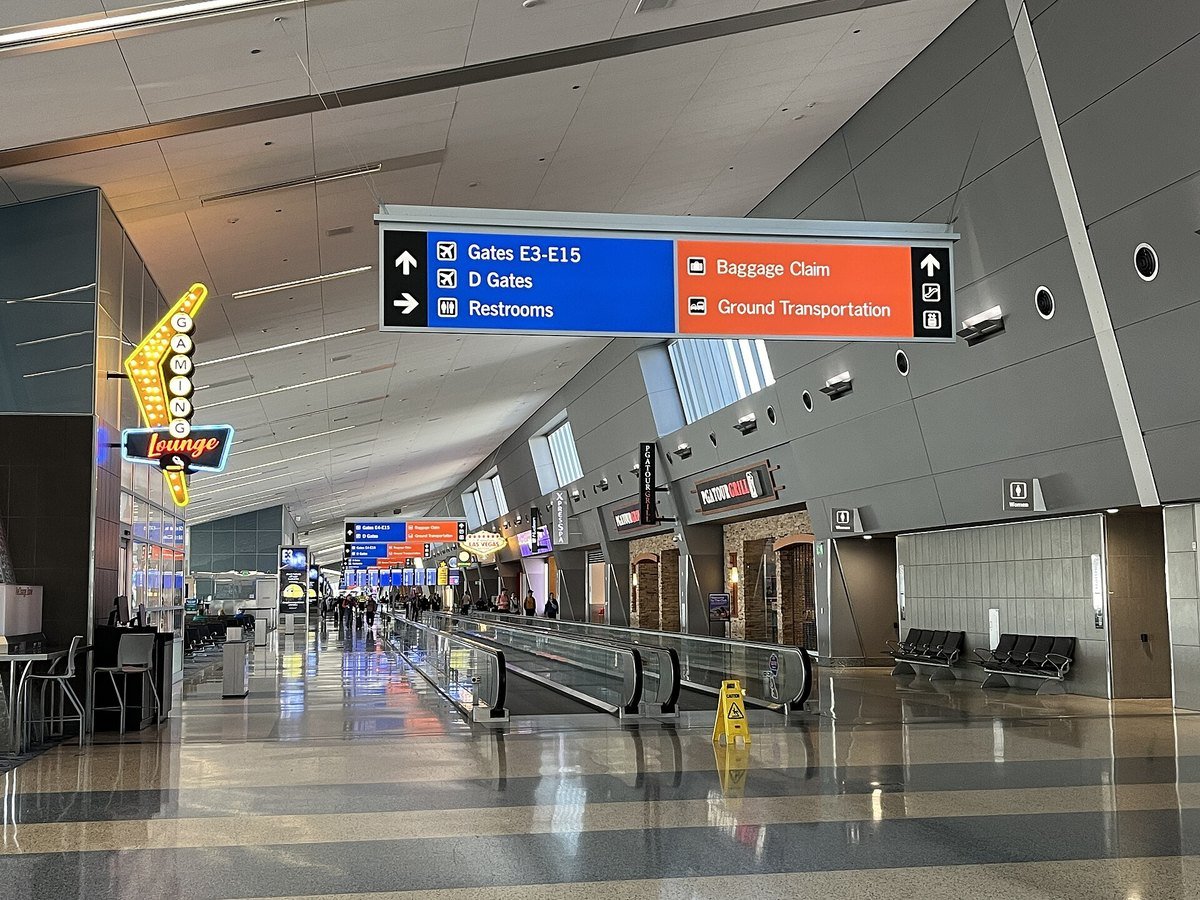
Tesla’s position is stricter still. The permit the Authority issued on July 27 explicitly prohibits passenger pickups within a quarter mile of the airport, and requires authorization from the airport operator before that changes.
Zoox has been closest to the curb the longest: the Review-Journal reported in March that the company had been running rides to Harry Reid for about a year using retrofitted Toyota Highlanders, with its purpose-built robotaxis due to begin airport testing. Testing is not service. A year of it has not yet produced a public airport pickup.
What you can actually ride today — and what it costs
One service is carrying paying passengers in Las Vegas right now, and it is the one with the smallest permit: Zoox, owned by Amazon.
Zoox began charging fares on August 10, 2026. That date matters beyond Nevada — it made Zoox the first company in the United States to collect a fare in a vehicle with no steering wheel, no pedals and no mirrors. It could do that because the National Highway Traffic Safety Administration granted it a commercial exemption effective the same day, covering eight federal motor vehicle safety standards, running two years, and permitting up to 2,500 vehicles.
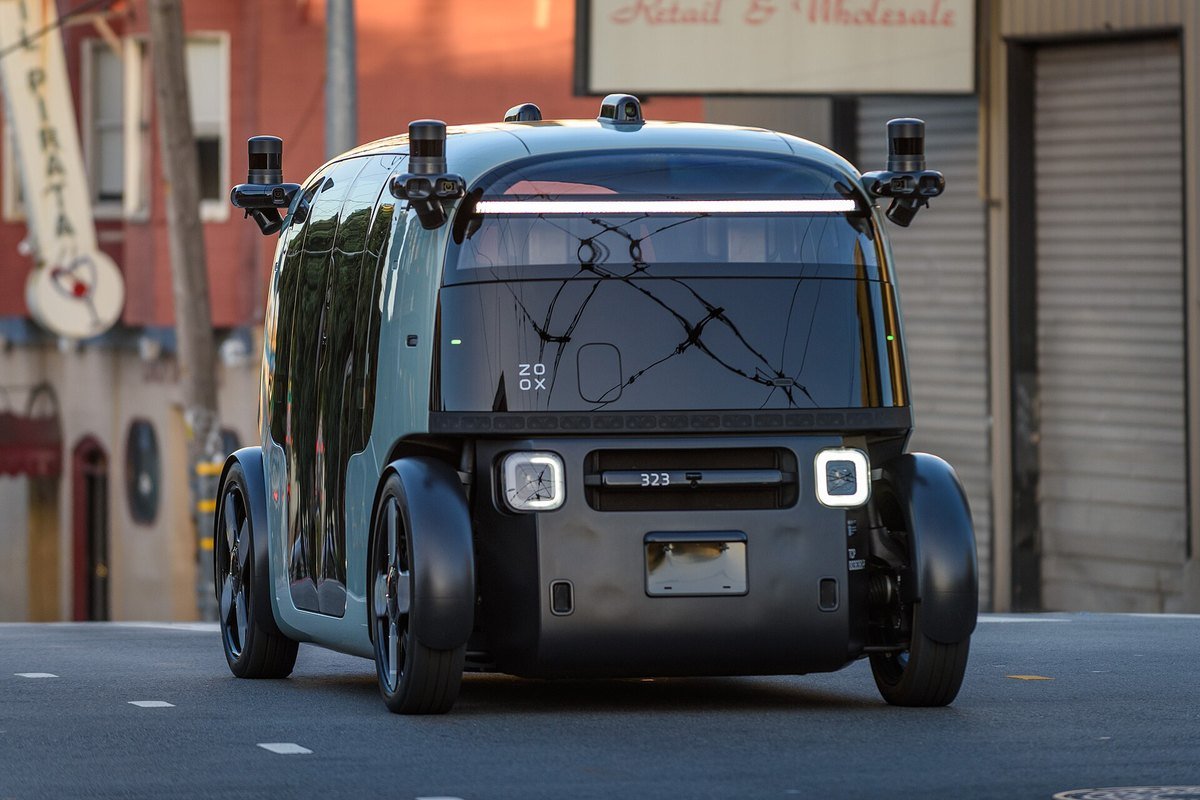
How the fare works. Zoox prices from a base fare plus distance and time. You see the full price before you book, and the company says the price does not rise if the vehicle takes a longer route than planned — the risk of a bad route sits with Zoox, not with you. Reporting around the launch placed the pricing in ride-hailing’s “comfort” tier, roughly 20 to 40 percent above a standard UberX fare. Location fees may be added at high-traffic destinations such as the Sphere and T-Mobile Arena, plus applicable taxes.
There is a detail in that fare card worth pausing on: it also lists a possible destination fee for the airport. The pricing is ready for a trip the authorization does not yet permit. That is a company waiting on a gate, not a service you can book.
The part almost nobody mentions: it is not door-to-door.
Zoox runs between a fixed set of pickup and drop-off points, not to any address you type. The Review-Journal reported stops at Resorts World, Topgolf, New York-New York, Excalibur and Area15, with expansion to the Sphere, T-Mobile Arena, the Las Vegas Convention Center and most Strip resorts. Riders through mid-2026 counted roughly fifteen. The vehicles also avoid Las Vegas Boulevard itself, using parallel side streets — efficient, but not the scenic Strip cruise people picture. Check the current stop list in the app before you plan around it.
By March 2026 the service had carried about 350,000 passengers since launching the previous year, according to the Review-Journal — a real service at a small scale, which is a fair description of the entire Las Vegas robotaxi market today.
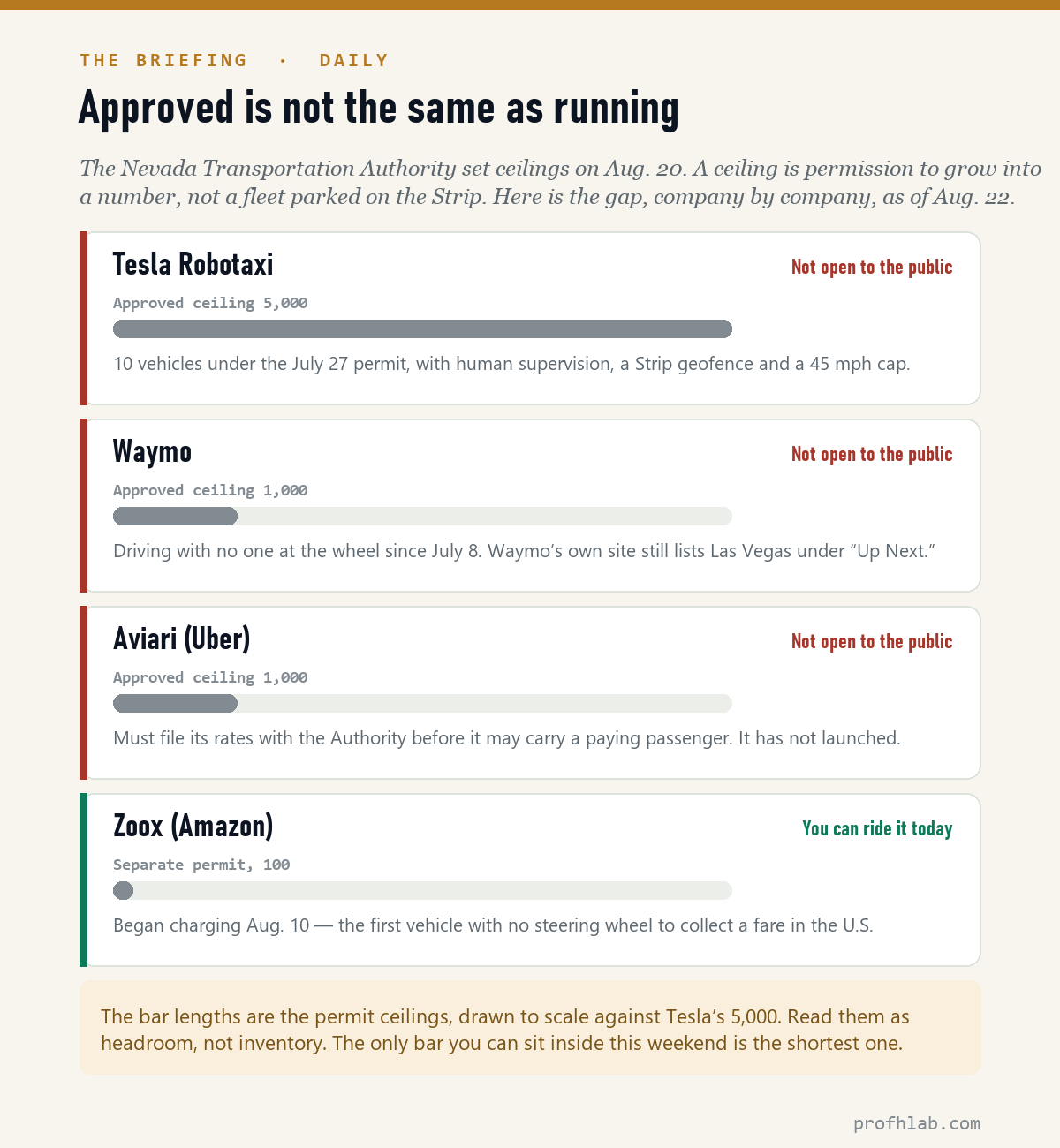
Approved versus running, company by company
| Company | Approved ceiling | Can you ride it? | Where it actually stands |
|---|---|---|---|
| Zoox (Amazon) | 100 (separate permit) | Yes — paid | Charging since Aug. 10 under a two-year NHTSA exemption. Fixed Strip stops, no airport. |
| Tesla | 5,000 | No | July 27 permit allows 10 vehicles with human supervision, a Strip geofence and a 45 mph cap. |
| Waymo | 1,000 | No | Driving with no one at the wheel since July 8. Waymo’s own site lists Las Vegas under “Up Next.” |
| Aviari (Uber) | 1,000 | No | Must file rates with the Authority before carrying a paying passenger. Not launched. |
Waymo’s case is the cleanest test of the gap between a permit and a product. Its cars have been driving the valley with nobody in the driver’s seat since July 8. It holds approval for a thousand vehicles. And its own website — the single most authoritative source on whether you can hail a Waymo — still files Las Vegas under Up Next. We checked on August 22. When a company will not claim it is open, it is not open.
How Tesla went from 10 vehicles to 5,000 in three weeks
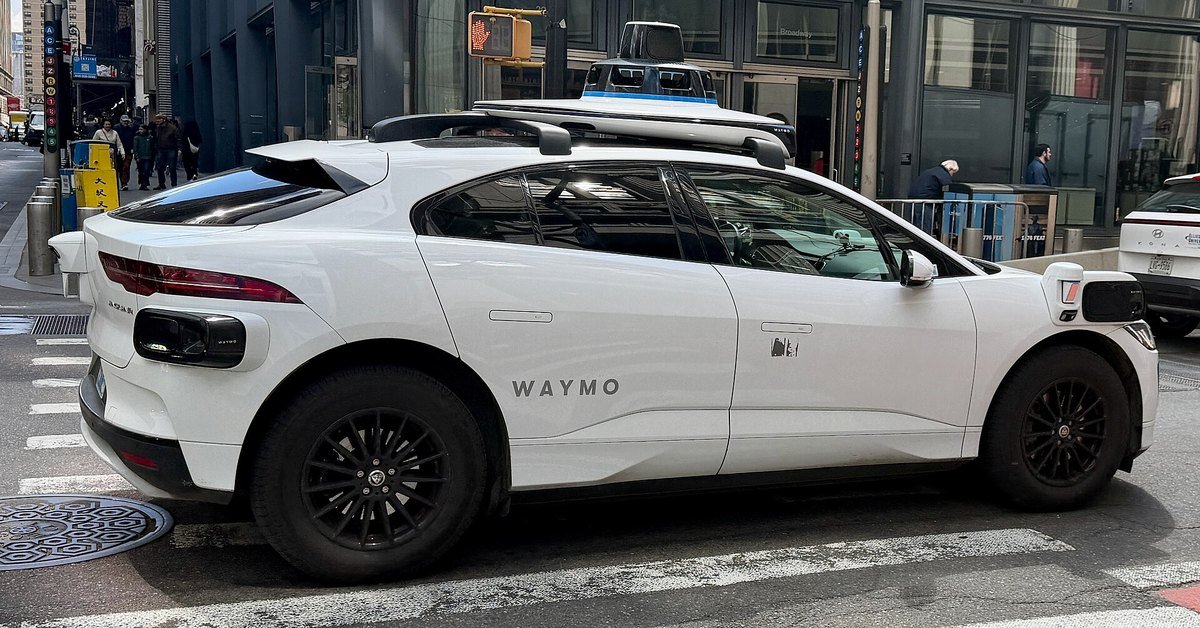
Tesla asked Nevada in June for authority to run up to 5,000 robotaxis across Clark County in the first twelve months. On July 27 the Authority granted it ten.
Not ten thousand. Ten. Along with a geofence confining it to an approved corridor of the Strip, a 45 mph speed ceiling, a ban on pickups within a quarter mile of the airport, a requirement that every vehicle be marked “Robotaxi,” a requirement that riders be told before each trip that they are in a driverless vehicle, and a requirement for appropriate human supervision.
Three weeks later the ceiling became 5,000. The reversal reads dramatically, but the company itself has been the most sober voice about it. Eric Early, chief engineer on Tesla’s Cybercab, told reporters that “the 5,000 has always been a ceiling for us,” and put the realistic one-year target at around 2,500 — citing non-technical constraints rather than the software.
The honest limit of this article. Ceilings are not fleets, and none of these companies has published a deployment schedule. We do not know how many vehicles will actually be on the road in six months, and anyone who tells you a number is guessing. What we can tell you is what is authorized today and what is bookable today — and those are two different lists. This is reporting on a transportation service, not investment advice about any of the companies named.
Book the airport leg as usual, and check Zoox’s stop map
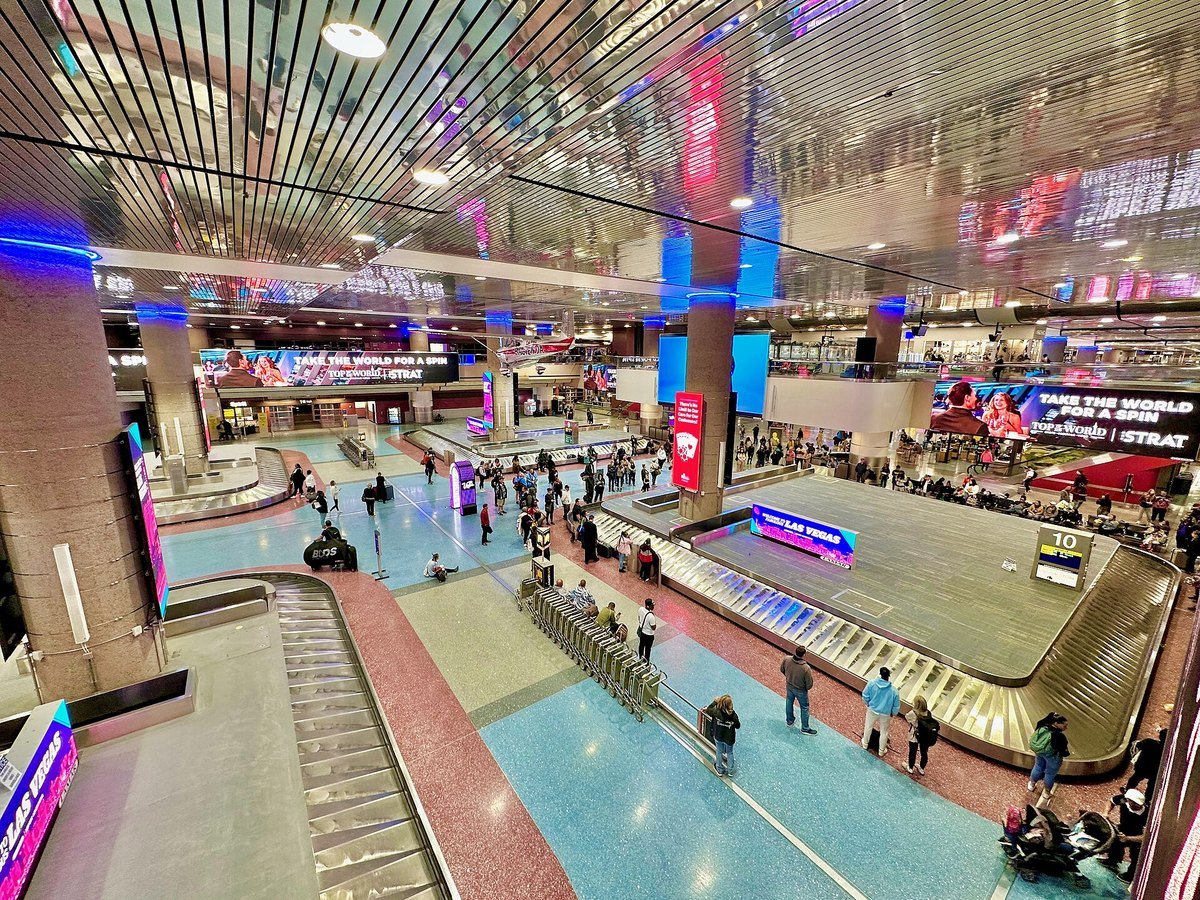
- Plan the airport leg the way you did last year. Taxi, rideshare, shuttle or a rental. No robotaxi will meet you at Harry Reid on this trip. Follow the Ground Transportation signs to the same hall as always.
- If you want to ride one, ride Zoox — and check the map first. It is the only paid service running. Because it works between fixed points rather than street addresses, confirm your hotel is a stop before you build an evening around it.
- Look at the price before you tap. The full fare is shown up front, and it does not go up if the route runs long. Compare it against a standard rideshare quote for the same trip; reporting around launch put Zoox roughly 20 to 40 percent above UberX.
- Be careful what you download. A hyped service that most people cannot actually book is exactly the gap fake apps and lookalike “booking” sites move into. Install only from the official app store listing, and never pay a “reservation fee” to hold a robotaxi ride — no legitimate service charges one. If that pattern feels familiar, it is the same one we mapped in our guide to AI-era scams.
- Watch one date. The next thing that would genuinely change your trip is a Clark County Department of Aviation authorization. Not another Transportation Authority vote — that gate is already open.
Two short videos worth your time
A federal exemption, not the software, set Zoox’s start date
Why does a car with no steering wheel need special federal permission? Federal motor vehicle safety standards were written assuming a human driver — they require things like mirrors and controls within reach of a driver’s seat. A vehicle without those cannot comply, so it needs an exemption. NHTSA granted Zoox one covering eight standards for two years, capped at 2,500 vehicles. The exemption, not the software, is what set the August 10 date.
Is the technology actually ready, or is this all paperwork? The two questions are genuinely separate, which is the confusing part. Waymo is driving the Las Vegas valley with nobody at the wheel and still is not selling rides. If you want the plain-English version of how these systems perceive and plan, we wrote Physical AI Explained — the same class of system, without the math.
What about the Tesla side of self-driving, as a consumer purchase? Different product, different money. A robotaxi you hail and a driver-assistance subscription you buy for your own car are not the same thing, and the costs work out very differently — we ran those numbers in the FSD subscription math.
Airport pickups, fares and Waymo: where Las Vegas stands
Can you take a robotaxi from the Las Vegas airport?
No. As of August 22, 2026, no autonomous vehicle company holds Clark County Department of Aviation approval for commercial rides at Harry Reid International Airport. The Nevada Transportation Authority’s August 20 vote covers Clark County roads, not airport curb access — those are two separate authorizations. Tesla’s permit additionally bars pickups within a quarter mile of the airport.
What robotaxi can I actually ride in Las Vegas right now?
Zoox, owned by Amazon. It began charging fares on August 10, 2026 and is the only service in Las Vegas currently carrying paying passengers. Tesla, Waymo and Aviari hold permits but have not opened to the public.
How much does a robotaxi cost in Las Vegas?
Zoox prices from a base fare plus distance and time, and shows the full price before you book. Reporting around the August launch placed it in ride-hailing’s comfort tier, roughly 20 to 40 percent above a standard UberX fare. Location fees may apply at destinations such as the Sphere and T-Mobile Arena, plus taxes. The fare does not increase if the vehicle takes a longer route than planned.
Is the Las Vegas robotaxi still free?
No. Zoox rides were free during its earlier public phase, but the company began charging on August 10, 2026. Guides and articles written before that date describing free rides are out of date.
How many robotaxis did Nevada approve?
The Nevada Transportation Authority approved ceilings totaling 7,000 on August 20, 2026: Tesla up to 5,000, Waymo up to 1,000 and Aviari, an Uber-owned company, up to 1,000. Zoox’s 100-vehicle permit is separate and was not part of that vote. Some coverage reported 8,000; the named permits add to 7,000, or 7,100 counting Zoox.
Is Waymo available in Las Vegas?
Not to the public yet. Waymo has been operating with no human at the wheel in the Las Vegas valley since July 8, 2026 and holds a permit for up to 1,000 vehicles, but its own website still lists Las Vegas under “Up Next” rather than as a live service, as of August 22, 2026.
Does the Zoox robotaxi pick you up anywhere on the Strip?
No. Zoox operates between a fixed set of pickup and drop-off points rather than any address you enter. Reported stops include Resorts World, Topgolf, New York-New York, Excalibur and Area15, with expansion to the Sphere, T-Mobile Arena and the Las Vegas Convention Center. The vehicles generally use side streets rather than Las Vegas Boulevard itself.
When will robotaxis serve the Las Vegas airport?
No date has been announced. Each company must be authorized separately by the Clark County Department of Aviation. Zoox and Waymo currently hold mapping and testing agreements at Harry Reid, and Zoox has run test trips there, but testing is not commercial service.
Sources
- Las Vegas Review-Journal, “Tesla, Waymo and Aviari cleared to deploy 7,000 Las Vegas robotaxis” (Aug. 21, 2026) — permit ceilings, airport authorization requirement, rate-filing condition, Sanchez quote.
- TechCrunch, “Tesla, Uber, and Waymo all get the OK to operate thousands of robotaxis in Nevada” (Aug. 20, 2026) — vote details, Eric Early comments.
- Electrek, “Nevada caps Tesla’s Vegas ‘Robotaxi’ fleet at 10” (Aug. 17, 2026) and Fortune (Aug. 19, 2026) — July 27 permit conditions, quarter-mile airport restriction, 45 mph cap.
- TechCrunch, “Zoox to start charging for robotaxi rides in Las Vegas” (Aug. 5, 2026) — fare structure, NHTSA exemption terms.
- Las Vegas Review-Journal (Mar. 24, 2026) — Zoox stop locations, airport testing with retrofitted vehicles, 350,000 passengers.
- Waymo.com service page — Las Vegas listed under “Up Next,” checked Aug. 22, 2026.
Written by Prof. H, who teaches robotics and AI. Every figure above was checked against the linked source on August 22, 2026. Permits and service areas change; the dates are there so you can tell how fresh this is when you find it.
Before you download a ride app: the fake-app pattern and FSD math
- Physical AI Explained — how a machine that moves in the world is different from a chatbot.
- The Tesla FSD subscription math — what driver assistance costs when you own the car.
- AI-era scams and how to spot them — including the fake-app pattern that follows every hyped launch.
Prof.’s H Newsletter
One short email a month, with the numbers in it
What actually moved in AI hiring, AI prices, and the scams aimed at older Americans. Counted here, dated, and linked to the source. One email a month, and your address goes nowhere else.