How to Get a Job at OpenAI or Anthropic: What 1,268 Open Postings Actually Say
Bloomberg reported this spring that candidates were paying private coaches $4,600 to prepare for an Anthropic interview. That same week, Anthropic had a page on its own website telling anyone who asked exactly when they may and may not use AI on the application — free, dated, and linked from every single job it had open.
Both things are true, and the gap between them is this article.
On August 23, 2026 we read every open posting at both companies: 750 at OpenAI, 518 at Anthropic, 1,268 in total, straight from the job-board feeds they publish. Then we read the careers pages, the interview guide, the fellowship posting and the residency page. Almost nothing in this article is advice. It is a transcript of what the two employers already tell you, plus the numbers that fall out when you count.
How we counted
Every number below comes from the companies’ own systems, read on August 23, 2026: OpenAI’s public job-board feed (750 roles), Anthropic’s (518), anthropic.com/candidate-ai-guidance, openai.com/interview-guide, and openai.com/residency. Postings change daily. Where we quote a rule, we quote it in the company’s words.
Six steps, from the AI-use rule to the scam warning
- Step 1 — Read the AI rule before you write anything
- Step 2 — Check which entry door is open this month
- Step 3 — Read the fine print that repeats on every posting
- Step 4 — Aim where the openings are
- Step 5 — Know the clock before you start
- Step 6 — The scam warning they print for you
- Questions people actually search
Step 1 — Read the AI rule before you write anything
This is the question everybody whispers and nobody looks up: am I allowed to use AI on an application to an AI company?
Anthropic answers it in public, stage by stage. The policy page is dated July 10, 2025, and a link to it appears in all 518 of its open postings under the heading “Guidance on Candidates’ AI Usage.” The short version, in their words:
- Resume and application questions: “Please create your first draft yourself, then use Claude to refine it.”
- Take-home assessments: “Complete these without Claude unless we indicate otherwise.” They add that they will be explicit when it is allowed.
- Interview prep: encouraged — research the company, practise answers, build a study guide.
- Live interviews: “This is all you–no AI assistance unless we indicate otherwise.”
The page even draws the line between the encouraged version and the forbidden one. Encouraged: “Help me think of ways to quantify the impact of the platform migration that I led.” Not allowed: “Write my answers to the application questions for an AI safety researcher position at Anthropic.” The difference is not the tool. It is whether the experience is yours.
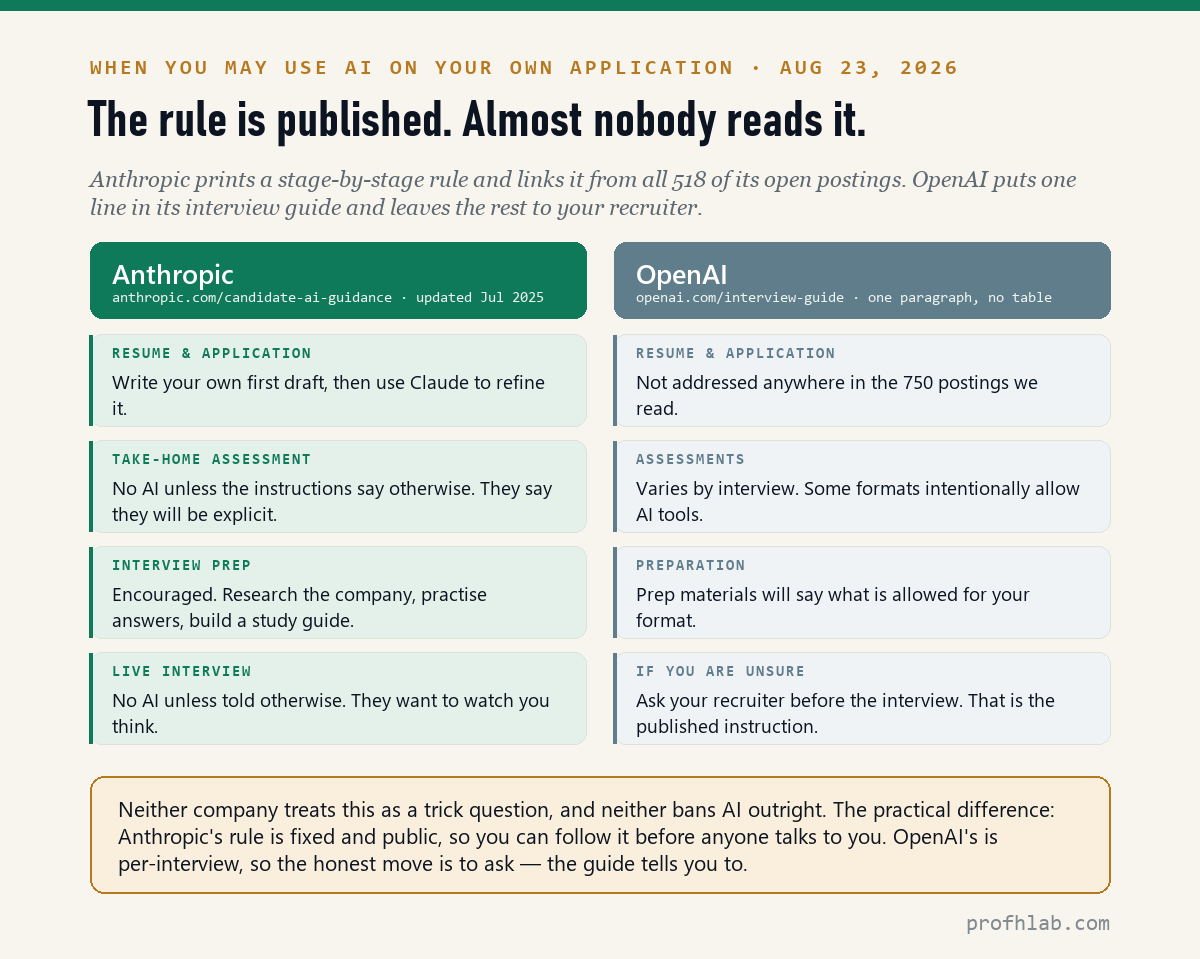
OpenAI handles it differently, and it took reading 750 postings to be sure: the subject does not appear in the postings at all. It appears once, in the interview guide, and it is deliberately not a fixed rule:
“Expectations for AI and other tools vary by interview: some formats intentionally allow them, while others are designed to assess your independent problem-solving without AI tools. We’ll explain what is allowed in your interview preparation materials. If you’re unsure, please ask your recruiter before the interview.”
So the practical instruction for OpenAI is the one they wrote themselves: ask. That is not a trap and it is not a test of nerve. A candidate who emails a recruiter asking which tools are permitted in a specific assessment is behaving exactly as the published guide asks.
The rule that covers both: draft it yourself, polish with the model, and never let it invent an experience you did not have.
Step 2 — Check which entry door is open this month
If you have no frontier-lab experience, there are two named on-ramps. Today, one is open and one is shut — and most of the guides ranking on this search do not say which.
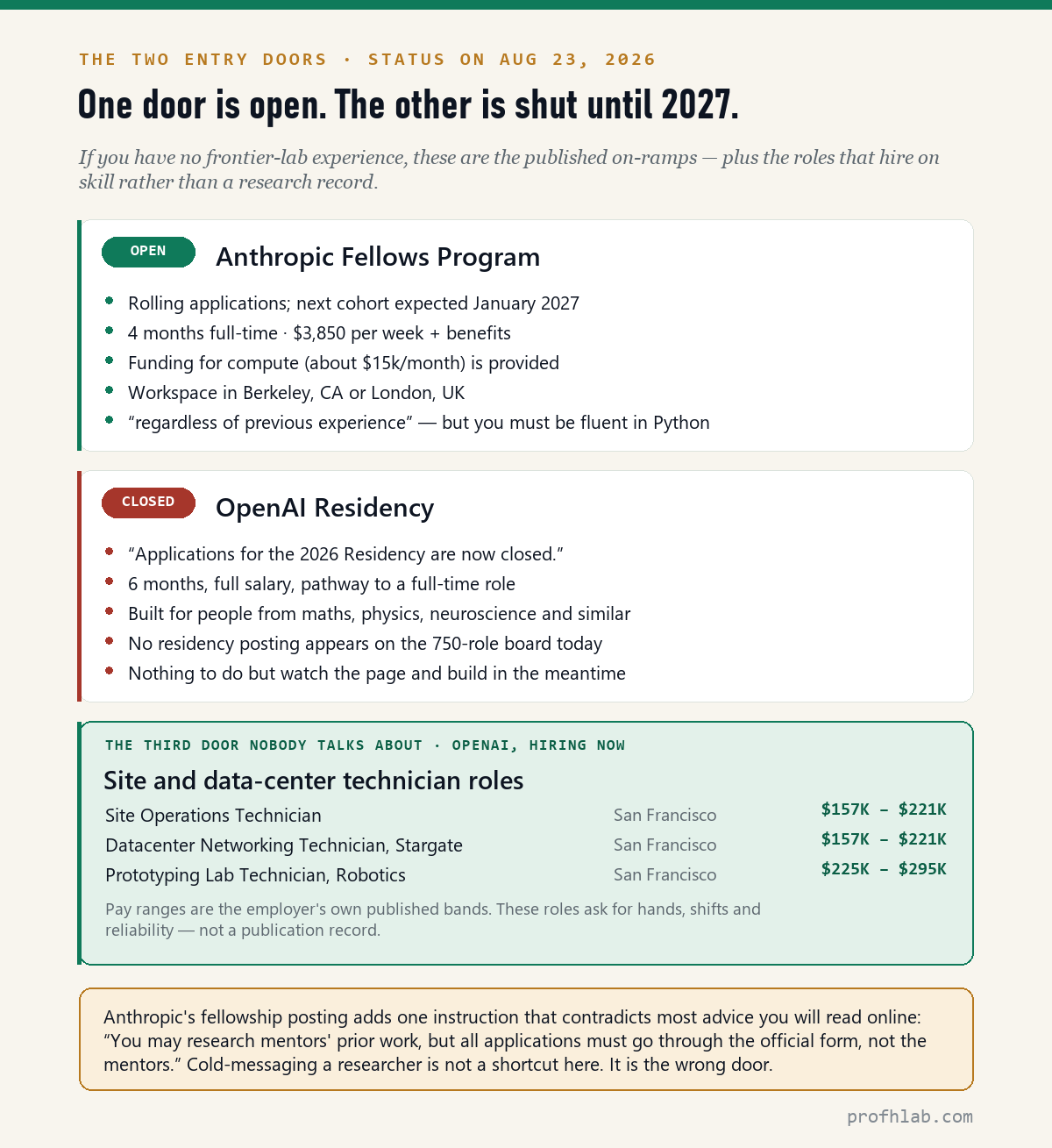
The Anthropic Fellows Program is open, on a rolling basis, for a cohort the posting says is “expected to start in January 2027.” The posting is unusually concrete: four months full-time, a stipend of $3,850 per week plus benefits, funding for compute of roughly $15,000 a month, a shared workspace in Berkeley or London, and mentorship from named Anthropic researchers.
It says it provides funding and mentorship “regardless of previous experience” — while also stating a hard floor: candidates must be “fluent in Python programming” and available full-time. In one earlier cohort, the posting says, over 80% of fellows produced papers.
The OpenAI Residency is closed. The program page says plainly: “Applications for the 2026 Residency are now closed.” It is a six-month program that pays a full salary and is aimed at people from adjacent fields — mathematics, physics, neuroscience — and no residency role appears anywhere on the 750-posting board today. If that is your route, the only honest move is to build something in the open and watch the page.
There is a third door that almost no career guide mentions, because it does not look glamorous: the people who keep the compute running. OpenAI is hiring site and data-center technicians in San Francisco with published bands starting at $157,000. These roles ask for hands, shifts and reliability rather than a publication record.

Roles you can apply to today
| Company | Role | Location | Published band | Posted | Apply |
|---|---|---|---|---|---|
| Anthropic | Anthropic Fellows Program | Berkeley / London | $3,850 / week | Rolling | Posting |
| Anthropic | Fellows — ML Systems & Reinforcement Learning | Berkeley / London | $3,850 / week | Rolling | Posting |
| Anthropic | Fellows — Economics & Policy | Berkeley / London | $3,850 / week | Rolling | Posting |
| OpenAI | Site Operations Technician | San Francisco | $157K – $221K | Jul 21, 2026 | Posting |
| OpenAI | Datacenter Networking Technician (Stargate) | San Francisco | $157K – $221K | Sep 23, 2025 | Posting |
| OpenAI | Prototyping Lab Technician, Robotics | San Francisco | $225K – $295K | Jun 24, 2026 | Posting |
Links go to the employer’s own board. All six were live when we checked on August 23, 2026.
The instruction that contradicts most advice online. Anthropic’s fellowship posting names its mentors, then says: “You may research mentors’ prior work, but all applications must go through the official form, not the mentors.” Cold-messaging a researcher is not a clever shortcut here. It is the wrong door, and the posting says so.
Step 3 — Read the fine print that repeats on every posting
Almost every applicant reads the responsibilities and skips the block at the bottom. That block is the part that decides whether you can actually take the job.
| What it decides | Anthropic — on all 518 postings | OpenAI — from the postings we read |
|---|---|---|
| Minimum education | “Bachelor’s degree or an equivalent combination of education, training, and/or experience” | Not stated as a company-wide rule; 59 of 750 postings mention a degree at all, usually as “or equivalent practical experience” |
| Field of study | “A field relevant to the role as demonstrated through coursework, training, or professional experience” | Role by role |
| Years of experience | “Years of experience required will correlate with the internal job level requirements for the position” | Role by role |
| Office time | “we expect all staff to be in one of our offices at least 25% of the time” | “a hybrid work model of 3 days in the office per week” — on 265 postings; a handful say 4 or 5 days |
| Relocation | Not stated in the standard block | “offer relocation assistance to new employees” — on 304 postings |
| Visas | “We do sponsor visas! However, we aren’t able to successfully sponsor visas for every role and every candidate” — plus “we retain an immigration lawyer to help with this” | No sponsorship statement appears in the standard posting text |
| Records | Standard equal-opportunity language | All 750 postings carry Fair Chance language: applicants with arrest or conviction records will be considered |
Two of those rows are worth stopping on.
The first is the degree line. Anthropic’s floor is a bachelor’s degree or an equivalent combination of education, training, and/or experience — the “or” is doing real work, and it is printed on every posting rather than buried in an FAQ. At OpenAI, most postings simply never mention a degree; the interview guide says outright, “We are not credential-driven.”
The second is office time, because it is the row that quietly rules people out. “At least 25% of the time” and “3 days in the office per week” are very different lives. One is compatible with living elsewhere and travelling. The other is a move.
Step 4 — Aim where the openings are, not where the headlines are
Here is the number that surprised us most. Of 1,268 open roles, exactly 134 are research jobs — 67 at each company. That is one opening in ten.
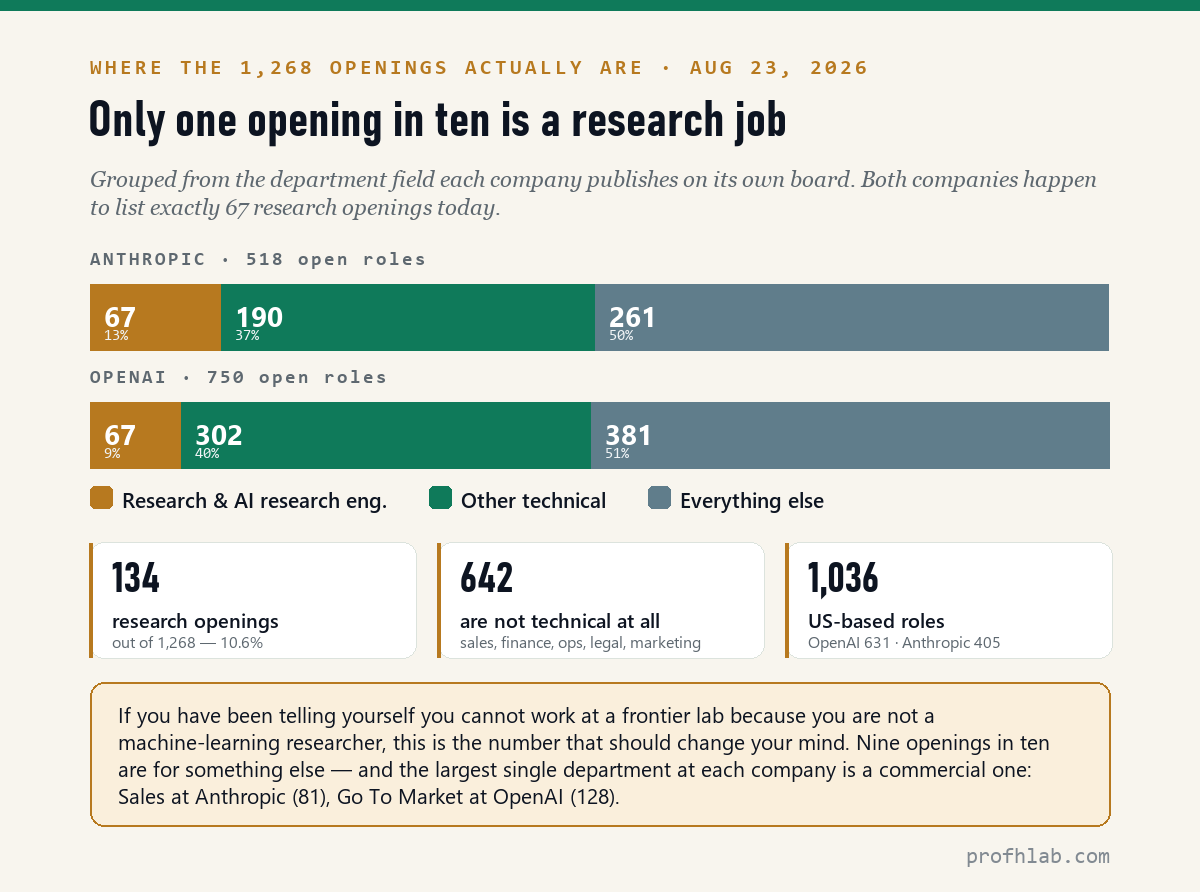
The largest single department at each company is a commercial one: Sales at Anthropic (81 openings) and Go To Market at OpenAI (128). Add finance, legal, marketing, support and operations and you get 642 roles — half of everything open — that ask for no engineering at all.
This is not a consolation prize. It is where the hiring is. If you have spent ten years in enterprise sales, in accounting, in trust and safety, in technical program management, the frontier labs currently have more open seats for you than for machine-learning researchers.
Geography narrows it again. 543 of OpenAI’s 750 postings list San Francisco. Anthropic spreads across San Francisco, New York and Seattle, usually as a choice of two or three. If you cannot be in those cities at least a quarter of the time, filter for the roles marked remote before you spend an evening on a cover letter.

Pay, for the record, is published by law in several states and both companies print it. Across US postings that include a band, the median low figure is $305,000 at Anthropic and $239,000 at OpenAI; the median high figures are $405,000 and $360,000. Those medians sit high because the roles skew senior — the lowest bands we found start at $116,480 and $108,000.
Step 5 — Know the clock before you start
OpenAI publishes its timeline. Anthropic publishes its stages. Neither is a secret, and knowing both stops you from reading silence as rejection.
| Stage | OpenAI — as published in the interview guide | Anthropic — Fellows Program posting |
|---|---|---|
| 1. Application | Résumé review takes the recruiting team about one week | Initial application and reference check |
| 2. First call | Conversation with a recruiter or hiring manager | — |
| 3. Assessment | Pair coding, take-home or technical test; result within a week; more than one is possible | Technical assessments and interviews |
| 4. Final round | 4–6 hours with 4–6 people over 1–2 days, virtual by default, San Francisco onsite optional | Research discussion |
| 5. Decision | Within one week of the final interviews; references may be requested then | Rolling review |
OpenAI’s guide also names its recommended reading, which is as close to an answer key as a hiring page gets: the OpenAI Charter, the research index, the blog, plus the Deep Learning Book and Spinning Up in Deep RL for technical roles. Anthropic’s postings point the same way — “The easiest way to understand our research directions is to read our recent research.”
Both companies told you what to read. Reading it is the cheapest edge available in this process.
Step 6 — The scam warning they print for you
Every one of Anthropic’s 518 postings carries this line, and it is worth memorising because the fake version of this job market is enormous:
“Anthropic recruiters only contact you from @anthropic.com email addresses.”
The posting adds that vetted agencies may identify themselves as working on behalf of Anthropic, and to be cautious of any other domain. Apply that rule to both companies and to every AI job you see this year. Nobody legitimate asks a candidate for money, for a cheque to be deposited and partly wired back, or for onboarding to happen entirely over a messaging app. If you want the full pattern, we wrote it up in our guide to AI-era scams.
What we got wrong when we started
We began this expecting to find that Anthropic, the safety company, would be the strict one about AI in applications and OpenAI the permissive one. The opposite is closer to true. Anthropic invites you to use Claude on your résumé and your prep, and only draws the line at assessments and live interviews. OpenAI does not tell you anything about the application stage at all; it hands the decision to the interview format and to your recruiter.
We also expected the boards to be dominated by research. They are not — 89% of what is open is something else. The mental model to drop is “frontier lab equals research lab.” As an employer, in August 2026, a frontier lab looks much more like a fast-growing enterprise software company that happens to run enormous data centers.
Read both employers’ guides, then the office and visa lines
- Before you write a word: open Anthropic’s AI guidance and OpenAI’s interview guide. Fifteen minutes, both.
- Draft your résumé yourself, then ask a model to help you quantify what you did — not to describe work you did not do.
- Scroll to the Logistics block on any Anthropic posting and to the hybrid line on any OpenAI posting before you apply. Office days and visa sponsorship are the two facts that end applications late.
- Filter by department, not by dream. Sales, finance, operations, support and trust & safety have far more open seats than research.
- If you are early-career: the Anthropic Fellows Program is accepting applications now for a January 2027 cohort. The OpenAI Residency is closed for 2026 — check the page rather than a blog post.
- Apply through the official form. Not through a mentor’s inbox.
What interview coaches teach, both companies publish for free
“Should I pay for interview coaching?” That is your call, and we take no position on any coach. What we can say is that the material those sessions are built on — the stages, the timeline, the AI rules, the recommended reading — is published free by both employers, and we have linked all of it above.
“What if I am not going to get one of these 1,268 jobs?” Most people will not; these are two companies. The wider AI job market is much larger and much less concentrated, and we mapped 20 company boards and 3,650 open roles in which AI companies are hiring right now. If you are worried about your current job instead, start with will AI take my job.
“What should I actually learn?” Both companies point at their own research. If the papers are the barrier, our plain-English explainers of the underlying ideas are here, and the tools people build with are here.
The $4,600 interview-coaching market, and Anthropic’s founders
What we are and what we are not
We are not recruiters. We take no money from any employer, and there are no affiliate links in this article. Every posting linked here goes to the employer’s own board and was live on August 23, 2026 — postings close without notice, and the official page always wins. Nobody legitimate will ever ask you to pay to apply.
OpenAI’s 750 roles vs Anthropic’s 518: PhDs, visas, fellowships
Is it harder to get a job at OpenAI or Anthropic?
Neither company publishes an acceptance rate, so anyone quoting one is guessing. What is measurable is the shape of the opportunity: OpenAI has 750 open roles to Anthropic’s 518, and 543 of OpenAI’s are in San Francisco. Both list exactly 67 research openings. If your background is commercial, OpenAI’s Go To Market department alone has 128 openings; if you are early-career and technical, Anthropic currently has an open fellowship and OpenAI does not.
Do you need a PhD to work at OpenAI?
No. OpenAI’s interview guide says, “We are not credential-driven—rather, we want to understand your unique background and what you can contribute.” Only 59 of the 750 postings we read mention a degree at all, and those usually add “or equivalent practical experience.” Individual research roles do ask for a PhD; the company as a whole does not.
Can I use ChatGPT to write my resume for these applications?
For Anthropic, the published rule is that you write the first draft and use AI to refine it — using it to invent experiences is explicitly not allowed. For OpenAI, the postings and interview guide do not address the application stage, but they do say expectations vary by interview format and that you should ask your recruiter if unsure. The safe practice at both: your experience, your first draft, AI for clarity.
Does Anthropic sponsor visas?
Every Anthropic posting contains this: “We do sponsor visas! However, we aren’t able to successfully sponsor visas for every role and every candidate. But if we make you an offer, we will make every reasonable effort to get you a visa, and we retain an immigration lawyer to help with this.” That is a genuine commitment with a genuine caveat, and it is role-specific — ask early. OpenAI’s standard posting text carries no equivalent statement, so ask the recruiter directly. This is general information, not immigration advice.
What is the Anthropic Fellows Program deadline?
There is no single deadline. The posting says applications are reviewed on a rolling basis for a cohort “expected to start in January 2027,” and adds that it can sometimes accommodate fellows starting outside the usual timelines if you note that in your application. Terms as published: four months full-time, $3,850 per week plus benefits, roughly $15,000 a month of compute funding, and a workspace in Berkeley or London.
Is the OpenAI Residency open for 2027?
Not as of August 23, 2026. The residency page states, “Applications for the 2026 Residency are now closed,” and says nothing yet about a 2027 cohort. No residency role appears on OpenAI’s 750-posting board today. Watch the official page rather than secondhand roundups, which have a habit of describing closed programs as open.
How long does the OpenAI hiring process take?
OpenAI publishes its own estimates: about one week for résumé review, a week to hear back after an assessment, final interviews of 4–6 hours with 4–6 people spread over one or two days, and a decision within one week of those finals. Add scheduling and multiple assessments and a typical process runs several weeks rather than several days.
How many days a week do you work in the office at OpenAI?
Three, on most postings. The exact sentence — “We use a hybrid work model of 3 days in the office per week and offer relocation assistance to new employees” — appears on 265 of the 750 postings we read, with a handful specifying four or five days. Anthropic’s rule is looser: “we expect all staff to be in one of our offices at least 25% of the time,” which the postings note may be higher for some roles.
Ask the desk
Looking for something specific — a city, a shift pattern, a career switch, a role that does not need a degree? Tell us and we will go read the boards for you and post the answer.
Next check: the Anthropic Fellows cohort timing and any 2027 OpenAI Residency announcement. We will re-read both pages when the January cohort date gets closer.
Sources: OpenAI and Anthropic public job-board feeds (750 and 518 postings, read Aug. 23, 2026); Anthropic, Guidance on Candidates’ AI Usage (updated Jul. 10, 2025); OpenAI Interview Guide; OpenAI Residency; Anthropic Fellows Program posting.
Prof.’s H Newsletter
One short email a month, with the numbers in it
What actually moved in AI hiring, AI prices, and the scams aimed at older Americans. Counted here, dated, and linked to the source. One email a month, and your address goes nowhere else.