Should I Put ChatGPT on My Resume? We Counted 2,930 AI Job Postings (August 2026)
Yes — but not as the word “ChatGPT” sitting in your skills list. On August 30, 2026 we read all 2,930 US job postings on twenty AI and robotics company boards, and 147 of them contained the word ChatGPT. Drop OpenAI’s own board and that falls to 15 postings out of 2,930 — one half of one percent. The word that appeared most often was not a tool at all. It was communication, in 1,875 postings: 64%.
That is the counted answer. The useful answer is the one underneath it, because 242 of those postings do expect you to use AI in the job — they just never ask for it the way people write it on a résumé. Once you see the sentence pattern employers actually use, the fix to your own résumé takes about ten minutes.
How we counted
On August 30, 2026 we pulled every posting from the public job board of twenty AI and robotics employers through each company’s own Greenhouse or Ashby feed — 3,709 roles worldwide. Of those, 2,930 were US roles carrying a full job description, and those 2,930 are the denominator for every percentage on this page.
We searched the full text of each posting and counted postings, not mentions: a posting that says “Python” nine times counts once. A word can appear anywhere in the posting, including the company’s description of itself, which turns out to matter enormously — see the second chart. We are not recruiters and take no money from any employer named here. Full method on How We Count; daily totals on our AI Jobs Tracker.
We counted brand names first, then the 242 postings
- What happened when we counted the brand names
- What the postings ask for instead
- The 242 postings that really do want AI
- The sentence pattern — and how to copy it
- The entry-level cut: zero out of 75
- What to do with this
- If you want to go deeper
- Questions people actually search
What happened when we counted the brand names
The raw number looks respectable. Across 2,930 US postings, 421 — 14.4% — contained the name of a consumer chatbot: ChatGPT, Claude, Gemini or Copilot. One in seven. On that number alone you would put the tool on your résumé and feel fine about it.
Then we looked at who was doing the naming, and the number fell apart.
Of the 264 postings mentioning Claude, 234 were Anthropic’s own. Of the 147 mentioning ChatGPT, 133 were OpenAI’s. These companies are not asking you to know their chatbot. They are describing the product you would be hired to build. Remove the two boards and the 421 becomes 54 postings — 1.8%.
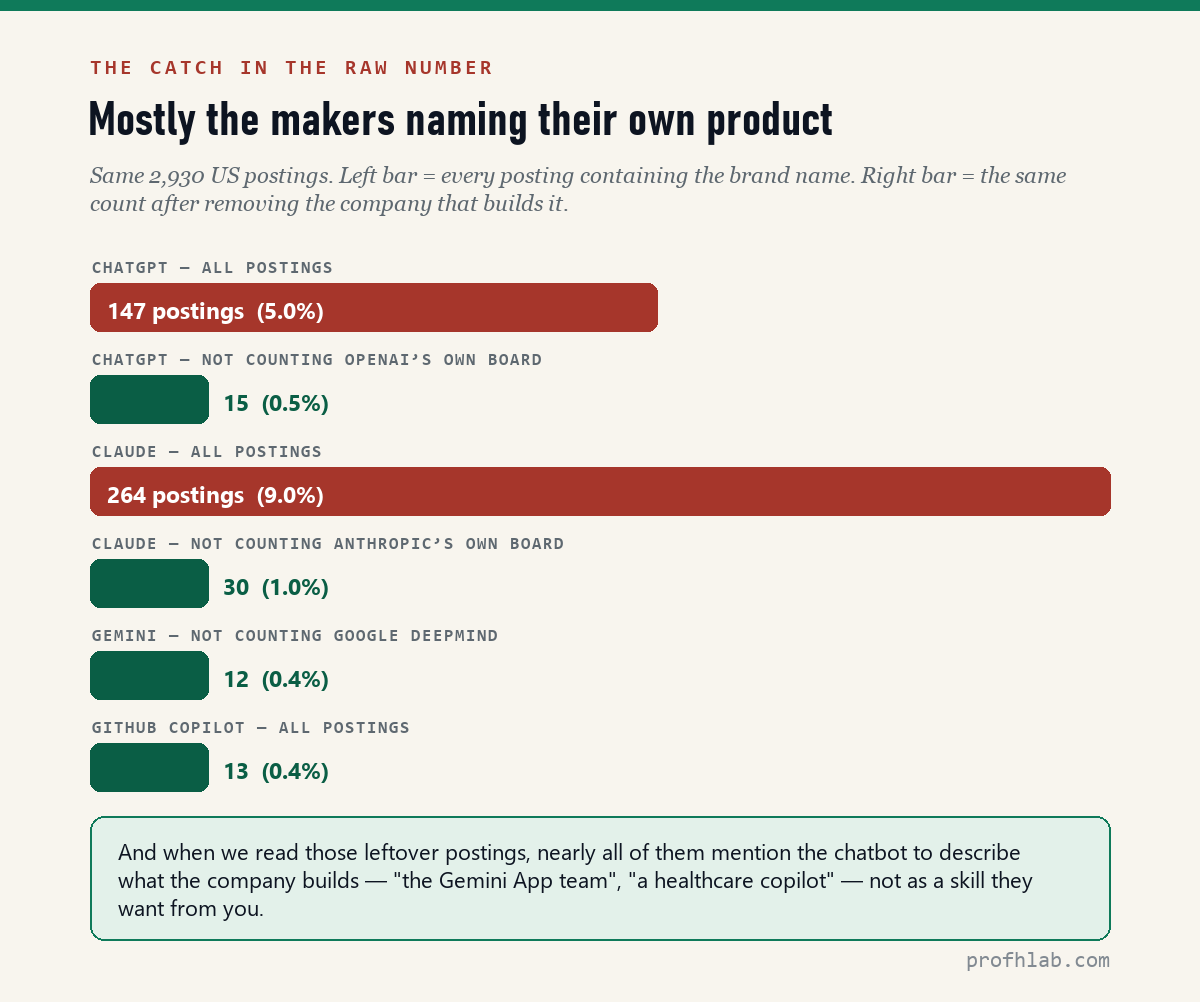
We then read the 54 that were left. Nearly all of them are not skill requirements either. Google DeepMind postings say “the Gemini App team” because that is the team. A Scale AI posting mentions “a healthcare copilot” because that is the product being described. Another explains that reinforcement learning from human feedback “enabled ChatGPT to get such a large headstart.” That is a sentence about industry history, not a line on a job spec.
After that pass, the number of postings on twenty AI company boards that ask a candidate to know ChatGPT by name, as a named skill, rounds to nothing. This is the single most surprising thing we have counted since we started the desk — and it is the opposite of what almost every résumé article on the internet will tell you.

What the postings ask for instead
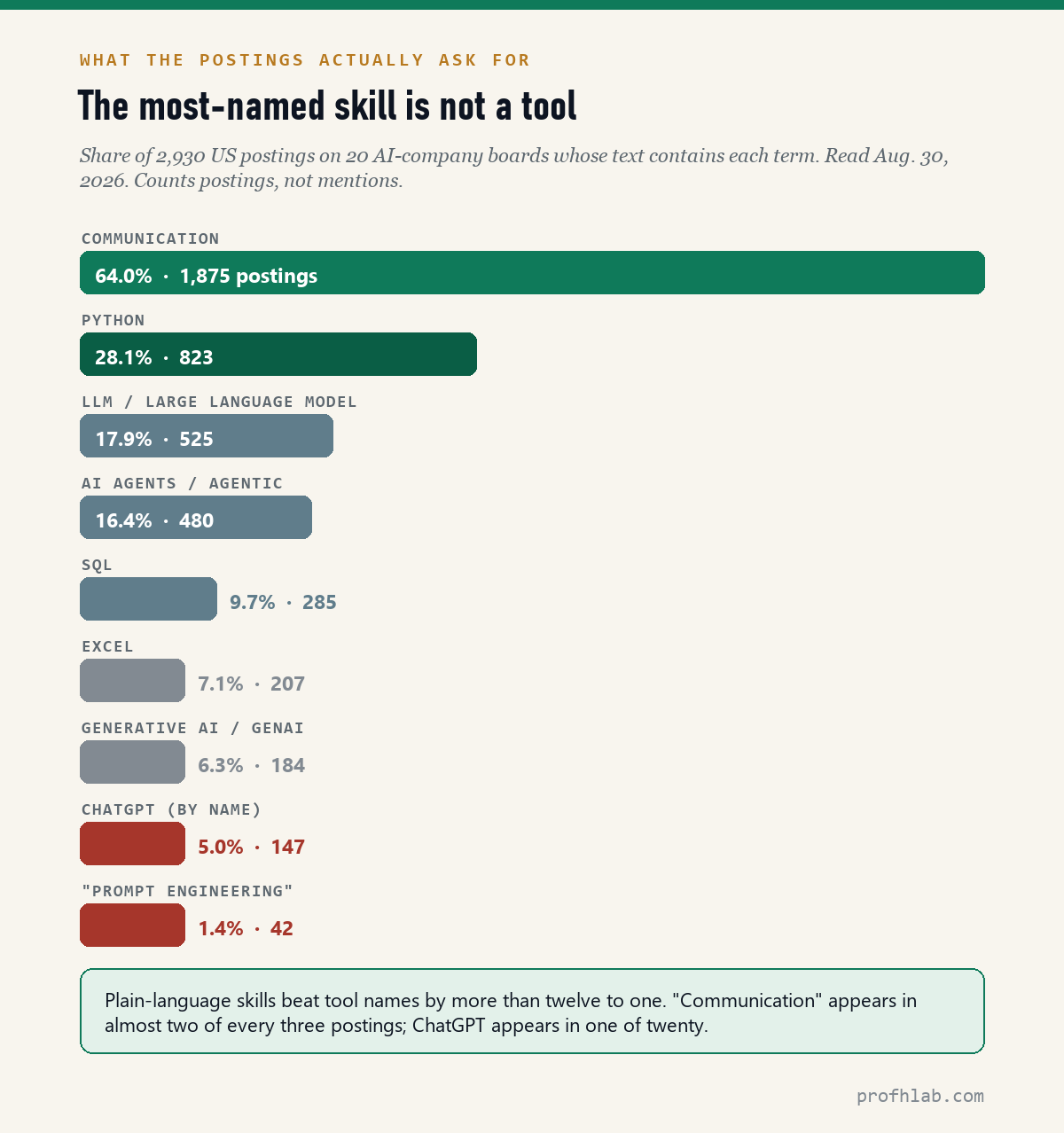
Here is the same 2,930 postings, ranked by how many contain each term. We have put the tool names in the same table as the plain-language ones on purpose, because the ordering is the argument.
| Term in the posting | Postings | Share | What that tells you |
|---|---|---|---|
| Communication | 1,875 | 64.0% | The most requested thing in AI, by a distance |
| Python | 823 | 28.1% | Still the one language worth naming |
| LLM / large language model | 525 | 17.9% | The category word employers use, not the brand |
| AI agents / agentic | 480 | 16.4% | The phrase that grew fastest this year |
| SQL | 285 | 9.7% | Twice as common as ChatGPT |
| Excel | 207 | 7.1% | A 1985 tool outranks the 2022 one |
| Generative AI / GenAI | 184 | 6.3% | Safer résumé wording than a brand |
| ChatGPT (by name) | 147 | 5.0% | 133 of them are OpenAI’s own postings |
| “Prompt engineering” | 42 | 1.4% | The 2023 job title has largely gone quiet |
Read the top and bottom rows together. The skill most in demand at the twenty companies building artificial intelligence is the ability to explain things to other people. The most fashionable résumé keyword of the last three years appears in 42 postings out of 2,930.
The 242 postings that really do want AI
This is where the advice turns constructive, and it is the part the résumé blogs miss. We searched for postings containing a sentence that expects the candidate to use AI tools in the work — wording like “comfortable using,” “experience using,” “leverage.” There were 242 such postings, 8.3% of the 2,930, spread across 15 of the 20 companies.
So the demand is real. It is simply written in a different grammar. Here is what those sentences look like, quoted exactly, from five different employers — and note how few of them are engineering jobs:
| Employer | Role | What the posting actually says |
|---|---|---|
| 1X | People Operations Generalist | “Experience using Claude or other AI tools to automate, streamline, or improve recurring People Operations processes.” Posting |
| Scale AI | AI Advisory Consultant | “Hands-on with GenAI in daily work — can point to concrete examples of using AI tools to work faster.” Posting |
| Nuro | Head of Communications | “Have experience using AI tools to improve research, synthesis, drafting, scenario planning, and workflow efficiency, while applying strong editorial judgment…” Posting |
| ElevenLabs | Sales Development | “…leveraging AI tools, agents, or automated workflows to move faster and at greater scale.” Posting |
| OpenAI | Research Program Manager | “Are comfortable using APIs, automation, and AI tools such as Codex to accelerate workflows, remove manual overhead, and upskill quickly…” Posting |
Postings read on their employer’s own board, August 30, 2026. Postings close without notice — the official page always wins.
The sentence pattern — and how to copy it
Read those five quotes again and the shape is identical every time. Not “knows tool X.” Always “uses tool X to achieve outcome Y.” The tool is never the end of the sentence. It is the middle.
Scale AI states the test outright, and it is worth pinning above the desk of every job seeker: “can point to concrete examples.” That is what a hiring manager is checking for. The word “ChatGPT” in a skills list is not an example. It is a claim with nothing behind it, and it takes four seconds to see through.
So the rewrite is mechanical. Take each bullet where you were going to name the tool, and finish the sentence with what happened.
| Instead of this | Write this |
|---|---|
| Skills: ChatGPT | Used AI drafting tools to cut the first-draft time on monthly client reports from two days to four hours, then edited every figure by hand before release. |
| Proficient in prompt engineering | Built and documented a set of standard prompts the team of six now uses for intake summaries, cutting rework after handoff. |
| Familiar with AI tools | Automated the weekly roster and shift-swap email with a scripted workflow, removing about three hours of manual work a week. |
| AI enthusiast | (Delete it. It is the clearest signal that there is no example behind the claim.) |
Two guardrails, because both matter more than the wording. First, keep the noun general — “AI drafting tools,” “generative AI” — unless the posting itself names a product; 184 postings said “generative AI” against 42 that said “prompt engineering.” Second, never claim an outcome you cannot describe out loud for ninety seconds, because the interview question is always “walk me through that.” If you used a chatbot to write the résumé itself, that is not a skill and does not belong on it — and every number on it still has to be true.
The entry-level cut: zero out of 75
If you are changing careers or starting out, this is the cut that matters. Seventy-five of the 2,930 US postings were entry-level by title — intern, apprentice, technician, fellow, junior, new grad.
Not one of the 75 named ChatGPT, Claude, Gemini or Copilot. Zero.
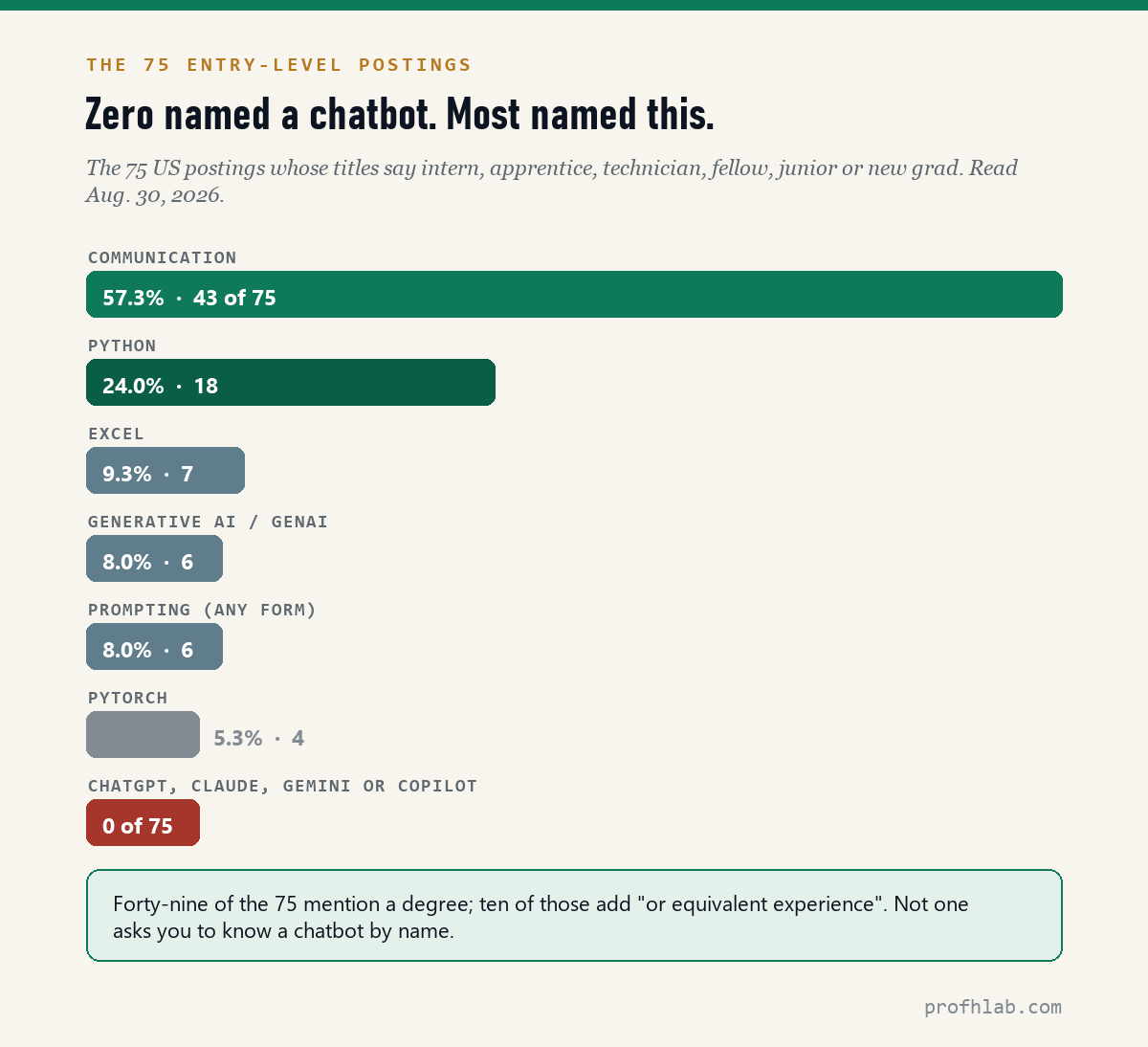
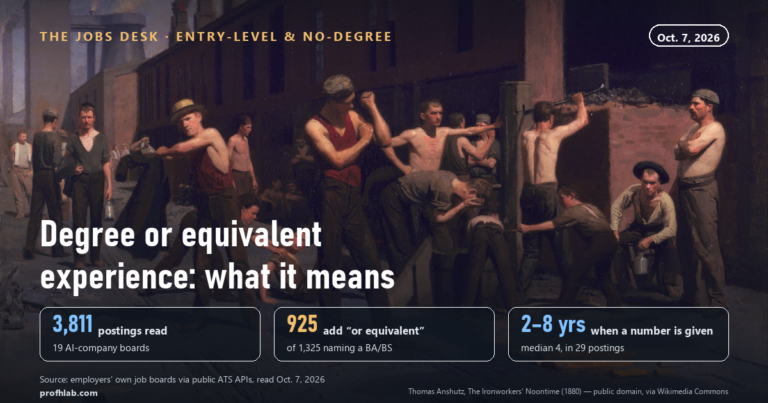
What they asked for instead: communication in 43 of the 75, Python in 18, Excel in 7. Forty-nine mentioned a degree, and ten of those added “or equivalent experience” — wording worth taking literally, as we found when we looked at whether you need a degree to be a robotics technician.
Most of these openings are hands-on rather than desk jobs. xAI alone was advertising fiber, controls, plumbing, fire protection and data centre operations technicians around Memphis and Southaven on the day we looked — we broke down that cluster and its pay in the xAI Memphis jobs report, and the wider route in how to become a data center technician with no experience.

Delete the standalone ChatGPT line and write outcomes instead
1. Open your résumé and find every tool name. For each one, either finish the sentence with an outcome you can defend, or delete it. Ten minutes.
2. Delete the standalone “ChatGPT” skills-list entry. On the evidence above it is doing no work on these boards, and it invites a question you would rather answer on your own terms.
3. Check the actual posting before you tailor. If the employer names a product, mirror their word exactly. If they say “generative AI,” say generative AI. Their wording is the keyword list.
4. Put one line about communication where a recruiter will see it. It appeared in 64% of postings — more than every AI tool name on this page combined. Name the audience: who did you explain what to, and what did they then do?
5. Prepare the ninety-second story for each AI bullet you keep. “Walk me through that” is the next question, every time.
Who is hiring, what it pays, and which employers publish it all
“Which companies are actually hiring, and for what?” The live count sits on our AI Jobs Tracker, updated daily, and the guided version is which AI companies are hiring right now.
“What do these jobs pay?” We read 2,144 published salary ranges in which AI company pays the most. For the narrow route into the two biggest labs, how to get a job at OpenAI or Anthropic.
“Where are the openings that publish everything?” Federal agencies and the national labs, by rule: how to get a federal job with no experience and national laboratory jobs, no degree.
“What about the AI work advertised on social media?” Some is real, some is not — we checked in are AI training jobs legit. For the anxious version of the whole question, will AI take my job.
“I want to actually learn one of these tools first.” Start with something small and real, like using ChatGPT for Excel formulas, or the plain-language walkthrough in how to use ChatGPT if you are over 50. Then you will have the concrete example the postings ask for.
Have a question about a specific company, city or role? Ask the desk — we answer on the AI Jobs Desk page, and we check the employer’s own page before we reply. If your question is broader than jobs, Ask Prof H.
Listing AI skills, and whether a recruiter can tell
Should I put ChatGPT on my resume?
Not as a standalone skill-list entry. On August 30, 2026 we read 2,930 US postings on twenty AI and robotics boards; 147 contained the word ChatGPT, and 133 of those were OpenAI’s own postings describing its product. Excluding OpenAI’s board, 15 postings out of 2,930 mentioned it at all — 0.5% — and on reading them, essentially none asked for it as a candidate skill. Put the outcome on your résumé instead: what you used an AI tool to do, and what measurably changed. That is the form 242 postings asked for.
How do I list AI skills on my resume?
Copy the grammar employers use: “used [tool type] to [outcome].” Every one of the 242 postings we found expecting AI use phrased it that way — for example, 1X asked for “experience using Claude or other AI tools to automate, streamline, or improve recurring People Operations processes.” Scale AI stated the test directly: candidates should “point to concrete examples of using AI tools to work faster.” Prefer the general category (“generative AI”, 184 postings) over a brand, unless the posting you are answering names a specific product — then mirror its exact wording.
What AI skills do employers actually want in 2026?
Judging by what appears in the postings themselves on August 30, 2026: communication first, in 1,875 of 2,930 US postings (64%), then Python (823, 28.1%), then the concepts rather than the products — LLMs or large language models (525, 17.9%) and AI agents or “agentic” work (480, 16.4%). SQL appeared in 285 and Excel in 207, both more often than ChatGPT’s 147. “Prompt engineering” as a phrase appeared in 42 postings, 1.4%.
Is prompt engineering still a skill worth listing?
As a phrase it has gone quiet on these boards: 42 of 2,930 postings, 1.4%, on August 30, 2026, against 184 for “generative AI” and 480 for agents. The underlying ability still counts, but list it as a result rather than a title — the standard prompts you wrote that a team now uses, and what that changed. A résumé line reading “proficient in prompt engineering” matches almost nothing employers are currently writing.
Do entry-level AI jobs require you to know ChatGPT?
Not on the boards we read. Of the 75 US entry-level postings on August 30, 2026 — intern, apprentice, technician, fellow, junior or new grad — zero named ChatGPT, Claude, Gemini or Copilot. Communication appeared in 43 of the 75, Python in 18, Excel in 7. Forty-nine mentioned a degree and ten of those added “or equivalent experience.” Many of these are hands-on technician roles rather than desk jobs.
Will a recruiter know I used AI to write my resume?
We cannot count that, and anyone quoting a detection rate is guessing — so treat it as a risk rather than a certainty. What we can say from the postings is that the follow-up question is structural, not technological: employers repeatedly ask for “concrete examples,” and interviews open with “walk me through that.” A claim you cannot narrate for ninety seconds fails at that step regardless of who typed it. Using AI to tidy your own phrasing is not the risk; letting it invent a number or an achievement is.
Cite this
profhlab.com, “Should I Put ChatGPT on My Résumé? We Counted 2,930 AI Job Postings,” August 30, 2026. ChatGPT appeared in 147 of 2,930 US postings on twenty AI and robotics boards (5.0%), falling to 15 (0.5%) once OpenAI’s own board is excluded; “communication” appeared in 1,875 (64.0%); none of the 75 entry-level postings named any consumer chatbot. Method: How We Count. Daily totals: AI Jobs Tracker.
Sources: the public job boards of twenty AI and robotics employers, read August 30, 2026; individual postings linked above. Images: Albert Anker, The Village Clerk (public domain); Shixart1985 (CC BY 2.0); Derrick Coetzee, NERSC (CC0); Sgt. 1st Class Joel Quebec, U.S. Army (public domain), via Wikimedia Commons. New to the site? Start here, or browse the FAQ. One short email a month.
Prof.’s H Newsletter
One short email a month, with the numbers in it
What actually moved in AI hiring, AI prices, and the scams aimed at older Americans. Counted here, dated, and linked to the source. One email a month, and your address goes nowhere else.