Which States Banned Data Centers? None by Law, but Voters Backed Limits in 46 of 47 Local Votes (Nov. 2026)
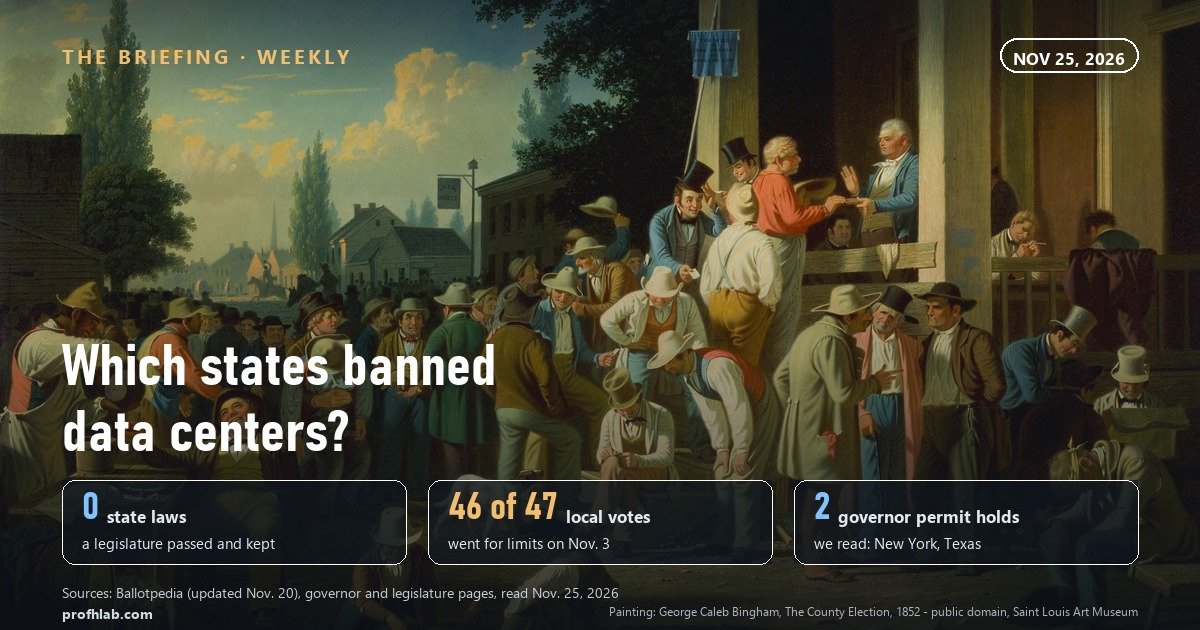
None. As of November 25, 2026, no state has a data center ban that its legislature passed and its governor signed, and the bans voters approved on November 3 were all local: Ballotpedia counted 46 of 47 local contests that day going for limits on data centers.
Google’s autocomplete shows how people phrase it: “which states banned data centers,” “which state outlawed data centers,” “are data centers being banned in the us.” The answer you get depends on what you count as a ban, and most headlines this month did not say.
So we sorted it the slow way. We opened governor orders, legislature status pages, a congressional bill record and county election results, and put each one in one of three boxes: a law, a pause on permits, or a local vote. The short version: the governors moved faster than the legislatures, and the towns moved fastest of all.
What we checked on November 25, 2026
- Governor pages: New York Executive Order 62 and the Texas governor’s September 21 directive.
- Legislature records: Maine LD 307, New York S10642, and H.R. 9442 on govinfo.
- Ballotpedia’s list of 2026 data center measures (as of November 20) and its November 6 news count, plus the official county or state results page for 7 of those measures (9 tried).
- Google autocomplete for 12 phrasings of the question.
Limits, in plain words: we could not open congress.gov, the Oregon governor’s letter, or Ohio’s attorney general site, so for those we cite named news reports and say so. Local counts change as results are certified. This is public-record information, not legal advice.
Written and checked by Prof. H. An AI assistant helped draft and run the page reads; every quote was read on the source’s own page on the date shown.
Has any state actually banned data centers by law?
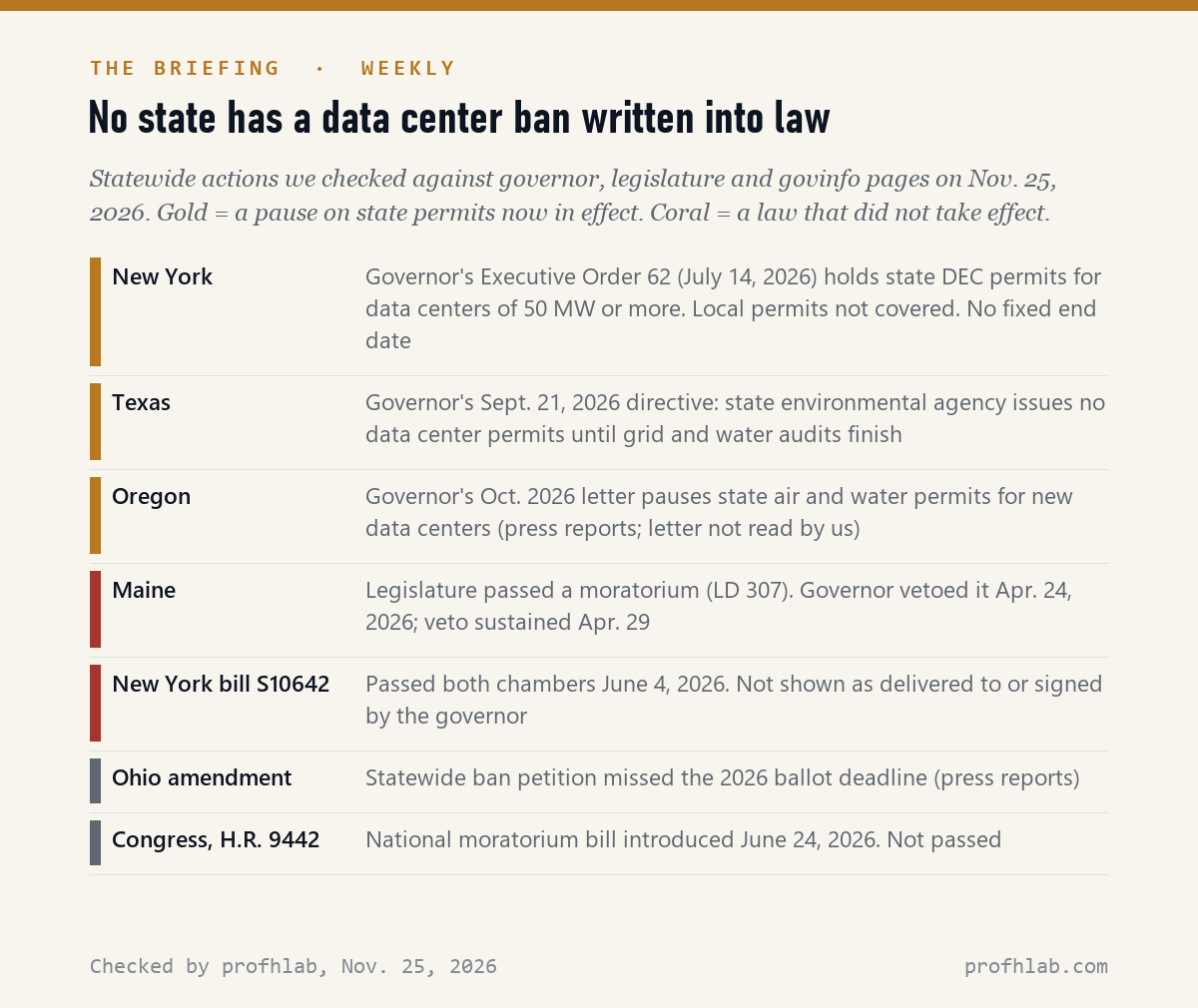
No: of the statewide moves we could read on official pages on November 25, 2026, the only moratorium a legislature passed, Maine’s LD 307, was vetoed on April 24, 2026, and the veto was sustained on April 29. Every statewide hold now in force came from a governor, not a vote of lawmakers.
Maine’s bill title tells you what it tried to do: “Place a Temporary Limitation on Certain Data Centers.” Spectrum News reported on April 29 that the House override vote fell short at 72 to 65, below the two-thirds an override needs. Maine towns then did locally what the state did not: seven of them approved six-month moratoriums on November 3.
New York came closer than most people realize. Its Senate bill S10642 and the matching Assembly bill A11560 would freeze state permits for data centers of 20 megawatts or more for a year. The Senate page shows both chambers passed it on June 4, 2026, the Senate vote 43 to 17, and no later action. It is not law.
The Siting Report, a newsletter that tracks these fights, wrote on November 20 that 20 statewide moratorium bills or proposals appeared in 14 states this year and that none became law. It did not list bill numbers, so we could check only the two above. Both fit its count.
What New York and Texas governors paused, and what they left open
Two governors have halted state permits on paper we could read: New York’s Executive Order 62, signed July 14, 2026, holds state environmental permits for data centers that can use 50 megawatts or more, and Texas’s September 21, 2026 directive tells its environmental agency to issue no data center permits until audits finish.
New York’s order is narrower than the word moratorium suggests. It covers applications the Department of Environmental Conservation had not yet deemed complete on July 14. It “does not apply to permits, approvals, licenses, or similar forms of permission from local governments.” It runs until the state finishes an environmental impact study, with no fixed end date in the text.
Texas used blunter words. Governor Greg Abbott’s release says: “Until they do, TCEQ will issue no permits sought by data center projects.” “They” means data centers that complete grid and water audits by the state grid operator ERCOT and the Texas Water Development Board. The agency owed the governor an update by October 19, 2026.
Oregon is the third, but we could not read the paper. Oregon Public Broadcasting reported on October 13 that Governor Tina Kotek sent a letter pausing state air and water permits for new or expanded data centers until July 1, 2027. Treat that as reported, not verified by us.
| Place | What it is | Signed or dated | What it stops |
|---|---|---|---|
| New York | Executive Order 62 | July 14, 2026 | State DEC permits, 50 MW and up; not local permits |
| Texas | Governor directive to TCEQ | Sept. 21, 2026 | State environmental permits until audits finish |
| Oregon | Governor letter (reported) | Oct. 2026 | State air and water permits to July 1, 2027 |
| Maine | LD 307 moratorium bill | Vetoed Apr. 24, 2026 | Nothing; veto sustained Apr. 29 |
| New York | S10642 / A11560 bill | Passed June 4, 2026 | Nothing yet; no governor action shown |
Sources: governor.ny.gov, gov.texas.gov, legislature.maine.gov and nysenate.gov, read November 25, 2026; Oregon from Oregon Public Broadcasting, October 13, 2026. A permit hold is not a ban: projects that already hold permits are not touched.

What did voters decide about data centers on November 3, 2026?
Limits, almost everywhere they were asked: Ballotpedia’s list, updated November 20, 2026, finds voters favored limiting data center development in 46 of 47 local contests that day, approving 33 limits and defeating 13 measures that would have helped data centers. The one exception was Harwood, North Dakota.
Of the 33 approved limits, 5 were full bans, one each in California and Florida and three in Ohio. Thirteen were partial bans: four in Kansas, one in Maine and eight in Ohio. Maine towns added seven six-month moratoriums. The rest were zoning rules, voter-approval rules, three non-binding votes and a financial-guarantee rule in Perry, Ohio.
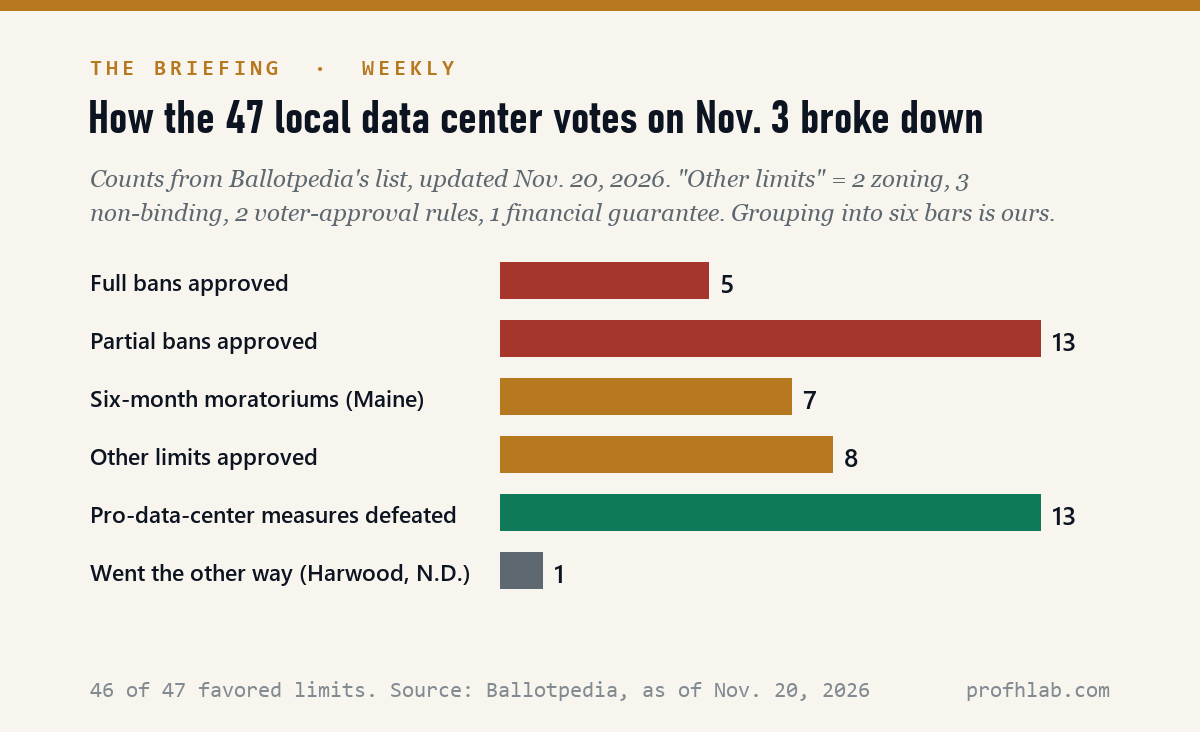
Counts moved after election night, and that is worth knowing before you repeat one. Ballotpedia’s own news post on November 6 said 40 of 41; its list grew to 47 as more town results, mostly Maine moratoriums, came in. CBS News ran a segment on November 5 about “44 ballot measures” passing, counted by a different tracker with wider rules.
Across all of 2026, the same list counts at least 59 local data center measures in 14 states. Of the 55 decided by November 20, voters favored limits in 54. Ohio had the most on November 3: by our tally of the list, 15 approved limits and 6 pro-data-center questions defeated.
Do the official county results match the trackers?
On direction, yes; on numbers, not always: of 9 official results pages we opened on November 25, 2026, 7 loaded, all 7 matched Ballotpedia’s yes or no outcome, and 2 showed vote totals that differ from the figures on Ballotpedia’s list.
| Place and measure | Official result we read | Ballotpedia list | Results page |
|---|---|---|---|
| Alhambra, Calif. Measure DB, ban in all zones | Yes 19,162 (83.91%), No 3,674 | Same | Los Angeles County, results as of Nov. 19 |
| Edgewater, Fla. Amendment 4, ban on new data centers | Yes 7,884 (77.20%), No 2,328; marked official | Ballotpedia shows 7,188 / 2,490 | Volusia County, updated Nov. 24 |
| Grove City, Ohio Issue 28, voter approval for big projects | Yes 11,146 (54.64%), No 9,254; marked official | Same | Franklin County, official, Nov. 19 |
| Emporia, Kan. Ban on high-impact data centers | Yes 4,553, No 2,848 (our sum of 23 precincts, about 61.5%) | Ballotpedia shows 4,346 / 2,891 | Lyon County, official final, Nov. 13 |
| Americus, Kan. Data center question | Yes 278, No 127 | Same | Lyon County, official final, Nov. 13 |
| El Dorado, Kan. City question, data center ban | Yes 3,019 (71.54%), No 1,201 | Same | Butler County, updated Nov. 10 |
| Harwood, N.D. Charter amendment, extra review | No 326 (75.64%), Yes 105; marked official | Same | North Dakota Secretary of State |
| Ashville, Ohio EdgeConneX term summary referendum | Not read | Pickaway County site blocked automated readers | |
| Wells, Maine Data center measure | Not read | Town posted a scanned PDF we could not read |
Read November 25, 2026. Emporia’s total is our sum of the county’s 23 precinct pages. The Edgewater and El Dorado pages do not print the question text; we matched them by contest name and numbers. Rows marked Not read are not counted as agreeing.
The two gaps look like timing, not error: Edgewater’s official page is dated November 24 and shows about 700 more yes votes than Ballotpedia’s figure, and Emporia’s final county report adds about 200. That is our inference; neither page explains its change. Either way, the outcome did not flip.
Not every no vote was a ban. In Ashville, Ohio, voters rejected a referendum that would have upheld the village’s term summary for talks with the data center firm EdgeConneX. In Wilmington, Ohio, they defeated four rezonings from residential to industrial land. Both count toward Ballotpedia’s 46, and neither bans anything outright.

Why are people voting against data centers, and what does it cost a household?
The money worry is about power bills, and two states have answered it with rate laws rather than bans: New Jersey signed its Data Center Fair Share law on July 7, 2026, and Oklahoma approved its Data Center Customer Ratepayer Protection Act on May 11, 2026, both to keep data centers from shifting grid costs onto households.
That is the quieter half of this story. A ban decides whether a building goes up. A rate law decides who pays for the substation and transmission line it needs. New Jersey’s governor’s office describes a separate ratepayer class for data centers; Oklahoma’s House says its act took effect July 1, 2026.
We looked at what an AI data center draws in how much power an AI data center uses and at bills in is my electric bill going up because of AI. Taxes, jobs, water and noise are town by town in are data centers good for local communities.
Could a state ban data centers next year?
Possibly, and three markers are already on the calendar: Bloomberg reported on November 6, 2026 that the data firm Cleanview puts about 40% of pending US data center capacity in states whose new governors promised to pause or stop it. In most states, new governors are sworn in during January.
In Ohio, a citizen petition for a constitutional amendment banning data centers over 25 megawatts missed the July 1 deadline for the 2026 ballot, the Tribune Chronicle and Vindicator reported in June; its backers now aim for November 2027. In Congress, H.R. 9442, the Artificial Intelligence Data Center Moratorium Act, was introduced on June 24, 2026 by Rep. Alexandria Ocasio-Cortez with nine colleagues named on the bill text.
Our inference, labeled as one: the next statewide step is more likely another permit hold or rate law than a legislated ban, because those are what passed this year. We will read the New York and Texas pages again after January 1, 2027, and update this Briefing with what changed.
Checking a data center vote near you. Search your county board of elections site for the measure number, not the news. Read the ballot language: “ban,” “moratorium” and “zoning” mean very different things. Note whether the result says unofficial. If a project is already permitted, a new local ban may not reach it.
Bans, pauses and vetoes, each answered in a few lines
Which states banned data centers?
None, as of November 25, 2026, in the sense of a statewide ban passed by a legislature and signed into law. New York and Texas governors have put state permits for new data centers on hold, and Maine lawmakers passed a moratorium that the governor vetoed in April 2026. The bans that voters approved on November 3 were local, in towns and counties.
Are data centers being banned in the US?
Not nationally. A national moratorium bill, H.R. 9442, was introduced in the House on June 24, 2026, and we found no record that it passed. Local bans are spreading: Ballotpedia counted 5 full bans and 13 partial bans among the local measures voters approved on November 3, 2026.
Which state outlawed data centers?
No state has outlawed them. The closest statewide steps we could read on official pages are New York Executive Order 62, signed July 14, 2026, which holds state environmental permits for data centers of 50 megawatts or more, and a Texas directive of September 21, 2026 telling the state environmental agency to issue no data center permits until audits finish.
Did Maine pass a data center moratorium?
The legislature did, and it did not become law. The Maine Legislature status page for LD 307 shows a governor veto on April 24, 2026 and the final disposition Veto Sustained on April 29, 2026.
Can a town ban a data center?
In many places, yes, through zoning or a local ballot measure. On November 3, 2026, Ballotpedia counted full data center bans approved by voters in one California, one Florida and three Ohio localities. What a town can do depends on its state law, so read the measure text on your county election site.
Is there a data center moratorium in New York?
There is a hold on state permits, not a ban. Executive Order 62, signed July 14, 2026, tells the state Department of Environmental Conservation to hold discretionary permit applications for data centers of 50 megawatts or more until a state environmental review is finished. It does not cover local permits.
Official pages and reports behind every claim, with read dates
- New York Governor, Executive Order No. 62, signed July 14, 2026 (read November 25, 2026)
- Office of the Texas Governor, Governor Abbott Directs TCEQ To Halt Data Center Permits, September 21, 2026 (read November 25, 2026)
- Maine Legislature, LD 307 status, veto April 24 and Veto Sustained April 29, 2026 (read November 25, 2026)
- New York State Senate, S10642, actions through June 4, 2026 (read November 25, 2026)
- GovInfo, H.R. 9442, Artificial Intelligence Data Center Moratorium Act, introduced June 24, 2026 (read November 25, 2026)
- Ballotpedia, Data center-related ballot measures, 2026, list as of November 20, 2026 (read November 25, 2026)
- Ballotpedia News, Voters favored limiting data center development in 40 of 41 local ballot measures on Nov. 3, November 6, 2026 (read November 25, 2026)
- New Jersey Governor, Data Center Fair Share law signing, July 7, 2026 (read November 25, 2026)
- Oklahoma House of Representatives, Data Center Customer Ratepayer Protection Act news, August 6, 2026 (read November 25, 2026)
Reported, not read on an official page by us: Oregon governor’s letter (Oregon Public Broadcasting, October 13, 2026); Maine override vote (Spectrum News, April 29, 2026); Ohio petition deadline (Tribune Chronicle and Vindicator, June 2026); Cleanview capacity share (Bloomberg via Insurance Journal, November 6, 2026); The Siting Report, November 20, 2026.
The rest of our data center desk: What is an AI data center · Where AI data centers are being built · How AI data centers are built · Who is building the most AI data centers · Why Musk wants data centers in space · Who is Nvidia’s CEO now · Anthropic data center jobs · AI jobs tracker · Physical AI library · AI price tracker · How to avoid surveillance pricing · ChatGPT for beginners over 50 · The Briefing · Start here · FAQ.
Cite this
As of November 25, 2026, no US state had a data center ban passed by its legislature and signed into law; New York and Texas governors had put state permits on hold, and voters favored limits in 46 of 47 local contests on November 3 (Ballotpedia, as of November 20). Source: profhlab.com, “Which States Banned Data Centers?”
One short email a month, if you want the next change when it lands.
About the author. Prof. H teaches robotics and AI and writes The Briefing, a weekly read of what AI changes do to households and towns. Every page here was fetched and read on the date shown. This is general public-record information, not legal advice. Corrections and questions: ask here.
Prof.’s H Newsletter
One short email a month, with the numbers in it
What actually moved in AI hiring, AI prices, and the scams aimed at older Americans. Counted here, dated, and linked to the source. One email a month, and your address goes nowhere else.