SAVE Plan Ending: Your 90-Day Deadline and the RAP vs. IBR Math
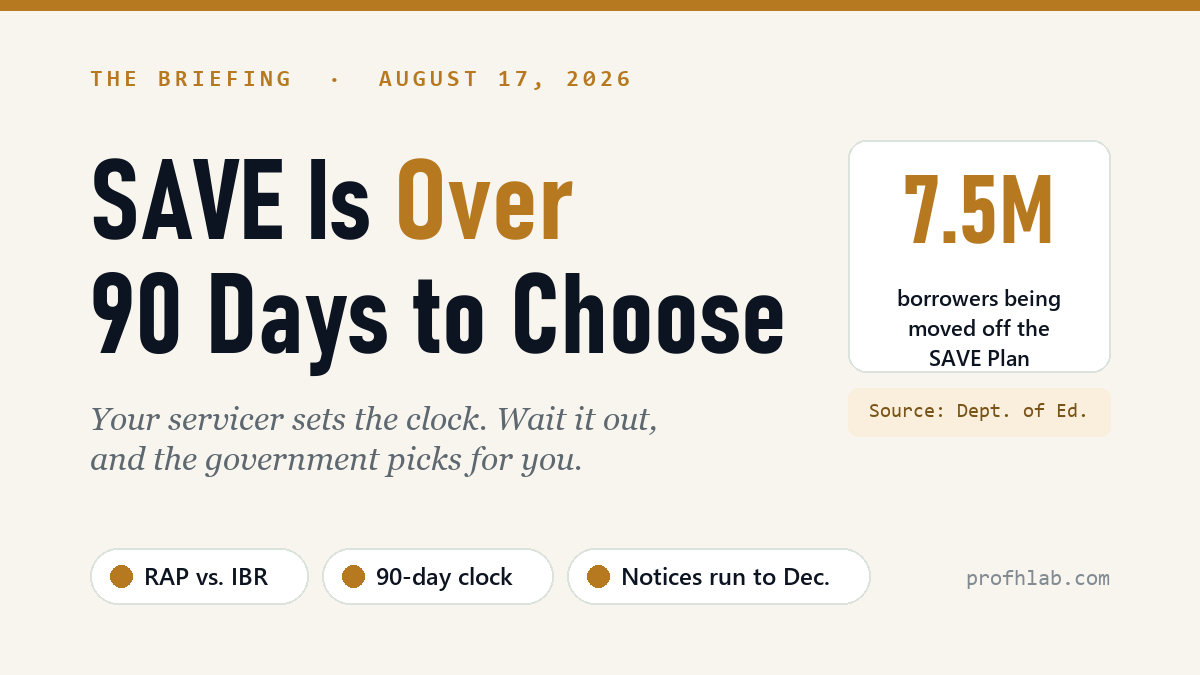
If you are one of the 7.5 million people who were parked in the SAVE Plan, a letter from your loan servicer is either already in your inbox or is coming in the next few months. It gives you 90 days to pick a new repayment plan. If you let the clock run out, you do not get to keep the old deal — you get moved to the Standard Plan or the new Tiered Standard Plan, whichever your servicer names, and those are fixed payments that ignore what you actually earn.
The Department of Education announced the wind-down on March 27, 2026, and servicers began mailing the notices on July 1. The notices are staggered — they will keep going out in batches for months — so your deadline is not the same as your friend’s. The only date that governs you is the one printed on your notice. This is the arithmetic of the choice you have to make, and the one trap in the new plan that almost nobody explains before you sign.
What actually changed
A court approved a settlement between the Department and the State of Missouri that ended the SAVE Plan. In the Department’s words, borrowers “will be given at least 90 days to enter a legal repayment plan of their choice.” Two new options opened on July 1, 2026: the Repayment Assistance Plan (RAP), a new income-driven plan, and the Tiered Standard Plan, a fixed plan with a 10-, 15-, 20-, or 25-year term depending on how much you owe.
One thing worth knowing if you have been sitting still: the months you spent in the SAVE forbearance did not count toward income-driven forgiveness or Public Service Loan Forgiveness, and interest started accruing again on August 1, 2025. Waiting has not been free.
RAP or IBR? The answer depends on your household
Most people coming off SAVE are choosing between RAP and Income-Based Repayment (IBR). They calculate payments in fundamentally different ways, and that difference — not the marketing — is what should decide it.
| RAP | IBR | Tiered Standard | |
|---|---|---|---|
| Payment based on | 1–10% of your entire AGI, by bracket | 10% or 15% of income above 150% of the poverty line | Your loan balance, not your income |
| Household credit | $50 per dependent | Poverty-line exemption rises with household size | None |
| Minimum payment | $10 | $0 | Fixed |
| Forgiveness at | 30 years | 20 years (borrowers new after July 1, 2014) or 25 | None — it amortizes |
| Unpaid interest | Waived monthly, all loan types | Limited subsidy | Not applicable |
That third row in the table is where the money is. RAP charges a percentage of every dollar you make. IBR ignores the first 150% of the federal poverty line for your household — $23,940 for one person in 2026, and $49,500 for a household of four. So RAP tends to win for single filers in the middle, and lose badly for anyone with dependents.
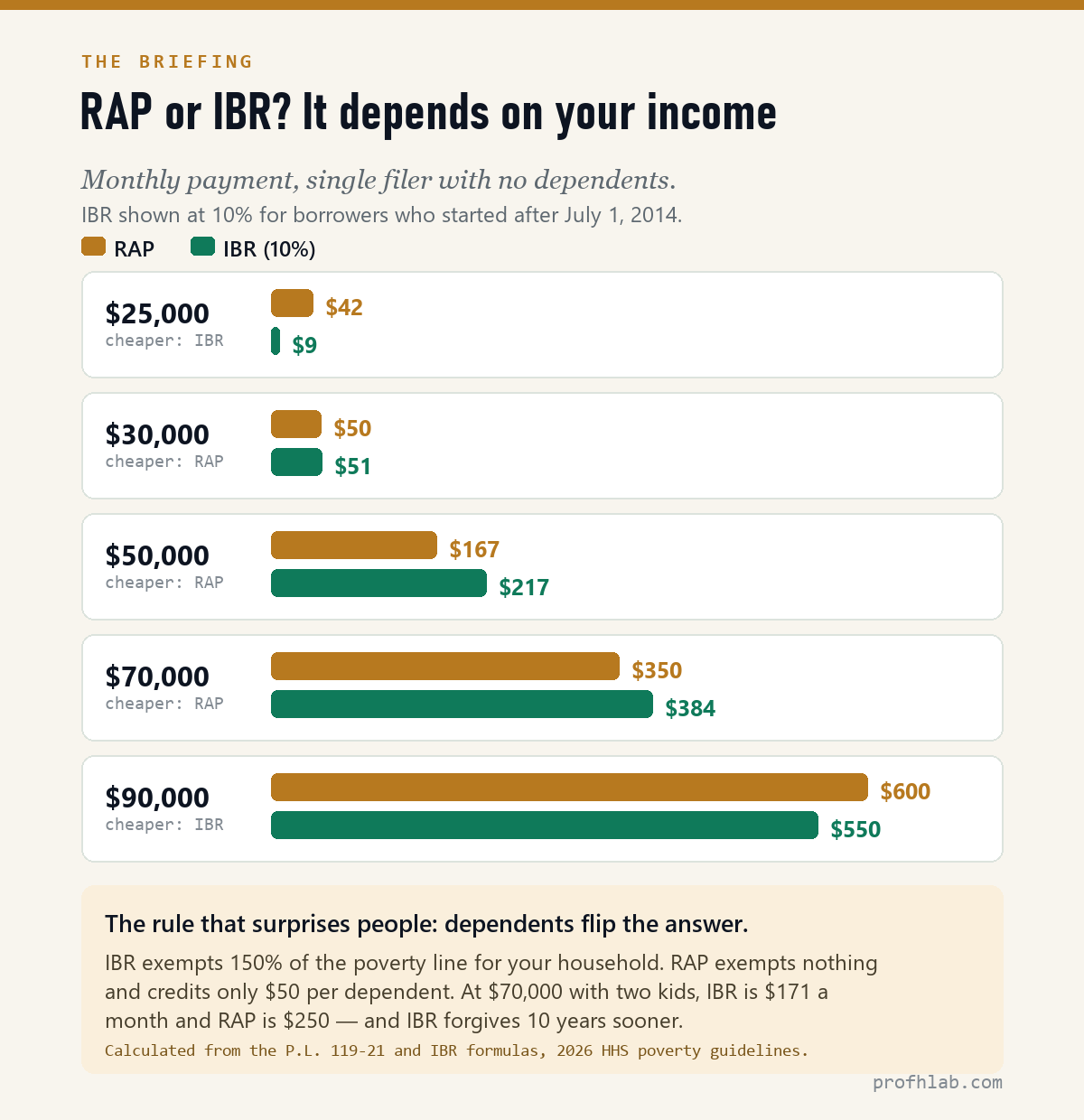
Run the two formulas for a single filer with no dependents and a clear band appears: RAP is cheaper roughly between $30,000 and $80,000 of AGI, and more expensive on either side of that. Below about $30,000, IBR can drop to nearly nothing while RAP keeps charging. Above about $80,000, RAP’s climbing rate overtakes IBR’s flat 10%.
Now add two children and a $70,000 income. IBR is about $171 a month; RAP is $250 — and IBR forgives ten years sooner. In our calculations, at no income level did RAP beat the 10% version of IBR for a household of four. The $50-per-dependent credit is simply much smaller than a poverty-line exemption that scales with family size.
The cliff nobody warns you about
RAP’s rate is not marginal. It is a flat percentage applied to your whole AGI, and it steps up one point at every $10,000 line. Cross a line by one dollar and the higher rate hits every dollar you earn.
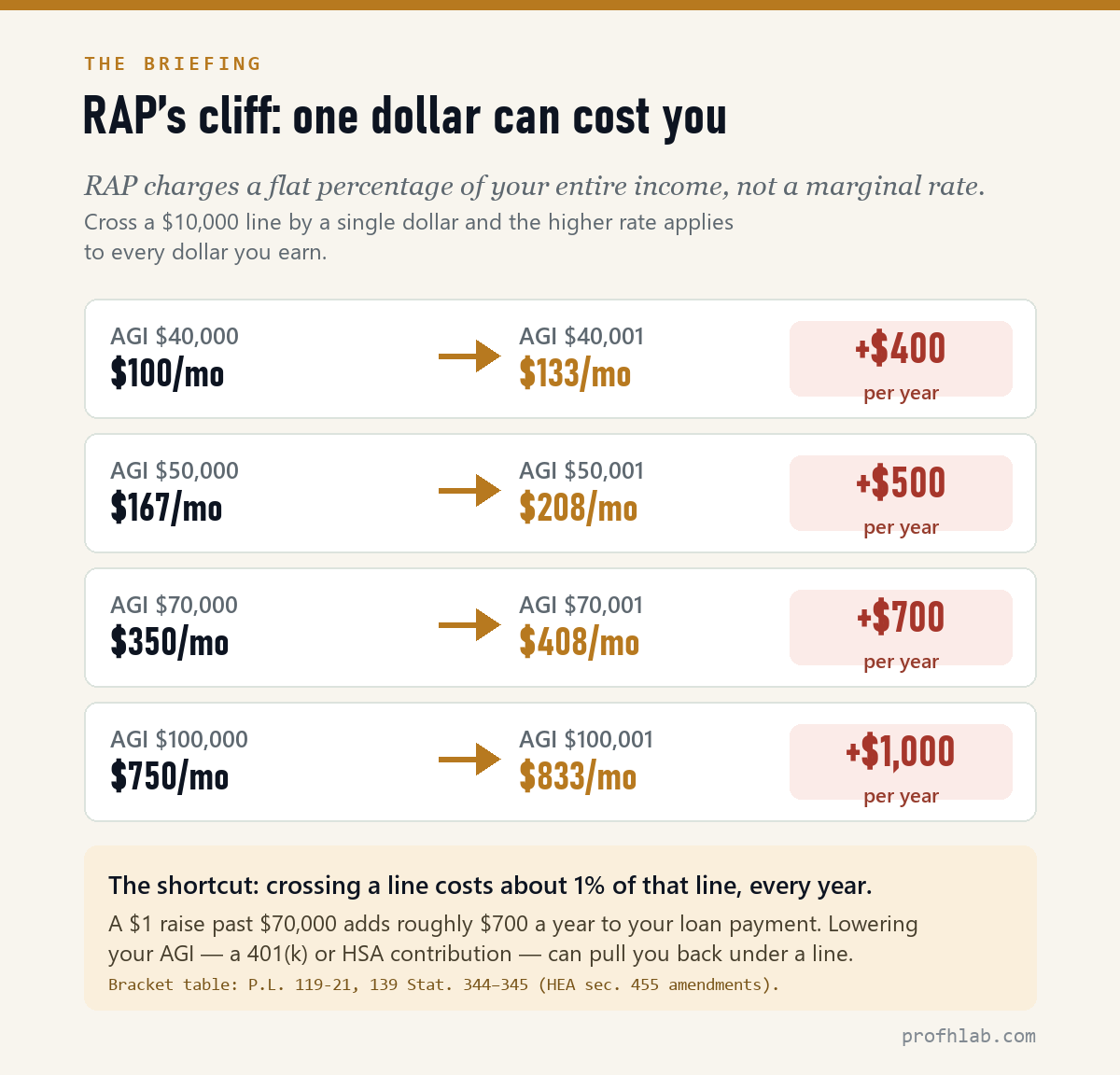
The shortcut is easy to remember: crossing a $10,000 line costs about 1% of that line, every year. A raise that pushes you from $70,000 to $70,001 adds roughly $700 a year to your loan payments. If you are on RAP and hovering near a line, a 401(k) or HSA contribution that lowers your AGI can pull you back under it.
Where the math stops. These figures are calculated from the published formulas and the 2026 poverty guidelines, using AGI and household size only. Your actual payment depends on your loan balance, your servicer’s determination, whether you file jointly, and — for IBR — whether you meet the hardship test to enroll. This is general information, not financial advice. Confirm your own numbers with the official Loan Simulator before you choose.
If you borrowed for your child, read this twice
Parent PLUS loans are never eligible for RAP, even if you consolidate them. That closes the door most parent borrowers assumed was open.
There is one narrow path left, and it has a hard date on it. A Direct Consolidation Loan that includes a Parent PLUS loan can reach IBR — but only if the borrower makes at least one payment under Income-Contingent Repayment (ICR) before July 1, 2028. ICR itself ends no later than that same date. If you are a parent borrower who wants an income-driven payment for the long run, that sequence — consolidate, enroll in ICR, make a payment — has to be finished before the door shuts.
One more trap, for anyone thinking about going back to school or cosigning new debt: if you take out any new Direct Loan on or after July 1, 2026, RAP becomes the only income-driven plan available for all of your loans, including the old ones. A borrower in IBR with a 20-year forgiveness clock would be reset to RAP’s 30-year clock.
What to do this week
- Find your actual deadline. Log in at StudentAid.gov and check your servicer’s message. The 90-day clock starts when your notice is issued, not on a national date. If no notice has arrived, you can still switch early by contacting your servicer.
- Run both numbers before you pick. Use the free Loan Simulator at studentaid.gov/loan-simulator. Enter your household size honestly — as shown above, it changes the answer.
- Apply online and consent to the IRS data transfer. The IDR request takes about ten minutes. Giving consent lets the Department pull your tax information directly instead of making you upload documents, which speeds up processing.
- If you are pursuing PSLF, do not drift. Months in forbearance do not count. Ask your servicer about the PSLF buyback process for months already lost.
- Get the notice in writing. Save the letter that states your specific deadline. If you are auto-enrolled and think it was in error, that letter is your evidence.
Free help, from the source. The Federal Student Aid Information Center is at 1-800-433-3243 (1-800-4-FED-AID), open weekdays. Applying for any repayment plan is always free at StudentAid.gov.
Nobody legitimate charges a fee to lower your payment or “get you approved.” Any call, text, or ad promising fast forgiveness for an upfront payment is a scam — the pressure to act before a real government deadline is exactly what these operations exploit. See our guide to spotting AI-assisted scams.
Worth watching
What a missed SAVE deadline costs, and whether RAP beats IBR
What happens if I miss my 90-day SAVE deadline?
You are automatically enrolled in either the Standard Repayment Plan or the new Tiered Standard Plan, as specified by your servicer. Both are fixed-payment plans that are not based on your income, so the payment can be substantially higher than an income-driven plan. You can still apply to switch to an income-driven plan afterward, but you will have made payments at the higher amount in the meantime.
Is RAP or IBR cheaper for me?
It depends mostly on household size. For a single filer with no dependents, RAP is generally cheaper between roughly $30,000 and $80,000 of adjusted gross income. For households with dependents, IBR is usually cheaper at every income level, because IBR exempts 150% of the poverty line for your household while RAP only credits $50 per dependent. Run both in the official Loan Simulator before deciding.
Do the months I spent in the SAVE forbearance count toward forgiveness?
No. Time in the SAVE forbearance does not count toward income-driven repayment forgiveness or Public Service Loan Forgiveness, and interest resumed accruing on those loans on August 1, 2025. Some borrowers pursuing PSLF have recovered credit for those months through the PSLF buyback process — ask your servicer.
Can Parent PLUS borrowers use RAP?
No. Loans made to parents, including Direct PLUS Loans and FFEL Program loans, are never eligible for RAP, even if consolidated. A Direct Consolidation Loan that includes a Parent PLUS loan can qualify for IBR only if the borrower makes at least one payment under Income-Contingent Repayment before July 1, 2028, which is also the date by which ICR ends.
Will taking out a new student loan change the plan on my old loans?
Yes, and this catches people. If you take out any new Direct Loan on or after July 1, 2026, RAP becomes the only income-driven plan available for all of your loans, including ones you borrowed years earlier. A borrower whose older loans carried a 20-year forgiveness timeline under IBR would move to RAP’s 30-year timeline.
Why does one extra dollar of income raise my RAP payment so much?
RAP uses flat brackets rather than marginal rates. The percentage steps up one point at each $10,000 of AGI and then applies to your entire income, so crossing a threshold by a single dollar raises your annual payment by roughly 1% of that threshold. Crossing $50,000 costs about $500 a year; crossing $100,000 costs about $1,000.
Sources
- U.S. Department of Education, “Next Steps for Borrowers Enrolled in the SAVE Plan” — press release, March 27, 2026 (7.5 million borrowers; 90-day window; July 1 notice start; Tiered Standard terms).
- Federal Student Aid, “Top FAQs About Income-Driven Repayment Plans” — StudentAid.gov (plan comparison table; loan-type eligibility; ICR and PAYE end no later than July 1, 2028; the ICR-payment condition for Parent PLUS consolidation loans).
- Public Law 119-21, 139 Stat. 344–345 — statutory RAP payment brackets, $50 dependent reduction, $10 minimum, 360-month term.
- Congressional Research Service, IF13075, “The Repayment Assistance Plan (RAP)” — July 31, 2025 (interest subsidy, matching principal payment, effect of new borrowing on existing loans).
- HHS Office of the Assistant Secretary for Planning and Evaluation, 2026 Poverty Guidelines — January 2026 ($15,960 for one person; $33,000 for four, 48 contiguous states and D.C.).
After the loan deadline: your 2027 raise and September 15 taxes
- Your 2027 Social Security raise, and what Medicare takes back
- Estimated taxes due September 15: the $1,000 rule and the withholding fix
- AI scams targeting older adults — and the first 60 minutes that matter
About the author: Prof. H teaches and writes at Prof H Lab, where every price and figure is dated and traced to a primary source. Questions are welcome on the Ask page.
Prof.’s H Newsletter
One short email a month, with the numbers in it
What actually moved in AI hiring, AI prices, and the scams aimed at older Americans. Counted here, dated, and linked to the source. One email a month, and your address goes nowhere else.