Are Deleted ChatGPT Chats Really Deleted? Seven Places Your Data Lives, and the One You Cannot Clear
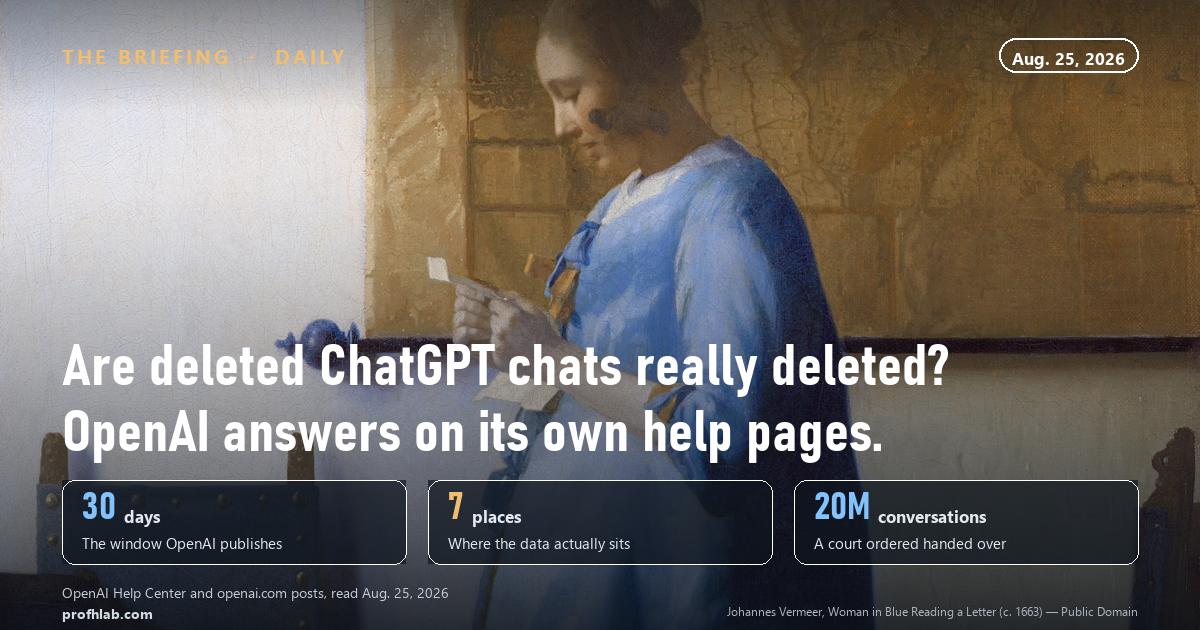
You type something into ChatGPT you would not say out loud. A salary. A diagnosis. A sentence about your marriage. Then you hover over the conversation in the sidebar, click the three dots, click Delete, and the chat vanishes.
The question that arrives about four seconds later is the one this page is about: are deleted ChatGPT chats really deleted?
OpenAI answers it. Not in a press release — on ordinary help pages that anyone can open, updated within the last two weeks. The answer is yes, within 30 days, followed by three carve-outs and one sentence that quietly undoes the whole thing.
So on August 25, 2026 we read seven of OpenAI’s current help articles and two of its own posts about the litigation, wrote down every retention number it publishes, and built the inventory nobody seems to publish: every separate place your ChatGPT data sits, whether the Delete button reaches it, and the order you have to work in so that clearing one does not refill from another.
Jump to what you need
The short answer, in OpenAI’s words · The seven places your data lives · Why the order you click in matters · The part that is not yours to delete · How long “deleted” actually takes · Temporary Chat is not a shredder · The ten-minute pass · Questions people actually ask
Are deleted ChatGPT chats really deleted? OpenAI’s own sentence
From the help article Chat and File Retention Policies in ChatGPT, updated a week before we read it:
“When you delete a chat (or your account), the chat is removed from your account immediately and scheduled for permanent deletion from OpenAI systems within 30 days, unless: the chat has already been de-identified and disassociated from you, or OpenAI must retain it longer for security or legal obligations.”
Read that twice, because the exceptions are doing real work.
“De-identified and disassociated from you.” A conversation that has been stripped of your name and account ID is no longer treated as yours to delete. It is not destroyed. It is orphaned. This is not a loophole OpenAI hides — it is the first exception listed on the page — but it is the one every “30 days and it’s gone” summary drops.
“Security or legal obligations.” This is the door the courts walk through, and we will get to who walked through it.

The sentence that changes the answer
Buried in OpenAI’s Memory FAQ is the most useful thing the company has written about deletion, and it is not on the deletion page:
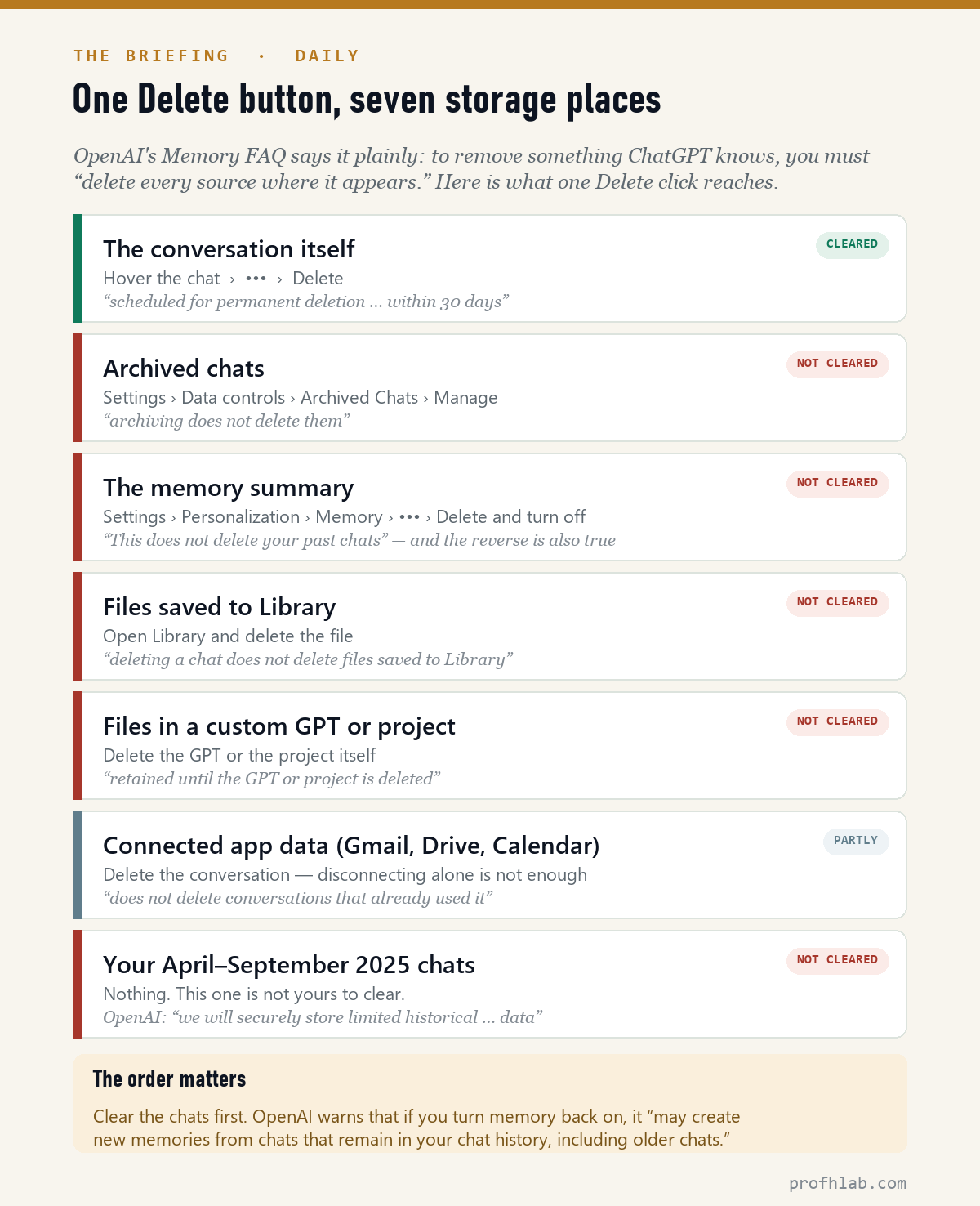
“To fully delete something ChatGPT may know about you, you’ll need to delete every source where it appears, including past chats, archived chats, files, the memory summary, and disconnect any connected apps that may contain that information.”
That is OpenAI telling you, in its own voice, that the Delete button on a conversation is not a delete button on the information in it. Add the two stores documented elsewhere — files inside a custom GPT or project, and the block of 2025 conversations held for the litigation — and you get seven.
Why the order you click in matters
Here is the trap, and it is the reason a tidy person can do all the work and end up back where they started.
Deleting your memories does not delete your chats. OpenAI says so directly: on the memory summary, choosing Delete and turn off memory “does not delete your past chats.” Fine. But the same paragraph adds the sting:
“If you turn memory back on later, ChatGPT may create new memories from chats that remain in your chat history, including older chats.”
So if you wipe the memory summary first and clear the chats second, you are fine. If you wipe the memory summary first and leave the chats — which is what most people do, because wiping memory feels like the big move — then the day you switch memory back on, it can reconstitute itself from the history you never touched.
Chats first. Memory last. That ordering is not stated anywhere in OpenAI’s documentation; it falls out of reading two pages against each other.
The part that is not yours to delete
Now the exception that swallowed the rule for a while, and what is left of it.
In May 2025, in the copyright case brought by The New York Times and other publishers, a federal magistrate ordered OpenAI to preserve output log data that would otherwise have been deleted — including conversations users had already deleted. That order is over. OpenAI’s own update, dated October 22, 2025, says its obligations under it “ended on September 26, 2025” and that it has “returned to our standard data retention practices.”
But two things survived it, and this is where the tidy story stops.
First, OpenAI still holds a block of conversations: “The New York Times continues to demand that OpenAI keep a specific set of user data from April–September 2025 … we will securely store limited historical April–September 2025 user data.” OpenAI says it is locked down, restricted to a small audited legal and security team, and has not been handed to anyone. If you used ChatGPT in that window, there is no button in your settings that reaches it.
Second, and larger: in January 2026, U.S. District Judge Sidney Stein of the Southern District of New York affirmed a magistrate’s order compelling OpenAI to produce 20 million de-identified conversation logs to the publishers’ lawyers. The plaintiffs had originally asked for 120 million. OpenAI had offered to hand over only the conversations that mentioned the plaintiffs’ articles. The court took neither position and ordered the full 20-million sample, finding that de-identification plus the existing protective order adequately balanced users’ privacy against the plaintiffs’ need.

The number that did not make the headlines came later. In a July 9, 2026 sanctions motion, the publishers alleged that OpenAI had concealed the existence of a database of roughly 78 million de-identified ChatGPT conversations that it had already assembled and searched internally. That is an allegation, not a finding, and OpenAI disputes the characterisation. But note what is not in dispute in either party’s telling: de-identified conversations are a corpus that gets kept, queried and produced. Which is precisely what exception number one on the retention page said would happen.
Two minutes of context, from people who are not us
How long “deleted” actually takes
If you want out cleanly — a copy of your history in hand, then the account closed — OpenAI’s own numbers say that is a five-week errand, not an afternoon.
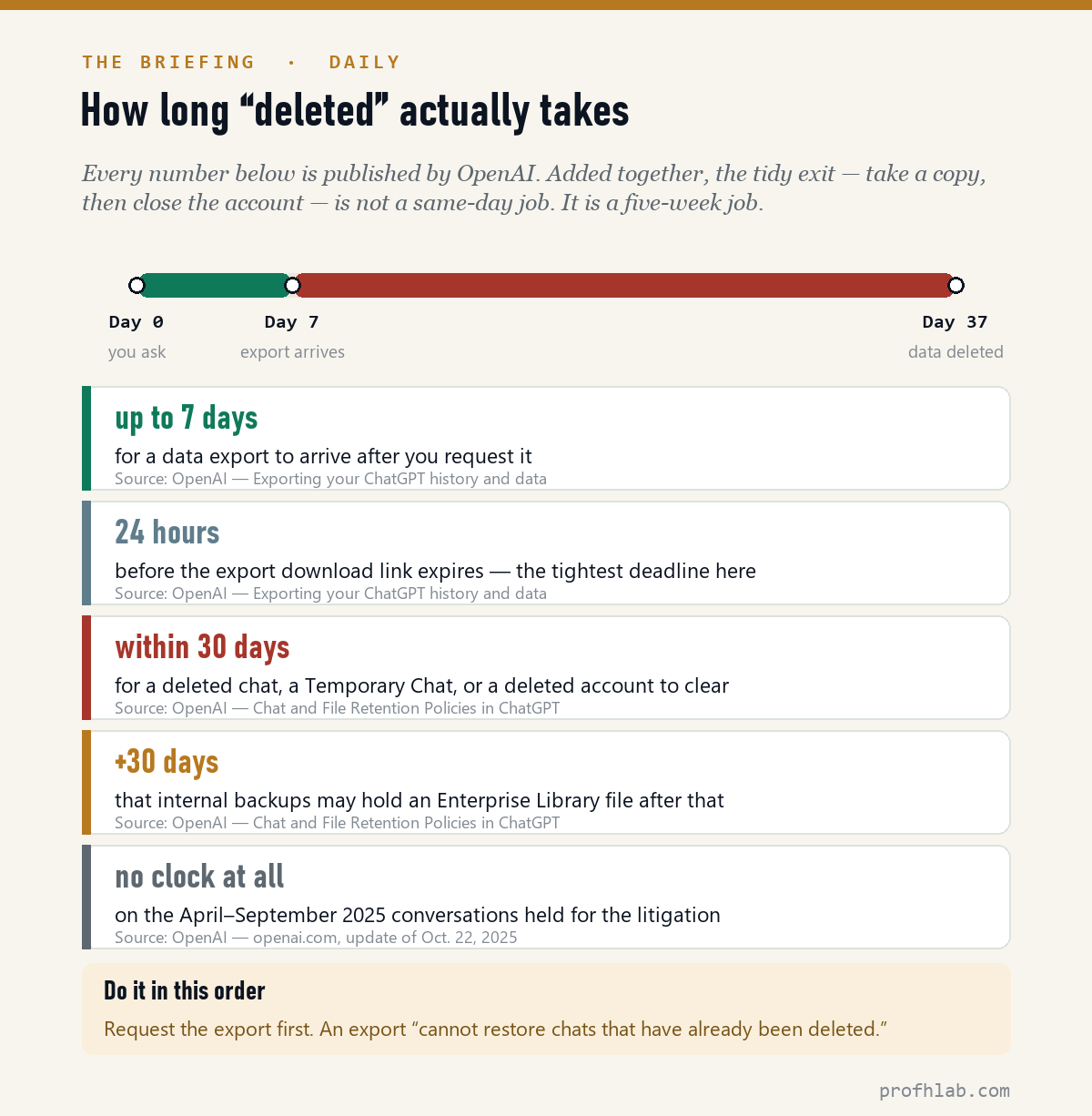
An export can take up to 7 days to arrive. When it does, the download link expires 24 hours later — so a request fired off before a holiday can quietly expire unclaimed. Then deletion runs its 30 days. Seven plus thirty is thirty-seven, and that assumes you catch the link.
Do it in the other order and there is no recovery: an export, OpenAI says, “cannot restore chats that have already been deleted.”

Temporary Chat is not a shredder
Plenty of advice tells nervous users to just use Temporary Chat. It is good advice, and it is oversold.
What OpenAI promises: Temporary Chats do not appear in your history, are not used to train models, and do not create memories. What OpenAI also says, in the same FAQ: “For safety purposes we may still keep a copy for up to 30 days.”
So Temporary Chat is not no record. It is a 30-day record you cannot see, review or delete early — which for most purposes is better than a permanent one in your sidebar, and for one purpose is worse: you cannot prove it is gone, because you were never shown it.
One more wrinkle, straight from the same page: if you use a custom GPT that has actions, “data sent to third parties through those actions is subject to the recipient’s privacy policy,” and that recipient “may keep that data for longer than 30 days.” The 30-day rule stops at OpenAI’s edge.
What we found when we looked at the competition
We pulled the results that come back for this exact question on August 25, 2026. Two are personal Medium essays. Five are blogs attached to a product or a tools directory — a memory app, a privacy tool, a Chrome-extension listing site. None is a news organisation, a law firm, or OpenAI.
To their credit, two of them get the court timeline right, which is more than we expected. What none of them does is tell you what to click. That is the gap this page exists to fill, and we have nothing to sell you at the end of it.
Being honest about the limits
Everything above is what OpenAI publishes and what the court docket shows. Neither we nor you can verify from the outside that a given conversation has actually been erased on schedule, or that a de-identified copy is not sitting in a research corpus. “Within 30 days” is a commitment, not a receipt. Treat any AI chat the way you would treat an email to a company: assume a copy exists somewhere, and write accordingly. This is general information, not legal advice.
What to do with this: the ten-minute pass
In this order. The order is the whole point.
- Take a copy first, if you want one. Settings › Data controls › Export data › Confirm export. Put a reminder in your calendar for seven days out — the download link dies 24 hours after it lands.
- Stop the training feed. Settings › Data controls › turn off Improve the model for everyone. It syncs across web and mobile, and you can flip it back any time.
- Clear the archive you forgot about. Settings › Data controls › Archived Chats › Manage. Archiving never deleted anything; it only hid it from the sidebar.
- Delete the chats themselves. Individually from the sidebar, or all at once from Data controls — which also sweeps conversations inside projects.
- Empty the Library. Every PDF, spreadsheet and photo you uploaded is stored separately, and deleting the conversation does not touch it.
- Delete any custom GPT or project you no longer use. Files inside them are kept until the GPT or project itself is gone.
- Disconnect apps — then delete the chats that used them. Disconnecting Gmail or Drive stops new access; it does not clear what an old conversation already pulled in.
- Only now, wipe memory. Settings › Personalization › Memory › the three-dot menu › Delete and turn off memory. Doing this last is what stops it refilling.
- If you are leaving entirely: Settings › Account › Delete. You will type DELETE to confirm. Cancel any App Store or Google Play subscription first — deleting the account does not cancel those, and the charges keep coming.
Can’t sign in? OpenAI’s Privacy Portal handles verified deletion and download requests without an account login. Work or school account? None of the self-service options apply — Business, Enterprise, Edu and Healthcare workspaces are controlled by your administrator, and you should ask them.
Training opt-out and deletion are two separate switches
- Does turning off training delete anything? No. Chats stay in your history exactly as before; they are only excluded from model improvement. Deletion and training opt-out are two separate switches that people routinely confuse.
- Is this different on the paid plans? The 30-day rule is the same on Free, Go, Plus and Pro. Business, Enterprise, Edu and Healthcare workspaces run on the administrator’s retention policy and get a Compliance API, and self-service export and deletion are switched off. Our AI price tracker lists what each tier costs this month.
- What about the other assistants? Same questions, different menus — we walked Microsoft’s version in Does Copilot have access to my emails?
- Worried about who else is asking? Requests for your account details are a standard opening move in AI-flavoured fraud. The scam playbook aimed at people over 60 covers what a real support message never asks for.
The 30-day rule, its three exceptions and the chats being held
Are deleted ChatGPT chats really deleted?
Mostly yes, on a 30-day schedule — with three published exceptions. OpenAI says a deleted chat is “scheduled for permanent deletion from OpenAI systems within 30 days,” unless it has already been de-identified and disassociated from your account, or it must be kept for security or legal reasons. Conversations from April to September 2025 are being held under the third exception and cannot be cleared from your settings.
Does ChatGPT really delete your data after 30 days?
Thirty days is the outer edge of the window, not a delay before deletion begins — the chat leaves your account immediately and is scheduled for removal within that period. The same 30-day figure applies to Temporary Chats, to deleted accounts, and to files inside a deleted GPT or project.
Can deleted ChatGPT chats be recovered?
Not by you. OpenAI states that deleted chats “are not retrievable through the UI, APIs, or support,” and that a data export “cannot restore chats that have already been deleted.” If you want a copy, request the export before you delete anything.
Can my ChatGPT conversations be subpoenaed?
Conversations have already been produced in litigation. In January 2026 a federal judge in the Southern District of New York affirmed an order requiring OpenAI to hand 20 million de-identified conversation logs to publishers’ lawyers under a protective order. De-identified means names and account identifiers were stripped — not that the contents are unreadable.
Does deleting a chat delete what ChatGPT remembers about me?
No, and this is the most common mistake. The memory summary is a separate store with its own controls at Settings › Personalization › Memory. Worse, OpenAI warns that if you turn memory back on, it “may create new memories from chats that remain in your chat history, including older chats” — so clear the chats first and the memory last.
Is Temporary Chat completely private?
It is private from your history, your memory and model training. It is not a shredder: OpenAI says that “for safety purposes we may still keep a copy for up to 30 days.” And if the chat uses a custom GPT with actions, whatever gets sent to that third party follows the third party’s policy, which may run longer than 30 days.
Sources
- OpenAI Help Center, Chat and File Retention Policies in ChatGPT — the 30-day rule, the de-identification and legal exceptions, Library files, custom GPT and project files, the Enterprise backup window. Retrieved Aug. 25, 2026.
- OpenAI Help Center, How to Delete and Archive Chats in ChatGPT — the delete path, “not retrievable through the UI, APIs, or support,” archiving, and connected app data. Retrieved Aug. 25, 2026.
- OpenAI Help Center, Memory FAQ — “delete every source where it appears,” and the warning that memory can rebuild from remaining chats. Retrieved Aug. 25, 2026.
- OpenAI Help Center, Data Controls FAQ — the exact path for “Improve the model for everyone” on web and mobile, and cross-device sync. Retrieved Aug. 25, 2026.
- OpenAI Help Center, Temporary Chat FAQ — the 30-day safety copy and the third-party actions caveat. Retrieved Aug. 25, 2026.
- OpenAI Help Center, Exporting your ChatGPT history and data — up to 7 days to arrive, the 24-hour link expiry, and that an export cannot restore deleted chats. Retrieved Aug. 25, 2026.
- OpenAI Help Center, Deleting your ChatGPT account — the confirmation steps, the 30-day window, the App Store and Google Play subscription warning, and the managed-workspace exclusion. Retrieved Aug. 25, 2026.
- OpenAI, How we’re responding to The New York Times’ data demands, June 5, 2025, with the update of Oct. 22, 2025 — obligations ended Sept. 26, 2025, return to standard retention, and the April–September 2025 data that is still stored.
- OpenAI, Fighting the New York Times’ invasion of user privacy, Nov. 12, 2025 — the 20-million-conversation demand, the earlier 1.4-billion demand, and the 2020 Times editorial OpenAI cites back.
- ABA Journal, ChatGPT creator must turn over 20M chat logs in copyright litigation, federal judge says, January 2026 — Judge Sidney Stein affirming Magistrate Judge Ona Wang, the reduction from 120 million, de-identification and the protective order.
- TechCrunch, New York Times says OpenAI hid evidence in ChatGPT copyright trial, July 9, 2026 — the sanctions motion and the alleged 78-million-conversation database. Allegation, not finding.
Next privacy checks: AI on your phone and what ChatGPT infers
- How do I get rid of AI on my phone? Twelve places, one real off switch
- How does ChatGPT know my age?
- How to use ChatGPT: a beginner’s guide for people over 50
Written by Prof. H, who would rather quote the company’s own help page than a roundup of other roundups. Every retention figure and menu path above was read on OpenAI’s live documentation on August 25, 2026, and every court date comes from the filings or from OpenAI’s own posts. Litigation moves; check the dates before you rely on this. General information, not legal advice.
Prof.’s H Newsletter
One short email a month, with the numbers in it
What actually moved in AI hiring, AI prices, and the scams aimed at older Americans. Counted here, dated, and linked to the source. One email a month, and your address goes nowhere else.