How Do I Talk to a Real Person? The Government Prints Its Number. Amazon Does Not.
It is nine at night and there is a charge on the card that nobody in the house recognises. Forty-one dollars, a merchant name that is mostly consonants. You want to say the sentence out loud to a human being who can look it up: this is not mine. So you do what everyone does. You open a search box and you type the words how do I talk to a real person.
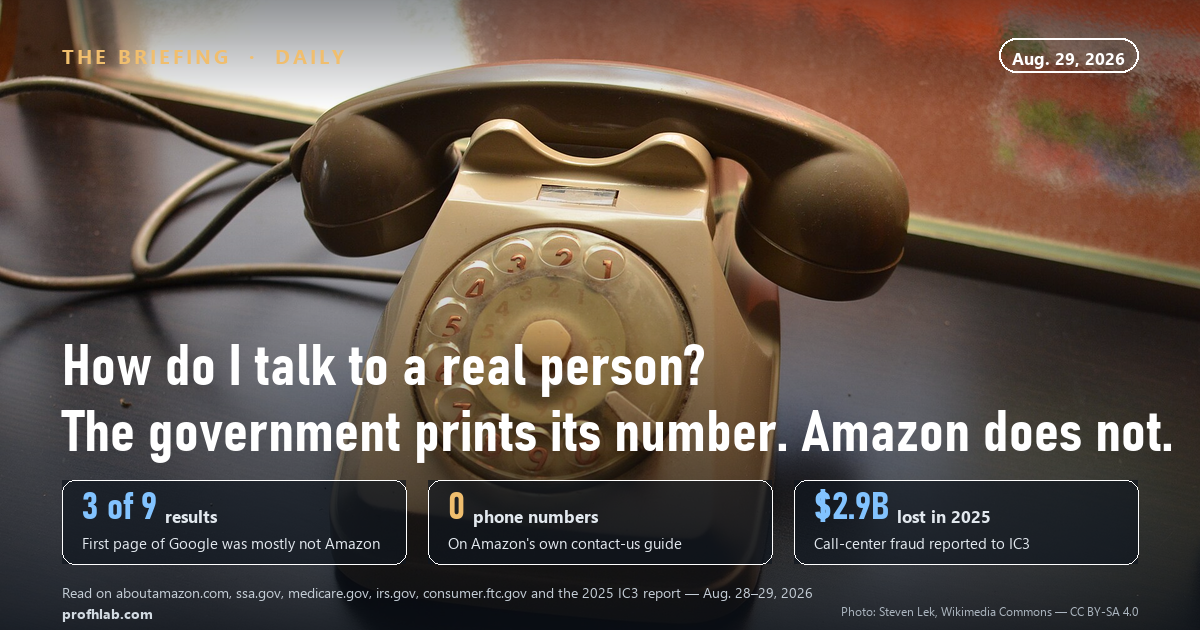
We typed them too, on August 28, and then did something slightly unusual: instead of following the first result, we wrote down all of them. Nine results came back on the first page. One of them belonged to Amazon.
What the first page of Google actually gives you
Three of the nine were blog posts on Goodreads — the book-review site. Not articles, not a help centre: author blog posts, the feature Goodreads gives novelists to talk about their novels. One is titled “Amazon Phone Number Customer Service Live Person.” We opened it. It is signed by an author account, it repeats itself for several hundred words, and the only phone number it actually contains is a British landline. The title promises an American 800 number. The post does not have one.
Two more results were forum threads. One was a Turkish consumer-complaint platform serving an English page. One was a complaints site whose page headline carries a ten-digit number that does not appear anywhere on Amazon’s own site. One was a Tom’s Guide article about a hidden button. And one — a single result out of nine — was Amazon’s own newsroom.
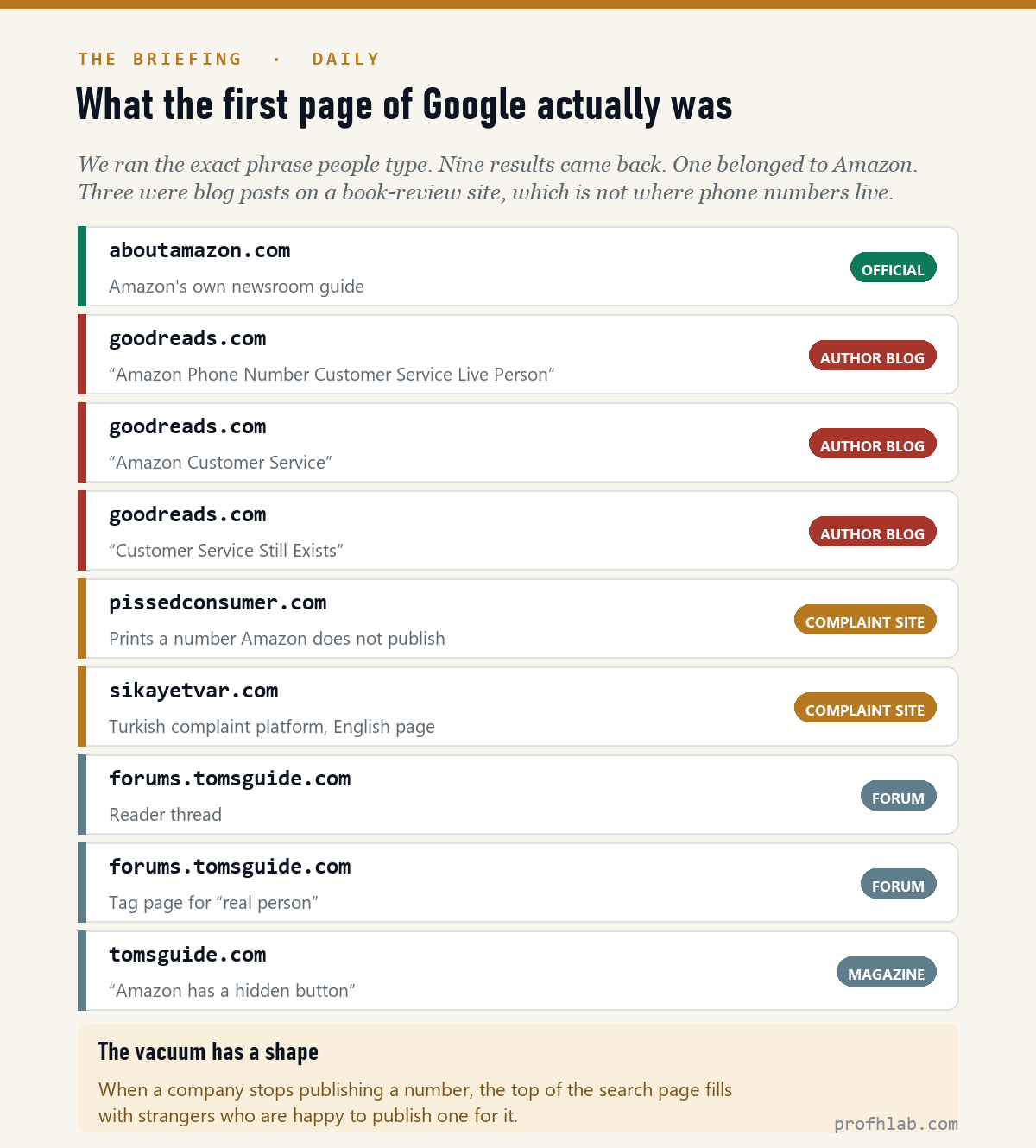
This is not a story about Google being bad at its job. It is a story about what happens to a question when the party who knows the answer stops answering it.
Amazon’s own page does not have a phone number on it
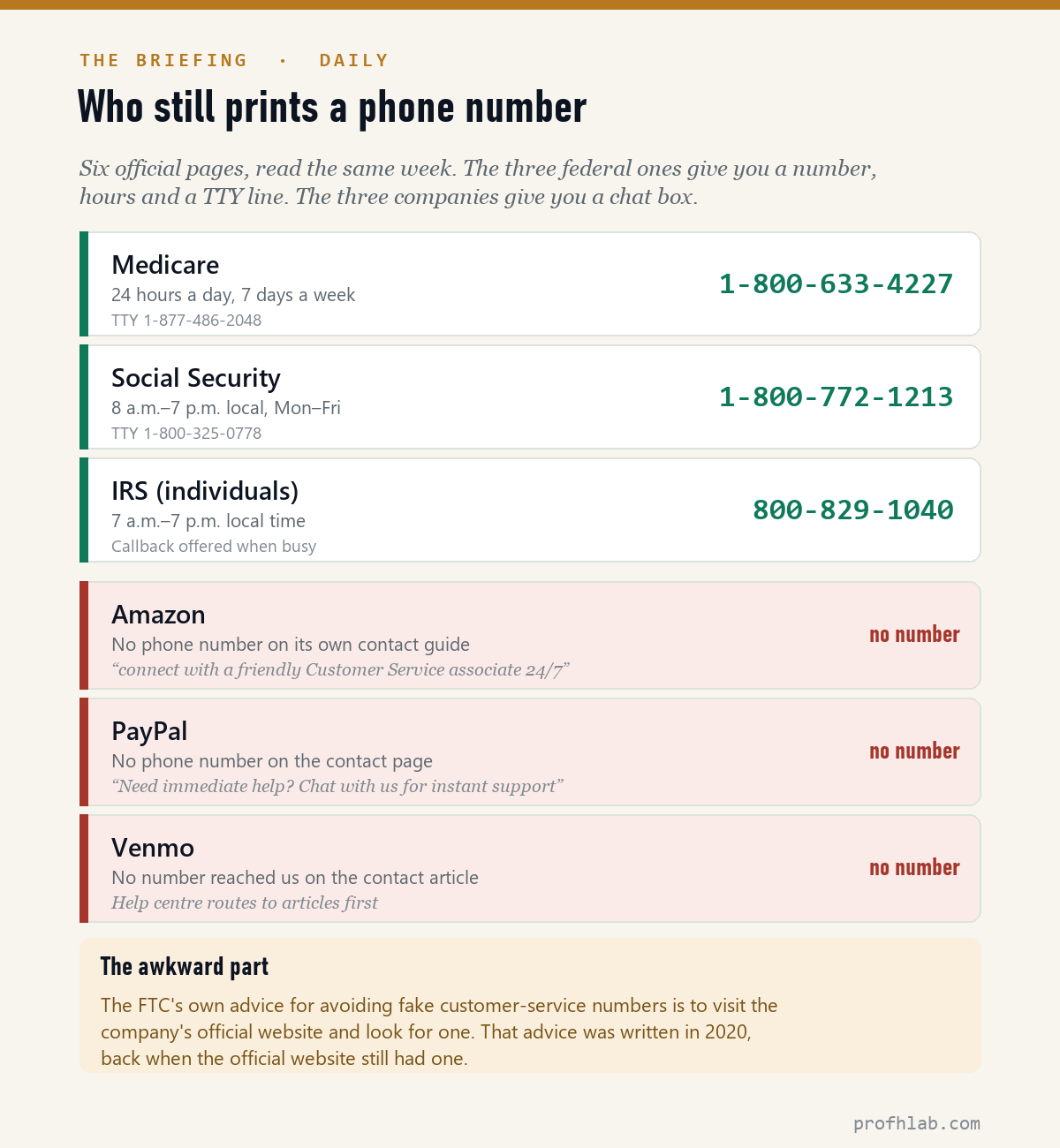
We read Amazon’s official guide, “How to contact Amazon customer service,” on its corporate newsroom. It is a helpful page, written in a friendly voice. It tells you that “you can connect with a friendly Customer Service associate 24/7 to solve any issue, large or small,” and that “with a quick online chat or phone call, they can answer your questions.”
It mentions the phone call. It does not print the number.
This is of a piece with how the company designs its other surfaces. When we went looking for a way to switch off the advertising Amazon added to Alexa+, the official answer was that you cannot; we found six settings that slow them down instead. The pattern is the same in both places: the thing you want exists, and the page that should name it does not.
PayPal’s contact page does the same thing in fewer words: Need immediate help? Chat with us for instant support. No number. Venmo’s contact article gave us no number either. In each case the design intent is obvious and, from the company’s side, entirely rational: they would rather you arrive already logged in, already identified, already attached to the order in question, than arrive as a voice on a line claiming to be you.
The government still prints its number
Read the federal pages the same week and the contrast is almost comic. Medicare’s page says you can “talk or live chat with a real person, 24 hours a day, 7 days a week,” and then gives you the number to do it: 1-800-633-4227, TTY 1-877-486-2048. The IRS publishes 800-829-1040, 7 a.m. to 7 p.m. local time, and volunteers its own average wait — about eight minutes in filing season, about fifteen the rest of the year, worse on Mondays and Tuesdays — along with an offer to call you back.
Social Security publishes 1-800-772-1213, 8 a.m. to 7 p.m. local time, Monday through Friday, TTY 1-800-325-0778. It also gives away the single most useful sentence we read all week: wait times are “typically shorter in the morning, later in the week, and later in the month.” Nobody at a private company will ever tell you that, because at a private company the wait is not a published statistic.
Social Security is drifting in the same direction as everyone else, mind you. Its contact page now opens with a heading that reads Before You Consider Calling, followed by an invitation to read the FAQs instead. The difference is that one click later, the number is still there, in plain text, on a .gov domain you can verify by looking at the address bar.
Why the standard safety advice has quietly expired
The Federal Trade Commission has a consumer alert about exactly this problem. “Some scammers are creating fake customer service information for popular companies,” it says, “and paying for it to show up in your search results.” The advice that follows is sensible: check the packaging, and — the key instruction — type the company’s website address directly into your browser to “look for customer service contact information, maybe a phone number.”
That alert was published in August 2020. Read it again next to what we found this week and you can see the hinge it turns on. It assumes the official website has a number on it. For Medicare, Social Security and the IRS, that assumption still holds. For Amazon, PayPal and Venmo, it does not. The best consumer-protection advice in the country now sends you looking for an object that several of the largest companies in America have stopped producing.
The mechanic itself is not new and it is not confined to search. Paid placement puts a stranger where an official answer should be in social feeds too, which is why we timed a set of five checks that take about ninety seconds on a suspicious ad. Search results deserve the same ninety seconds.
The rule that actually works in 2026. If an official page prints the number, call the number. If it does not, do not go looking for one — start inside the app or the account you are already logged into, and let them call you. A number you had to hunt for is a number you cannot verify, and an unverifiable number is the entire business model of the people waiting at the top of that search page.
What this gap costs
The FBI’s Internet Crime Complaint Center counted 47,794 tech and customer-support fraud complaints in 2025. Grouped with government-impersonation fraud — the two categories the bureau classifies as illegal call-centre operations — that is more than 80,000 complaints and losses exceeding $2.9 billion in a single year.
The age skew is the part worth sitting with. People aged 60 and over filed 201,266 complaints in 2025 and reported $7.7 billion in losses, more than any other age band by a wide margin. And the tooling has improved: IC3 logged 22,364 complaints with an AI element last year, with adjusted losses of $893,346,472, including more than $5 million lost to “distress” calls in which a cloned voice imitates a relative in trouble.
Two of those figures are worth reading against each other. The voice on the line is getting harder to place — we tested the advice people still repeat about this in how to tell if a phone call is AI — and the age band carrying the largest losses is the one most likely to want a human being rather than a chat window in the first place.
For that reader we keep a separate list of AI tools for seniors that are free and actually useful, assembled on the same rule as this piece: nothing goes in unless we opened it ourselves.
None of that is caused by Amazon removing a phone number. But it tells you what is standing in the doorway when a company leaves it open.

Two short videos from the FTC
Both are from the FTC’s official channel, and both are under a minute. The first is the exact scenario — a call or text about a suspicious purchase on Amazon.
Write the real Medicare, Social Security and IRS numbers on paper
Save the four numbers that are real. Write them on paper and put the paper where the phone lives. Medicare 1-800-633-4227 (24/7, TTY 1-877-486-2048). Social Security 1-800-772-1213 (8–7 local, weekdays, TTY 1-800-325-0778). IRS 800-829-1040 (7–7 local). These are printed on .gov pages and they do not change.
Call Social Security in the morning, later in the week, later in the month. That is their own published guidance about their own queue, and it costs nothing to use.
For Amazon, PayPal, Venmo, eBay: never start from a search box. Type the address yourself or open the app, sign in, and use the contact flow inside your account. Where a callback is offered, take it — a call you receive after asking for it is a call you can trust, and one you placed to a number you found is not.
If someone calls you first, the direction of the call is the tell. The FTC’s line has not changed in six years and does not need to: no legitimate company will ask you to wire money, buy gift cards, or hand over a password in exchange for customer-service help. Hang up on anyone who does, and never grant remote access to your computer.
If it has already happened, report it at reportfraud.ftc.gov. If you gave out personal information, IdentityTheft.gov will generate a free recovery plan.
Chatbots handle returns well, and urgent disputes badly
Is the chatbot actually worse? For a lost package or a return, usually not — it is faster than a queue and it already knows your order number. It is worse for anything unusual, disputed, or urgent, which is exactly the category that brings people to a search box at nine at night.
Can you tell whether the voice that answers is a person? Less and less. The old trick of listening for an unnatural pause has stopped working; we took that apart separately in how to tell if a phone call is AI.
What if the caller sounds like family? That is the distress-scam pattern in the IC3 numbers above, and the defence is a shared word agreed in advance. We wrote it up in AI scams targeting seniors.
Can you just remove the assistant instead? Partly. We went through every place an assistant now sits on a handset and found twelve of them and one real off switch. Fewer assistants will not get you a phone number, but it does cut down the number of doors.
What happens to what you typed into the chat box? Less deletion than the word implies. We traced seven places a deleted chat still lives, which is worth knowing before you paste an order number and a card ending into a support window.
What else do you count around here? Two running tallies: the AI price tracker, where we re-check subscription prices and log the changes with dates, and the AI jobs tracker, where we count openings rather than repeat press releases. The method behind both is written out in how we count.
Search-result numbers, 24-hour lines and why companies hide theirs
How do I talk to a real person at Amazon?
Not by calling a number you found in a search result. Amazon’s own contact guide does not publish one; it directs you to its Customer Service page, where you sign in and ask for chat or a callback. Starting from inside your signed-in account is both the fastest route and the only one where you can be certain who is on the other end.
Is the phone number I found for Amazon in Google results the real one?
We could not verify any of them. The numbers on page one of our search came from a complaints site and an author blog, not from Amazon, and one of those pages offered a British landline under an American headline. Amazon does not print a customer-service number on its own contact guide, which means a number found elsewhere cannot be checked against the source. Treat it as unverified.
What is the phone number to talk to a real person at Social Security?
1-800-772-1213, 8 a.m. to 7 p.m. local time, Monday through Friday; TTY 1-800-325-0778. Automated services run 24 hours. Social Security’s own page says waits are typically shorter in the morning, later in the week, and later in the month.
Does Medicare have a 24-hour phone number?
Yes. Medicare’s page states you can talk or live chat with a real person 24 hours a day, 7 days a week, except some federal holidays, at 1-800-633-4227 (TTY 1-877-486-2048).
Why do companies hide their phone numbers now?
Mostly because chat inside a signed-in account is cheaper to staff and it authenticates you before the conversation starts. That second reason is genuinely a security argument, not just a cost one. The side effect is that the space where a number used to be published is now filled by whoever wants to rank there.
Is it safe to call a customer service number I found on Google?
Only if you can trace it back to the company’s own site. The FTC warns that scammers create fake customer-service listings and pay to surface them in search results. If the official page prints the number, call it. If the official page does not print a number, that is your answer — use the app.
This is general consumer information, not legal or financial advice. For Medicare questions you can also reach a free, unbiased counsellor through your State Health Insurance Assistance Program (SHIP) at shiphelp.org, or call 1-800-MEDICARE.
Sources
- Our own record of all nine page-one Google results for “how do i talk to a real person at amazon customer service,” and our reading of the Goodreads author blog post that ranked among them — August 28, 2026.
- Amazon, “How to contact Amazon customer service,” aboutamazon.com — the “friendly Customer Service associate 24/7” and “quick online chat or phone call” wording, and the absence of a published number (read August 28, 2026).
- PayPal, “Contact Us” help page — “Need immediate help? Chat with us for instant support” (read August 28, 2026).
- Social Security Administration, “Contact Social Security By Phone” and “Contact Social Security” — 1-800-772-1213, hours, TTY, the 24-hour automated services, the “shorter in the morning, later in the week, and later in the month” guidance, and the “Before You Consider Calling” heading (read August 29, 2026).
- Medicare.gov, “Talk to someone” — “talk or live chat with a real person, 24 hours a day, 7 days a week,” 1-800-633-4227, TTY 1-877-486-2048 (read August 28, 2026).
- Internal Revenue Service, “Telephone assistance” — 800-829-1040, 7 a.m. to 7 p.m. local time, published average waits and the callback option (read August 28, 2026).
- Federal Trade Commission, “Scammers and ‘customer service’ — another imposter scam,” consumer alert by Jabari Cook, August 5, 2020 — the paid-search warning and the four protective steps (read August 28, 2026).
- FBI Internet Crime Complaint Center, 2025 IC3 Annual Report — 47,794 tech/customer support complaints; more than 80,000 call-centre fraud complaints with losses exceeding $2.9 billion; 201,266 complaints and $7.7 billion in losses among people 60 and over; 22,364 AI-related complaints with $893,346,472 in adjusted losses; more than $5 million lost to voice-cloned distress calls.
When the voice on the line might be a machine, or a scammer
- How to tell if a phone call is AI: the pause test is dead
- AI scams targeting seniors: the voice on the phone, and the one question that stops it
- How to tell if a Facebook ad is fake: 5 checks that take 90 seconds
- How to turn off Alexa+ ads on Echo Show: Amazon says you can’t, and 6 settings that slow them down
- How do I get rid of AI on my phone? Twelve places, one real off switch
- The best AI tools for seniors in 2026: free help for seeing, hearing, and reading
This piece ran in The Briefing, our daily look at where AI meets an ordinary bill, phone call or errand. New here? Start here, or put a question to us on the FAQ page.
Written by Prof. H, who set out to find a phone number and ended up writing down a search results page instead. Every figure above was read on the cited page on August 28 or 29, 2026, and the two video embeds were checked for playability the same day.
Prof.’s H Newsletter
One short email a month, with the numbers in it
What actually moved in AI hiring, AI prices, and the scams aimed at older Americans. Counted here, dated, and linked to the source. One email a month, and your address goes nowhere else.