Can You Opt Out of AI Resume Screening? We Read 19 AI Employers’ Own Pages. 0 Offer a Switch.
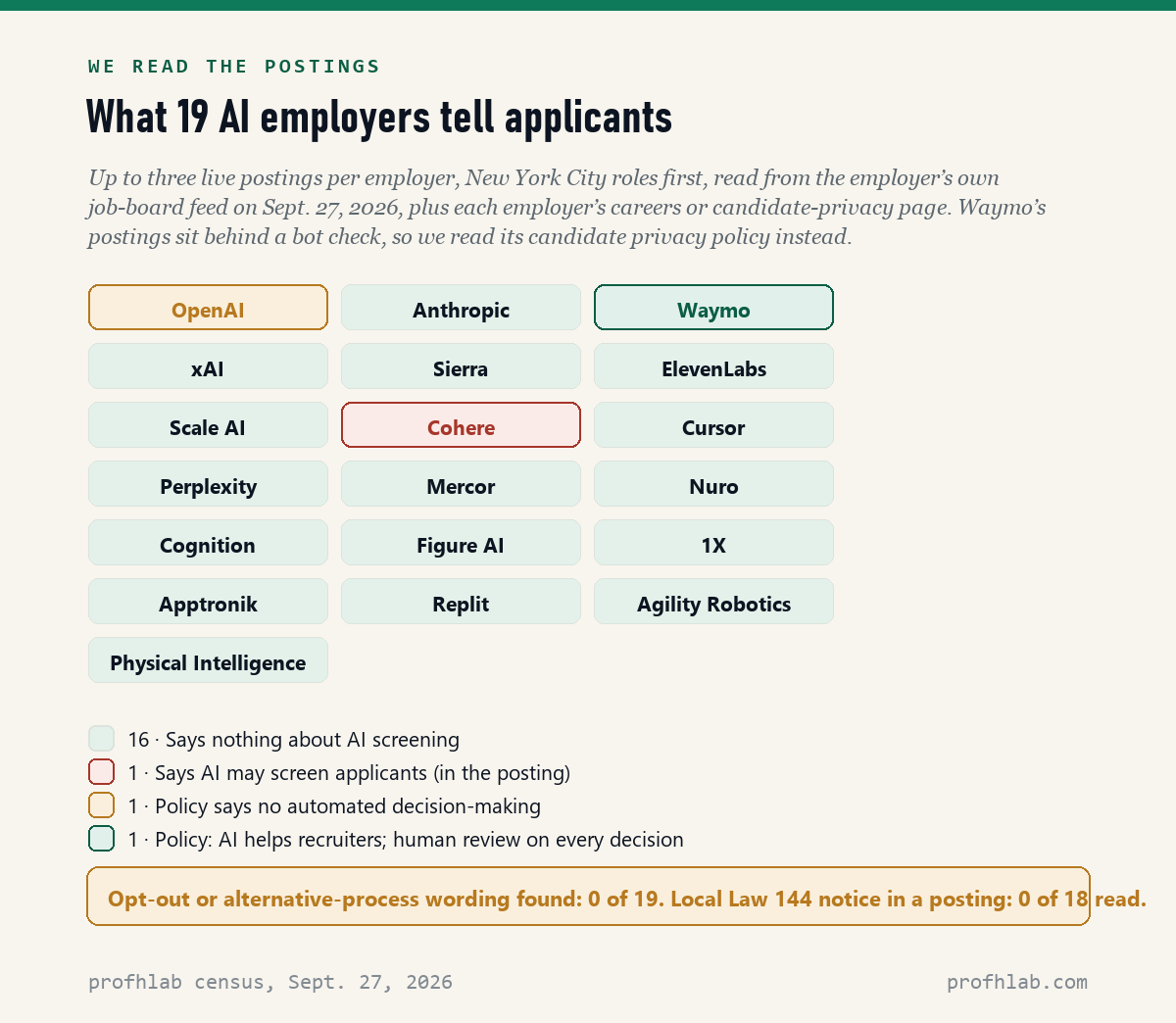
No. On September 27, 2026 we read the live job postings of 18 AI employers and the careers or candidate-privacy pages of all 19 we track every day, and 0 of them offer a way to opt out of AI resume screening. Exactly 1 of the 18 says in the posting that AI may screen you. The largest one, OpenAI, says the opposite in its own applicant privacy policy: “We do not use your personal information for automated decision-making.” The nine results Google returns for this question say none of that, because none of them opened an employer’s form.
What we checked on September 27, 2026
We took the 19 employers whose job boards feed our AI & Robotics Jobs Board (3,865 open postings on the September 26 scan) and, for each, read up to three live postings through the employer’s own job-feed — New York City roles first, because that is where a written AI-hiring law applies — plus the employer’s careers page or candidate privacy policy.
We searched every page for four things: any statement that AI or an automated tool screens applicants, any mention of New York City’s Local Law 144 or a bias audit, any opt-out or alternative-process wording, and any rule about applicants using AI themselves. We then read all nine page-one results for this question and scored them, and we read the New York City rules, the Colorado statute pages and the three employer policies we quote.
- 0 of 19 offer an opt-out or an alternative process, in a posting or on a policy page.
- 1 of 18 whose postings we could read (Cohere) says AI may screen applicants. Waymo’s postings sit behind a bot check, so we read its candidate privacy policy instead — it says AI helps recruiters and a human makes every decision.
- 13 of 19 had New York City postings, and 0 put the Local Law 144 notice in the posting. The law lets them put it on the careers site instead; of the 15 careers pages we could load, none linked a bias audit either.
- 6 of 9 page-one results are written by companies that sell resume tools. 0 of 9 quote an employer’s own policy.
Written and checked by Prof. H. An AI assistant helped draft and run the page reads; every quote below was read on the employer’s or agency’s own page on the date shown. This is a count of what the pages say, not legal advice.
Which AI employers admit they screen you with AI?
One of the 18 whose postings we could read says so in the posting, and it is Cohere. All three Cohere postings we opened, including a Remote (New York) role, carry the same sentence: “We may use AI-enabled tools to screen and assess applicants against the criteria for this position.” No opt-out follows it. It is the only in-posting disclosure we found among 18 employers, and it is also the most honest thing on any of these pages.
Waymo, whose 358 postings we could not read because its careers site answers automated requests with a bot challenge, puts its position in a candidate privacy policy last updated September 9, 2026: “To support our recruiters and enhance efficiency, we may use artificial intelligence tools to help our recruiters assess and evaluate candidates during the recruiting process.”
Two sentences later it draws the line an applicant actually cares about: “You will not be subject to decisions that will have a significant impact on you based solely on automated decision-making,” and, further down, “All hiring decisions will involve meaningful human review and oversight.”
The other sixteen — xAI, Sierra, ElevenLabs, Scale AI, Cursor, Perplexity, Mercor, Nuro, Cognition, Figure AI, 1X, Apptronik, Replit, Agility Robotics, Physical Intelligence and Anthropic — say nothing in their postings about whether a machine reads your resume. Anthropic comes closest, and it is the mirror image: every Anthropic posting links a page titled “Guidance on Candidates’ AI Usage” (last updated July 10, 2025) that tells you when you may use Claude while applying. It says nothing about whether Anthropic uses AI on you.
Does OpenAI use AI to screen job applicants?
OpenAI’s own policy says no. Every one of its 830 open postings links two PDFs, and the global employee-and-contractor privacy policy, last updated April 23, 2026, states under “Rights around Automated Decision-Making Technology”: “We do not use your personal information for automated decision-making.” The shorter U.S. version, dated February 1, 2023, says the same. The policy goes on to describe what rights you would have if that ever changed — a request for information, and an opt-out — which is the only opt-out language we found on any of the 19 employers’ pages, and it is hypothetical.
Take that for what it is: a statement in a privacy policy, not an audit. But it is a dated, primary-source statement from the company whose model most of the “beat the AI screener” articles are warning you about, and none of those articles mention it.

Why do the top results say there is an opt-out checkbox?
Because none of the nine opened a real employer’s form. We read every result Google returned for “opt out of ai resume screening” on September 27, 2026 and scored each for eight things. Three of the nine say an opt-out checkbox exists on applications. Zero counted one on an actual employer’s page.
Six of the nine are published by companies that sell resume builders or resume optimizers, which means the advice “don’t opt out, optimize your resume instead” is coming from the people who sell the optimizing. Only two of the nine link to any government source. Six name New York City’s law; three name Illinois or Colorado; none quote the text of any of them.
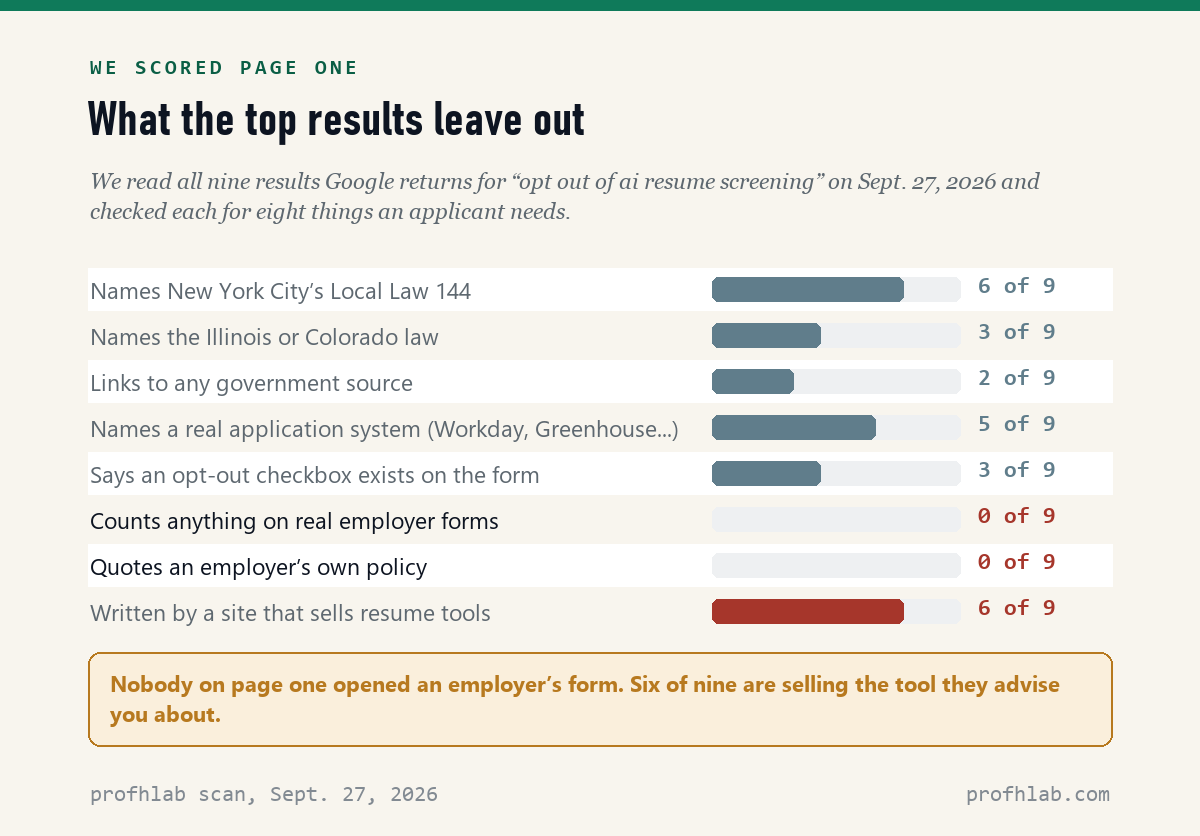
The checkbox those articles describe does exist somewhere — some applicant-tracking systems can show one when an employer turns it on — but on the 18 AI employers whose forms we could read, we did not find it once. If you are applying to the companies in our board, plan on there being no box.
What does New York City’s Local Law 144 actually give an applicant?
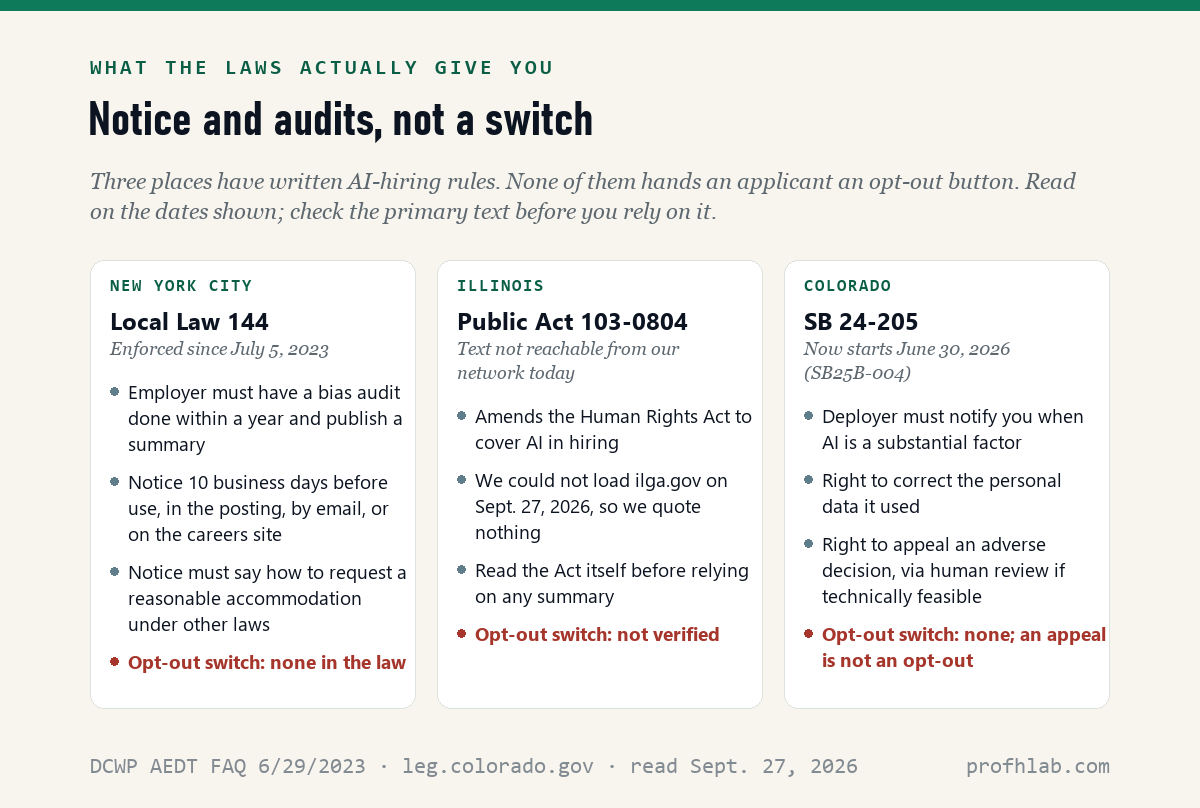
Notice and a published bias audit — not a switch. The city’s Department of Consumer and Worker Protection began enforcing the law on July 5, 2023. Its FAQ, dated June 29, 2023, says an employer using an automated employment decision tool on New York City residents must “ensure a bias audit was done and provide required notices.”
The audit has to have been done within a year of use, and the employer must publish “a summary of the results of the most recent bias audit” and the date it started using the tool, either on “the employment section of their website” or through a link to it.
The notice is the part that touches you. It must go out “10 business days before using an AEDT,” it must tell you which job qualifications the tool will assess, and it must “include in the notice instructions to request a reasonable accommodation under other laws.”
It can be in the posting, sent by mail or email, or — and this is the loophole that explains our zero — posted once on the careers site, where it “does not have to be position-specific.” So an employer can be fully compliant with a single page you will never see from the posting. Of the 15 careers pages we could load, none linked to one.
Two more things the FAQ says plainly. The law “does not require any specific actions based on the results of a bias audit” — an employer can publish a bad audit and keep using the tool. And there is no opt-out anywhere in it. What you get is the right to know, the right to read the audit, and the accommodation route. Complaints go to 311.
What changes in Colorado on June 30, 2026?
Colorado is the first state to give applicants an appeal, and it is an appeal, not an opt-out. Senate Bill 24-205, signed May 17, 2024, was due to start on February 1, 2026; a special-session bill, SB25B-004, signed August 28, 2025, moved the start of its requirements to June 30, 2026.
From that date a deployer of a “high-risk” AI system must tell you when the system makes, or is a substantial factor in, a consequential decision about you, must give you “an opportunity to correct any incorrect personal data” the system used, and must give you “an opportunity to appeal, via human review if technically feasible, an adverse consequential decision.” Employment decisions are consequential decisions under the act.
Read the qualifier twice: if technically feasible. And read what is missing: nothing in the statute page lets you refuse the tool up front. It is a right to know, a right to fix your data, and a right to a second look after a rejection.
What about Illinois? Here is what we could not verify today
Illinois amended its Human Rights Act to cover AI in hiring, and we are not quoting it. The amendment is Public Act 103-0804. On the day we wrote this, the Illinois General Assembly’s website would not load from our network through five different routes, and the secondary summaries we could reach disagree with each other on details.
Rather than repeat a summary we cannot check, we are telling you that the law exists, giving you its number, and asking you to read it at ilga.gov before you rely on any description of it — including ours, once we add one. We will update this section when we can read the text.
So what do you actually do when there is no switch?
Five things, in the order they will save you time. None of them is a trick, because the count above says the trick does not exist.
- Read the posting for the one sentence. If it says what Cohere’s says — “We may use AI-enabled tools to screen and assess applicants” — you know a machine reads first and a person reads a shortlist. Write the first page for the machine: the exact title, the exact tools, the plain nouns. Save your story for the interview.
- Look for the applicant privacy policy link, and search it for “automated.” OpenAI’s says it uses none. Waymo’s says AI assists and a human decides. That sentence tells you more than any resume-tool blog can.
- If the job is in New York City, ask for the notice. The employer must be able to show you the notice and the bias-audit summary. An employer that cannot is either not using a tool or not complying; either way you have learned something.
- Use the accommodation route if you have one. The New York City notice must tell you how to request a reasonable accommodation under other laws. That is the closest thing to an alternative process the law provides, and it is meant for people who need one, not as a general opt-out.
- Keep the rejection email. From June 30, 2026, a Colorado deployer owes you an explanation and a human-review appeal on an adverse decision. Rights like that are only useful if you kept the paper.
And the thing not to do: do not opt out of a process that has no opt-out by writing “please have a human read this” in the cover letter. On the 18 boards we read, it goes into the same parser as everything else.
How an applicant tracking system files and filters you
Indeed’s own explainer is the clearest short account of what an applicant tracking system does and does not do — it is a filing system first and a filter second. NBC10 Boston’s report is a useful reality check on the “AI filter” framing. Both verified as embeddable on September 27, 2026.

No opt-out box on 18 forms, and what NYC and Colorado require
Is there an opt-out checkbox for AI screening on job applications?
Not on any of the 18 AI employers whose forms we read on September 27, 2026. Some applicant-tracking systems can display one if the employer switches it on; none of these employers had.
Is it illegal for an employer to use AI to screen resumes?
No. New York City requires a bias audit and notice; Colorado, from June 30, 2026, requires notice, data correction and a human-review appeal; Illinois has amended its Human Rights Act. None of them bans the tool. Federal anti-discrimination law still applies to the outcome.
Does opting out hurt my chances?
We cannot measure an outcome for a switch that does not exist. What we can say is that on these 19 employers there is nothing to opt out of, so the question is moot for them. Where a box does exist, the honest answer is that nobody outside the employer knows what happens to that queue.
Which AI companies say a human reads every application?
Waymo’s candidate privacy policy (September 9, 2026) says all hiring decisions involve meaningful human review. OpenAI’s policy (April 23, 2026) says it does not use automated decision-making at all. Cohere says AI may screen and assess. The other 16 do not say.
How do I know if a company used an AI tool on my application?
In New York City, ask for the notice and the bias-audit summary; the employer must have them. Elsewhere, read the applicant privacy policy for the word “automated.” If neither exists, you do not know, and neither does anyone writing about it.
Can I use AI to write my resume if the employer screens with AI?
Anthropic is the only one of the 19 with a written policy on this, and it invites you to use Claude to refine a draft you wrote yourself. Our earlier count found that of 2,930 AI job postings, none asked you to hide it. Read Should I Put ChatGPT on My Resume? for the numbers.
Where every figure in this article came from
All read on September 27, 2026 unless dated otherwise. Our counting method is described at How We Count.
- Employer postings via each employer’s public job-feed (Ashby, Greenhouse and Lever posting APIs) for the 19 employers on our board, from the September 26, 2026 scan of 3,865 postings.
- Cohere postings, Remote (New York) and Remote (San Francisco).
- Waymo Candidate Privacy Policy, careers.withwaymo.com, last updated September 9, 2026.
- OpenAI Global Employee and Contractor Privacy Policy, last updated April 23, 2026, and U.S. Employee and Contractor Privacy Policy, February 1, 2023, both linked from every OpenAI posting.
- Anthropic, “Guidance on Candidates’ AI Usage,” last updated July 10, 2025.
- NYC Department of Consumer and Worker Protection, “Automated Employment Decision Tools: Frequently Asked Questions,” June 29, 2023, and the DCWP AEDT page.
- Colorado General Assembly pages for SB 24-205 (signed May 17, 2024) and SB25B-004 (signed August 28, 2025).
- Google page one for “opt out of ai resume screening,” nine results, scored for eight items.
- YouTube oEmbed and watch-page checks for the two videos.
- We could not load ilga.gov for Illinois Public Act 103-0804 and quote nothing from it.
The 2,974-posting certificate count and the job-alert guide
Entry-level AI jobs with no experience — how many of the 3,000-plus postings actually use the words, and what they ask for instead. Is an AI certificate worth it? — 0 of 2,974 postings asked for one. How to set up job alerts for specific companies — the 20 boards, and which ones have a real alert. Is the AI job market saturated? — the week-over-week count. And the Jobs Board itself, which is where the 19 employers in this article come from, refreshed every morning.
Prof.’s H Newsletter
One short email a month, with the numbers in it
What actually moved in AI hiring, AI prices, and the scams aimed at older Americans. Counted here, dated, and linked to the source. One email a month, and your address goes nowhere else.