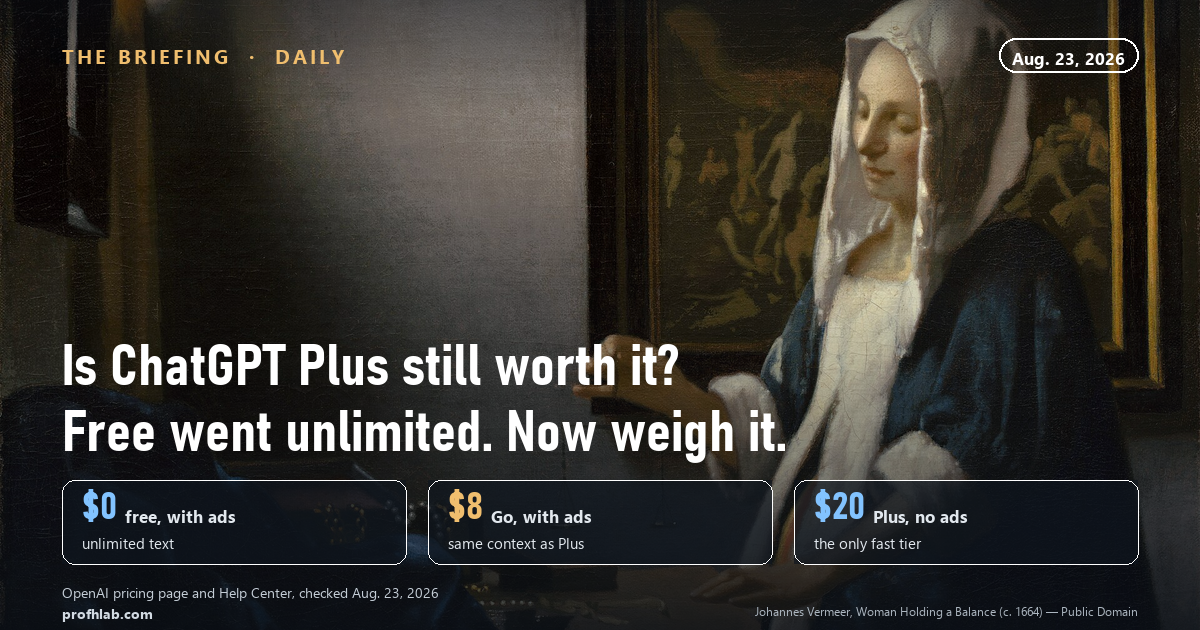
Is ChatGPT Plus Still Worth It? Free Went Unlimited, and OpenAI’s Own Page Says “Limited” Seven Times
Update · September 13, 2026
GPT-6 launched, and it does not change this answer
If you came here because you saw that GPT-6 Astra launched on September 3, 2026 and wondered whether $20 buys it: not in the box you type into. On Plus, Astra appears inside Work and Codex, while the ordinary chat window still offers GPT-5.6 Sol as its top model. The free tier runs GPT-5.6 Luna and does not get Astra at all.
Which means the $8-versus-$20 experiment described below is still the right experiment, and the ad on the free tier is still the real reason people upgrade. What Astra actually changed, and for whom.
Somewhere in America this morning, a person on the free version of ChatGPT typed a question, got an answer, and noticed a small labelled card underneath it. An ad. And a reasonable thought followed: wait — I thought I was paying $20 a month so this wouldn’t happen. They aren’t. That’s the other free account. Theirs.
Two things changed in August that make the old advice about ChatGPT plans wrong. On August 6 OpenAI announced it was removing the message cap on free text chats, and rolled it out the week of August 10. And on August 16 it quietly stopped letting personal accounts — Free, Go, Plus and Pro — build new custom GPTs.
So the single biggest reason people paid ($20 buys you more messages) got weaker, and one of the classic feature-list reasons (custom GPTs) got deleted. Nearly every “is ChatGPT Plus worth it” page on the internet was written before both. This one was written on August 23, 2026, with OpenAI’s own pricing page and help centre open in the next tab.
The word that defines the free tier is not “unlimited”
Here is the smallest, most useful thing we found, and it took no reporting at all — just counting. Go to OpenAI’s pricing page and read the Free plan card. It has eight bullets. One of them begins with the word Unlimited. The other seven begin with the word Limited.
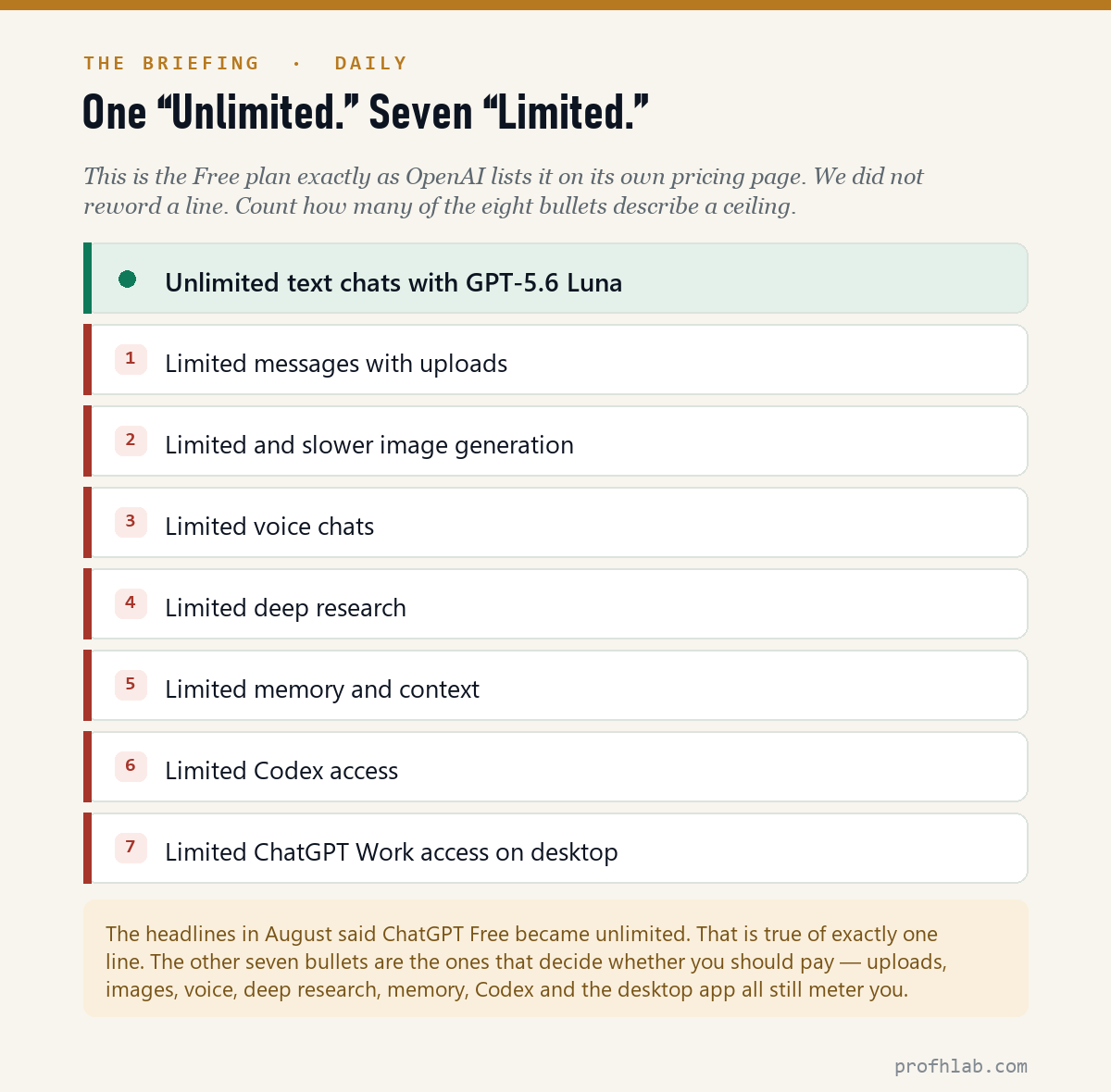
OpenAI’s own help centre says the same thing in a single sentence, and it is the most honest summary of the change anyone has written: “Free users have unlimited everyday text chats, subject to abuse-prevention safeguards. File uploads, image generation, voice, data analysis, and other tools have separate usage limits.”
Unlimited typing. Metered everything else. If what you do with ChatGPT is ask questions and read answers, the free tier just became genuinely sufficient. If what you do involves handing it a document, a photo, or your voice, nothing about your day got better on August 10.
“Free” is now two different plans, and only one is unlimited
This is the part that almost no coverage mentioned, and it comes straight from OpenAI’s ads FAQ, updated two days ago:
“If you’re on the Free plan and prefer not to see ads, you can switch to an Ads-Free experience. This removes ads, but comes with lower usage limits and reduced feature access (for example, fewer messages and no access to some tools like image generation or deep research). If you want an ad-free experience without the reduced Free limits, you can upgrade to Plus or Pro.”
Read that twice, because it reorganises the whole decision. There is no longer one free tier. There are two, and you have to pick which thing you’d rather give up.
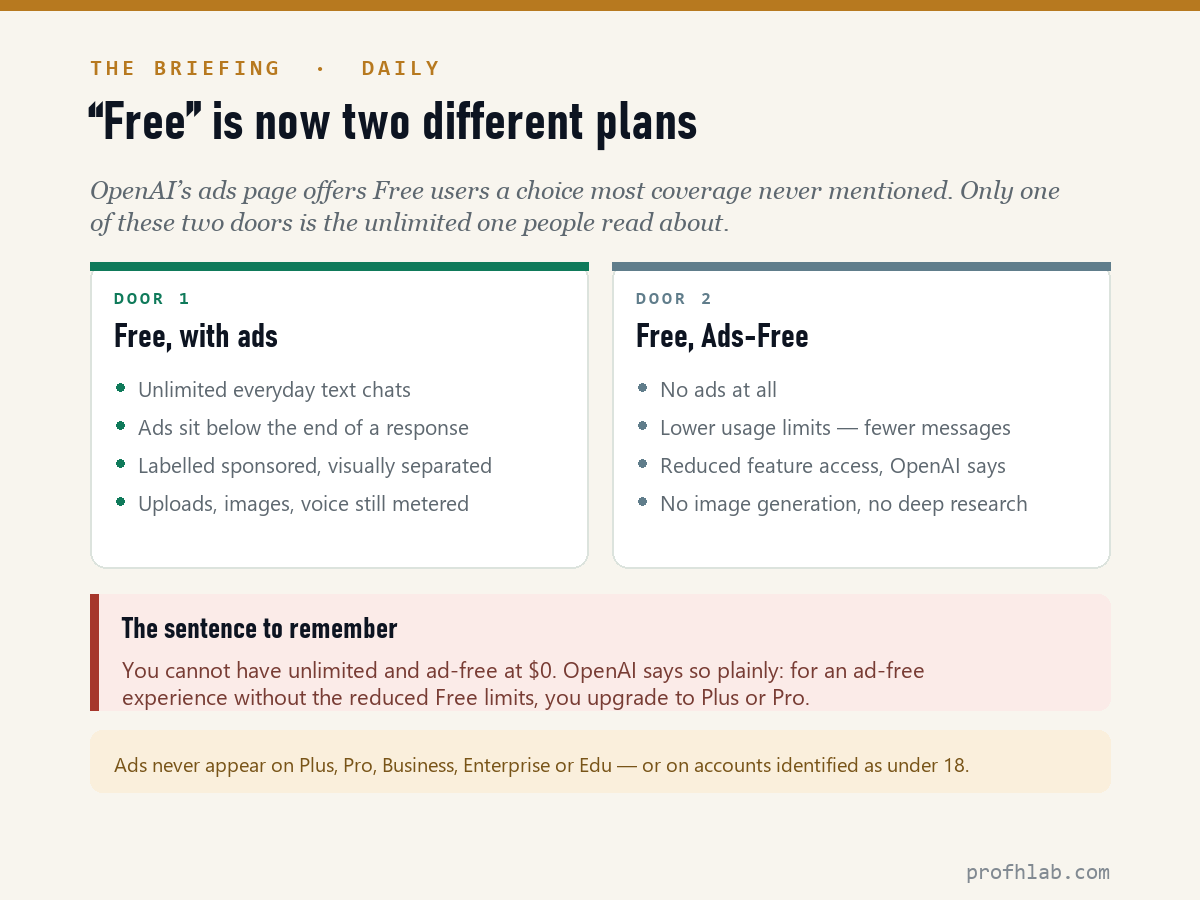
Which means the famous August headline — ChatGPT is now unlimited for free users — describes exactly one of two doors. If you walk through the other one, you are back to fewer messages and no image generation. The unlimited version is the ad-supported version. That’s the trade.
Why is ChatGPT showing me ads now?
Because OpenAI started putting them there on February 9, 2026, and has been widening the test ever since. Its own post has been updated three times: March 26 (early results), May 7 (expanding to the UK, Mexico, Brazil, Japan and South Korea) and August 11 (those five markets now out of testing and live).
The mechanics, from the help centre: “Ads can appear below the end of a response. Ads are clearly labeled as sponsored and visually separated from ChatGPT’s response.” And the eligibility rule, which is short enough to memorise: “Ads may appear for users on the Free and Go plans. Plus, Pro, Business, Enterprise, and Edu accounts will not have ads. We do not show ads to accounts identified as belonging to people under 18.”

Note the sentence about under-18 accounts, because it is genuinely useful and nobody puts it in a headline: if a teenager in your house uses ChatGPT on an account identified as theirs, it is ad-free without anyone paying anything. (How ChatGPT decides how old you are is a separate question we’ve already taken apart.)
One honest note on our own reporting. OpenAI’s help page says ad controls live at Settings → Ad Controls. When we opened a logged-in account by hand on August 20 and photographed the settings list for an earlier piece, there was no Ad Controls row in it. That gap is what a staged rollout looks like from the inside. If you don’t see the menu, you are not doing it wrong.
The number nobody prints: Go and Plus have the same context window
OpenAI publishes a plan comparison table below the pricing cards. Most write-ups skip it. It contains the single most decision-relevant number on the page, and it says something surprising.
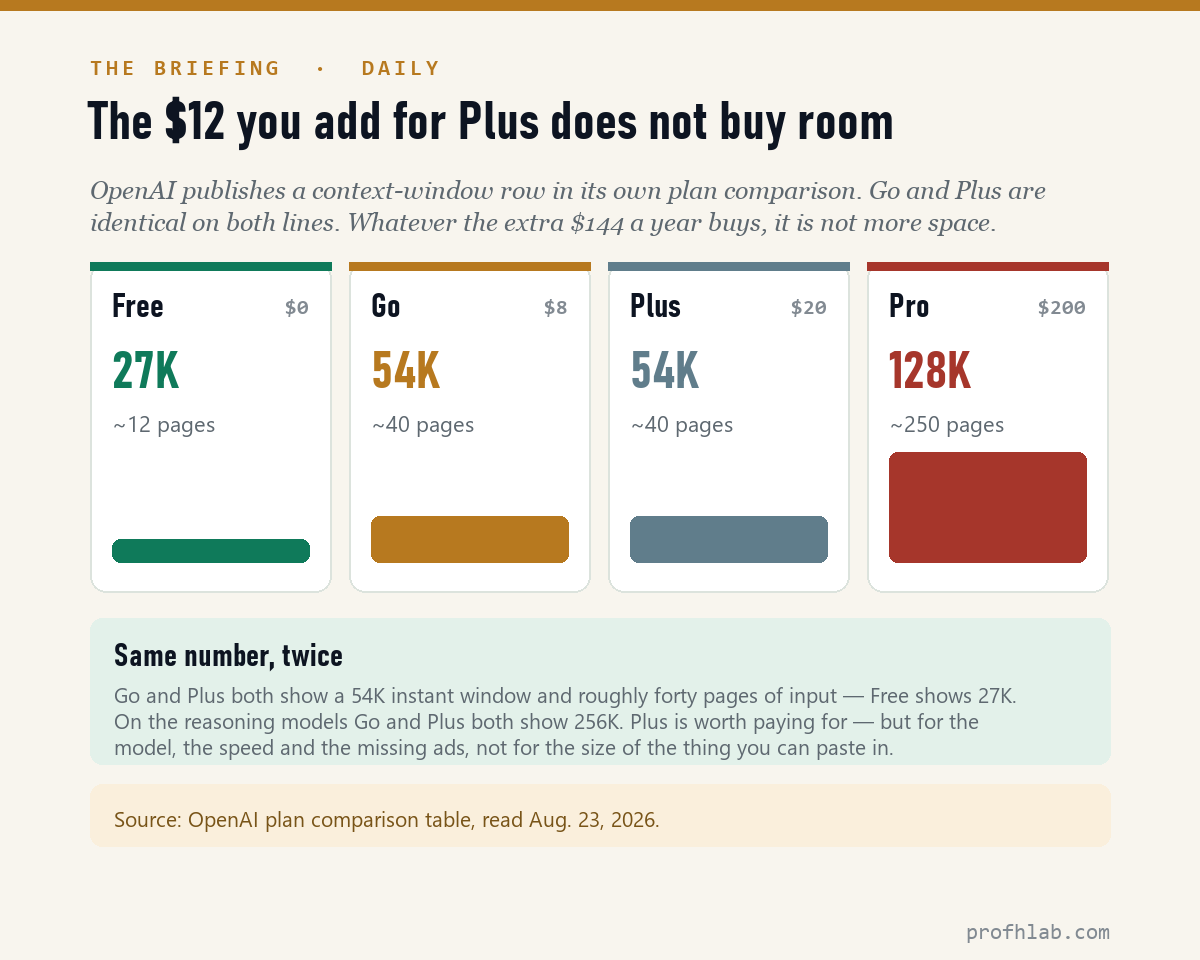
| Plan | Per month | Instant context | Input max | Response speed | Ads |
|---|---|---|---|---|---|
| Free | $0 | 27K | ~12 pages | Limited on bandwidth & availability | Yes |
| Go | $8 | 54K | ~40 pages | Limited on bandwidth & availability | Yes |
| Plus | $20 | 54K | ~40 pages | Fast | No |
| Pro | $200 | 128K | ~250 pages | Fast | No |
All values transcribed from OpenAI’s plan comparison table and pricing cards, August 23, 2026. On the reasoning models the pattern repeats: Go and Plus both show 256K, Pro shows 400K.
Two things fall out of that table. First, if your reason for wanting Plus was “I need to paste in longer documents,” Go gets you the identical ceiling for $12 less a month. Second — and this is the row people skip — Plus is the first tier where OpenAI stops describing your response speed as “limited on bandwidth & availability” and starts calling it “Fast.” Free and Go share that hedge. You are not only buying capability at $20. You are buying priority when the servers are busy.
What $20 actually buys in August 2026 — and what it stopped buying
Stripped of marketing, here is the honest list of what Plus adds over the $8 tier, per OpenAI’s own card: advanced reasoning models with GPT-5.6, expanded messages and uploads, more complex and accurate image creation, expanded deep research, expanded memory and context, projects and scheduled tasks, expanded Codex usage, and the full desktop-web-mobile version of ChatGPT Work. Plus no ads, plus the “Fast” label.
And here is what it no longer buys, which you will still find listed as a selling point on review sites written this month. From OpenAI’s help centre: “New GPT creation and publishing are not available on personal ChatGPT accounts, including Free, Go, Plus, and Pro.”
The precise version, because the distinction matters
You can still use custom GPTs on Plus, and existing ones you built still work and can still be edited. What ended on August 16 is building new ones and publishing to the GPT Store from a personal account. That now requires a Business, Enterprise or Edu workspace. If “I want to build my own GPT” was the line item that justified your $20, that line item is gone.
Is ChatGPT Go worth it, or should you go straight to Plus?
Frame the money correctly first. Almost everyone runs this comparison as $0 versus $240 a year. That’s the wrong pair, because Go already lifts the tool limits that make Free frustrating. The real question is $96 versus $240 — a difference of $144 a year.
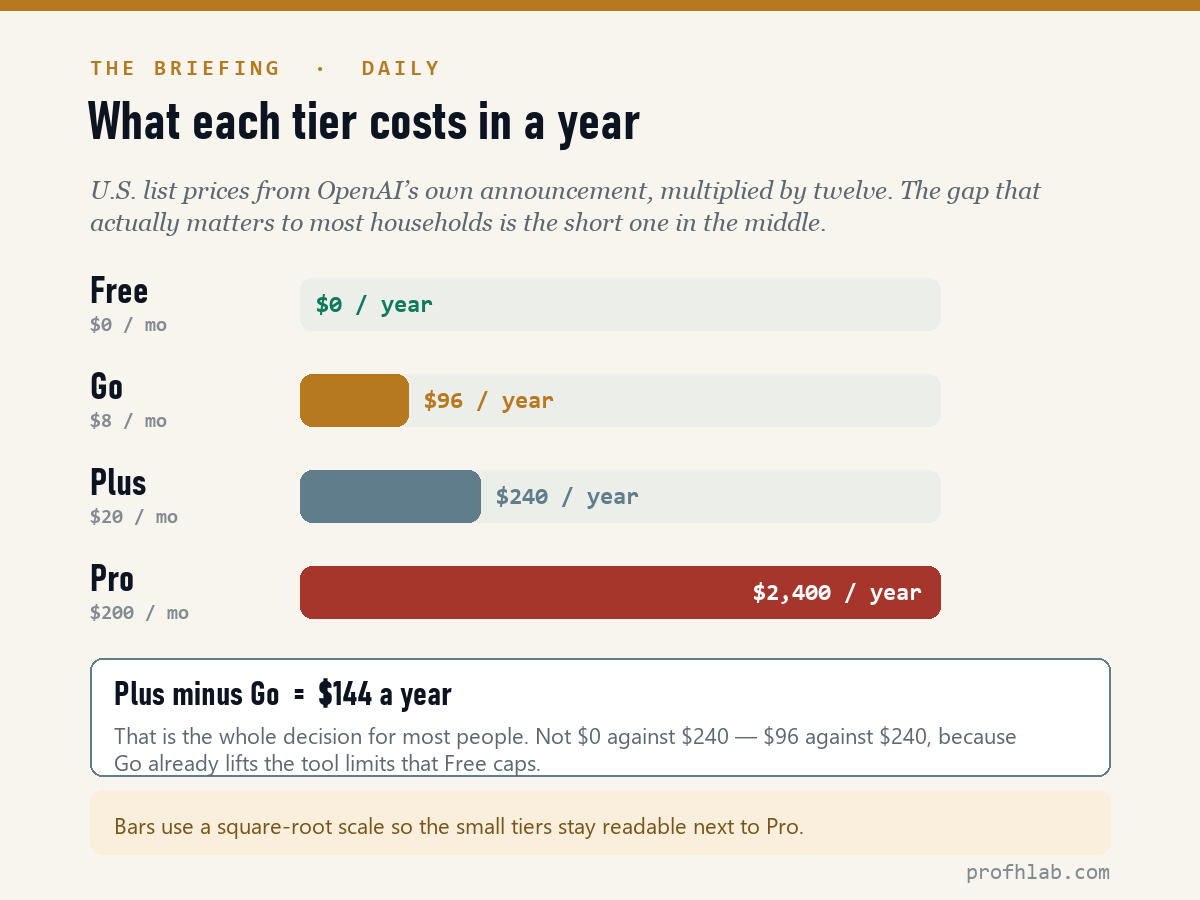
So spend the $144 on the four things Go does not give you, and skip it if none of them describe you:
- The better reasoning model. Go runs GPT-5.6 Luna. Plus adds the advanced GPT-5.6 reasoning models. If your questions have one right answer that’s hard to get to, this is the whole argument.
- Speed when it’s busy. “Fast” versus “limited on bandwidth & availability.” If you use it inside a workday with someone waiting, this is worth more than it sounds.
- No ads. A sponsored card under an answer is either invisible to you or intolerable. Only you know which.
- Deep research, projects and scheduled tasks. Expanded on Plus, limited or absent below it. These are the features people who say “Plus changed how I work” are usually describing.
The five-minute test that settles it
Don’t reason about this. Look at your own last two weeks in ChatGPT and answer five questions. Score one point each.
- In the last 14 days, did you hit a limit on uploads, images, voice or deep research — not on typing? (Typing no longer has one.)
- Have you waited on a slow or unavailable response while someone was waiting on you?
- Did an ad under an answer actually bother you, or did you have to be told they exist?
- Do you paste in things longer than about forty pages? (If yes, note that Plus won’t help — that’s Pro territory.)
- Do you use projects, scheduled tasks or deep research more than once a week?
0–1 points: stay on Free. The August change was built for you and it’s genuinely free. 2–3 points: Go at $8 almost certainly covers it — try it for a month before spending $240 a year. 4–5 points: Plus is doing real work for you; keep it.
Check your plan, then drop Plus to Go if habit is the only reason
Today, in about ten minutes
- Check what you’re actually on. In ChatGPT, open Settings and look at your plan. A surprising number of people are paying for a tier they signed up for in a different year.
- If you see ads and don’t want them personalised: Settings → Ad Controls. You can switch off ad personalisation, dismiss individual ads, ask why one was shown, and clear the data used for ads. If the menu isn’t there yet, it hasn’t reached your account.
- If you’re on Plus out of habit, downgrade to Go for one month and see whether you notice. $8 versus $20 is a real experiment you can run on yourself, and it’s reversible.
- If you’re a verified U.S. K–12 educator, check ChatGPT for Teachers — OpenAI lists it as free through June 2027. Don’t pay for what your job already qualifies you for.
- Diary the renewal date, not for the day itself but for two days before. That’s the only reliable way to make a subscription decision on purpose.
Most savings come from duplicate billing, not from switching
- “Is there a cheaper way to get the paid tier at all?” Sometimes yes — through a phone plan or a student status you already have, not through a discount code. We keep the live list, with expiry dates, in who is giving away AI subscriptions right now.
- “What does all of this cost me across every AI tool?” The subscription is rarely the whole bill. What AI really costs you per month does the arithmetic across the whole stack, and finds most people’s savings in duplicate billing rather than in switching tiers.
- “Which prices are current for everything else?” Our AI price tracker carries every tool we cover with the date each figure was last re-checked.
- “Someone emailed me an upgrade offer.” Nobody legitimate does that. Price changes appear in the app and on the company’s own site. The playbook for the rest is in our guide to AI scams.
Where this article stops
Every figure here is a U.S. list price read from OpenAI’s own pages on August 23, 2026, and prices and limits in this product have moved more than once this year. Ad availability differs by country and is still expanding. “Unlimited” is OpenAI’s word and it carries its own footnote — subject to abuse-prevention safeguards. This is a spending decision, not financial advice, and we take no commission on any plan mentioned; check the current page before you pay.
Free, $8 Go or $20 Plus: it depends on which limits you hit
Is ChatGPT Plus still worth it in 2026?
It depends on which limits you hit, and the answer changed in August 2026. Free now has unlimited text chats, so “I run out of messages” is no longer a reason to pay. Plus at $20 a month is worth it if you regularly hit the limits that remain — uploads, image generation, voice, deep research, memory — or if you need faster responses when servers are busy, or if you want no ads. If you mainly type questions and read answers, Free now covers you.
Is ChatGPT Go worth it, or should I go straight to Plus?
Go at $8 a month lifts the tool limits that make Free frustrating and gives you the same context window as Plus — 54K on the instant model, about forty pages of input. It does not give you the advanced reasoning models, the “Fast” response tier, expanded deep research, or an ad-free experience. Since the gap between them is $144 a year, trying Go for a month before committing to Plus is a cheap, reversible experiment.
Why is ChatGPT showing me ads now?
OpenAI began testing ads in ChatGPT on February 9, 2026 and has expanded the test through the year, taking them out of testing in five more countries on August 11. Ads appear only on the Free and Go plans, sit below the end of a response, and are labelled as sponsored. Plus, Pro, Business, Enterprise and Edu accounts do not get ads, and OpenAI says it does not show ads to accounts identified as belonging to people under 18.
How do I turn off ads in ChatGPT?
The full walkthrough is in our dedicated guide, how to turn ChatGPT ads off without paying $20. The short version: you cannot remove ads on Go at any setting. On the Free plan OpenAI offers an “Ads-Free” experience, but it comes with lower usage limits and reduced feature access — fewer messages, and no image generation or deep research. To be ad-free without those reductions you have to upgrade to Plus or Pro. Separately, you can turn off ad personalisation at Settings → Ad Controls, where you can also dismiss ads, see why one was shown, and clear ad data.
What is the difference between ChatGPT Go and Plus limits?
Less than most comparisons suggest on capacity, and more on quality. Both show the same context window: 54K on the instant model and 256K on the reasoning models, roughly forty pages of input either way. Plus adds the advanced GPT-5.6 reasoning models, expanded messages and uploads, more capable image creation, expanded deep research and memory, projects and scheduled tasks, expanded Codex, the full ChatGPT Work app — and it is the cheapest tier OpenAI describes as “Fast” rather than “limited on bandwidth & availability.”
Can I still create custom GPTs with ChatGPT Plus?
No — not new ones. As of August 2026 OpenAI states that new GPT creation and publishing are not available on personal ChatGPT accounts, including Free, Go, Plus and Pro. Existing custom GPTs still work and can still be used, and editing them depends on your plan and permissions. Building new GPTs and publishing to the GPT Store now requires a Business, Enterprise or Edu workspace. Many review pages still list custom GPT creation as a reason to buy Plus; it is out of date.
Is ChatGPT Plus worth it for image generation?
This is one of the clearer cases for paying. OpenAI describes Free image generation as “limited and slower,” Go as “more image creation,” Plus as “more complex and accurate image creation,” and Pro as “unlimited and faster.” If images are a regular part of your work rather than an occasional novelty, image generation is one of the few areas where each tier buys something you will notice immediately.
Sources
- OpenAI, ChatGPT pricing page and plan comparison table — plan bullets, context windows, response-speed rows. Read August 23, 2026.
- OpenAI Help Center, “ChatGPT Free Tier FAQ” — unlimited text chats, separate tool limits, GPT creation on personal accounts. Updated August 2026.
- OpenAI Help Center, “Ads in ChatGPT” — plan eligibility, ad placement, Ads-Free option, Ad Controls, under-18 policy. Updated August 21, 2026.
- OpenAI, “Introducing ChatGPT Go, now available worldwide,” January 16, 2026 — U.S. prices of $8, $20 and $200.
- OpenAI, “Testing ads in ChatGPT,” posted February 9, 2026; updated March 26, May 7 and August 11, 2026.
- OpenAI announcement of unlimited free text chats and GPT-5.6 Luna, August 6, 2026; rollout from the week of August 10.
Before you renew: giveaways, ad settings and your total AI bill
- What AI really costs you per month (once you claim what you already have)
- Who is giving away AI subscriptions right now — and which deals are already dead
- How to use ChatGPT: a beginner’s guide for people over 50
- ChatGPT ads: how to turn them off without paying $20
- The AI price tracker — every tool, every price, every date checked
About the author. Prof. H teaches robotics and AI, and writes Prof H Lab — independent reviews where every price is dated and re-checked. No commissions on anything in this article. One short email a month: join the Lab Report. Unsubscribe anytime.
Prof.’s H Newsletter
One short email a month, with the numbers in it
What actually moved in AI hiring, AI prices, and the scams aimed at older Americans. Counted here, dated, and linked to the source. One email a month, and your address goes nowhere else.