Do You Need a Degree to Be a Robotics Technician? What All 55 Open Robot Technician Postings Actually Require (August 2026)
Figure AI is hiring an apprentice to work on humanoid robots in San Jose. We read the whole posting, twice, looking for the education line. There isn’t one. No degree, no diploma, no certificate — the requirements are that you can lift 50 pounds, stand for eight hours, use torque tools, and have touched a robot before. The last line says the base rate “starts at $35/hr.”
At 2,080 hours a year that is roughly $72,800 — slightly more than the federal government’s published median wage for the entire robotics-technician occupation.
Search do you need a degree to be a robotics technician and the first page is trade schools and career-guide sites, and almost all of them say the same thing: get an associate’s degree. None of them counts a single live job posting. So on August 26, 2026 we pulled every hands-on robot technician, assembler, machinist and operator role open on the job boards of eight AI-robotics companies — 55 postings — and read the full text of each one.
Forty-two of the 55 do not name an academic credential anywhere in the posting. Two require a bachelor’s degree with no alternative offered. More postings set a limit on how much you must be able to lift than set any degree bar at all.
How we counted
On August 26, 2026 we read the public job-board feeds of OpenAI, Figure AI, 1X, Apptronik, Agility Robotics, Physical Intelligence, Nuro and Scale AI, and kept every US role whose title is hands-on robot work — technician, assembler, machinist, fabricator, harness, operator — while dropping engineer, tech-lead and consultant titles. That is 55 postings.
We then pulled the complete description text for each and searched it for education language, experience minimums, physical requirements, shift language and named certifications. Every count below comes from those 55 full texts, and every quotation is verbatim. Pay figures are what the employer printed; where a posting gives an hourly rate we leave it hourly rather than annualising it for them.
Four diploma postings, then the real gates: pounds and shifts
- The short answer, counted
- What the four postings that do ask for a diploma say
- The real gates: pounds, shifts and hours
- What these jobs actually pay, in the employers’ own numbers
- Where the official data disagrees — and why both are right
- The postings that are open right now
- What to do this week
- Questions people actually search
The short answer, counted
No, and it is not close. Of the 55 hands-on postings open this morning, 42 contain no mention of a degree, a diploma, a certificate or any other academic credential — not as a requirement, not as a preference, not in a bonus-qualifications list.
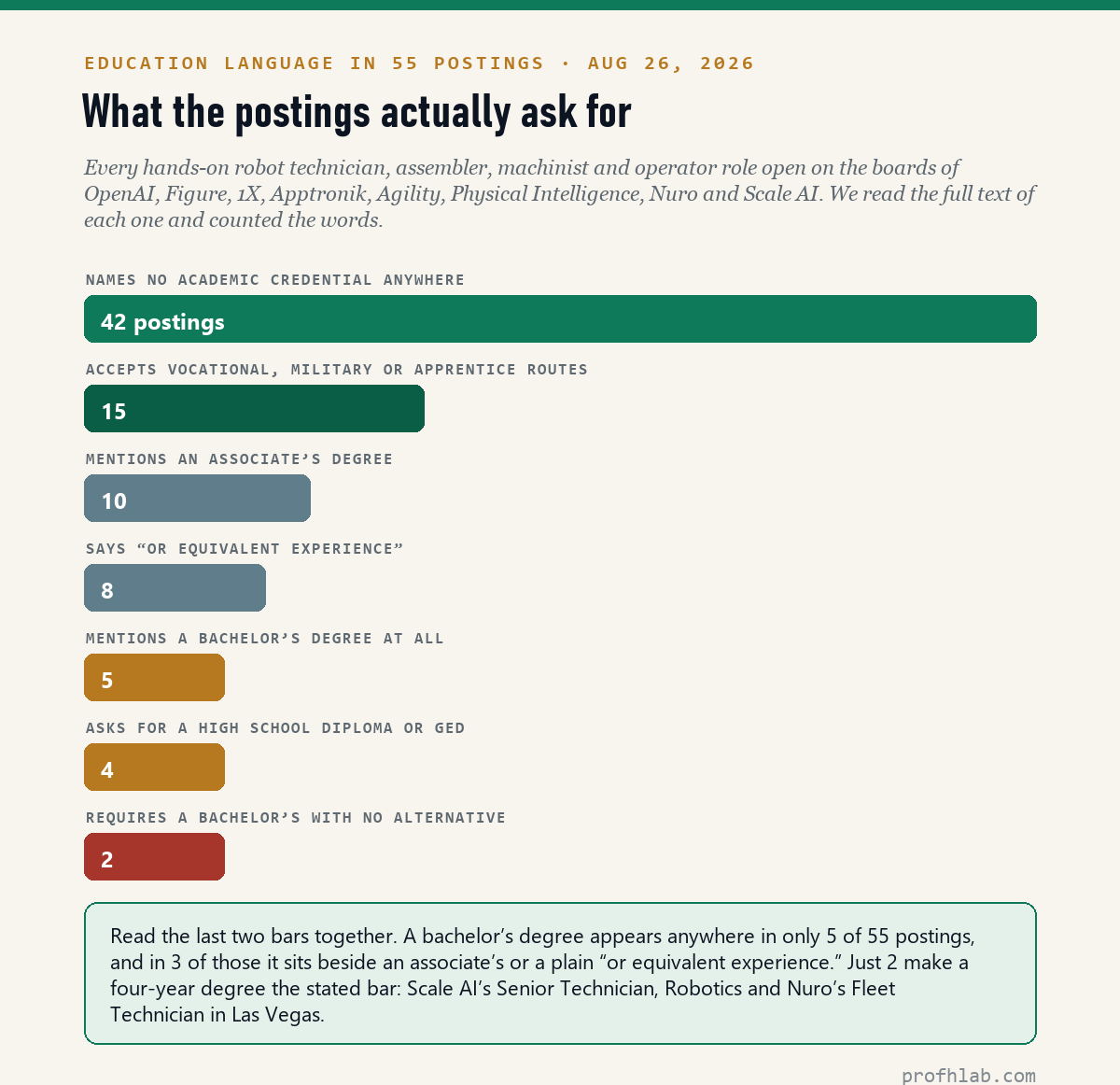
A bachelor’s degree appears anywhere in only five postings, and in three of those it is optional or paired with an alternative. Physical Intelligence phrases it about as gently as English allows, in its Robotics Technician posting: “Associate degree in Electrical/Mechanical Engineering, Robotics, or a related technical field (bachelor’s a plus), or equivalent hands-on experience.” Read that clause to the end. The associate’s is the ask, the bachelor’s is a bonus, and equivalent hands-on experience replaces both.
Only two postings in the whole set make a four-year degree the stated bar with nothing offered in its place: Scale AI’s Senior Technician, Robotics, and Nuro’s Fleet Technician in Las Vegas, whose posting opens its requirements with a flat “Education: Bachelor’s degree in Robotics, Computer Science, Engineering, or a related technical field.”
Here is the detail that makes that one worth pausing on. Nuro is simultaneously advertising Associate Fleet Technician roles in the Bay Area and Los Angeles — same fleet, same vehicles, same hands — and those postings ask for no degree at all. What they ask for instead is “Proven experience (e.g., from an academic program, vocational training, or professional role) demonstrating basic technical/mechanical aptitude with vehicles, electronics, or complex machinery.” One word in the job title, Associate, is the difference between a degree requirement and an explicit invitation to arrive from a vocational programme.
What the four postings that do ask for a diploma say
Four of the 55 name a high school diploma or GED. It is worth quoting them, because they are the clearest statement anyone in this industry has made about what the actual floor is.
- Apptronik, Machinist and CNC Operator, Austin: “High school diploma required; vocational training, machining coursework, or certifications in CNC operation, CAM programming, or 5-axis machining technology preferred.”
- Agility Robotics, Senior Assembly Technician I, Salem, Oregon: “High school diploma or GED; 2-year technical degree or military experience a plus.”
- 1X, Electrical Harness Technician, San Carlos: “High school diploma or equivalent, with 2–3+ years of direct experience in wire harness fabrication and assembly.” The one credential it names in its preferred list is not a degree at all — it is “IPC-620 certification”, a cable-and-wire-harness standard you can train for in days, not years.
- Figure AI, Facilities Technician, San Jose: “High school diploma or equivalent required. Technical certification or Associate’s degree in Facilities Management, Engineering, or related field preferred.”
Fifteen postings — more than a quarter of the set — explicitly name a vocational, military or apprentice route. OpenAI’s Site Operations Technician lists four doors in a single sentence and treats them as interchangeable: “Have an Associate’s degree, technical certification, military experience, or equivalent practical experience.” That posting advertises $157,000 to $221,000.
The real gates: pounds, shifts and hours
If the degree is not the filter, something else is. The postings are unusually blunt about what it is.
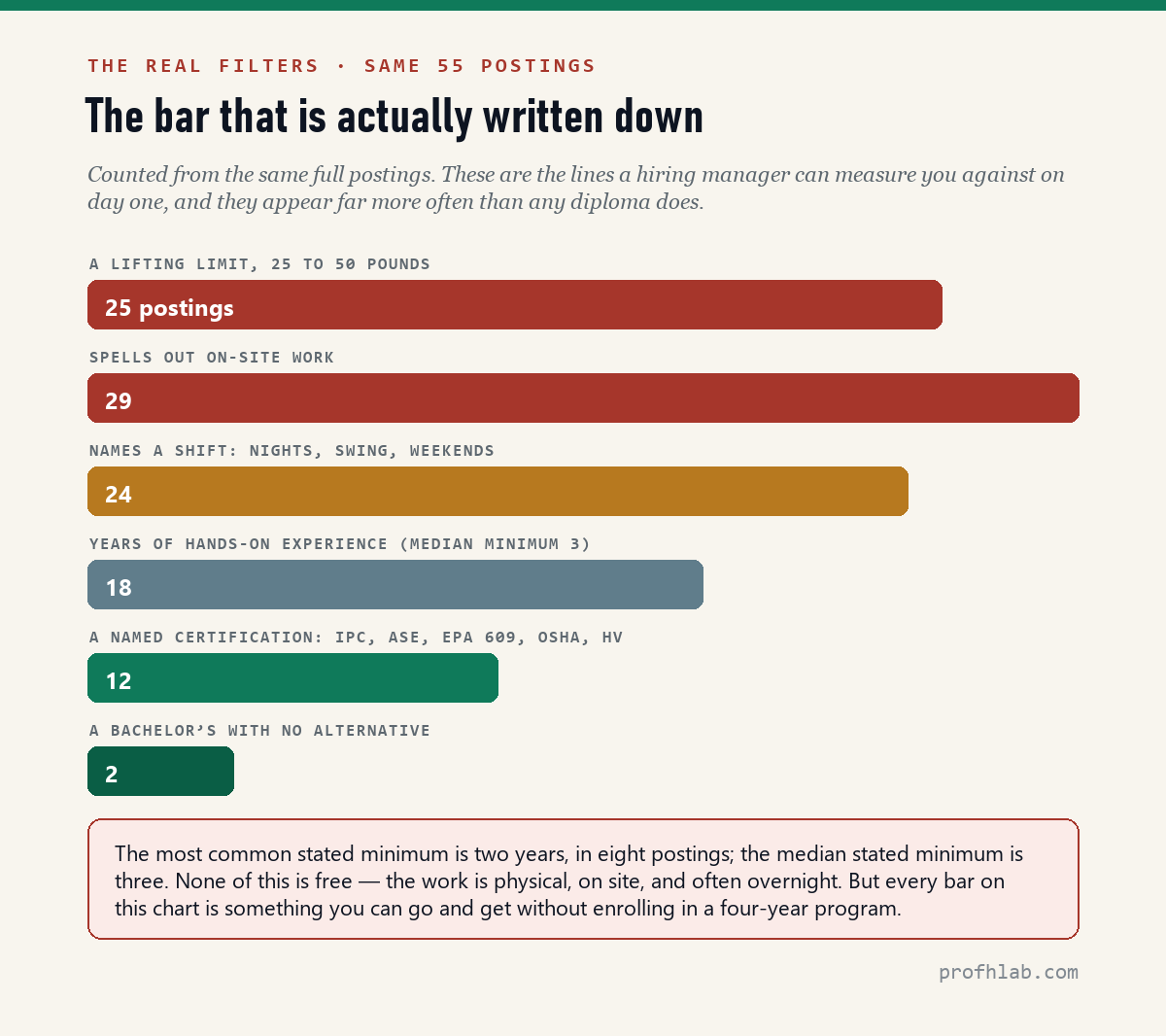
Twenty-five postings state a lifting requirement, most commonly 50 pounds. Ten of Figure’s postings name a 50-pound limit, and four of them — the apprentice role and the three humanoid robot operator shifts — carry the identical Physical Requirements sentence: “Must be able to safely lift, carry, and maneuver equipment or humanoid hardware weighing up to 50 lbs independently”, followed by “Ability to stand and move throughout the work area for the entirety of an 8+ hour shift.” A humanoid robot weighs what a person weighs, and somebody has to pick it up.
None of the 55 is remote. Not one. Twenty-four name a specific shift — morning, afternoon, night, swing — and Figure runs its San Jose robot service desk across three of them simultaneously. If you have been told that AI work is laptop work, this corner of it is the opposite: it is a floor, a bench, and a start time.
Eighteen postings state a minimum number of years of hands-on experience. The most common figure is two years, in eight postings; the median stated minimum is three. And “hands-on” is defined generously — 1X’s Robot Service Technician asks for “2+ years of experience in robotics, manufacturing, aerospace, automotive, electronics, or another hands-on technical field.” Automotive counts. Electronics counts. Twelve postings name a specific certification, and the ones that recur are the trade credentials, not the academic ones: IPC and IPC-620 for harness work, ASE for vehicles, EPA 609 for refrigerant, high-voltage safety, OSHA, CompTIA.
The honest caveat
A posting that does not name a degree is not a promise that no one screening résumés cares about one. It means the company has not written a degree into the bar it will defend, which is genuinely different from an announcement that says a bachelor’s is required — but it is not the same as saying degree-holders have no advantage.
What it does tell you is that if you have the hours, the tools and the certifications, you are inside the stated requirements, and nothing in the text gives anyone grounds to filter you out before a human reads it.
What these jobs actually pay, in the employers’ own numbers
This is where reading the postings pays for itself, because most career pages will quote you one national median and stop.
Twenty-one of the 55 postings publish a pay figure, and fifteen of those publish it by the hour. The median band across the hourly postings is $30.10 to $50.00 an hour — about $62,600 to $104,000 at 2,080 hours a year. The lowest band we found is 1X’s Robot Service Technician at $25 to $34 an hour; the highest is Figure’s Robot Service Technician at $35 to $65.
Put that next to the federal number. The Bureau of Labor Statistics puts the median wage for electro-mechanical and mechatronics technicians at $70,760 a year, which it also prints as $34.02 an hour. Twelve of the fifteen hourly bands reach or exceed that at the top of the range; seven start at or above it. The bottom of this market is ordinary technician pay. The top of it is not.
Three postings pay on an annual band and go considerably higher: OpenAI’s Prototyping Lab Technician, Robotics advertises $225,000 to $295,000. That is not a typical technician salary and we would not build a plan around it, but it is what the posting says.
And 34 of the 55 publish nothing. Forty-eight of these postings are in California, where an applicant has a statutory right to ask: California Labor Code section 432.3(c)(1) requires an employer, on reasonable request, to give an applicant the pay scale for the position they are applying to. If a posting is silent, that request is one line in your first email to the recruiter, and it is a right rather than a favour.
Where the official data disagrees — and why both are right
If you looked this occupation up properly, you would have found something close to the opposite of what we just told you. It is worth showing the two side by side, because the gap between them is the actual story.
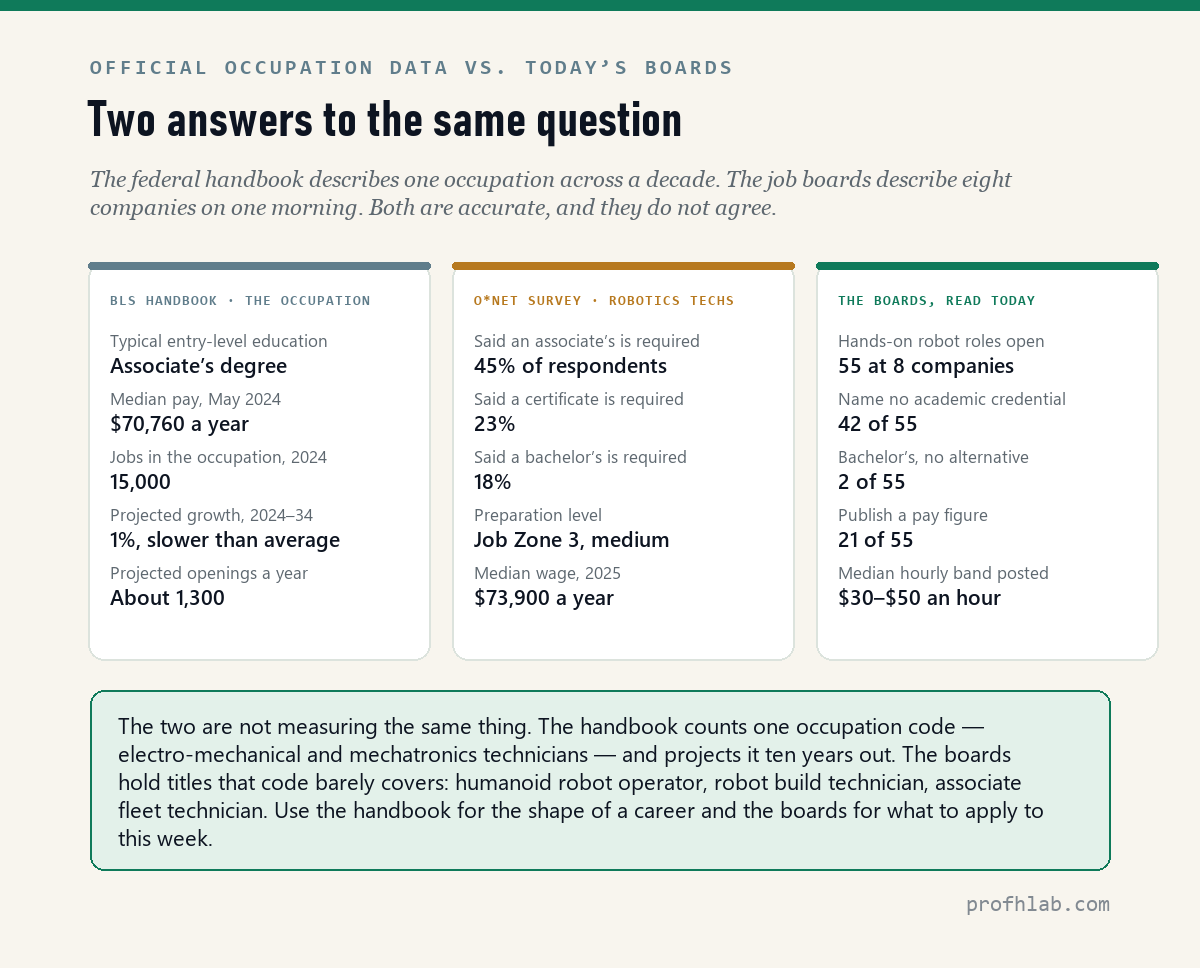
The Occupational Outlook Handbook lists the typical entry-level education for electro-mechanical and mechatronics technologists and technicians as an associate’s degree, and O*NET’s survey of people doing the job backs that up: 45 percent said an associate’s or other two-year degree is required, 23 percent a post-secondary certificate, 18 percent a bachelor’s. O*NET classes the work as Job Zone 3, medium preparation — “training in vocational schools, related on-the-job experience, or an associate’s degree.”
The handbook also projects the occupation growing 1 percent between 2024 and 2034, with about 1,300 openings a year nationally, from a base of 15,000 jobs.
Now hold that against our count: eight companies, one morning, 55 open hands-on roles. That is more than four percent of a whole year’s projected national openings, sitting on eight career pages at once.
Both numbers are honest, and the reconciliation is mundane rather than dramatic: they are not counting the same jobs. The handbook tracks one occupation code. The boards are full of titles that code barely reaches — Humanoid Robot Operator, Robot Build Technician, Associate Fleet Technician, Remanufacturing Technician. When an industry invents job titles faster than the statistical system classifies them, the official figures lag by definition, and the postings are the earlier signal.
The practical reading: use the handbook for the shape of a career and the wage floor, and use the boards for what to apply to this week. Do not use the handbook’s “typical entry-level education” as a gate on yourself. It describes what most people in the occupation happen to hold. It is not what these employers wrote down.
The postings that are open right now
Education below is what the posting itself says, not our inference. Every link goes to the employer’s own page.
| Role | Company | Where | Posted pay | Education named |
|---|---|---|---|---|
| Apprentice Robot Service Technician | Figure AI | San Jose, CA | From $35/hr | None |
| Robot Service Technician (Morning) | Figure AI | San Jose, CA | $35–$65/hr | None; 3+ years with complex systems |
| Remanufacturing Technician (Swing) | Figure AI | San Jose, CA | $35–$55/hr | None |
| Facilities Technician | Figure AI | San Jose, CA | $30–$55/hr | High school diploma or equivalent |
| Humanoid Robot Operator | Figure AI | Reno, NV | $26–$30/hr | None |
| Field Service Technician | Figure AI | Fontana, CA | $35–$50/hr | None |
| Robot Service Technician | 1X | San Carlos, CA | $25–$34/hr | None; 2+ years hands-on technical |
| Electrical Harness Technician | 1X | San Carlos, CA | Not published | High school diploma or equivalent; IPC-620 preferred |
| Robot Assembly Technician | 1X | Hayward, CA | Not published | None; 2+ years mechanical assembly |
| Robot Build Technician | Physical Intelligence | Fremont, CA | Not published | None; 2+ years electromechanical assembly |
| Engineering Support Technician | Agility Robotics | Fremont, CA | $74,000–$95,000 | AS degree and/or 3 years equivalent work |
| Senior Assembly Technician I | Agility Robotics | Salem, OR | Not published | High school diploma or GED; military a plus |
| Machinist and CNC Operator | Apptronik | Austin, TX | Not published | High school diploma; vocational training preferred |
| Associate Fleet Technician | Nuro | Santa Clara / SF, CA | $30–$41/hr | None; academic, vocational or professional experience |
| Site Operations Technician | OpenAI | San Francisco, CA | $157,000–$221,000 | Associate’s, certification, military or equivalent |
All fifteen were live on the employer’s own page on August 26, 2026. Postings close without notice; the official page always wins. The full daily count across twenty AI and robotics boards is on our AI Jobs Tracker.
What to do this week
- Today, five minutes: open any two postings above and use your browser’s find function on the words degree, diploma and equivalent. If all three come back empty, the education bar is not what is standing between you and that job — and you will stop screening yourself out.
- If you have trade hours but no degree: lead with the field the posting names. 1X counts “robotics, manufacturing, aerospace, automotive, electronics, or another hands-on technical field”; Nuro counts vehicles, electronics and complex machinery. Write your experience in their words, not yours.
- Pick one certification, not a degree: the credentials that actually recur in these 55 postings are IPC-620 for harness and cable work, ASE for vehicle work, EPA 609 for refrigerant, high-voltage safety and OSHA. Each is weeks, not years, and each appears in postings paying $30 an hour and up.
- Be honest with yourself about the physical bar: 25 of these postings ask you to lift up to 50 pounds and stand an eight-hour shift, and 24 name a night, swing or weekend rotation. That is the real cost of entry here, and it is not negotiable in the way a résumé line is.
- If the posting shows no pay: 34 of the 55 do not. In California, Labor Code 432.3(c)(1) entitles an applicant to the pay scale on reasonable request. Ask in your first reply, in one sentence, before you invest an evening in the application.
- Track the market rather than refreshing it: our AI Jobs Tracker re-reads twenty company boards every day, with entry-level counts and published pay bands.
Not in California? The data center floor hires in more places
“Is there a version of this that is not in California?” Mostly not, in this particular set — 48 of the 55 are Californian, with the rest in Austin, Houston, Salem, Reno and Las Vegas. The nearest thing to a nationwide equivalent is the data-centre floor, which is hiring in Memphis, Atlanta, Hillsboro and half a dozen other places: how to become a data center technician with no experience.
“What about public-sector routes?” The national laboratories run their own technician hiring with published rules, and the qualification standards are open to read rather than guess at — we went through them in national laboratory jobs, no degree and how to get a federal job with no experience.
“Which companies have the most open roles overall?” Robot technician work is a slice of a much larger board. The whole count, across twenty companies, is in which AI companies are hiring right now.
What we are and what we are not
We are not recruiters and we are not career counsellors. We take no money from any employer, and there are no affiliate links in this article. Every posting linked here is on the employer’s own domain, and every one was live on August 26, 2026 — postings close without notice and the official page always wins. Nobody legitimate will ask you to pay to apply for a technician job, no employer recruits by text message, and an offer that arrives before an interview is not an offer.
Watch the work
Two videos that show the rooms these postings describe, rather than talking about them.
Pay, training time and the forty-two postings with no credential
Do you need a degree to be a robotics technician?
Not according to the employers hiring for it right now. We read all 55 hands-on robot technician, assembler, machinist and operator postings open on eight AI-robotics job boards on August 26, 2026. Forty-two named no academic credential at all; four asked for a high school diploma or GED; ten mentioned an associate’s degree, eight of those alongside a phrase like “or equivalent experience.” Only two made a bachelor’s degree the stated bar with no alternative offered.
The official picture is different — the Bureau of Labor Statistics lists an associate’s degree as the typical entry-level education for the occupation — but that describes what people in the job tend to hold, not what these postings require.
What education do you need to be a robotics technician?
In practice, one of four things, and the postings treat them as interchangeable. OpenAI’s Site Operations Technician posting states it most plainly: “Have an Associate’s degree, technical certification, military experience, or equivalent practical experience.” Fifteen of the 55 postings we read name a vocational, military or apprentice route explicitly. Where a specific credential is named it is usually a trade certification rather than a degree — IPC-620 for wire harness work, ASE for vehicles, EPA 609 for refrigerant handling, high-voltage safety, OSHA, CompTIA.
How much do robotics technicians make?
Twenty-one of the 55 postings published a pay figure, and fifteen of those published it hourly. The median posted band was $30.10 to $50.00 an hour, roughly $62,600 to $104,000 a year at 2,080 hours. The lowest was $25 to $34 an hour at 1X and the highest $35 to $65 at Figure AI; OpenAI’s Prototyping Lab Technician, Robotics is an outlier at $225,000 to $295,000 a year. For comparison, the Bureau of Labor Statistics puts the median wage for electro-mechanical and mechatronics technicians at $70,760 a year, or $34.02 an hour, as of May 2024.
Are there robotics technician jobs with no degree?
Yes, and they are not rare. Forty-two of the 55 postings in our August 26, 2026 read named no academic credential of any kind. Figure AI is advertising an Apprentice Robot Service Technician in San Jose whose requirements are the ability to lift 50 pounds, stand for an eight-hour shift, use torque tools and read assembly documentation, with a base rate that the posting says starts at $35 an hour.
Nuro’s Associate Fleet Technician postings in the Bay Area and Los Angeles ask for technical aptitude “from an academic program, vocational training, or professional role” and pay $26 to $41 an hour depending on the city.
How do you get a job as a robotics technician?
Match the experience field the posting names, then bring one trade certification. The postings define hands-on experience broadly — 1X counts “robotics, manufacturing, aerospace, automotive, electronics, or another hands-on technical field” — so time on a vehicle bench or an electronics line counts if you describe it in their vocabulary.
Eighteen of the 55 postings state a minimum number of years, most commonly two, with a median stated minimum of three. Apply on the employer’s own careers page rather than through an aggregator, and be ready for the physical and shift requirements, which are stated more often than any qualification.
How long does it take to become a robotics technician?
Faster than the conventional answer, if you already have trade hours. The formal route O*NET describes is Job Zone 3 — vocational training, related on-the-job experience, or a two-year degree — but the live postings mostly ask for two to three years of hands-on technical work in any adjacent field plus a specific certification, and certifications like IPC-620 or EPA 609 are measured in days or weeks. Someone coming from automotive, electronics assembly, HVAC or military maintenance work is often already inside the stated requirements without any further schooling.
Is a humanoid robot operator a real job?
It is, and Figure AI alone had seven such postings open on August 26, 2026, across San Jose, Reno, Los Angeles and Fontana, including morning, afternoon and night shifts at the San Jose site. The published bands we found for the commercial site team roles were $26 to $30 an hour. None of the operator postings named an academic credential; what they specify is the ability to lift and manoeuvre up to 50 pounds of humanoid hardware independently and to stay on your feet for a full shift.
Ask the desk
Want this run for your city, your trade background, or a company we did not scan today? Tell us what you are looking for and we will go read the postings and publish the answer.
Next check: Apptronik posted its Austin machinist and wire-harness roles on August 24, the newest cluster in this set. The number to watch is whether Austin keeps adding hands-on robot roles through September — if it does, this becomes the first serious non-California location for humanoid manufacturing work, and the pay bands there will tell us what the job is worth outside the Bay Area.
Sources: the public job-board feeds of OpenAI, Figure AI, 1X, Apptronik, Agility Robotics, Physical Intelligence, Nuro and Scale AI, all read August 26, 2026; BLS Occupational Outlook Handbook, electro-mechanical and mechatronics technologists and technicians; O*NET OnLine 17-3024.01, Robotics Technicians; California Division of Labor Standards Enforcement, Equal Pay Act FAQ (Labor Code 432.3). Photographs credited in each caption. Written by Prof. H for The Jobs Desk.
Prof.’s H Newsletter
One short email a month, with the numbers in it
What actually moved in AI hiring, AI prices, and the scams aimed at older Americans. Counted here, dated, and linked to the source. One email a month, and your address goes nowhere else.