Are AI Engineer Jobs Remote? 248 Openings Say Yes. The Employers’ Own Data Says 25.
Some are. On September 8, 2026 we read every live posting on the job boards of twenty AI, robotics and self-driving companies — 3,776 openings. 1,249 of them are US roles with “engineer” in the title, and 248 of those carry a remote label. That is one in five. Then we checked the second field, the one the employer fills in and job sites ignore.
On the eleven boards that publish it, 59.8% of the postings flagged remote are labeled “Hybrid” by the same employer, in the same file. The number of US engineering roles we could verify as fully remote today is 25.

We are not guessing at anyone’s intentions here, and we did not read a single job description to reach that number. Every figure below comes from a field the company itself publishes on its own careers page. The gap between the two fields is the whole story.
The two fields on every posting, and why only one of them travels
Most AI companies host their careers page on one of two systems: Greenhouse or Ashby. Eleven of our twenty boards run on Ashby, and Ashby’s public posting feed carries two separate pieces of information about where the work happens:
isRemote— a true/false flag. This is the one job aggregators read and turn into a “Remote” badge.workplaceType— a word the employer chooses:Remote,Hybrid, orOnSite. This one almost never leaves the source.
Here is a live example you can check yourself. OpenAI’s posting for Software Engineer, Full Stack (People Innovation) lists its location as “US – Remote” and carries isRemote: true. Its workplaceType is Hybrid. Both statements are published by OpenAI, at the same moment, on the same posting.
Check any posting in about thirty seconds.
If the job lives on jobs.ashbyhq.com/<company>/<id>, open the company’s whole board as data and search it for the role:
https://api.ashbyhq.com/posting-api/job-board/openai
Swap openai for the company name in the posting URL. Find your job title, then read the workplaceType next to it. That is the answer, in the employer’s own words, before you spend an evening on a cover letter.
How 248 becomes 25
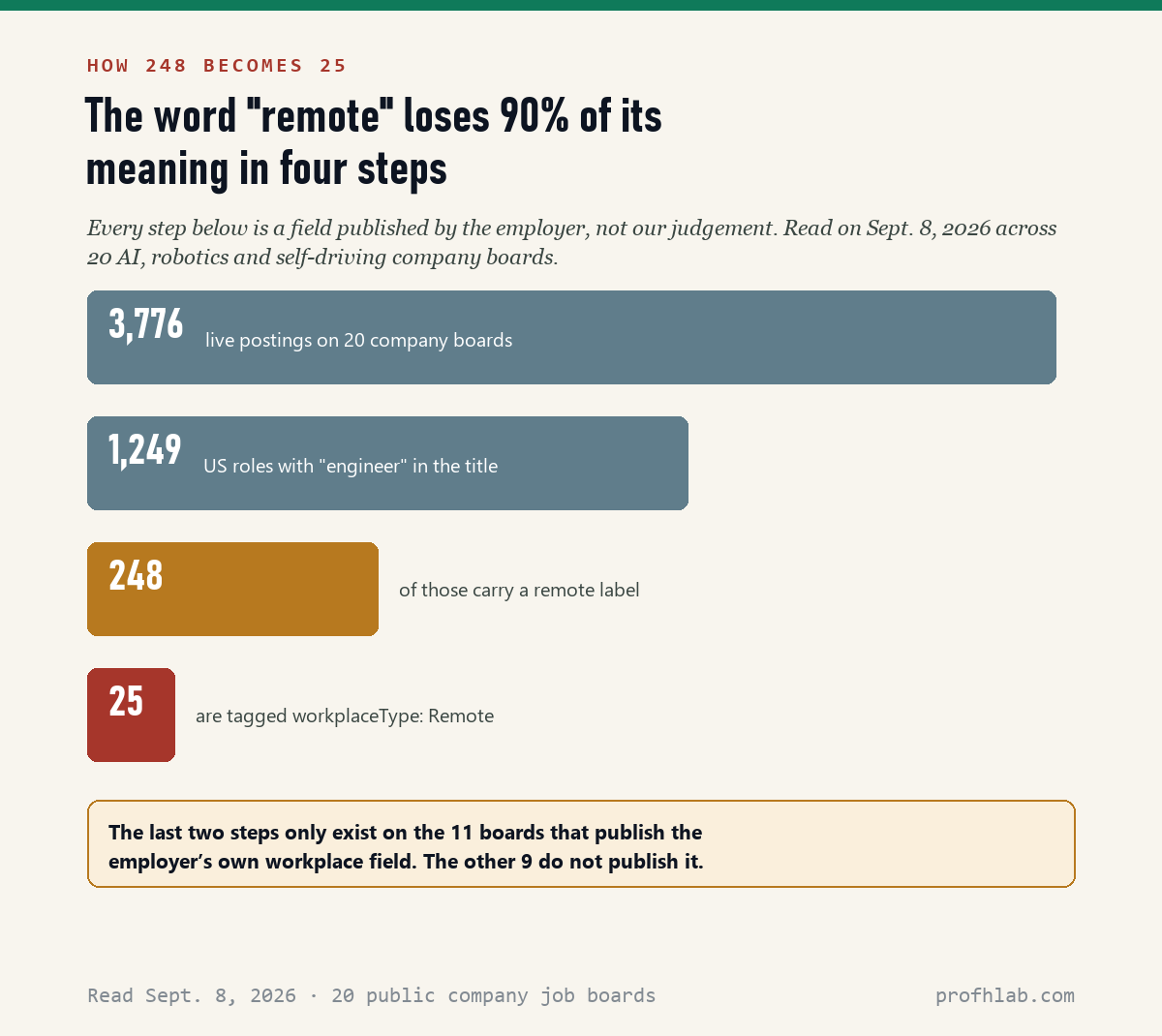
Start with the whole scan: 3,776 live postings, 2,986 of them open to US candidates. Filter to titles containing “engineer” and you get 1,249. Filter those to anything carrying a remote label and you get 248.
Now apply the employer’s own word. Across the eleven Ashby boards there are 2,002 postings, 1,072 of them flagged isRemote. Of those 1,072, 641 say Hybrid. When you keep only the ones the employer calls Remote and that name a US location, 141 postings survive — and 25 of them are engineering roles.
The nine Greenhouse boards do not publish a workplace field at all, so we cannot make the same check there. That cuts both ways: some of their remote-labeled roles may be genuinely remote, and we would rather say so than inflate a number. What we can say is that on every board where the employer publishes the answer, the label and the answer disagree more often than they agree.
Which boards disagree with themselves the most
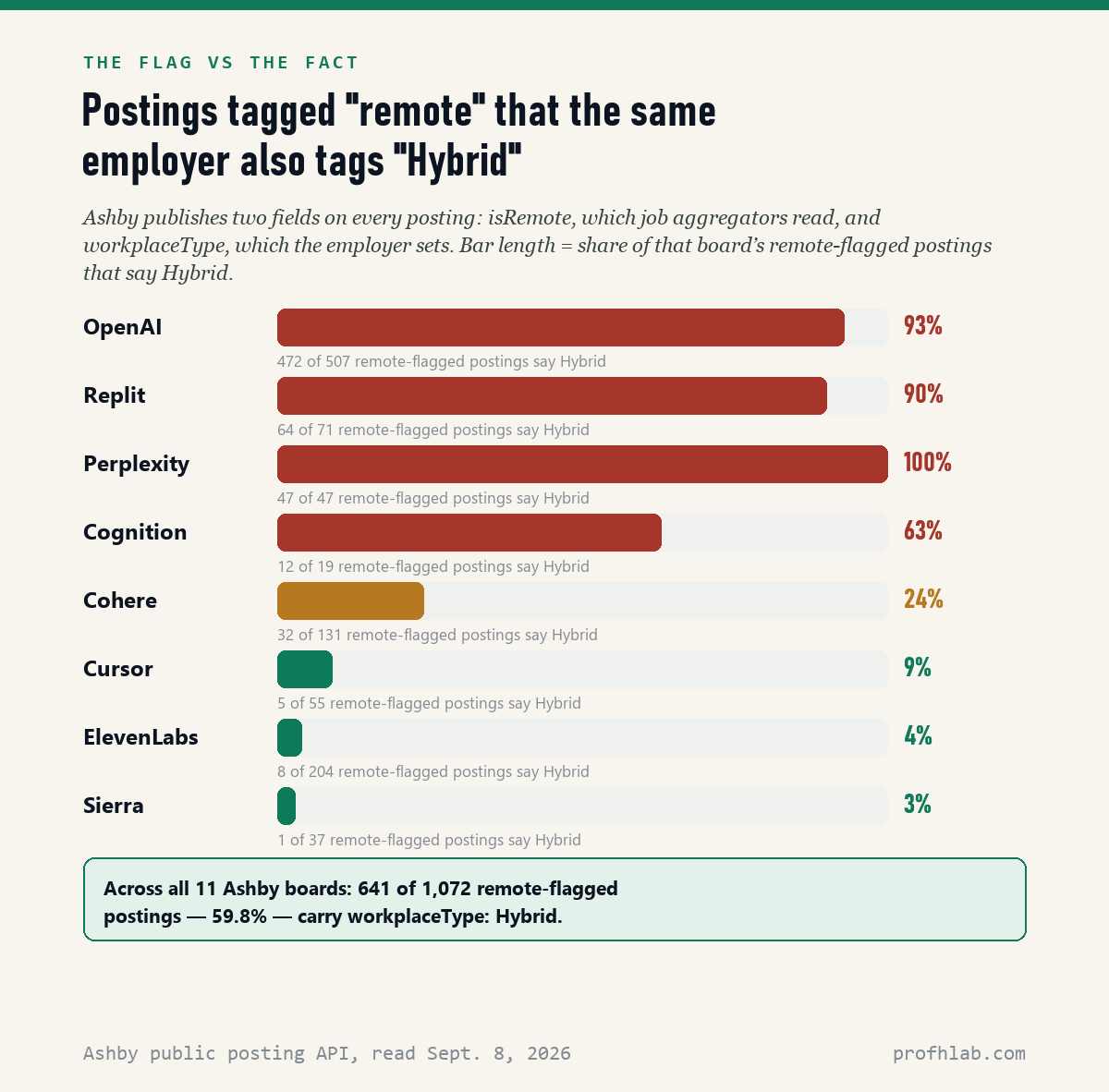
Perplexity is the cleanest case: all 47 of its remote-flagged postings say Hybrid. Not most — all of them. OpenAI is the largest in absolute terms: 472 of 507. Replit, 64 of 71.
At the other end, ElevenLabs flags 204 postings remote and only 8 of them say Hybrid, Sierra 1 of 37, Cursor 5 of 55. Those three boards mean what the badge says. If you are filtering job sites for remote AI work and you do not know which end of this chart a company sits on, you are spending most of your applications on the wrong end.
“Remote (San Francisco)” is not a typo
You will see this phrasing constantly, and it looks like a formatting bug. It is not. Of the 825 US postings in our scan carrying a remote label, 578 — seven in ten — name a city inside the location string. Another 71 use Anthropic’s phrasing, which we think is the most honest on any board we read: “Remote-Friendly (Travel-Required)”. Only about one in six names no place at all.
Read the parenthesis as the answer to a question the badge never asks: remote from where, and near which office? If a city is in there, someone at that company expects to see you in that city. How often is a conversation for the recruiter screen — but the fact that there is a city at all is already settled before you apply.

The rule that predicts this better than any search filter
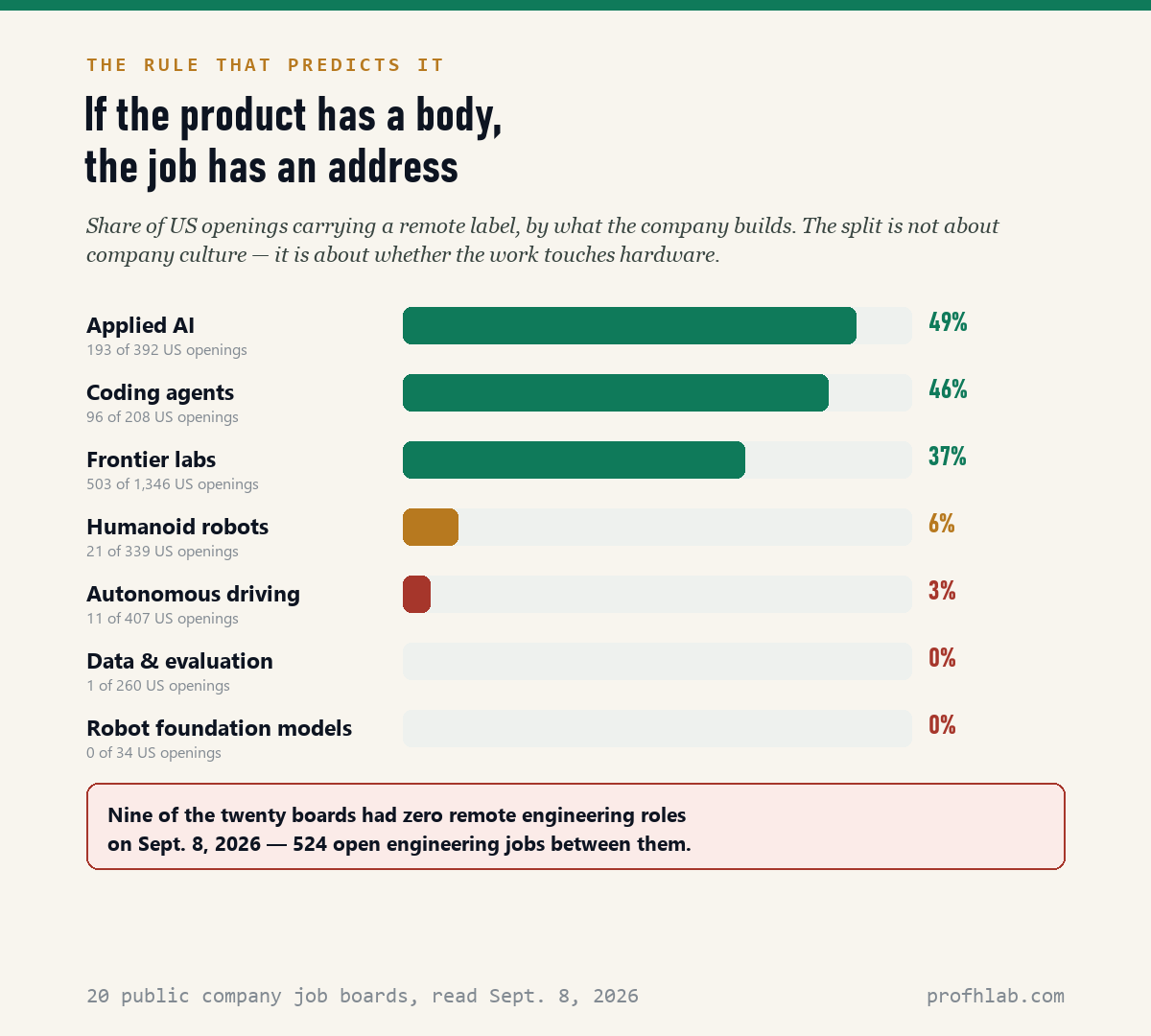
Sort the twenty companies by what they actually make and the noise disappears. Applied AI companies label 49% of their US openings remote. Coding-agent companies, 46%. Frontier labs, 37%. Then it falls off a cliff: humanoid robots 6%, self-driving 3%, data and evaluation 0.3%, robot foundation models 0%.
If the product has a body, the job has an address. You cannot calibrate a torque sensor over Zoom, and nobody at Figure, 1X, Apptronik, Nuro or Physical Intelligence is pretending otherwise — between them they had zero remote engineering roles open today. Nine of the twenty boards had zero, covering 524 open engineering jobs.
This is worth knowing before you apply rather than after. If you have read our piece on robotics technician roles, the same physical constraint is why those jobs pay what they pay: someone has to be standing next to the machine.
The 25 that survive, and what they have in common
Here is every US engineering role on those eleven boards that the employer itself labels workplaceType: Remote, as of September 8, 2026. Links go to the employer’s own posting.
| Company | Role | Location as posted | Published range | Apply |
|---|---|---|---|---|
| Cohere | Audio Inference Engineer, Model Efficiency | New York | CA$250K – CA$535K | View |
| Cohere | Data Engineer, Data Foundations | New York | $160K – $325K | View |
| Cohere | Forward Deployed Engineer, Agentic Platform | United States | CA$175K – CA$385K | View |
| Cohere | Forward Deployed Engineer, Agentic Platform (West Coast) | San Francisco | CA$175K – CA$385K | View |
| Cohere | Software Engineer, Data Infrastructure | New York | $160K – $325K | View |
| Cohere | Staff Research Engineer, Model Efficiency | New York | CA$250K – CA$535K | View |
| Cursor | Field Engineer, Life Sciences | Remote | Range not published | View |
| Cursor | Field Engineer, Public Sector | Remote | Range not published | View |
| Cursor | Field Engineer, SLED | Remote | Range not published | View |
| Cursor | Regional Director, Field Engineering – Verticals | Remote | Range not published | View |
| Cursor | Software Engineer, Billing | Remote | Range not published | View |
| Cursor | Software Engineer, User Operations | Remote | Range not published | View |
| ElevenLabs | Audio Engineering Lead (Post-Production) | United States | Range not published | View |
| ElevenLabs | Compliance Engineer | New York | Range not published | View |
| ElevenLabs | Engineering – Internal AI Transformation | United States | Range not published | View |
| ElevenLabs | Enterprise Solutions Engineer – North America | United States | Range not published | View |
| ElevenLabs | HPC Infrastructure Engineer – GPU Clusters | United States | Range not published | View |
| ElevenLabs | IT Engineer | United States | Range not published | View |
| OpenAI | Offensive Security Agent Engineer | US – Remote | $347K – $490K | View |
| OpenAI | Offensive Security Engineer, Agent Products | US – Remote | $347K – $490K | View |
| OpenAI | Principal Security Engineer, Infrastructure Security | US – Remote | $401K – $510K | View |
| OpenAI | Principal Software Engineer, Infrastructure Security | US – Remote | $401K – $510K | View |
| OpenAI | Security Engineer, Infrastructure Security | US – Remote | $266K – $445K | View |
| OpenAI | Software Engineer, Infrastructure Security | US – Remote | $266K – $445K | View |
| OpenAI | Technical Threat Investigator, Threat Intel Engineering | San Francisco | $230K – $385K | View |
Ranges are copied verbatim from the posting. Cohere is a Canadian company and publishes some US-located roles in Canadian dollars; we have not converted them. Postings close without notice — the employer’s page is the only thing that counts.
Look at the OpenAI block. All seven of OpenAI’s fully remote engineering roles are security roles — infrastructure security, offensive security, threat intelligence. Not research, not product, not infrastructure generally. Security.
The pattern holds across the table. Cursor’s remote engineering is field engineering and billing. ElevenLabs’ is IT, compliance, HPC infrastructure. Cohere’s is data infrastructure and model efficiency out of New York. Fully remote engineering at an AI company clusters in security, infrastructure and customer-facing engineering — the functions that were already distributed before anyone said the word “AI”. If you want to work on the model itself, you are being asked to move.
A note about our own tracker.
Our AI Jobs Tracker counts a posting as remote when it carries a remote label — the same flag we just spent this article qualifying. That column is an upper bound, not a count of fully remote jobs, and today’s reading of 825 should be read that way. We would rather say that plainly than quietly leave you with a number that is three times too friendly. How we count everything else is written up at How We Count.
Two numbers that surprised us
Remote-labeled roles advertise more money, not less. Among the US postings that publish a range, the median advertised floor is $235,000 for remote-labeled roles against $216,000 for the rest (631 and 1,552 postings respectively). That is not a remote-work premium. It is a seniority artifact: the roles a company is willing to let out of the building are the ones it is hiring a very experienced person into. We unpack why these ranges are so wide in a separate piece, and compare employers in which AI company pays the most.
Entry-level and remote is almost an empty set. Of the 90 US openings our scan classes as entry-level today, two carry a remote label. One of them is a Perplexity internship posted in Belgrade. For a reader in the United States, the honest count is one: the Mercor Research Fellowship (APEX), posted at $40K–$80K. That is the whole list. If you are starting out, our pieces on data center technician work and federal entry points describe doors that are actually open.
One more thing worth knowing: this is not a number that swings week to week. On September 1 the share was 826 of 2,955 US openings. Today it is 825 of 2,986. Eight days, essentially no movement. Anyone telling you remote AI hiring is opening up or slamming shut this month is describing something we cannot see in the postings.
Why the office came back, in seven minutes
If you want the business logic behind the hybrid tag rather than the arithmetic, this holds up well.
Shortlist by the Remote badge, but decide by the workplace field
- Stop filtering on the badge. On a job site, “Remote” is a rendering of
isRemote. Use it to build a shortlist, never to decide. - Open the board as data. Paste
https://api.ashbyhq.com/posting-api/job-board/<company>into your browser and readworkplaceTypefor the exact title. Thirty seconds, no account. - Read the parenthesis. A city inside the location string is a commute you have not been told about yet. Ask about it on the first call, not the fourth.
- Aim at the functions that are actually distributed. Security, infrastructure, IT, compliance, field and forward-deployed engineering. That is where all 25 of today’s roles live.
- Skip the humanoid and self-driving boards if remote is non-negotiable. Nine boards, 524 open engineering roles, zero remote. Your time is better spent elsewhere.
- Check the whole set yourself. Every one of the 3,776 postings is on our jobs board, filterable by remote, entry level, pay band and city, with the apply link going straight to the employer.
We are not recruiters.
We take no money from any employer named here, and none of these links pay us. Postings close without notice and companies edit their own fields — the official page always wins over anything we wrote. If a “recruiter” for one of these roles asks you for a fee, a bank detail, or moves you to a chat app, it is not that company. Our read on that industry is in are AI training jobs legit.
If you want to go one level deeper
Does this mean OpenAI is lying? No, and we would not put it that way. A recruiting system asks for a boolean and a workplace type, and a company that is happy to let you work from home three days a week can answer true to the first without contradicting the second. The failure is downstream, in the tools that read one field and drop the other. See also how to get a job at OpenAI or Anthropic.
What about the Greenhouse companies? They do not publish a workplace type, so we treated their labels at face value and said so. Anthropic is the interesting one: it writes the constraint into the location string instead — “Remote-Friendly (Travel-Required)”. We looked at that board specifically in is Anthropic hiring right now, and at xAI’s Memphis operation in xAI Memphis jobs and salary.
Should I apply to the hybrid ones anyway? Often yes — just apply knowing what you are applying to. Related: should I apply to old job postings, and, if you are a student, when summer 2027 internships open.
Ask the desk.
Tell us your state, your function and whether remote is a hard requirement, and we will check the boards against it and answer on the page. It is free, there is no account, and we never ask for money. Post your request on The Jobs Desk. New here? Start Here explains what this site is, and the FAQ answers 132 of the questions we get most.
What people ask before they trust a remote badge
Are AI engineer jobs remote?
Some are, but far fewer than job sites suggest. On September 8, 2026, 248 of 1,249 US engineering openings across twenty AI company boards carried a remote label — about one in five. On the eleven boards that also publish the employer’s own workplace type, 59.8% of remote-flagged postings say “Hybrid”. The number we could verify as fully remote US engineering roles was 25.
Does OpenAI have fully remote jobs?
A few. On September 8, 2026, OpenAI’s board carried 507 postings flagged remote, of which 472 were labeled Hybrid by OpenAI itself. Twenty-three postings were labeled workplaceType: Remote with a US location, and seven of those were engineering roles — all of them in security, infrastructure security or threat intelligence.
What does “hybrid remote” mean on a job posting?
It means the company expects you in an office some of the week and is using a remote-flavoured label anyway. In Ashby’s data these are two separate fields: a true/false remote flag that job sites display, and a workplace type the employer sets to Remote, Hybrid or OnSite. A posting can read “US – Remote” and still be tagged Hybrid. The workplace type is the one to trust.
What does “Remote (San Francisco)” mean?
It means remote work anchored to that city’s office. Of 825 US remote-labeled postings in our September 8 scan, 578 named a city inside the location string, and San Francisco appeared 385 times — more than any other. Treat the city in the parentheses as a commute you have not discussed yet.
Can machine learning engineers work remotely?
Less often than other engineers. The fully remote engineering roles we verified on September 8 sat in security, infrastructure, IT, compliance and field engineering. Research and model work was not among them. If the job touches training runs, evaluation labs or hardware, expect an address.
Are there remote robotics jobs?
Almost none at the companies building robots. Humanoid robot boards labeled 6% of US openings remote and self-driving 3%, and Figure AI, 1X, Apptronik, Nuro and Physical Intelligence had zero remote engineering roles open on September 8. Nine of our twenty boards had zero, covering 524 open engineering jobs.
Are there entry level remote AI jobs?
Very close to none. Of 90 US openings our scan classed as entry-level on September 8, two carried a remote label, and one of those was an internship posted in Belgrade. The single US-relevant one was the Mercor Research Fellowship (APEX) at $40,000–$80,000.
Which AI companies actually hire remote workers?
On September 8, the boards whose remote labels mostly held up were ElevenLabs (8 of 204 flagged postings said Hybrid), Sierra (1 of 37) and Cursor (5 of 55). The boards where the label mostly did not hold up were Perplexity (47 of 47 said Hybrid), OpenAI (472 of 507) and Replit (64 of 71).
Cite this
profhlab, “Are AI Engineer Jobs Remote?”, September 8, 2026. Across twenty AI, robotics and self-driving company job boards (3,776 live postings), 248 of 1,249 US engineering openings carried a remote label; on the eleven boards publishing the employer’s own workplace type, 641 of 1,072 remote-flagged postings (59.8%) were labeled Hybrid. Fully remote US engineering roles: 25. profhlab.com/are-ai-engineer-jobs-remote/
Daily counts and company breakdowns: AI Jobs Tracker · every posting, filterable, with employer apply links: Jobs Board · method: How We Count.
Sources and method
- Twenty public company job boards (Greenhouse and Ashby posting APIs), read September 8, 2026: 3,776 live postings, 2,986 open to US candidates. Companies: OpenAI, Anthropic, xAI, Google DeepMind, Scale AI, Mercor, Perplexity, Cohere, Sierra, ElevenLabs, Cursor, Cognition, Replit, Figure AI, Apptronik, Agility Robotics, 1X, Physical Intelligence, Waymo, Nuro.
- Workplace-type figures come from the Ashby public posting API, e.g. api.ashbyhq.com/posting-api/job-board/openai — no key, no account. Fields used:
isRemote,workplaceType,location,compensation.compensationTierSummary. - “Engineering role” means the word engineer appears in the posted title. Entry-level is a keyword heuristic (intern, new grad, junior, apprentice, fellow, technician, co-op) and is labeled as such.
- Week-over-week comparison against our own scan of September 1, 2026.
- No USAJOBS data appears in this article, our jobs board or our exported files, per the USAJOBS API terms effective August 7, 2026.
Written and checked by Prof. H for The Jobs Desk. Every posting figure was read on September 8, 2026 and will drift — the employer’s own page wins.
Prof.’s H Newsletter
One short email a month, with the numbers in it
What actually moved in AI hiring, AI prices, and the scams aimed at older Americans. Counted here, dated, and linked to the source. One email a month, and your address goes nowhere else.