Unitree IPO, Explained: The 629% Pop, and Whether You Can Buy the Stock
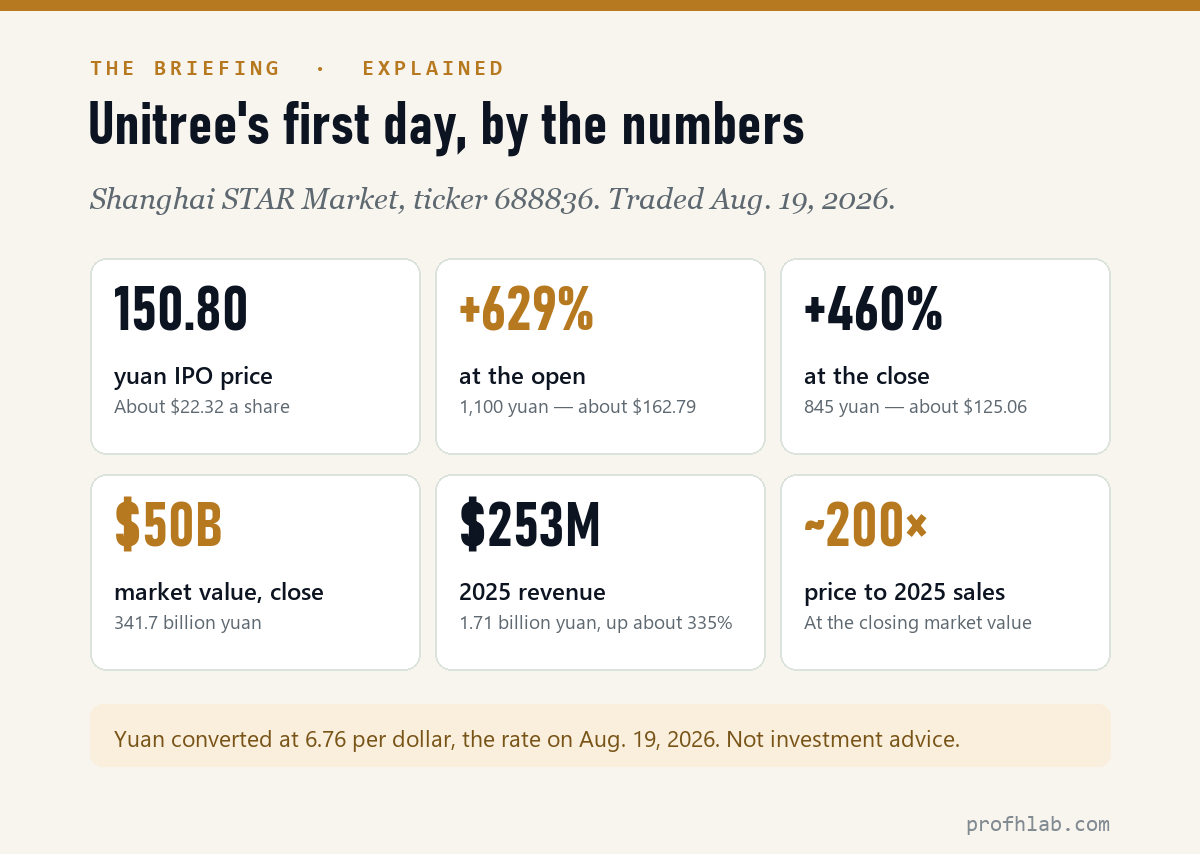
At 9:30 a.m. in Shanghai on Wednesday, a company that makes robot dogs and backflipping humanoids opened for trading at 1,100 yuan a share — 629% above the 150.80 yuan its shares had been sold at days earlier. By the closing bell it had given a chunk of that back, finishing at 845 yuan, up about 460%. That still valued Hangzhou-based Unitree Robotics at roughly 341.7 billion yuan, or about $50 billion.
For context on the appetite behind it: Bloomberg reported that retail investors placed about 9.8 million orders chasing roughly 8.1 trillion yuan — about $1.2 trillion — of stock in an offering that raised $905 million. The retail tranche was 5,526 times subscribed.
Unitree is the first general-purpose robotics company to list on mainland China’s public markets, which is why the debut traveled far beyond finance pages. But most of the coverage answers a question almost nobody is actually typing into a search box. The three things people are searching for are simpler: can I buy the stock, how much does one of these robots cost, and can I even get one in the US. Those have clear answers, and two of them are “no, and here’s exactly why.”
What this is. An explainer about a robotics company and the rules around its products. It is not investment advice, and nothing here is a recommendation to buy or sell anything. Prices and figures were checked on August 19, 2026, and yuan amounts are converted at 6.76 per dollar, the rate that day.
What happened on August 19
| Item | Detail |
|---|---|
| Listing | Shanghai Stock Exchange STAR Market, ticker 688836 |
| Legal name | Hangzhou Yushu Technology Co. |
| IPO price | 150.80 yuan (about $22.32) per share |
| Shares sold | 40.45 million, raising about 6.1 billion yuan ($905 million) |
| Opening price | 1,100 yuan — up 629%, valuing it near 445 billion yuan ($66 billion) |
| Closing price | 845 yuan — up about 460%, or roughly $50 billion |
| 2025 revenue | About 1.71 billion yuan ($253 million), up roughly 335% |
| 2025 humanoid shipments | About 5,500 units — the most of any maker worldwide |
The gap between the open and the close is the part worth pausing on. A stock that opens up 629% and closes up 460% fell about 23% from its first printed price over the course of a single session. Both numbers are real; headlines mostly quoted the first one.
Who is Unitree, and why does this listing matter?

Wang Xingxing founded Unitree in August 2016, building on a quadruped robot he had developed for his master’s thesis. The company shipped its first consumer four-legged robot, the Go1, in 2021, added the H1 humanoid in 2023, and released the G1 in 2024. It employs roughly 500 people.
What makes it unusual is not that it builds humanoids — several companies do — but the price point. Most humanoid robots are research platforms quoted on request. Unitree publishes prices and sells from a web store, and those prices start below $5,000. That is why it leads global humanoid shipments: roughly 5,500 of the estimated 15,000 humanoids shipped worldwide in 2025 were Unitree’s.
The listing matters because it is the first time public markets have been asked to put a number on a pure-play humanoid company. Before Wednesday, “what is a humanoid robot business worth?” was a private-round question. Now there is a printed answer, and it changes daily.
Is Unitree publicly traded — and can I buy the stock?
Yes, it is publicly traded. No, most Americans cannot buy it directly, and this is the single most misunderstood part of the story.
Unitree listed on the STAR Market, which trades yuan-denominated A-shares in Shanghai. Foreign access to A-shares runs through two channels. The first is the Qualified Foreign Institutional Investor program, which is for licensed institutions, not individuals. The second is Stock Connect, the Hong Kong link that lets foreign investors trade mainland shares — but for STAR Market names, only stocks included in the SSE 180 or SSE 380 indexes (or dual-listed in Hong Kong) are eligible.
A company that listed this morning is in none of those indexes. Index inclusion is a scheduled review, not an automatic consequence of listing, and it depends on the company holding enough of its market value to qualify. In practice that means a lag of months between the IPO and the point at which a typical US brokerage account could reach the shares at all.
The realistic exposure route for a US investor is indirect — a fund that holds STAR Market or humanoid-robotics companies broadly. Whether any given fund holds Unitree depends on that fund’s licensing and its benchmark, and the answer today is generally “not yet.”
A warning that belongs here. Any hard-to-access, heavily hyped stock attracts fake “pre-IPO share” and “special allocation” offers — by email, text, social media DM, or a phone call from someone claiming to be a broker. A genuine brokerage does not cold-call you with access to a Shanghai listing. If you get one of these, treat it the way you would any unsolicited investment pitch.
Our full guide: AI scams targeting seniors — and the first 60 minutes that matter.
How much does a Unitree robot cost?
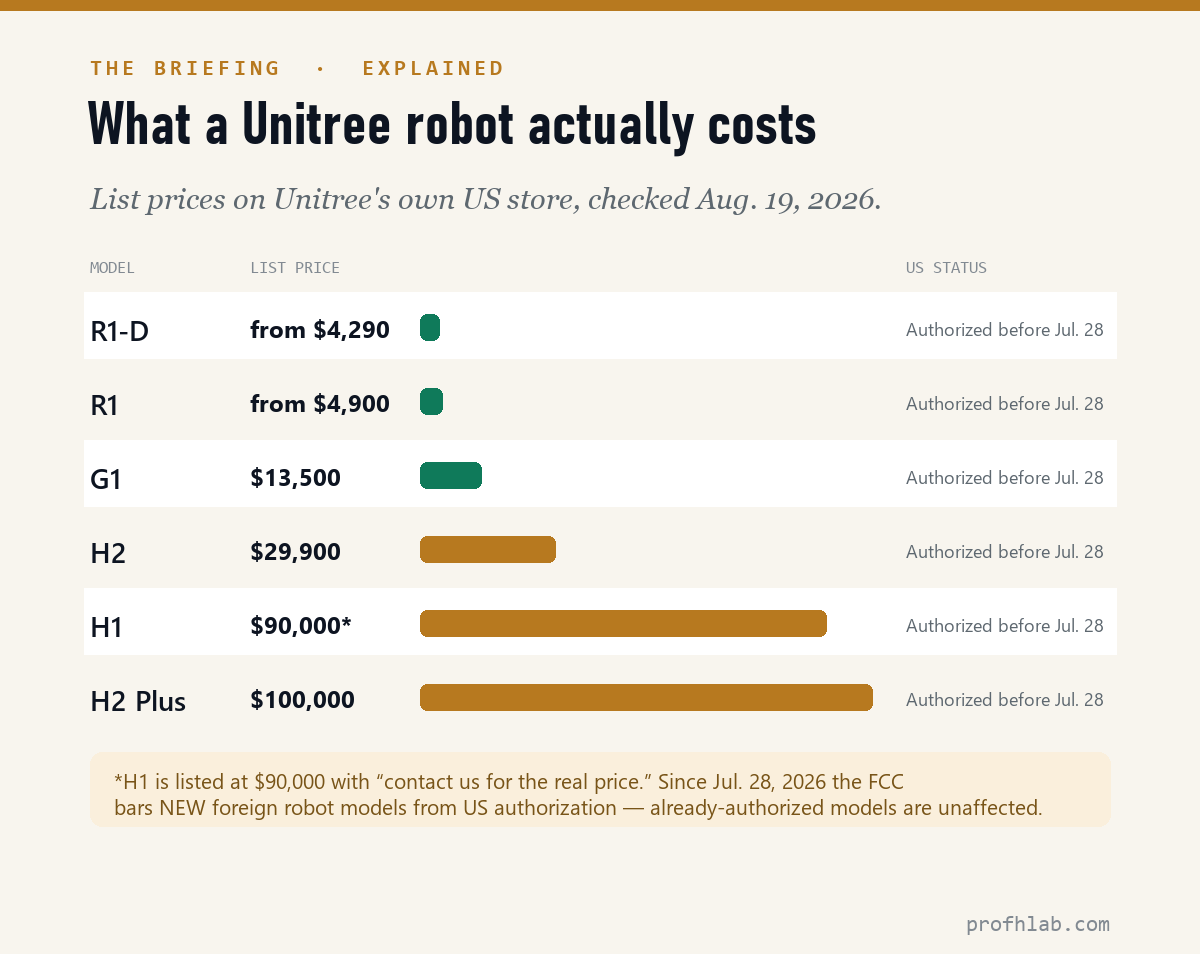
These are list prices from Unitree’s own US store, checked on the day of the IPO:
| Model | List price | What it is |
|---|---|---|
| R1-D | From $4,290 | Entry humanoid, demo and education focused |
| R1 | From $4,900 | Entry humanoid, about 1.2 m tall |
| G1 | $13,500 | The workhorse — the one in most viral clips |
| H2 | $29,900 | Full-size humanoid |
| H1 | $90,000 (listed, with “contact us for the real price”) | Earlier full-size platform |
| H2 Plus | $100,000 | Top of the published range |
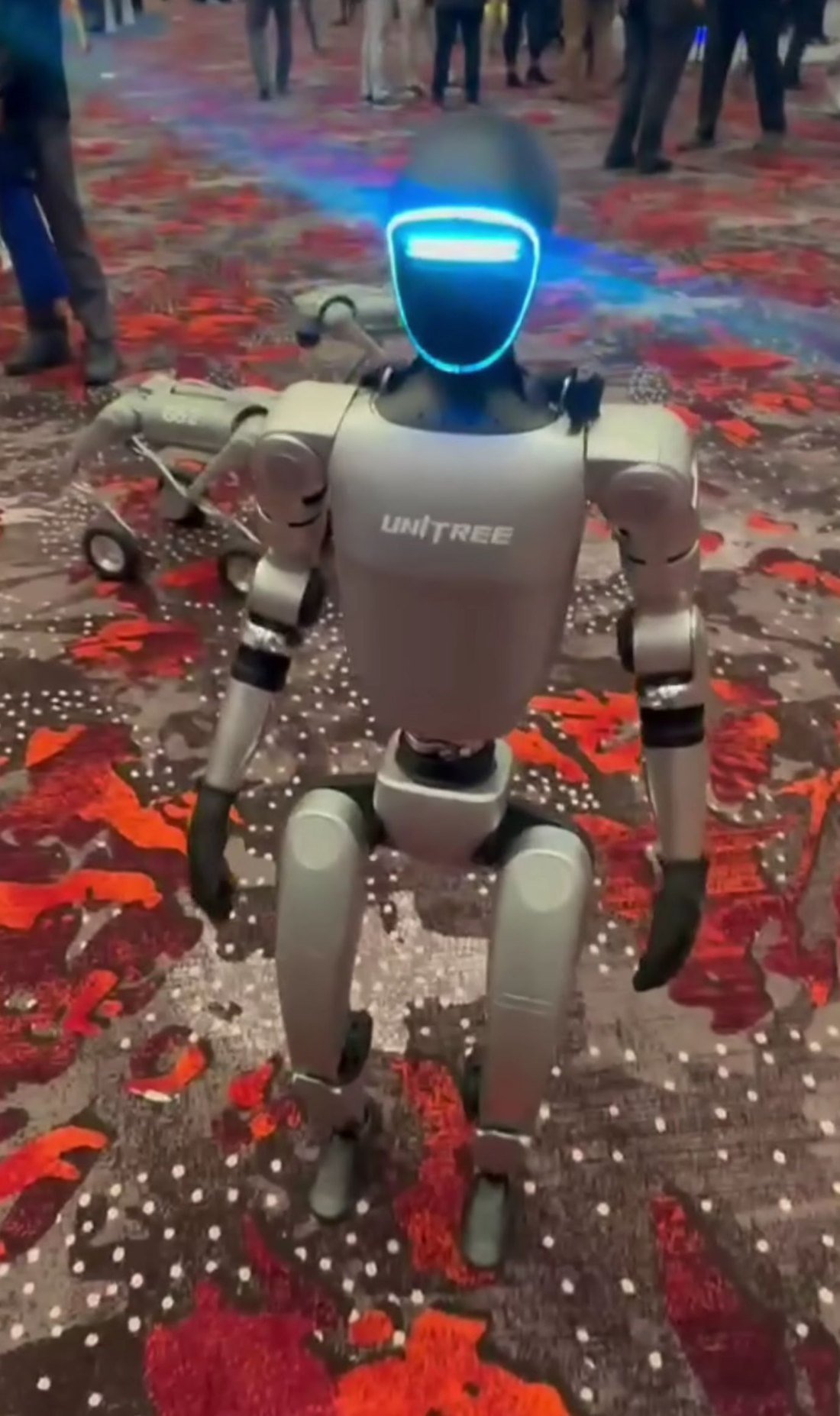
One correction to a widely repeated number: the G1 is frequently quoted at $16,000, its launch price. The current list price is $13,500. If you see $16,000 in an article, it is reading from 2024.
Worth being blunt about what these are. A $4,900 humanoid is a development and demonstration platform, not an appliance. It does not fold your laundry out of the box, it needs a person who can work with an SDK, and battery life is measured in tens of minutes. We went through the real cost of ownership — accessories, import, the gap between the sticker and the total — in our Unitree R1 buying guide.
Can you still buy a Unitree robot in the US?
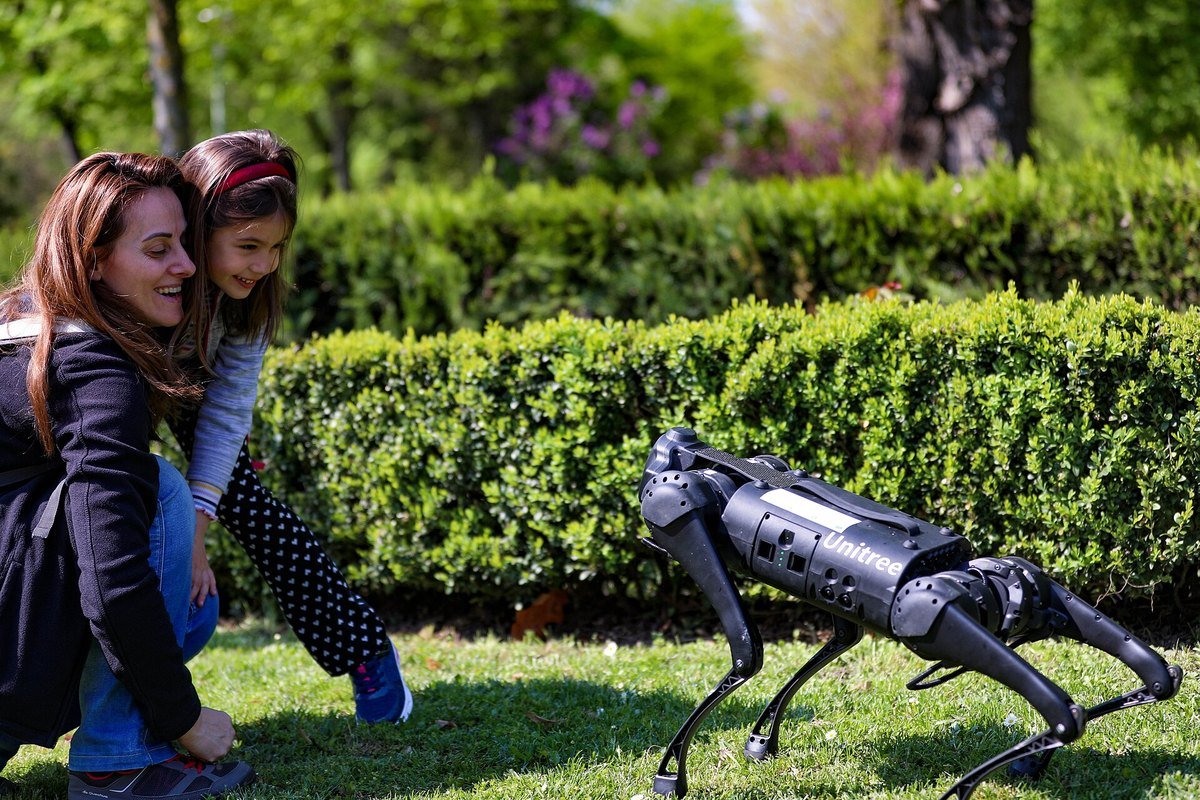
This is where a lot of coverage published this week is simply wrong, in both directions.
On July 28, 2026, the FCC added two new categories to its Covered List: foreign-produced “advanced robotic devices,” which it defines as mobile robots, such as humanoids and quadrupeds, and connected power inverters. The action followed a determination by a White House-convened interagency body that these products “pose unacceptable risks to the national security of the United States or the safety and security of United States persons.”
Here is what that actually does, per the FCC’s own fact sheet:
- New models in those categories cannot receive the FCC equipment authorization required to import, market, or sell them in the US.
- It does not affect devices people already bought.
- It does not revoke authorizations models already received.
- Federal government purchase and use is exempt.
- Manufacturers can apply for Conditional Approval — for robotics, through the Department of War — by showing their devices do not pose those risks.
So: Unitree’s G1, H2, R1 and its Go2, B2 and A2 quadrupeds cleared FCC authorization before July 28 and remain legal to sell and operate. The published price list above is not theoretical. What is now uncertain is Unitree’s next generation — any new model needs an authorization the Covered List now blocks by default.
Unitree itself flagged the risk to future US sales in its IPO disclosures, while downplaying the effect on its current lineup. Both of those can be true at once. China’s foreign ministry called the move protectionism that “will only hurt the interests of U.S. companies and consumers.”
About the “Superman” robot that reportedly outran Usain Bolt
Two days before the listing, Unitree unveiled a humanoid it calls Superman, claiming a standing jump of 2 meters and a top speed of 12.66 meters per second. For comparison, biomechanical analysis of Usain Bolt’s 2009 world-record 100 m put his peak instantaneous speed at about 12.27 m/s. The company said it built the robot in a little over three months.
Treat that number as a claim, not a measurement. Unitree has not published the payload the robot was carrying, the surface it ran on, or whether the runs are repeatable, and no independent party has verified them. The company itself called the robot a work in progress. A demo figure released 48 hours before a listing deserves the same scrutiny as any other pre-IPO announcement — which is not an accusation, just the ordinary standard.
Ask for the FCC ID, and report any “pre-IPO” Unitree offer
- If you were looking at buying a robot: check the model’s authorization status, not just the listing. Currently authorized models are fine; a brand-new model announced after July 28 may not be legally importable. Ask the seller directly for the FCC ID.
- If someone offers you “pre-IPO” or special-access Unitree shares: that is a scam pattern. Report it to the SEC at sec.gov/tcr or the FTC at reportfraud.ftc.gov.
- If you want to verify anything here yourself: the FCC’s Covered List and its robotics FAQ are public at fcc.gov/supplychain/coveredlist. Unitree’s list prices are on its own store.
- If you hold a fund with China or robotics exposure: whether it can hold this stock depends on its licensing and benchmark, and that is disclosed in the fund’s own documents rather than in news coverage.
Robots need physics, not text, and China ships most humanoids
- Why is a walking robot hard, when chatbots seem easy? Different problem entirely — language models predict text, robots need a model of physics that survives contact with the real world. We unpack it in Physical AI Explained.
- Can I experiment without spending $4,900? Yes. The major robotics simulators are free, and the hardware ladder starts around $249. See The Physical AI Toolbox.
- Is China really that far ahead in humanoids? By shipments, yes — roughly 85% of the global market by most estimates. By capability per dollar it is contested, and the US ban is about network security rather than a judgment on the engineering.
Can Americans buy ticker 688836, and did the US ban the robots?
Is Unitree publicly traded?
Yes. Unitree, legally Hangzhou Yushu Technology Co., began trading on the Shanghai Stock Exchange’s STAR Market on August 19, 2026, under ticker 688836. It is the first general-purpose robotics company listed on mainland China’s markets.
Can I buy Unitree stock in the US?
Not directly, in most cases. Unitree’s shares are mainland A-shares. Foreign access runs through the institutional QFII program or through Stock Connect, and Stock Connect only covers STAR Market stocks that are in the SSE 180 or SSE 380 indexes or dual-listed in Hong Kong. A newly listed company is in none of those, so there is a lag of months before typical foreign access is even possible. Indirect exposure through a fund depends on that fund’s licensing and benchmark.
How much does a Unitree robot cost?
On Unitree’s own store as of August 19, 2026: R1-D from $4,290, R1 from $4,900, G1 at $13,500, H2 at $29,900, H1 listed at $90,000, and H2 Plus at $100,000. The G1 is often quoted at $16,000, which was its 2024 launch price rather than the current one.
Did the US ban Unitree robots?
Partly. On July 28, 2026 the FCC added foreign-made humanoid and quadruped robots to its Covered List, which blocks new models from receiving the authorization needed to import, market or sell them in the US. Models already authorized — including Unitree’s G1, H2, R1, Go2, B2 and A2 — are unaffected, as are robots people already own. Federal government use is exempt, and makers can apply for Conditional Approval.
Why did Unitree stock fall from its opening price?
It opened at 1,100 yuan and closed at 845 yuan, about 23% below the open, though still roughly 460% above the IPO price of 150.80 yuan. Large first-day gaps between the opening print and the close are common when demand at the offer far exceeds supply; the opening price is set by that imbalance rather than by later trading.
How many humanoid robots has Unitree sold?
About 5,500 humanoid units in 2025, the most of any manufacturer worldwide. Estimates put total global humanoid shipments that year near 15,000, with Chinese makers accounting for roughly 85% of the market.
Is the Unitree Superman robot really faster than Usain Bolt?
Unitree claims a top speed of 12.66 m/s, which is above the roughly 12.27 m/s peak measured for Bolt’s 2009 world-record run. But the company has not disclosed the payload, the running surface, or whether the result is repeatable, and no independent verification exists. Treat it as an unverified company claim.
What is Unitree worth?
It closed its first session at about 341.7 billion yuan, roughly $50 billion at the August 19, 2026 exchange rate, after opening near $66 billion. For scale, its 2025 revenue was about 1.71 billion yuan ($253 million), so the closing value was around 200 times last year’s sales — on revenue that grew roughly 335% year over year.
Sources
- Federal Communications Commission, Fact Sheet: FCC Updates Covered List to Include Foreign-Produced Advanced Robotic Devices and Power Inverters, July 28, 2026, and the Covered List robotics FAQ.
- Bloomberg, Unitree IPO pricing, subscription and debut coverage, August 6-19, 2026.
- South China Morning Post and CNBC, Shanghai debut coverage, August 19, 2026.
- Unitree Robotics official store (shop.unitree.com), humanoid robot list prices, checked August 19, 2026.
- PBS NewsHour, NPR and CBS News reporting on the FCC action and China’s response, July 29, 2026.
- Exchange rate 6.76 yuan per US dollar, open.er-api.com, August 19, 2026.
Watch
Before you buy an R1: the total cost behind the sticker price
- Buying a Humanoid Robot in 2026: What a Unitree R1 Really Costs — the total-cost breakdown behind the sticker price.
- Physical AI Explained: Why a Chatbot Knows the Cup Falls but a Robot Doesn’t — the reason humanoids are hard.
- The Physical AI library — every robot, chip and paper we have taken apart, in order.
Prof. H writes The Briefing at Prof H Lab, where every price is dated and every source is named. Questions are welcome on the answer board.
Prof.’s H Newsletter
One short email a month, with the numbers in it
What actually moved in AI hiring, AI prices, and the scams aimed at older Americans. Counted here, dated, and linked to the source. One email a month, and your address goes nowhere else.