What Does 25% Travel Mean for a Job? 190 AI Job Postings Put a Number on It (Oct. 29, 2026)
On October 29, 2026, “25% travel” in a job posting meant you could be away from your home base about a quarter of the time: roughly 13 weeks a year, or one week in four. Of the 3,817 open jobs we read on 19 AI company career boards that day, 190 put a number on travel, and their most common ceiling was not 25% but 50%.
The percentage is a ceiling and an average, not a schedule. The few postings that explained it measured it over a year, and one warned of “bursts.” So the real question for you is how the weeks are spread.
Here is the twist we did not expect. Exactly 25% was named by only 22 postings. But 56 gave a range that included it, like “25–50%,” which means 25% is often the floor, not the promise.
What we checked on October 29, 2026
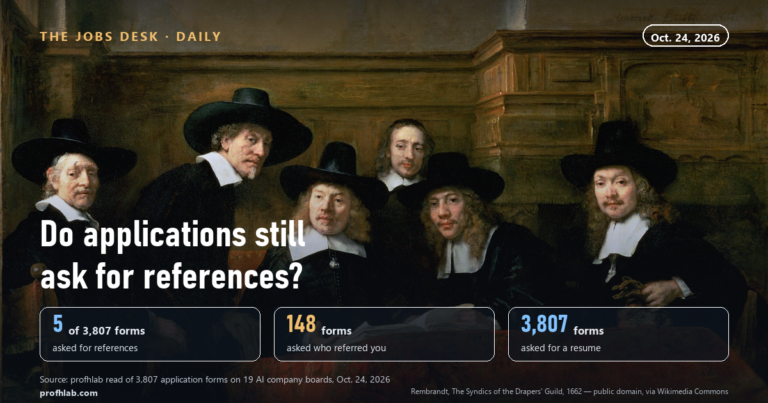
- Posting text: the full text of all 3,817 open jobs on 19 AI company boards (OpenAI, Anthropic, xAI, Scale AI, Waymo, Figure AI and 13 more), read through the employers’ public Greenhouse and Ashby feeds. Only 1 posting came back with almost no text.
- Travel lines: we pulled every sentence with the word travel and read the 190 that carry a percentage by eye. When a posting gave a range, we counted its top number as the ceiling. Percentages about bonuses or office days were left out, as were 2 postings that showed the figure in square brackets, like an unfinished draft.
- Not sorted: another 410 postings use the word travel without a percentage, and 219 mention it only as a perk, such as a travel stipend. We did not read all of those by eye, so we give them no breakdown.
- Pay: the posted range from the same feeds, US postings only. Ranges are what the employer published, not offers. Google DeepMind’s US board, the 20th on our daily list, returned an error and is not counted.
Written and checked by Prof. H. An AI assistant helped draft this piece and run the page reads; every quote was read on the source’s own page on October 29, 2026.
What does 25% travel mean for a job, in weeks and days?
By plain arithmetic, 25% travel is about 13 weeks of a 52-week year, or roughly 65 of 260 weekdays, and on October 29, 2026, 22 AI company postings named 25% as their ceiling. That is our math, not an employer’s definition. No posting we read spelled out a day count.
What the postings did spell out was the time frame. Waymo’s AV Compliance Lead posting, read October 29, 2026, says travel “is expected to be 10-15% of the year with a maximum of 20%.” Apptronik’s Manager, Manufacturing Engineering posting says “averaging 15% per year.”
Both measure across a year. So a 25% job can mean a week away every month, or a quiet spring and a busy fall. The posting usually will not tell you which.

How much travel do AI company job postings ask for?
Of 3,817 AI company postings read on October 29, 2026, 190 stated a travel percentage, and their median ceiling was 30%. 66 of them topped out at 50%, the single most common figure. Another 28 asked for 10% or less.
So most AI jobs, 3,627 of 3,817, never name a travel percentage at all. When they do, it tends to be a field job: a customer-facing engineer, a data center build, a factory or supplier visit.
The companies that use the line most were OpenAI and xAI with 36 postings each, Waymo with 33 and Anthropic with 28. Waymo puts a travel requirements line in many postings, even low ones like 5% for a Senior Actuary.

Which AI jobs list a travel percentage, and what do they pay?
On October 29, 2026, the AI jobs that named travel ran from a 5% actuary at Waymo to xAI construction electricians who must travel 80% or more, and their posted US pay ran from $32 an hour to $405,000 a year. The table shows eleven US postings across that range, in each posting’s own words.
| Company and title | Travel line in the posting | Posted US pay |
|---|---|---|
| Waymo, Senior Actuary | “Travel Requirements: 5%” | $196,000–$242,000 |
| xAI, Critical Facilities Technician (Memphis area) | “as needed (up to 10%)” | No range in the posting |
| Waymo, AV Compliance Lead | “10-15% of the year with a maximum of 20%” | $200,000–$247,000 |
| Agility Robotics, Firmware Manager | “averaging ~15% with bursts of extended stays” | $198,000–$257,000 |
| Anthropic, Partnerships Manager, US Public Health | headquarters “every ~6 weeks” (~20%) | $215,000–$300,000 |
| Anthropic, Staff Forward Deployed Engineer | “Travel frequently (25%)” to customer sites | $280,000–$320,000 |
| Anthropic, Data Center Mechanical Engineer (remote-friendly) | “up to ~30%” to data center sites | $320,000–$405,000 |
| OpenAI, Field Service Engineer (remote, US) | “Remote – travel 50%” | $157,000–$221,000 |
| OpenAI, Forward Deployed Software Engineer (SF) | “Travel up to 50% is required” | $185,000–$325,000 |
| Figure AI, Staging Specialist | “75%+ travel required” | $32 an hour (in the posting text) |
| xAI, Electrician (Construction) | “80% or more travel on a rotation, with per diem” | No range in the posting |
The pay ranges are the employers’ posted ranges, read October 29, 2026. “No range in the posting” means we found none in the text. Postings close without notice, so check the employer’s page before you apply. Every open role is also on our jobs board, where you can browse every open role and apply on the employer’s site.

Do jobs with 50% travel pay more than jobs with little travel?
In our October 29, 2026 count, the 37 US postings with a travel ceiling of 50% or more and a posted range had a median band of $207,000 to $300,000, against $198,000 to $247,000 for the 31 at 20% or less. That gap is real in the data. It does not prove that travel itself is paid extra.
Here is why. 49 of the 62 postings with “deploy” in the title, mostly forward deployed engineers, set their ceiling at 50% or higher. Those are senior software jobs that would pay well with no travel at all. The middle group, 21% to 40%, had a lower median band, $177,000 to $228,000, across 26 postings.
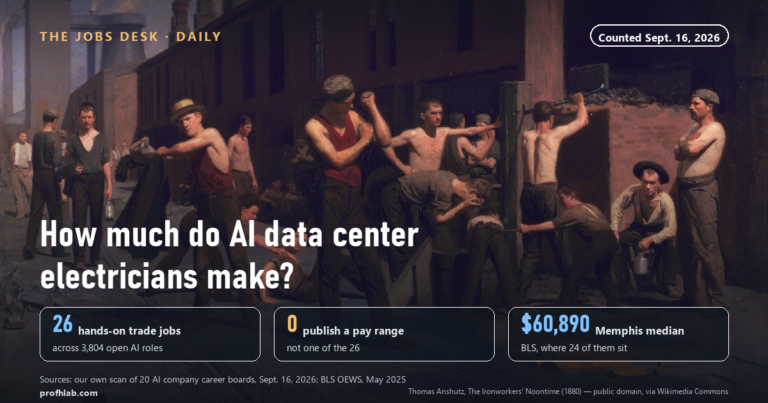
One posting does attach money to the travel itself. xAI’s construction electricians are told to “Expect 80% or more travel on a rotation, with per diem,” meaning a daily allowance on the road. For the roles themselves, see how much forward deployed engineers make and how much AI data center electricians make.
Can a remote job still require travel?
Yes: on October 29, 2026, 25 remote-tagged AI company postings stated a travel percentage, and most of them said 50%. Remote here means the job has no daily office. It does not mean the job stays at home.
OpenAI’s Field Service Engineer posting opens its key line with “Remote – travel 50%,” for field support at data center sites. Anthropic’s community engagement role for its Louisiana data center region says: “You will travel regularly within Louisiana, up to 50% of the time.”
Anthropic’s remote-friendly Data Center Mechanical Engineer posting asks for travel “up to ~30% to data center sites across the region.” If you want a desk at home and little else, read the travel line before the location line. For the location fine print, see why remote jobs have location requirements and what remote-friendly means at Anthropic.

How do employers spread a travel percentage over the year?
In the AI postings we read on October 29, 2026, the same kind of percentage came with at least four patterns: bursts, rotations, fixed visits to headquarters and regular field trips. Here is each one in an employer’s own words.
- Bursts. Agility Robotics’ Firmware Manager posting says: “Candidates should anticipate regular travel to Salem, OR, averaging ~15% with bursts of extended stays during critical project phases.”
- Rotations. xAI’s construction electricians are told to expect 80% or more travel “on a construction rotation.”
- Fixed visits. Anthropic’s Partnerships Manager, US Public Health posting asks people based outside San Francisco to travel to headquarters “every ~6 weeks,” adding up to about 20%.
- Regular field trips. Figure AI’s Deployment Engineer (Data Collection) posting lists “regular travel across the Bay Area, and ~25% travel across the country.”
Our reading, which is an inference from these postings and not a rule any of them states: the percentage tells you the total, and the words around it, like rotation, bursts or every six weeks, tell you the rhythm. When those words are missing, the rhythm is the thing to ask about.

What should you ask before you agree to a travel percentage?
A percentage alone, which is all most of the 190 travel lines we read on October 29, 2026 give, does not tell you four things: how many trips a year, how long each one lasts, how much notice you get, and who pays. These are the steps we would take.
- Find the ceiling and the range. “25–50%” means up to half your time. 56 postings gave a range or ceiling that covers 25%.
- Look for a time word. “Of the year,” “per year” or “every ~6 weeks” tells you how it is counted.
- Look for a place. “Within your region” may be a drive; “domestic and international” may mean flights and a passport.
- Ask the recruiter for the real number. Ask how much the person in the role traveled last year. It is a fair question at the screening call.
- Check for travel money. Only one posting in our read named a per diem. If it is not written, ask how travel costs are paid.
If the travel is more than you want, the job may still be worth a conversation; see should you apply if you do not meet every requirement.
We are not recruiters. We take no money from employers, and postings can close at any time; the employer’s official page wins. Never pay anyone for a job, never deposit a check and send money back, a text message is not a job offer, and apply only on the employer’s own site. More at the Jobs Desk sources.
Office days, pay bands and level words this desk has also counted
Travel is one line in a posting. These pieces read the others on the same boards:
- What hybrid means in a job posting — the office-days line.
- Are AI engineer jobs remote — how many really are.
- Do remote jobs pay less — pay by work setting.
- AI companies hiring remote workers — the boards with remote roles.
- What relocation assistance means — when the job asks you to move instead.
- What contract-to-hire means — another phrase decoded.
- What Associate means in a job title — the level word.
- Does the salary range include bonus — what the posted band covers.
- xAI Memphis jobs and salary — where many of the rotation jobs sit.
- How to become a data center technician — field work, often closer to home.
- Humanoid robot operator jobs — the hands-on robot roles.
- Is Waymo hiring and is Figure AI hiring — two boards in this count.
Daily counts for all 19 boards are on the AI jobs tracker. Have a question about your own search? Ask the Jobs Desk.
Is 25% travel a lot? Six travel questions people search
What does 25% travel mean for a job?
It means you could spend about a quarter of your working time away from your home base. Over a 52-week year that is about 13 weeks, or roughly 65 of 260 weekdays, by simple arithmetic. Employers spread it differently, so ask how many trips there are and how long each one lasts.
Is 25 percent travel a lot?
It sits in the middle of what AI companies ask. On October 29, 2026, 190 of 3,817 AI company postings put a number on travel; the median ceiling was 30 percent and the most common was 50 percent. Only 22 named exactly 25 percent.
How many days is 20 percent travel?
About 52 of 260 weekdays a year, or roughly 10 weeks, by arithmetic. On October 29, 2026, 28 AI company postings named 20 percent as their travel ceiling, most of them at Waymo and xAI.
Does 50 percent travel mean every other week?
Not always. Most of the 66 postings with a 50 percent ceiling that we read on October 29, 2026 did not say how the time is scheduled. Other postings describe bursts of extended stays or rotations, so ask whether it means weekly trips, long stays or busy seasons.
Can a remote job require travel?
Yes. On October 29, 2026, 25 remote-tagged AI company postings stated a travel percentage, including the OpenAI Field Service Engineer posting, which says travel 50 percent.
Do jobs with more travel pay more?
We cannot say that from our count. US postings with a 50 percent ceiling had a higher median posted band than those at 20 percent or less, but most of them were forward deployed engineering jobs, which pay more anyway.
Sources
- Full text and posted pay of every open job on 19 AI company boards, read through the employers’ public Greenhouse and Ashby feeds on October 29, 2026. Quoted postings: Waymo AV Compliance Lead, Apptronik Manager, Manufacturing Engineering, Agility Robotics Firmware Manager, xAI Electrician (Construction), Anthropic Partnerships Manager, US Public Health, OpenAI Field Service Engineer, Figure AI Staging Specialist.
- “Day in the Life of an FDE”, Salesforce Careers & University, published February 13, 2026; “Consultant: The pros & cons of traveling for work”, Khan Academy, published September 19, 2017; both checked October 29, 2026.
- Photos: Miami departures board (Bobby Hidy, CC BY-SA 2.0), MTA electrician (MTA Capital Construction, CC BY 2.0), Yesler substation crew (Seattle Municipal Archives, CC BY 2.0); featured image, Claude Monet, The Saint-Lazare Station, 1877, public domain; all via Wikimedia Commons, read October 29, 2026.
Next check: we will read the travel lines on these boards again in late January 2027 and note whether 50% is still the most common ceiling.
Prof.’s H Newsletter
One short email a month, with the numbers in it
What actually moved in AI hiring, AI prices, and the scams aimed at older Americans. Counted here, dated, and linked to the source. One email a month, and your address goes nowhere else.