How to Tell If You Are Talking to AI on the Phone: 3 U.S. Warnings Say Hang Up and Call Back
You often cannot tell by ear alone: on November 11, 2026 we read 3 U.S. government warnings about AI voices, and all 3 say the same thing – hang up and call back on a phone number you already know. The FBI’s May 15, 2025 alert says a cloned voice and a real one “can sound nearly identical.”
So if a call makes you wonder, “Is this a real person?”, you are asking a fair question, and you did nothing wrong by picking up. Listening clues can help, and we list the best ones below. But the step that settles it is not a clue. It is a callback you dial yourself.
What we read and counted on November 11, 2026
We read 2 FBI public service announcements (December 3, 2024 and May 15, 2025), 1 FTC consumer alert (March 20, 2023), and the FCC’s February 8, 2024 ruling on AI voices in robocalls. We also searched the Federal Register for the FCC’s later AI-call proposal.
Then we opened the 10 results a search for this question returned and counted what each one told readers to do. 9 opened; Medium blocked our reader, so we counted it as unread, not as a zero. We did not place or receive any test calls.
Written and checked by Prof. H. An AI assistant helped draft this article and ran the page reads; every quote was read on the source’s own page on the date shown.

Can you tell an AI voice from a real person just by listening?
Sometimes, but not reliably: the FBI wrote on May 15, 2025 that “AI-generated content has advanced to the point that it is often difficult to identify,” and that a cloned voice and a real contact “can sound nearly identical.”
That warning was about a real campaign. The FBI said that since April 2025, scammers had sent texts and AI-generated voice messages pretending to be senior U.S. officials. Many of the targets were current or former government officials and their contacts, the very people most likely to know those voices.
The FTC put it more bluntly on March 20, 2023, in an alert about fake family emergencies. Its first piece of advice was four words: “Don’t trust the voice.” Its next advice was to call the person on a phone number you know is theirs.
Which listening clues are worth knowing anyway?
The clearest list we found came from the National Consumer Law Center, a nonprofit, in an explainer its web address files under October 2026. It names 6 things to notice. Use them as reasons to be careful, not as proof either way.
- Total silence between sentences. NCLC says real callers usually have some background noise or a slight microphone hum.
- Answers that come too fast. People often pause or say “umm” before they reply, especially to a surprise question.
- The same answer twice, as if read from a script.
- A flat voice that never changes its tone or speed.
- A message that talks to your voicemail as if it were a live person.
- A famous voice. NCLC’s advice is short: a movie star or politician is unlikely to be calling you, so hang up.
The FBI’s two alerts add one clue of their own: listen closely to “tone and word choice.” If your grandson never says “Grandmother” and the caller does, that is worth noticing. NCLC itself adds a warning, though: some AI voices “can be very difficult to tell from a human voice.”
What should you do the moment a call feels wrong?
Hang up and call back on a number you already have: that step appears in all 3 government warnings we read on November 11, 2026, and it works whether the voice is AI, a human scammer or a real person with a real problem.
- Say you will call right back, then hang up. You do not owe the caller an explanation.
- Find the number yourself. Use your phone’s contacts, the back of your bank card, or a paper address book. Do not use a number the caller gave you.
- Dial it. The FBI’s 2024 alert says to hang up, look up the bank or organization, “and call the phone number directly.”
- If you cannot reach the person, the FTC says to try another family member or their friends.
- Send nothing while you check. Both FBI alerts say not to send money, gift cards or cryptocurrency to people you have met only online or by phone.

A scammer may push back with “don’t hang up” or “don’t tell anyone.” Treat that pressure as your answer. A real bank, a real doctor’s office and a real grandchild can all wait two minutes for you to call back.
Why a family secret word beats any trick question
Both FBI alerts, from December 3, 2024 and May 15, 2025, tell families to “create a secret word or phrase” to verify each other, because a voice can be copied but a word you agreed on in person cannot be guessed from the internet.
Pick something odd and private, like the name of a childhood dog plus a street you lived on. Do not post it, text it or put it in an email. If a “grandchild” calls in a panic and cannot give the word, hang up and call that grandchild’s own number.
Some guides suggest asking the caller, “Are you an AI?” 2 of the 9 results we read said so. That can catch a simple sales bot. But a scammer, human or machine, can simply lie, so we would not trust the answer. Our family safe word examples show how to choose one that is easy to remember.
What 9 top search results tell you, and what most leave out
Of the 9 top results we could read on November 11, 2026, 6 gave listening clues, but only 4 said to hang up and call back on a known number, the one step all 3 government warnings share.
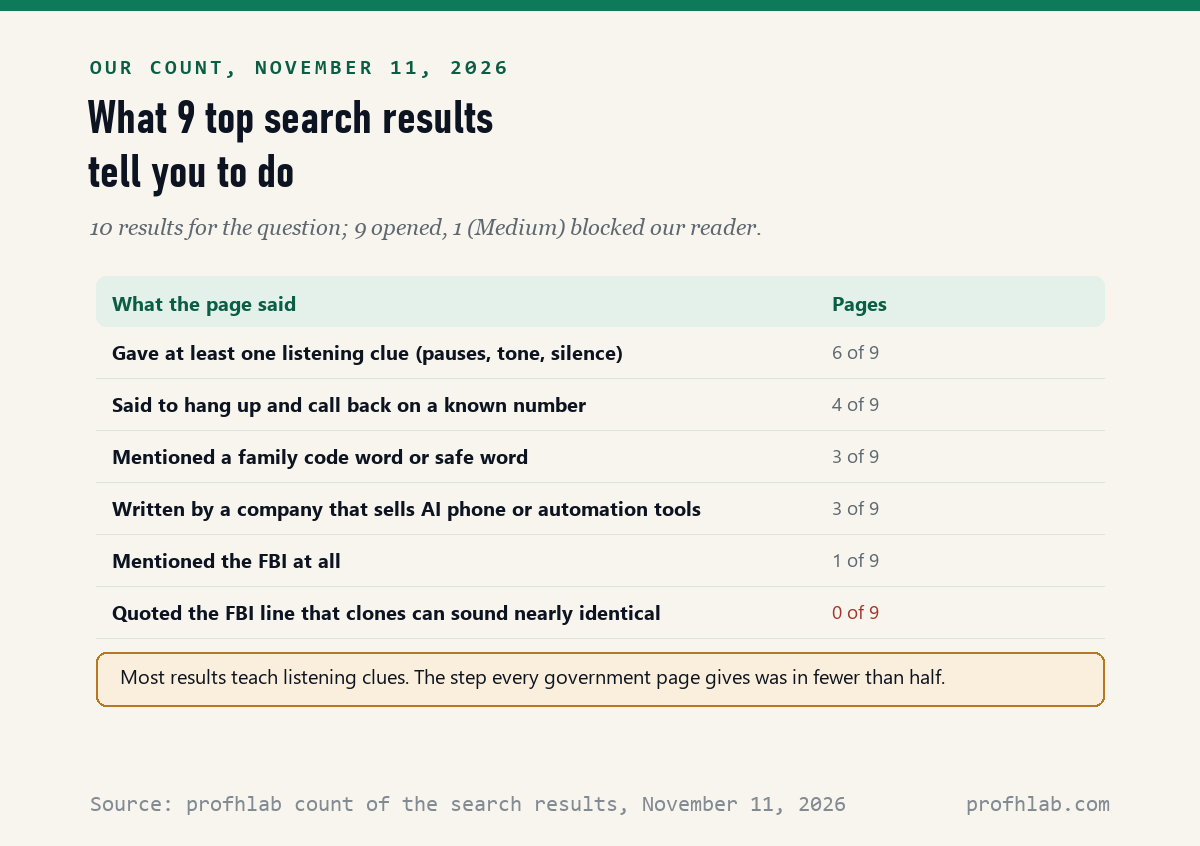
3 of the 9 were written by companies that sell AI phone or automation products: Dialzara, fonio.ai and Layer3 Labs. Their tips were not wrong, and several were useful. But a page that sells AI callers has a reason to stress how the technology sounds.
Only 1 of the 9, Dialzara, mentioned the FBI at all, and none quoted the FBI’s “nearly identical” line. That gap is the reason we wrote this page. The most useful sentence on the subject comes from the agency that investigates these crimes.
Is it legal for an AI voice to call you?
Not without your consent in most robocall cases: on February 8, 2024 the FCC announced a unanimous ruling that AI-generated voices count as “artificial” under the Telephone Consumer Protection Act, the main U.S. law on junk calls.
The ruling says such calls need “the prior express consent of the called party,” with some exceptions the law already had. The FCC’s press release said the change took effect immediately and gives state attorneys general another tool against voice-cloning scams.

Does an AI caller have to tell you it is AI? Not under any federal rule we could find. On August 8, 2024 the FCC proposed requiring callers to disclose AI-generated calls. When we searched the Federal Register on November 11, 2026, it showed that proposal (published September 10, 2024) and no final rule. That is our reading of the search, not legal advice.
How to report an AI voice scam call
The FTC takes scam reports at ReportFraud.ftc.gov, and the FBI’s alerts ask victims of fraud to report to the Internet Crime Complaint Center at ic3.gov; both addresses were on the pages we read on November 11, 2026.
The FBI’s 2024 alert lists what helps most: the caller’s name and number, how and when you paid if you did, and what the caller asked for. Write those down while you remember. If money already left your account, call your bank using the number on your card first.
Two short videos, one from NBC News and one from AARP
Our verdict for anyone who answers the phone
- Tonight: agree on a family secret word, in person or on a call you placed yourself.
- On any call about money, a crisis or an account: hang up and dial a number you already have.
- Use the listening clues as a reason to slow down, never as proof that a call is safe.
- If you paid or shared details: call your bank first, then report at ReportFraud.ftc.gov or ic3.gov.
Our verdict: stop trying to win a listening test you may not be able to win. The callback is free, takes two minutes, and works the same whether the fake caller is a machine or a person.
More from our scam-safety and AI-basics shelves
- Phone calls: stopping AI calls on a landline, what happens if you say yes on a scam call, why so many Medicare calls and call screening on iPhone.
- Spotting fakes: AI videos on YouTube, AI pictures, AI-written email and fake shopping sites.
- The bigger picture: AI scams that target seniors, family safe word examples and what is safe to tell a chatbot.
- In an emergency: whether Alexa can call 911.
- New to AI? Begin at Start Here, then try our ChatGPT guide for beginners over 50. Curious about jobs in this field? Our AI jobs tracker counts openings every week.
Short answers on AI calls, voice messages and caller ID
How to tell if a call is AI generated?
Listen for total silence, instant answers and a flat voice, but do not rely on them. The FBI said on May 15, 2025 that cloned voices can sound nearly identical to real ones. Hang up and call back on a number you know.
How to know if a voice message is AI?
You often cannot tell from the recording. The FBI warned in 2025 about AI-generated voice messages posing as U.S. officials. Do not reply to the message or use its number; call the person on a number you already had.
How to tell if you are speaking to AI?
Ask a question only the real person could answer, or ask for your family secret word. Asking whether the caller is an AI can catch a simple bot, but a scammer can lie, so a callback is the safer test.
How to tell if a call is spoofed?
Do not let caller ID decide for you. The FBI says to research the number that called, then find the real number of the person or organization on your own and call that number directly.
Is it illegal for AI to call you?
Robocalls with AI voices need your prior express consent in most cases, under an FCC ruling of February 8, 2024. A proposed rule that would make callers disclose AI had no final version in the Federal Register on November 11, 2026.
What should I do if I already talked to an AI scam call?
If you paid or shared account details, call your bank on the number on your card. Then report it at ReportFraud.ftc.gov or ic3.gov. If you only talked and shared nothing, hang up and block the number.
FBI, FTC and FCC pages, and the 10 results we counted
- FBI Internet Crime Complaint Center, Senior US Officials Impersonated in Malicious Messaging Campaign, Alert I-051525-PSA, May 15, 2025, read November 11, 2026.
- FBI Internet Crime Complaint Center, Criminals Use Generative Artificial Intelligence to Facilitate Financial Fraud, Alert I-120324-PSA, December 3, 2024, read November 11, 2026.
- FTC, Scammers use AI to enhance their family emergency schemes, by Alvaro Puig, March 20, 2023, read November 11, 2026.
- FCC, FCC Makes AI-Generated Voices in Robocalls Illegal (press release, February 8, 2024) and Declaratory Ruling FCC 24-17 (adopted February 2, released February 8, 2024), both read November 11, 2026.
- FCC, Notice of Proposed Rulemaking FCC 24-84 on AI-generated calls, released August 8, 2024, and the Federal Register notice of September 10, 2024, both read November 11, 2026.
- National Consumer Law Center, AI Voice Explainer, read November 11, 2026.
- Results read November 11, 2026, with the date each page lists where it had one: Dialzara (November 3, 2026), PhilSTAR L!fe (September 7, 2026), fonio.ai (October 15, 2026), Make Tech Easier (January 8, 2025), Tom’s Guide (March 27, 2026), Skipcall (November 3, 2026), Vice (August 9, 2024), Layer3 Labs (November 9, 2026) and the NCLC explainer above. A Medium post blocked our reader, so we counted it as unread.
Prof.’s H Newsletter
One short email a month, with the numbers in it
What actually moved in AI hiring, AI prices, and the scams aimed at older Americans. Counted here, dated, and linked to the source. One email a month, and your address goes nowhere else.