How to Tell If Meta Glasses Are Recording: Three Patches Later, the Light Still Isn’t Proof
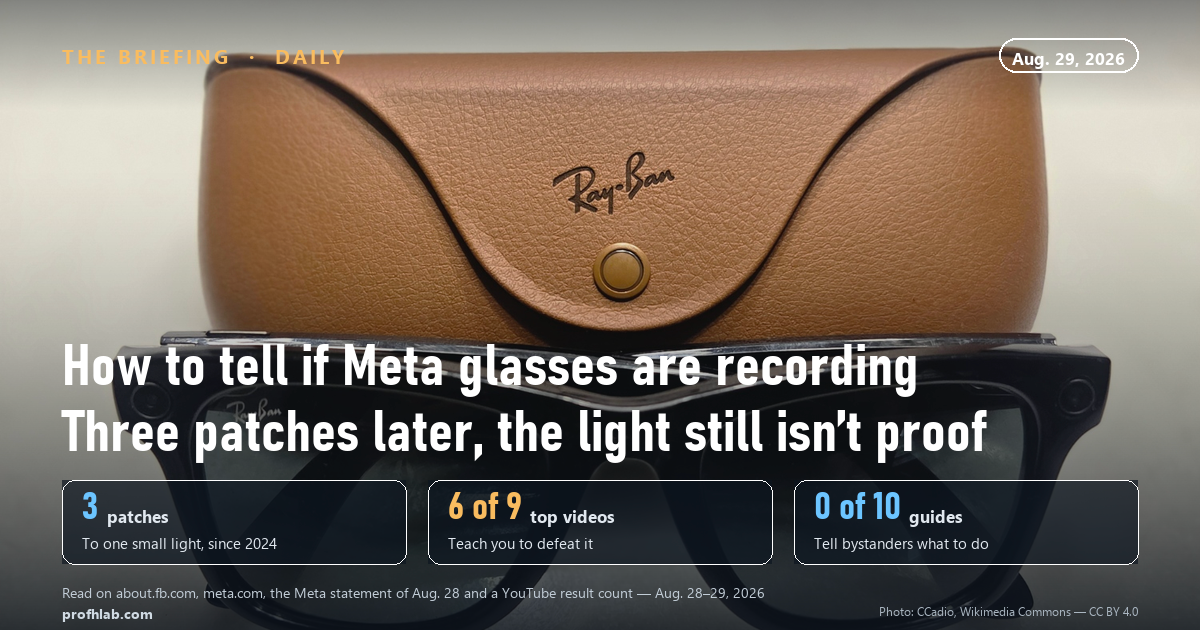
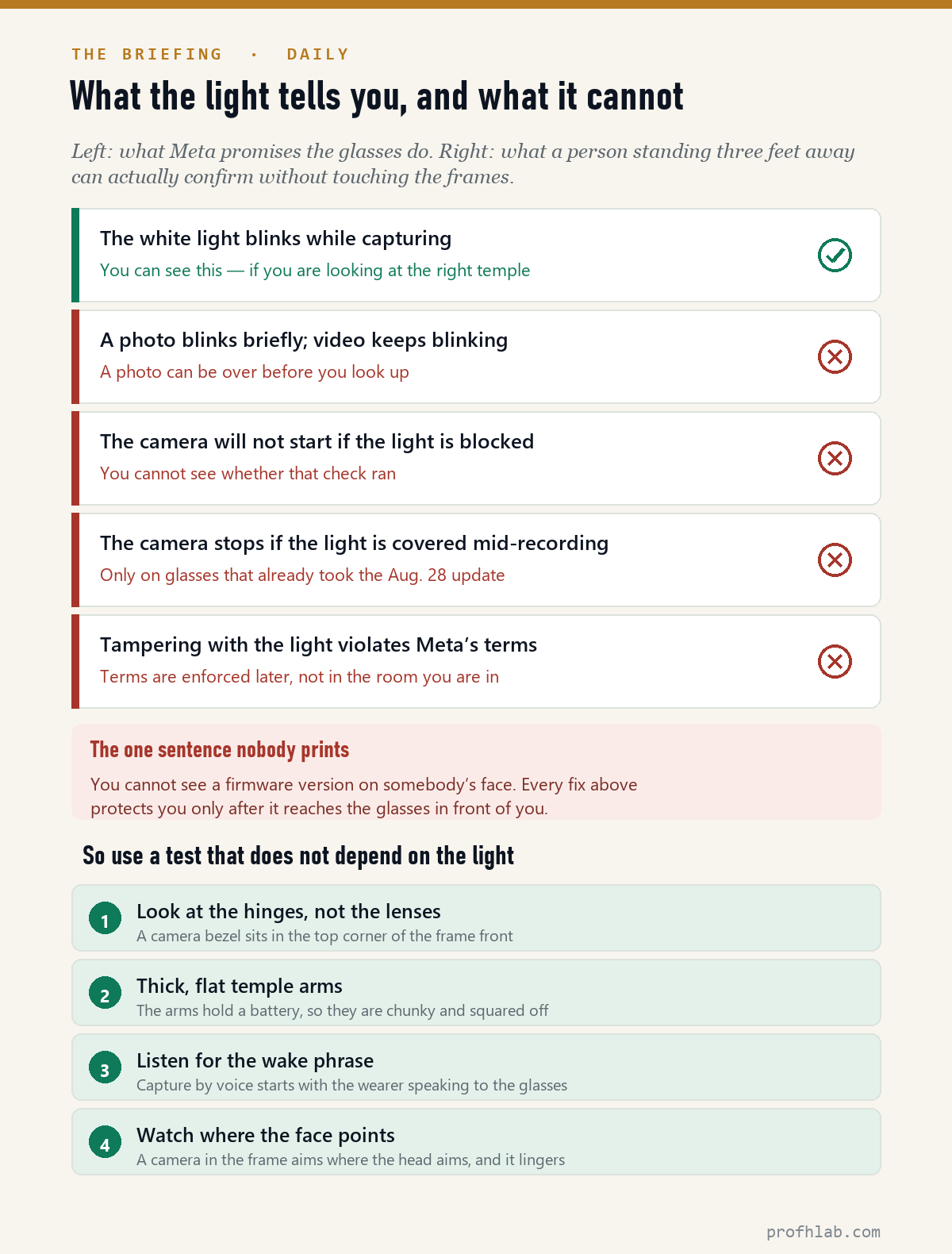
Look for the small white light on the front of the frame, near the right hinge. A brief blink means a photo was taken. A light that keeps blinking means video is rolling. That is the answer Meta gives, and it is the correct answer — but Meta has now patched that one light three separate times since 2024, and the newest patch only began rolling out on August 28, 2026.
Which raises the question this article is actually about. If the light has needed three repairs, how much weight should you put on it when the person across the coffee shop is wearing a pair? We read Meta’s own privacy pages, its statement from this week, and the ten guides Google currently ranks for this exact question. Zero of those ten told the person being recorded what they could actually do about it. So that part is at the bottom of this page.
First, what the light is supposed to do
Meta calls it the capture LED. In a July 7, 2026 post on its own newsroom, the company describes it plainly: “There’s a light on the front of every pair of our AI glasses that we call a capture LED. Whenever content is being captured for your gallery, this white light blinks to let people know you’re capturing content.”
The behavior differs by what is being captured. For a photo, Meta says, “it blinks briefly, while for a video, it continues to blink for as long as you are recording.” Meta also says it chose white because it “delivered the best combination of visibility and experience.”
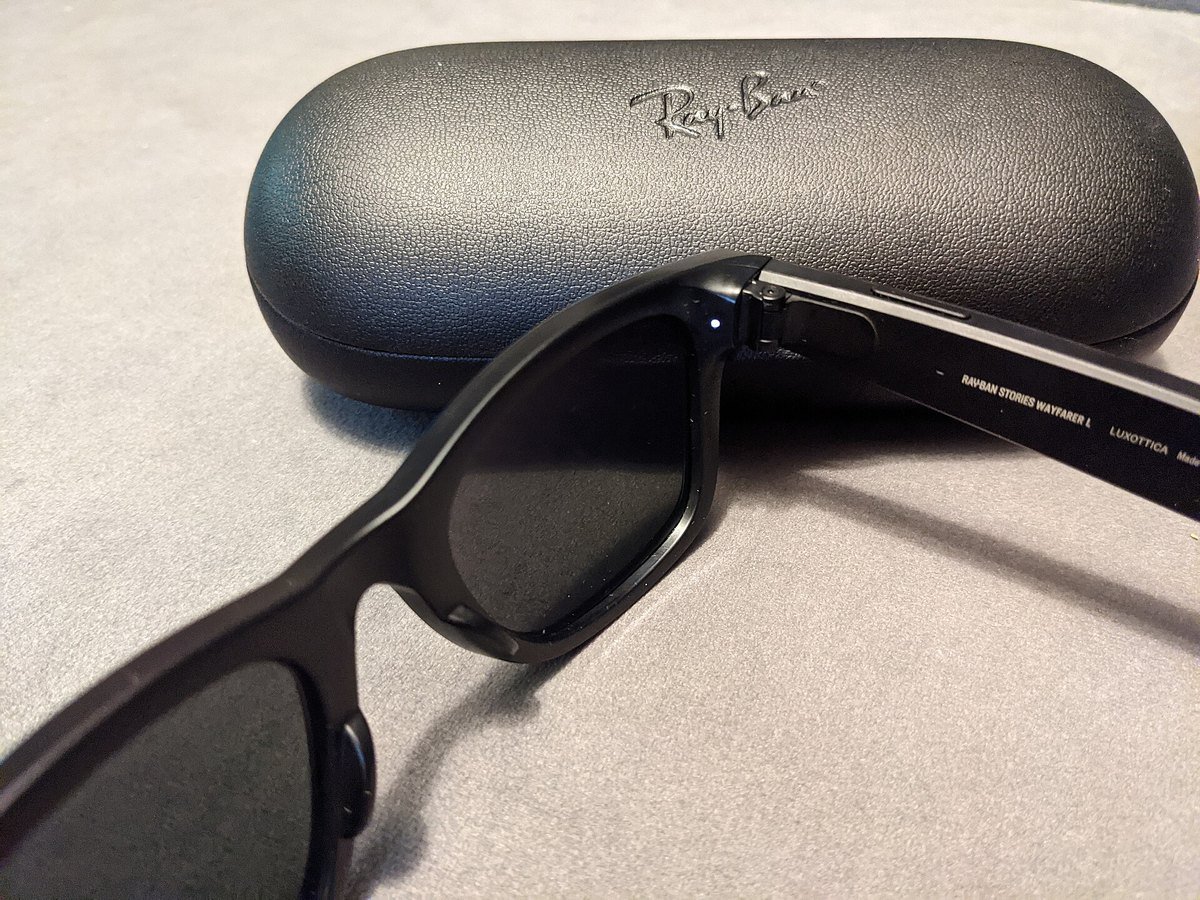
Look at that photo for a second longer than feels necessary. The light works. The light is also about two millimetres across, sits below eye level, and competes with every other thing happening in a room. For a photo it blinks once. A still image can be taken and finished before you have finished looking up.
What actually changed on August 28
Until this week, the check ran only at the start. Cover the light, and the camera refused to begin. So people started the recording first and covered the light afterward. Meta confirmed both the loophole and the fix in a statement this week:
“The camera won’t start recording if the LED is blocked, but some people try to bypass this by starting a recording and then covering it up. A fix for this is starting to roll out — the camera will now stop working if the light is covered during a recording.”
— Meta, statement reported August 28, 2026
Note the tense. Starting to roll out. Not rolled out. We will come back to why that word is the most important one in the sentence.
Three patches to one small light
Lay the repairs out in order and a pattern appears that no single news story shows, because each story covers only its own week.
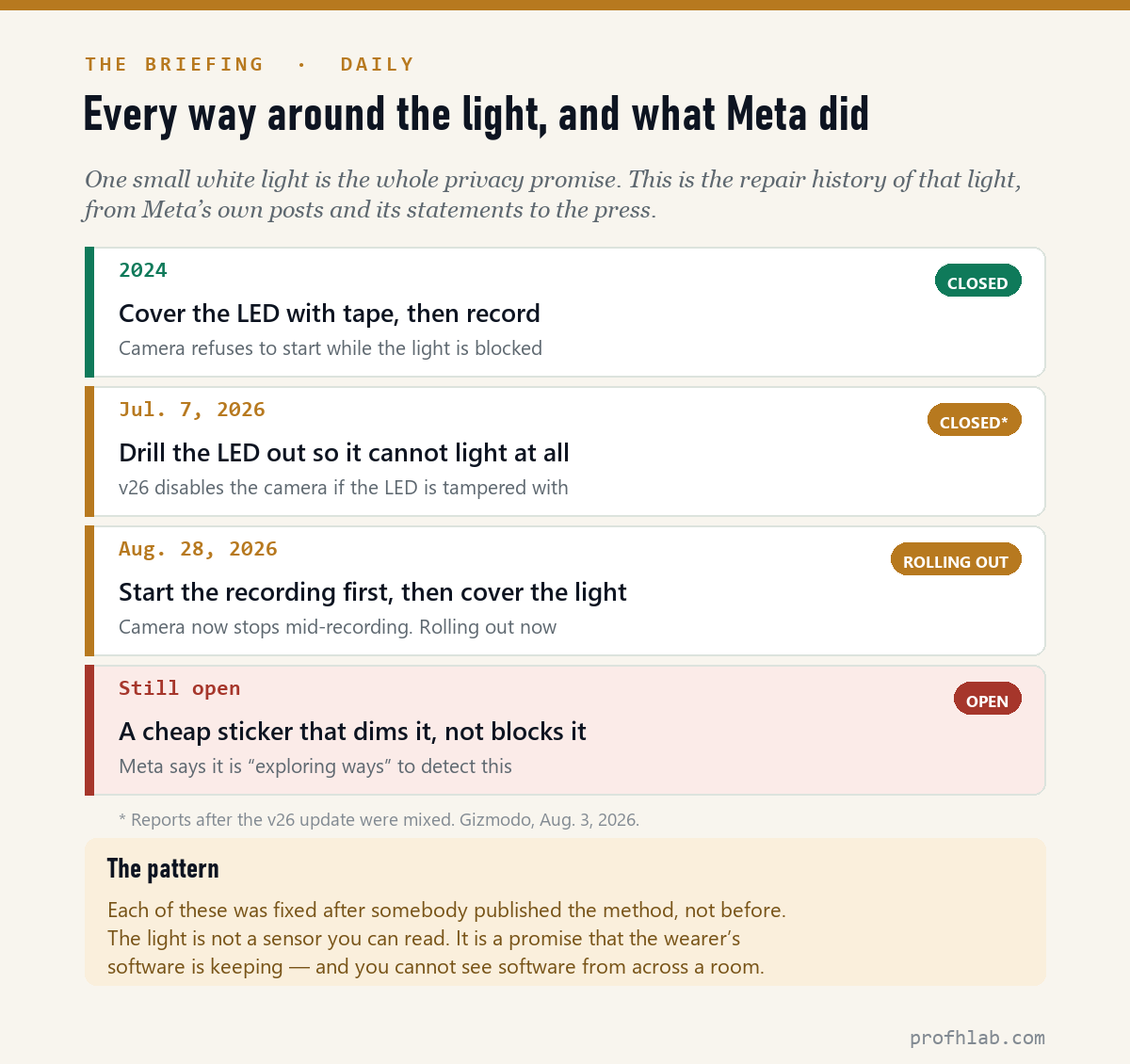
In 2024, with the second generation of glasses, Meta made the camera refuse to start while the light was blocked. That closed the tape trick. So people stopped covering the light and started drilling it out — a destroyed LED is not a blocked LED, and the software was only checking for blocked. Meta closed that one on July 7, 2026, with the update it calls v26, which now disables the camera if it detects the LED was “physically tampered with or destroyed.” It applies to Ray-Ban Meta, Oakley Meta, and the $300 Meta Glasses.
Then came start-first-cover-later. Fixed this week. Three patches, three methods, and each fix arrived after the method was circulating publicly, not before.
The fourth method, which is still open
Here is the one that has not been fixed, and it is the cheapest of the four. Engadget found that the capture LED can be obscured with inexpensive stickers bought online, leaving the indicator “barely noticeable” — reported by Gizmodo on August 3, 2026.
Read that carefully, because the distinction is the whole engineering problem. The glasses ask a binary question: is the LED blocked or not? A sticker that dims the light without blocking it can answer “not blocked” to the sensor while answering “I cannot see anything” to a human being ten feet away. Meta’s check is digital. Your eyesight is analog. The gap between those two is where a $2 sticker lives.
Meta’s position, given to Gizmodo: “We built our AI glasses with privacy in mind from the start, and that includes designing the camera so it won’t function if the LED is covered or doesn’t work. Products and people that have found ways around this built-in privacy protection violate our policies, so we’re exploring ways to strengthen our ability to detect such tampering and disable the camera.”
That is a fair answer from a company that has, to be honest about it, patched this three times in fourteen months when it could have shipped a bigger light. But “exploring ways” is not a fix, and you are the one standing in the room today.
The sentence nobody prints
Every protection above is software. Software arrives on a schedule you cannot see.
You cannot read a firmware version off somebody’s face. The August 28 fix protects you only once it has reached the specific pair of glasses in front of you, and there is no outward sign of whether it has. The same is true of v26. A bystander looking at a pair of Meta glasses in August 2026 is looking at a device that might be fully patched, might be three updates behind, or might have a sticker on it.
There is a second signal worth knowing about, and it is not one Meta publishes. On August 29, 2026, we ran the search phrase meta ray-ban glasses privacy LED recording light on YouTube and read the first nine results. Six of the nine were tutorials on covering or removing the light, with a combined 481,004 views. One was a news clip about this week’s fix. Two were reviews.
We are not linking those videos, and the count is not an accusation against the people who watched them — curiosity accounts for plenty of it. But it is a measurement of something real: the demand for defeating this light is large enough to sustain a small content genre. That is the context in which to decide how much the light is worth to you.
So how do you actually tell?
Use a test that does not depend on a two-millimetre light being visible at the moment you happen to glance over. Four things, in the order you will notice them.
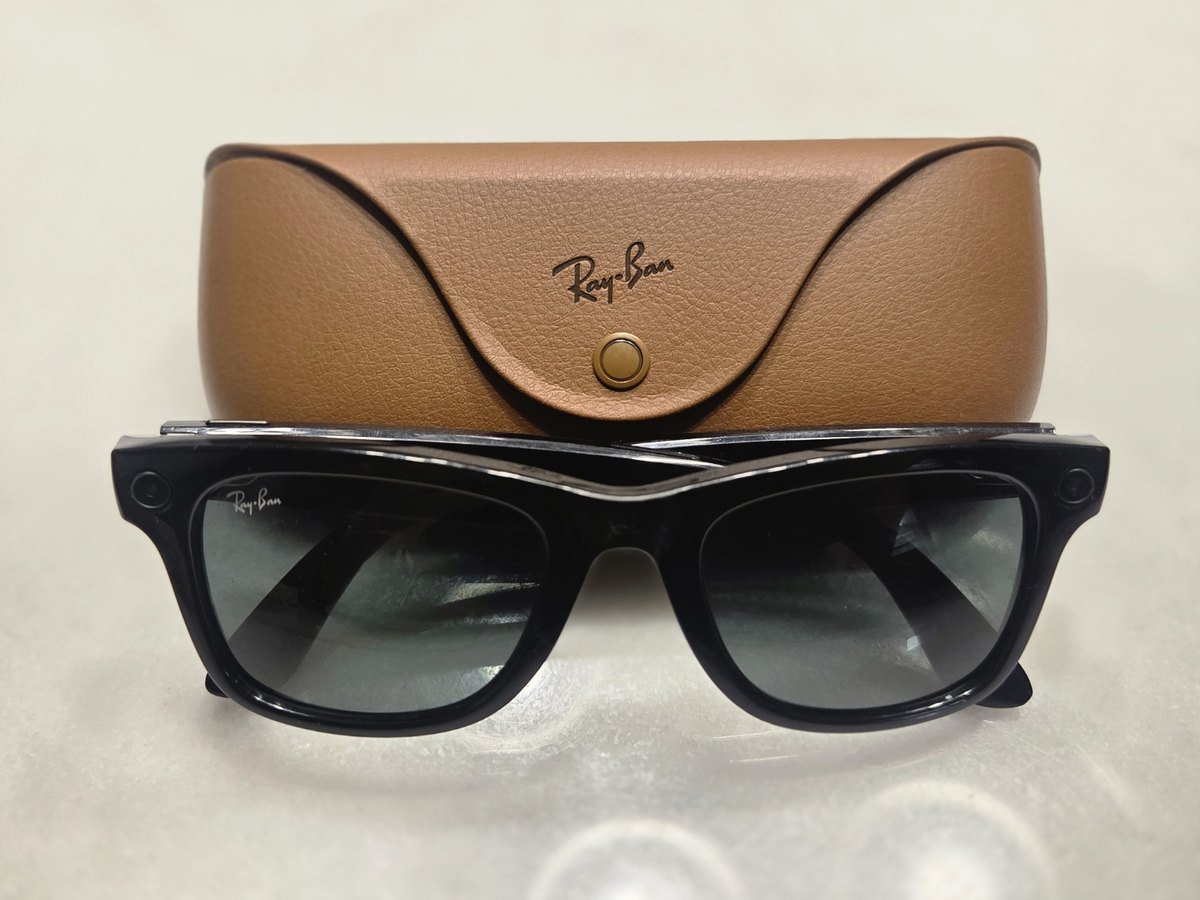
- The corners of the frame front. A camera bezel sits where an ordinary pair of glasses has nothing but plastic. It reads as a small dark circle at the outer top corner.
- The temple arms. They hold a battery, so they are thick, flat and squared off where regular arms taper. This is the tell you can see from behind and from the side, which is where you usually are.
- The wake phrase. Voice capture starts with the wearer talking to the glasses. If you hear somebody address their eyewear, capture is a live possibility.
- Where the face points, and for how long. A camera mounted in a frame aims where the head aims. A person filming holds their head still and pointed in a way that a person merely looking does not.
What these glasses actually capture
Abstract privacy arguments are easy to wave off, so here is a concrete one. The photo below was taken with Ray-Ban Meta smart glasses in Miami on May 2, 2026, and released by the photographer under a Creative Commons licence.

Nothing about this photograph is sinister. It is a nice, ordinary street scene, and taking it was almost certainly legal. That is exactly the point: this is the routine output, not the abuse case. Four strangers are in it. None of them is looking at the camera, because there was nothing to look at.
Ask the wearer to stop: Meta’s own guidance backs you
Of the ten pages Google surfaced for this question on August 29, 2026, three mentioned consent in any form, two named the firmware version, and none told the reader what to do if they believe they are being filmed. So:
- Ask. It works more often than people expect, and Meta’s own guidance backs you. Meta’s privacy page for the glasses tells wearers to stop capturing if someone says they do not want to be filmed. You are not making an unusual request; you are invoking the manufacturer’s stated etiquette.
- Say what you want, not what you suspect. “Would you mind not filming me?” puts the burden in the right place. “Are you recording me?” invites a one-word denial you have no way to check.
- Know where the rules are already stricter. Locker rooms, restrooms, medical exam rooms, and changing areas carry specific legal protections in every state. Filming in public is generally lawful where there is no reasonable expectation of privacy — but audio is a different statute, and several states require every party to a conversation to consent. Your state attorney general’s office publishes the rule for your state. This is general information, not legal advice.
- If you see a light that has been taped, stickered or drilled, that is a policy violation you can report. Meta’s terms state: “You may not tamper with the Glasses or otherwise obscure or modify any of the features on the Glasses that signal to others that the Glasses are recording.” Report it through Meta’s in-app help rather than confronting the wearer.
- Tell venue staff, not the internet. A gym, clinic or care facility can enforce its own camera policy on the spot. That is a faster remedy than any of the above.
- If it has already happened and the footage is online, the platform’s harassment and non-consensual imagery reporting flows are the route with actual teeth. Save the URL and a screenshot with the date before you report.
Where this lands hardest
Waiting rooms, pharmacy queues, senior centres and care facilities have three things in common: people are there for reasons they did not choose to publicise, they are often seated and stationary for a long time, and a great many of them will never have heard of a capture LED. A blinking two-millimetre dot is a privacy notice that assumes good eyesight, a good angle, and prior knowledge that the dot means anything at all.
One more thing worth knowing, because it cuts the other way: Meta says photos and videos are “stored privately on your glasses” until the wearer chooses to import them. The glasses are not a live broadcast by default. The risk is what a person decides to do with a file, which is the same risk a phone has carried for eighteen years. The difference is only that a phone held at arm’s length announces itself and a pair of sunglasses does not.
The wearer can check the firmware; the bystander never can
- “Is the fix on the glasses I just bought?” Check the firmware version in the Meta AI app under your device’s settings. As the wearer you can see it; as a bystander you cannot, which is the asymmetry this whole article is about.
- “What about the audio?” The microphones and the camera are separate systems, and the capture LED signals capture for your gallery. If audio privacy is your concern specifically, the state-law question above matters more than the light does.
- “Is this just Meta?” No. Every camera-in-a-frame product faces the same design problem, and Meta is the one with the volume to make it visible. The 2013 Google Glass backlash was the first round of this argument; the hardware got better looking, and the argument did not change.
- “How do I spot the AI in everything else?” We keep a running set: how to tell if a phone call is AI, how to tell if a YouTube video is AI generated, and how to tell if a Facebook ad is fake.
The light, the thick temple arms and whether recording you is legal
How to tell if Meta glasses are recording?
Look for a small white light on the front of the frame near the right hinge. A brief blink indicates a photo; a light that keeps blinking indicates video. Because that light has been defeated in several ways, also check for a dark camera bezel in the top corner of the frame front and unusually thick, flat temple arms.
Can Meta glasses record without the light on?
Meta has closed three methods for doing so: covering the light before recording (2024), physically destroying the LED (v26, July 7, 2026), and covering it after recording starts (announced August 28, 2026). As of August 29, 2026, dimming the light with an inexpensive sticker had not been fixed; Meta said it is “exploring ways” to detect it. Any of these protections only applies once the update has reached that particular pair of glasses.
Is it illegal for someone to record me with smart glasses?
It depends on where you are and whether audio is involved. Video recording in a public place is generally lawful in the United States where there is no reasonable expectation of privacy. Restrooms, locker rooms, changing areas and medical exam rooms have specific protections. Audio recording is governed by separate state statutes, and several states require all parties to consent. Check your state attorney general’s guidance. This is general information, not legal advice.
What do Meta Ray-Ban glasses look like compared with normal glasses?
The frame front carries a small dark circular camera bezel at one outer top corner and the capture LED at the other. The temple arms are noticeably thicker, flatter and more squared off than ordinary eyewear because they contain the battery and electronics.
Can I ask someone to stop recording me?
Yes, and Meta’s own privacy guidance instructs wearers to stop capturing when someone says they do not want to be filmed. Asking for what you want — “would you mind not filming me?” — is more effective than asking whether recording is happening, which you have no way to verify.
Sources
- Meta Newsroom, “Meta’s AI Glasses: Your Questions Answered,” July 7, 2026 — capture LED behavior, second-generation blocking detection, v26 tamper detection, on-device storage. about.fb.com
- Meta, AI glasses privacy pages, read August 29, 2026 — capture LED guidance and the instruction to stop capturing when asked. meta.com/ai-glasses/privacy
- Meta statement on the mid-recording fix, reported August 28, 2026. 9to5Google
- Meta statement on sticker dimming and Engadget’s finding, August 3, 2026. Gizmodo
- v26 rollout, affected models and the Meta terms clause on tampering. Road to VR
- YouTube result count and view totals for “meta ray-ban glasses privacy LED recording light,” and the audit of the ten pages ranking for “how to tell if meta glasses are recording” — both run by us on August 29, 2026. Method: How we count.
Beyond the glasses: the switches for your photos, Gmail and phone
- How to stop Meta AI from using my photos on Facebook — the two switches that work and the two that do not.
- AI scams targeting seniors — the safe word that beats voice cloning.
- How do I get rid of AI on my phone? — twelve places, one real off switch.
- How to stop AI from reading your Gmail — all five switches.
- Are deleted ChatGPT chats really deleted? — seven places your data lives.
- Does Copilot have access to my emails?
- How does ChatGPT know my age?
- How to turn off Alexa+ ads on Echo Show
- How do I talk to a real person?
- The best AI tools for seniors in 2026
- How to use ChatGPT: a step-by-step guide for beginners over 50
- More in The Briefing, and our running data on the AI Jobs Tracker and AI subscription prices.
Written and verified by Prof. H. Every figure above was read on the cited page on August 28–29, 2026. Where a claim comes from our own count rather than a company, we say so and describe the method.
Prof.’s H Newsletter
One short email a month, with the numbers in it
What actually moved in AI hiring, AI prices, and the scams aimed at older Americans. Counted here, dated, and linked to the source. One email a month, and your address goes nowhere else.