How Many Seniors Are Scammed Every Year? The FTC Counted 123,000 Loss Reports in 2025

About 123,000 is the federal count: on October 19, 2026 the FTC told Congress that people 60 and older filed 469,597 fraud reports in 2025, and about 123,000 of them said money was lost, over $3 billion in all. The FTC adds, in the same report, that most fraud is never reported, so that number is a floor.
This is the November edition of AI Scam Watch, our monthly read of what federal fraud agencies actually published. The October edition promised to check whether that yearly report had a 2026 version. It does, and it answers a question families type into search boxes every day. It also says almost nothing about AI. That gap is the story.
What we checked on November 4, 2026
- The FTC’s Protecting Older Consumers 2025–2026 report to Congress, all 54 pages. We counted every use of “AI,” “artificial intelligence,” “deepfake” and “clone.”
- Every consumer warning two agencies published from October 7 to November 3, 2026: 8 FTC consumer alerts and 6 FBI IC3 public service announcements. 3 of the 14 name AI.
- The FBI’s 2025 Internet Crime Report, its section on AI-related complaints.
- The FTC’s October 1, 2026 notice on impersonation ads in the Federal Register (11 pages) and its public docket, which listed 149 comments on November 4.
- Google autocomplete for 16 phrasings of this question, read November 4.
Dollar figures are quoted from agency pages or are our own arithmetic on those figures, and we say which. We describe what the documents say; this is not legal or financial advice.
Written and checked by Prof. H. An AI assistant helped draft and run the page reads; every quote was read on the source’s own page on the date shown.
How many seniors are scammed every year in the United States?
The FTC’s count for 2025 is about 123,000 reports of money lost by people 60 and older, out of 469,597 fraud reports from that age group, according to its report to Congress released October 19, 2026. Those 469,597 were about 33% of all fraud reports that included an age.
Two cautions sit inside those numbers, and the FTC states both. First, reports are not people: one person can file more than one, and many file none. Second, the FTC did not take reports from consumers from October 1 to November 13, 2025, because of a lapse in funding. Six weeks of the year are missing from the front door.

Here is where the numbers flip. Over $3 billion across about 123,000 loss reports works out to roughly $24,000 per report (our arithmetic on the FTC’s rounded totals). Yet the typical, or median, loss for people 60 and older was about $900. The average is more than 25 times the typical case.
That gap is not a mystery. The FTC says the fivefold rise since 2020 was driven largely by reports of losses over $100,000, often to investment scams, romance scams or impersonations. A small number of people lose their savings; half of the loss reports are under about $900. For people 80 and older the median loss was $2,000, up 21% from 2024 and higher than any other age group.
Why does the FTC put the real cost anywhere from $13.3 billion to $119.5 billion?
Because it has to guess how much fraud goes unreported, and it shows two guesses. The October 19 report estimates the overall cost of fraud to older adults in 2025 at $13.3 billion to $119.5 billion, “depending on methodology,” an increase of 32% or 47% over 2024.
Put next to the reported $3 billion, the low estimate is about 4 times the reported losses and the high one about 40 times (our arithmetic). The FTC itself calls reported losses the “tip of the iceberg” and says the scale of underreporting, especially for big losses, is not well understood. When a headline gives one number for elder fraud, ask which of these it is.
| Number | What it counts | Source |
|---|---|---|
| 469,597 | Fraud reports from people 60+, 2025 | FTC report, Oct. 19, 2026 |
| About 123,000 | Of those, reports that said money was lost | FTC report, Oct. 19, 2026 |
| Over $3 billion | Losses in those reports | FTC report, Oct. 19, 2026 |
| $13.3B to $119.5B | FTC estimate of the full cost, unreported fraud included | FTC report, Oct. 19, 2026 |
| About $24,000 | Average per loss report | Our arithmetic, Nov. 4, 2026 |
| About $900 | Median loss, age 60+ | FTC report, Oct. 19, 2026 |
Sources: FTC, Protecting Older Consumers 2025–2026, released October 19, 2026, read November 4, 2026. The average is profhlab arithmetic on rounded totals.
Which scams took the most from people over 60 in 2025?
Investment scams, by a wide margin: the FTC says older adults’ reported losses to them jumped 42% in 2025, and these consumers often described being lured to fake cryptocurrency-investment platforms after being targeted on social media. Losses that started on social media were about twelve times higher than in 2020.
Government impersonation came second. Across all ages, the report’s footnote lists $161 million lost to fake FTC agents, $144 million to fake Social Security staff and $28 million to fake FBI agents. Of the losses where an age was given, older adults reported 92% of the fake-FTC money. Business impersonation came next, with fake banks at the top.

Money mostly moved by bank transfer and cryptocurrency, the two costliest payment methods in the report. Credit cards were the most frequently reported, and gift cards were the most common payment on tech-support, romance, family-impersonation and prize scams. Social media produced the largest total losses, but frauds that began with a phone call had the higher median loss.

Where does AI show up in these federal numbers?
Barely, in the FTC’s report. In 54 pages we found “AI” 3 times, all in one-line summaries of FTC cases against “Active Listening” ad services, and “voice cloning,” “deepfake” and “artificial intelligence” 0 times (our count, November 4, 2026). The report sorts losses by scam type, first contact and payment method. None of those breakdowns is a tool.
The FBI does keep an AI tag. Its 2025 Internet Crime Report counts 22,364 complaints with AI-related information and $893,346,472 in losses, against total losses that passed $20 billion. That is under 4.5 cents of every reported dollar (our arithmetic). It lists over $5 million lost to “distress” calls, where voice cloning mimics a loved one.
Compare that with $797,943,193 reported lost to government impersonation in the same FBI report. Our reading, and it is an inference: these low counts do not prove AI is rare. The FTC report does not sort losses by tool, and a victim may never learn that a voice was cloned. The fake official is the costlier problem on paper. The cloned grandchild is the one that makes the news.
| Federal source | What it says about AI | Read |
|---|---|---|
| FTC, Protecting Older Consumers 2025–2026 (54 pages) | “AI” 3 times, all in ad-tech case summaries; voice cloning and deepfake 0 | Nov. 4, 2026 |
| FBI IC3, 2025 Internet Crime Report | 22,364 AI-related complaints; $893,346,472 in losses; distress calls over $5 million | Nov. 4, 2026 |
| FTC impersonation-ads notice, Oct. 1, 2026 (11 pages) | “AI” 5 times, 3 of them about the ad platforms’ own tools; “artificial intelligence” once; deepfake 0 | Nov. 4, 2026 |
Word counts are profhlab’s, on the text of each document as published, November 4, 2026.
Did any October warning from the FTC or FBI name AI?
Three of fourteen did. From October 7 to November 3, 2026 the FTC published 8 consumer alerts and the FBI’s Internet Crime Complaint Center published 6 public service announcements; we read all 14. Last month the count was 2 of 11.
| Agency and date | Warning | Names AI? |
|---|---|---|
| FTC, Oct. 7 | Explicit image of your child shared online | Yes: sharing “AI-generated deepfakes” of children can be a crime |
| FBI, Oct. 15 | Scammers exploit the 2026 midterm election | Yes: AI voices, images and messages that impersonate candidates |
| FBI and CISA, Oct. 16 | Phishing aimed at election and campaign officials | Yes, as “super intelligence (SI)” |
| FTC, Oct. 22 | The FTC is not calling to deactivate your phone number | No |
| FTC, Nov. 2 | Tell the FTC about imposter ads online | No |
| 9 others | Sextortion help, charity sweepstakes, health plan ads, travel fees, franchising, election crimes, threats to election workers, North Korean IT workers, a PHP flaw | No |
Sources: FTC consumer alerts and FBI IC3 public service announcements, all read November 4, 2026.
One oddity, recorded without comment on the technology itself: the October 16 FBI and CISA warning never says “artificial intelligence.” It says “super intelligence (SI)” and warns that SI lets criminals write phishing in fluent, natural language. Misspellings, the warning notes, were how people used to spot a fake email; SI-written text now reads as genuine.
A caller from the FTC says your phone will be shut off
This is the new script the FTC warned about on October 22, 2026, and it lands on the costliest agency impersonation in the report: fake FTC agents took $161 million in 2025, all ages. The caller says your number was used in scams in another country and threatens to deactivate it.
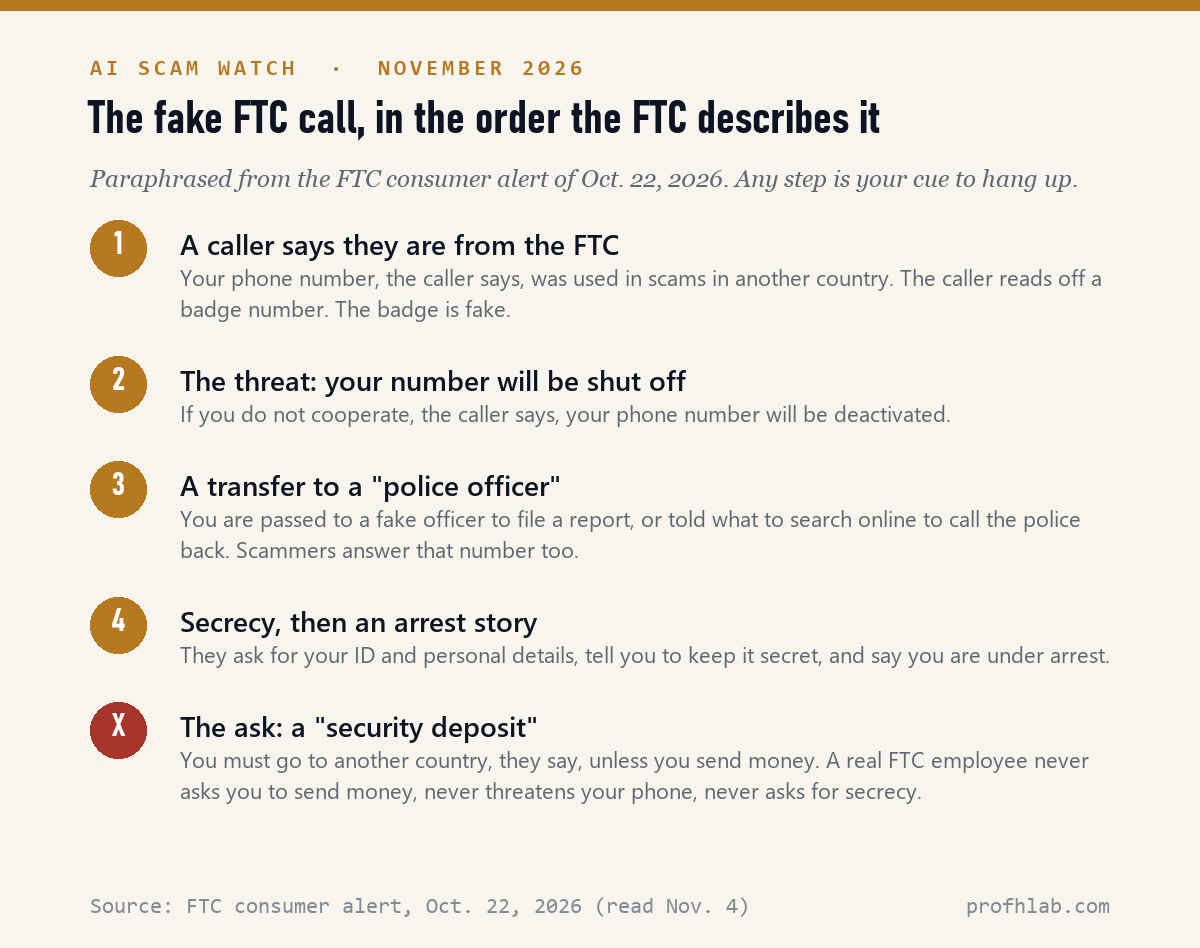
The clever part is the callback. If you hesitate, the FTC says, they may tell you what to search online to find the police department’s number, and people in on the scam answer it. It feels like checking the story. It is the story. Look up numbers on an agency’s own .gov site, and never through a search the caller tells you to run.
Candidate voices, cloned: the FBI warning for election season
On October 15, 2026 the FBI warned that scammers “exploit artificial intelligence (AI) tools to generate highly realistic voices, images, and written messages” that impersonate candidates, campaigns, government agencies and trusted contacts. The midterm vote was held November 3, but donation and merchandise pitches do not stop on election night.
The warning names four schemes: a “campaign investment pool” that promises a payout if a candidate wins, fake political action committees, merchandise that never ships, and texts saying you are not registered to vote. The FBI’s plainest line: campaign donations are not an investment and will not increase in value. Check a committee on the FEC website before giving.
Can you tell the FTC what to do about scam ads before November 30?
Yes. On October 1, 2026 the FTC published an advance notice in the Federal Register asking whether search engines, social media and online marketplaces should do more about ads that impersonate businesses or the government. Comments close November 30, 2026. On November 4 the docket listed 149 comments.
The FTC’s November 2 alert lists three things platforms could be required to do: vet advertisers and ads before they run, give people a way to report impersonation ads, and investigate and remove the ones that turn out to be scams. If a fake bank or fake agency ad once reached your family, a short factual comment is the kind of evidence the notice asks for.
The notice’s own numbers set the scale: consumers reported losing about $16 billion to fraud in 2025, and impersonation was the top fraud reported, with over 1 million reports and nearly $3.5 billion lost. Read the notice in the Federal Register and comment in docket FTC-2026-1552.
What should a family do this week if a parent gets these calls?
- Agree on one rule: nobody official asks for money by phone. The FTC said on October 22 that its staff never ask you to send money; the FBI said the same of police in September.
- Pick a family safe word for emergency calls; our safe word examples show how.
- Write down the real numbers for the bank, Social Security and the doctor, and keep the list by the phone.
- Never move money to “protect” it. The FTC report names Bitcoin ATMs, mailed cash and couriers as the routes.
- Report, even with no loss: ReportFraud.ftc.gov and ic3.gov. The FTC notes that older adults file no-loss reports at much higher rates, and investigators search those reports to build cases.
If money has already left the account, call the bank the same day and ask for a fraud claim. Then read how AI scams target seniors, how to tell if a phone call is AI and what happens if you say yes on a scam call.
We chose three newsroom clips with plain titles. We did not find a 2026 video from the FTC or FBI on this report, so these are station reports, not agency videos.
Where this edition stops.
These are reported numbers. They undercount by design, they count reports rather than people, and the FTC’s 2025 data has a six-week hole. Our AI word counts show what the documents say, not how often AI was really used. We did not read state attorney general warnings this month.
Cite this:
People 60 and older filed 469,597 fraud reports with the FTC in 2025, about 123,000 of them reporting a money loss totaling over $3 billion (FTC, October 19, 2026). The FTC’s 54-page report mentions voice cloning and deepfakes 0 times, and 3 of 14 FTC and FBI consumer warnings published from October 7 to November 3, 2026 named AI. Source: profhlab.com, AI Scam Watch, November 2026, counted November 4, 2026.
Seniors, scam counts and cloned voices: six short answers
How many seniors are scammed every year?
Nobody counts every case, but the federal floor for 2025 is clear. The FTC told Congress on October 19, 2026 that people 60 and older filed 469,597 fraud reports in 2025, and about 123,000 of those reports said money was lost, over 3 billion dollars in all. The FTC says most fraud is never reported, so the real number is higher.
How much money do seniors lose to scams each year?
Reported losses by people 60 and older passed 3 billion dollars in 2025, up from about 2.4 billion in 2024 and about 600 million in 2020, according to the FTC report released October 19, 2026. Adjusting for unreported fraud, the FTC estimates the full cost for older adults at 13.3 to 119.5 billion dollars.
What is the most common scam targeting seniors?
By money lost, investment scams, which rose 42 percent in 2025 among people 60 and older, often starting on social media. Government impersonation came second, led by scammers posing as the FTC, the Social Security Administration and the FBI, then business impersonation, led by fake banks.
Are AI voice cloning scams counted in the FTC numbers?
Not separately. The 54-page FTC report of October 19, 2026 does not use the words voice cloning or deepfake. The FBI 2025 Internet Crime Report does tag AI: 22,364 complaints and about 893 million dollars in losses, with over 5 million dollars reported for family distress calls that use cloned voices.
Does the FTC ever call to shut off your phone number?
No. The FTC consumer alert of October 22, 2026 says a real FTC employee will never ask you to send money, never threaten to disconnect your phone, never tell you to keep conversations secret and never text a photo of an employee ID to prove who they are. Hang up and report the call at ReportFraud.ftc.gov.
How can I comment on the FTC rule about scam ads?
The FTC is taking public comments until November 30, 2026 on whether search engines, social media and online marketplaces should do more to stop ads that impersonate businesses or the government. The notice is Federal Register document 2026-20143, and comments go to docket FTC-2026-1552 on regulations.gov.

Every federal document behind this edition, and the day we opened it
- FTC, Protecting Older Consumers 2025–2026, report to Congress, released October 19, 2026 (read November 4, 2026)
- FTC press release on the report, October 19, 2026 (read November 4, 2026)
- FTC consumer alert, The FTC is not calling to deactivate your phone number, October 22, 2026 (read November 4, 2026)
- FTC consumer alert, Tell the FTC about imposter ads online, November 2, 2026 (read November 4, 2026)
- FTC consumer alert on explicit images of children, October 7, 2026 (read November 4, 2026)
- FBI IC3, Scammers Exploit 2026 U.S. Midterm Election, I-101526-3-PSA, October 15, 2026 (read November 4, 2026)
- FBI and CISA, Cyber Threat Actors Use a Variety of Techniques to Target Election and Campaign Officials, I-101626-PSA, October 16, 2026 (read November 4, 2026)
- FBI IC3, 2025 Internet Crime Report, AI section (read November 4, 2026)
- Federal Register 2026-20143, Rule on Impersonation of Government and Businesses, October 1, 2026 (read November 4, 2026)
- Regulations.gov docket FTC-2026-1552, 149 comments listed November 4, 2026
- Word counts and arithmetic are ours. Method: how we count.
On December 2, the next edition rechecks three things
The December AI Scam Watch publishes Wednesday, December 2, 2026. We will count the comments in docket FTC-2026-1552 after it closes November 30, read every November FTC and FBI warning for AI, and look for any federal number on voice-cloned calls that is newer than the FBI’s 2025 report.
Earlier editions and companions: AI Scam Watch, October 2026 · AI Scam Watch, September 2026 · why so many Medicare calls · stop AI calls on a landline · scam ads on YouTube · spot a fake shopping site · spot an AI video · spot an AI-written email · the Cleo AI refund email · pre-IPO stock pitches · AI tools for seniors · ChatGPT for beginners over 50 · The Briefing · Start here · Resources · FAQ. One short email a month, if you want the next edition when it lands.
About the author. Prof. H teaches robotics and AI and writes The Briefing and AI Scam Watch, a monthly read of what federal fraud agencies actually published. Every document here was fetched and read on the date shown. This is general consumer information, not legal or financial advice. Corrections and questions: ask here.
Prof.’s H Newsletter
One short email a month, with the numbers in it
What actually moved in AI hiring, AI prices, and the scams aimed at older Americans. Counted here, dated, and linked to the source. One email a month, and your address goes nowhere else.