What to Put for Current Company If Unemployed: 133 of 3,771 AI Job Forms Ask (Nov. 22, 2026)
If you are unemployed, type your last employer only when the form asks for your “current or most recent” employer; if it asks only for a current company, leave an optional box empty or write “Not currently employed.” On November 22, 2026, just 133 of the 3,771 AI job application forms we opened asked for a current company at all. None of them offered an “unemployed” checkbox, so the words you type are the whole answer.
The box looks like a trap when you are between jobs. On the forms we read, it mostly is not one. The label itself usually tells you what to put, and on most forms the box does not exist.
What we read for this report
- Application forms: the questions on 3,771 open job applications at 19 AI and robotics employers, pulled from each employer’s public Greenhouse or Ashby job feed on November 22, 2026. All 3,771 forms on those boards were read without an error. A 20th board, Google DeepMind’s U.S. feed, returned an error (HTTP 404) and was not read; we did not count it as zero.
- What we counted: every question whose label asks for a current, present or most recent company, employer or job title, plus any question about whether you are employed now. We read each matching label and its help text in full, and noted whether the form marks it required.
- The law we quote: New York City Local Law 14 of 2013, which added unemployment status to the city’s Human Rights Law, read from the city’s own PDF, and the NYC Commission on Human Rights page that lists the city’s protected categories, both read November 22, 2026.
- A limit: some Greenhouse forms can show a separate work history block that the public feed does not list. We counted only the questions the feed returns, so a form could ask about your work history in a block we could not see.
Written and checked by Prof. H. An AI assistant helped draft this piece and run the page reads; every quote was read on the source’s own page on the date shown. This is general information, not legal or career advice for your situation.
What should you put for current company if you are unemployed?
Match the label: on November 22, 2026, 78 of the 133 forms that asked wrote “current or most recent employer,” which invites your last employer’s name, while the other 55 wrote only “Current company” and left the box optional on 54 of them. Those two wordings need two different answers.
When the label says “current or most recent,” your last employer is the honest answer. You are not pretending to still work there. The question already allows for people who have left.
When the label says only “Current company” and the form does not require it, you can leave it empty. If you would rather not leave a blank, type “Not currently employed.” Neither choice claims a job you do not have.
What we would not do is type a past employer into a box that asks only for your current one. That puts a statement on the application that is not true. It is our view, not a rule from any employer we read, but it is the one choice on this page that can come back to bite you.

How many AI job applications even ask for your current company?
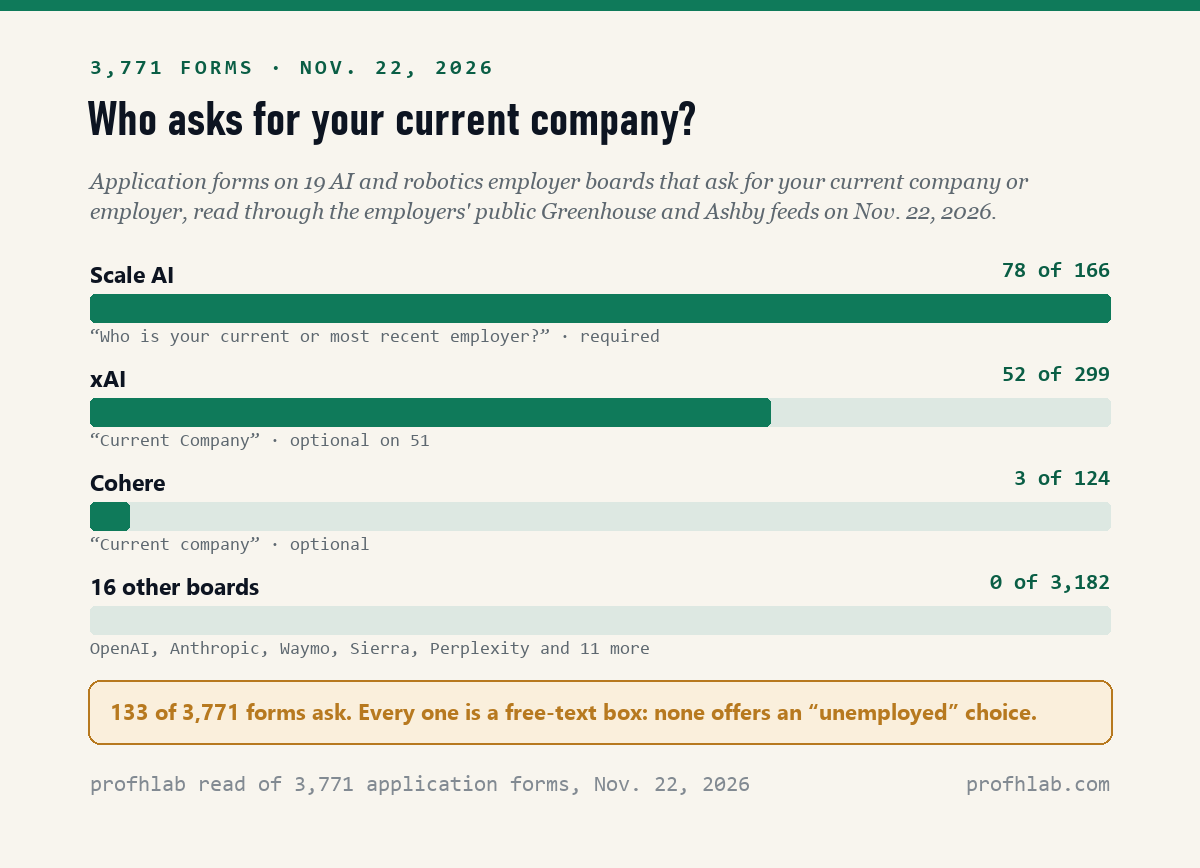
133 of 3,771 forms, about 3.5%, asked for a current company or employer when we read them on November 22, 2026, and they came from only 3 of 19 employers: Scale AI, xAI and Cohere. The other 16 boards, including OpenAI, Anthropic and Waymo, had no such question on any open form.
Scale AI asked on 78 of its 166 forms and made the box required on every one of them. xAI asked on 52 of 299 forms and marked it optional on 51. Cohere asked on 3 of 124, always optional.
So for most AI applications the question never comes up. The form asks for a resume, often a LinkedIn link, and the rest of your story lives in those two places. The live count of open roles behind these forms is on our AI jobs tracker, and you can browse every open role and apply on the employer’s site from our job board.
What do the three wordings on these forms actually ask?
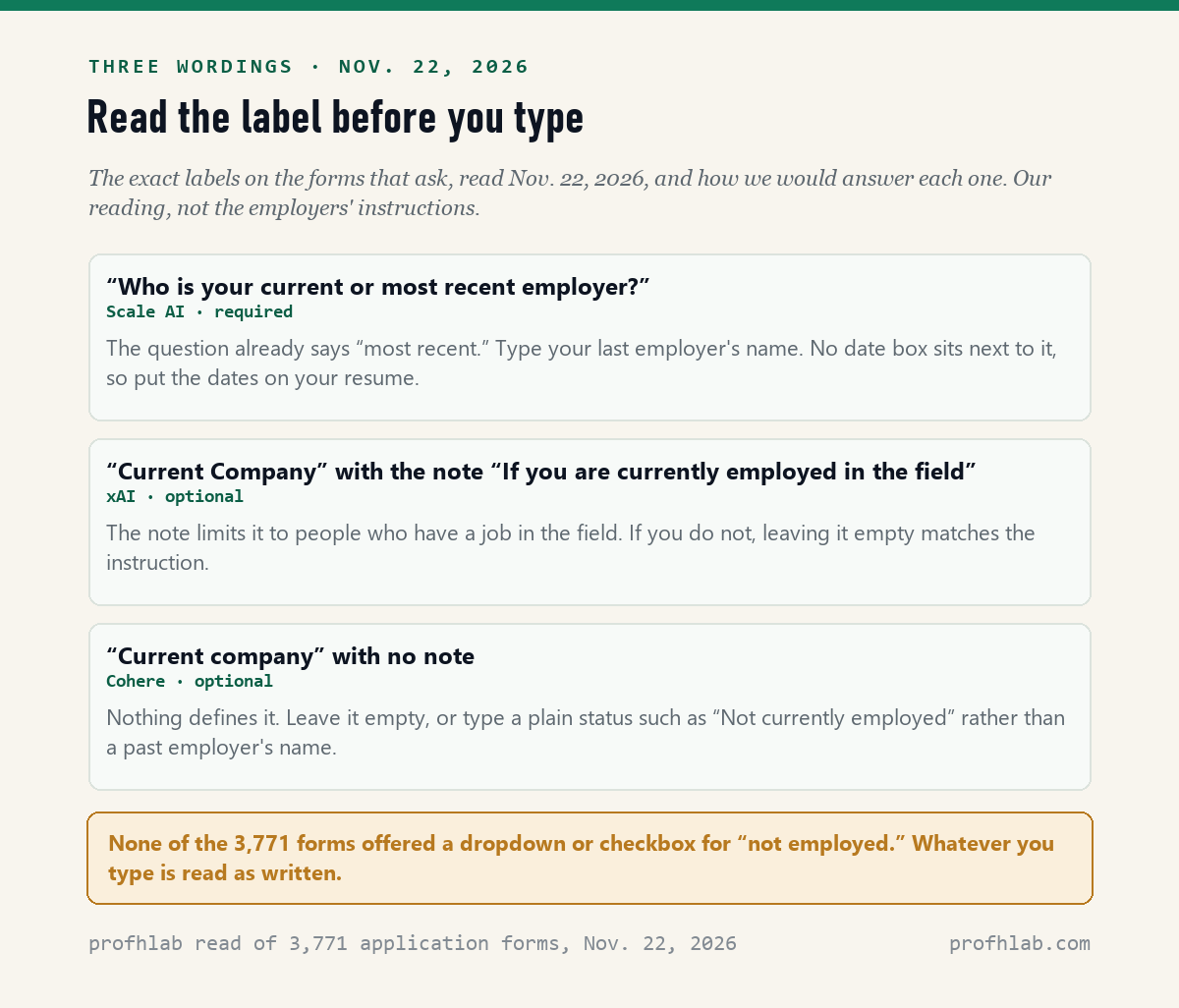
Each of the three employers words the box differently, and the wording decides the answer: Scale AI says “current or most recent,” xAI adds a note limiting it to people “currently employed in the field,” and Cohere says only “Current company.” All three are plain text boxes.
Scale AI. The label reads “Who is your current or most recent employer?” It is required on all 78 forms that carry it, and 43 of those forms also ask “What is your current or most recent job title?” If you are out of work, your last employer and last title answer both questions truthfully.
xAI. The label is “Current Company,” and the help text under it says “If you are currently employed in the field, please tell us the name of your employer.” Read literally, the box is meant for people who have a job in the field right now. If that is not you, leaving it empty follows the instruction.
Cohere. The label is “Current company” with no help text, and the form does not require it. There is no instruction to follow, so empty or “Not currently employed” are both fair answers.
Is it lying to list your last job as your current company?
It depends on the label: of the 133 forms that asked on November 22, 2026, 78 explicitly allowed a most recent employer, so naming your last job there is accurate. On a box that says only “Current company,” the same name would describe a job you no longer hold.
Some advice online says you can keep a job listed as current for a few months after it ends. We could not find any employer form that says so, and none of the 3,771 forms we read mentioned a grace period. Treat that advice as someone’s opinion, not a rule.
The safer habit is to keep every document consistent. Your resume shows the end date, your LinkedIn shows the same end date, and the form box says either your last employer (where the label allows it) or nothing. If those three agree, there is nothing to explain later.
What should you write in the current job title box?
The same rule applies: on November 22, 2026, 95 forms asked for a current job title, 43 at Scale AI worded as “current or most recent” and 52 at xAI worded as “Current title.” xAI’s help text again starts with “If you are currently employed in the field.”
For Scale AI, your last title is the answer. For xAI, the box is optional on 51 of its 52 forms, so empty is fine if you are not working in the field.
If you are freelancing, consulting or doing paid contract work, that is current work. A title like “Freelance data analyst” is true if you are taking paying clients. A title invented only to fill the box is not, and we would leave it out.
Do any AI job forms ask whether you are employed right now?
Not directly: none of the 3,771 forms we read on November 22, 2026 asked “Are you currently employed?” as a general question, and none asked for a current salary. The closest questions were narrow ones.
xAI asked on 146 forms whether you are “currently employed by any construction companies doing work for SpaceXAI” (some forms spell it SpaceXSI). We read that as a conflict check aimed at contractors’ staff, not a question about whether you have a job; the form does not say why it asks. If you do not work for such a contractor, the true answer is no.
Waymo asked on 291 of its 363 forms whether you are “subject to any active non-compete, non-solicitation, or similar restrictive agreement with a current or former employer.” Being unemployed does not change that answer. An agreement from your last job can still be active after you leave, so check your paperwork before you answer.
Scale AI asked a similar question on 132 forms: whether you are “currently bound by any agreements with a current or former employer that may restrict your ability to work for Scale AI.” The word “former” is the point. Leaving a job does not by itself end what you signed there.
ElevenLabs asked on 10 forms for your “current notice period.” If you have no job to give notice to, your notice period is none, and you can start right away. Our start date guide covers how to word that.
Can an employer turn you down just because you are unemployed?
In New York City it generally cannot: Local Law 14 of 2013 bars employers from basing a hiring decision on “an applicant’s unemployment,” and the city’s Commission on Human Rights still listed unemployment status as a protected category when we checked on November 22, 2026.
The same law bars job ads for city vacancies that say “being currently employed is a requirement or qualification for the job.” It defines unemployed as “not having a job, being available for work, and seeking employment.”
There are limits. The law still lets an employer consider unemployment “where there is a substantially job-related reason for doing so,” and lets it ask about “the circumstances surrounding an applicant’s separation from prior employment.” So an interviewer in New York City can still ask why you left.
Outside the city, the rules differ. Law firm summaries mention similar limits on job ads in a few other places, but we did not read those laws for this report, so we name only the one we read. None of the 3,771 application forms we read asked you to confirm that you are currently employed.

Which answer fits each box when you are between jobs?
The table sums up what we would type in each box we found on November 22, 2026, using the employers’ exact labels. Copy the wording of your own form before you decide, because a label can change from one posting to the next.
| Label on the form | Where we saw it | What we would type if unemployed |
|---|---|---|
| Who is your current or most recent employer? | Scale AI, 78 forms, required | Your last employer’s name |
| What is your current or most recent job title? | Scale AI, 43 forms | Your last job title |
| Current Company / Current title (“If you are currently employed in the field”) | xAI, 52 forms, mostly optional | Leave empty |
| Current company | Cohere, 3 forms, optional | Leave empty, or “Not currently employed” |
| Non-compete with a current or former employer? | Waymo, 291 forms; Scale AI asks a similar question on 132 | Answer from your last job’s paperwork |
| What is your current notice period? | ElevenLabs, 10 forms, required | None, available now |
A gap usually shows up again in the free-text boxes. If you want to explain it in one line, the optional box covered in our guide to what to write in additional information is the natural place, and a short cover letter is the other.
How do career coaches suggest explaining the gap itself?
Two established career channels cover the gap and the LinkedIn profile on video; when we checked on November 22, 2026, the first had 177,271 views and the second 25,542. Neither is about a specific form field. We include them for how they word a gap, and we did not check every claim in them.
The LinkedIn point matters here. Of the 3,771 forms we read, 2,855 asked for a LinkedIn profile, far more than asked for a current company. If your profile still shows an old job as current, fix that first. Our guide to LinkedIn’s AI settings covers other profile settings worth a look while you are there.
Checks to run on your resume, LinkedIn and form before you hit submit
These steps keep the three places an employer reads in agreement; they are our suggestions, based on the forms we read on November 22, 2026.
- Read the label twice. “Current or most recent” means your last employer. “Current” alone means now.
- Check whether it is required. The form marks which boxes it needs. An optional box can stay empty.
- Match your end dates. Resume, LinkedIn and any work history block should show the same month your last job ended.
- Answer the start date and notice questions as available now. See our start date guide and our note on desired salary.
- Apply only on the employer’s own site. Use the links on our job board, which go straight to the employer’s page.
Other boxes on the same forms have their own guides: how did you hear about us, the sponsorship question, voluntary self-identification and whether forms ask for GPA. If you have been out of work a while, our pieces on applying to older postings, whether the AI job market is saturated and AI jobs for people over 50 may help, and the answer to whether you can opt out of AI resume screening is short.
We are not recruiters. We take no money from employers, and postings can close at any time. The employer’s official page wins over anything on this page.
Scam rules that never change: never pay to apply, never deposit a check and send money back, a text message offer is not an offer, and apply only on the employer’s own domain. More in our sources and safety notes.
Stuck on a form box we have not covered? Ask the desk and we will read the form and answer on the Jobs Desk page. We will recount these boxes on December 20, 2026, to see whether any employer adds an “unemployed” option.
What else do unemployed applicants ask about this field?
Can I put N/A for current company?
Yes, if the box is optional and asks only for a current company. On November 22, 2026, the optional boxes we read were at xAI and Cohere. On a required “current or most recent” box, such as Scale AI’s, your last employer is the better answer.
What should I put for current company if I am a student?
If you are in school and not working, the same rule applies: leave an optional current company box empty, or name your school only if the form asks about schools. A paid internship or campus job you hold now is a current employer.
Should I put my last employer as current company on LinkedIn?
Only with the real end date. Of the 3,771 AI job forms we read on November 22, 2026, 2,855 asked for a LinkedIn link, so the profile is asked for far more often than the form box. Showing an ended job as current creates the mismatch you were trying to avoid.
Does leaving current company blank hurt my application?
We could not verify how any employer scores a blank box, and none of the forms we read said. On the optional boxes, the help text itself told people without a job in the field to skip it, which suggests a blank is expected there. That is our inference.
Is it illegal to not hire someone because they are unemployed?
In New York City, generally yes: Local Law 14 of 2013 bars hiring decisions based on unemployment, with exceptions for substantially job-related reasons. We did not read other states’ laws for this report. This is general information, not legal advice.
Sources
- Application form questions for 3,771 open postings at 19 employers, via the public Greenhouse Job Board API and Ashby job pages, read November 22, 2026. Example forms: Scale AI, xAI, Cohere.
- New York City Council, Local Law 14 of 2013 (unemployment status), read November 22, 2026.
- NYC Commission on Human Rights, The Law (protected categories), read November 22, 2026.
- U.S. Department of Labor, American Job Center finder on CareerOneStop, checked November 22, 2026.
- Photos: American Job Center National Harbor (Maryland GovPics, CC BY 2.0), Depression-era storefront (public domain), City of Seattle job booth, circa 1965 (Seattle Municipal Archives, CC BY 4.0), Hubert von Herkomer, Hard Times, 1885 (public domain).
Prof.’s H Newsletter
One short email a month, with the numbers in it
What actually moved in AI hiring, AI prices, and the scams aimed at older Americans. Counted here, dated, and linked to the source. One email a month, and your address goes nowhere else.