Does USPS Text You About a Package? Only If You Asked First, and 2 of 5 Carriers Say a Real Text Can Ask You to Pay
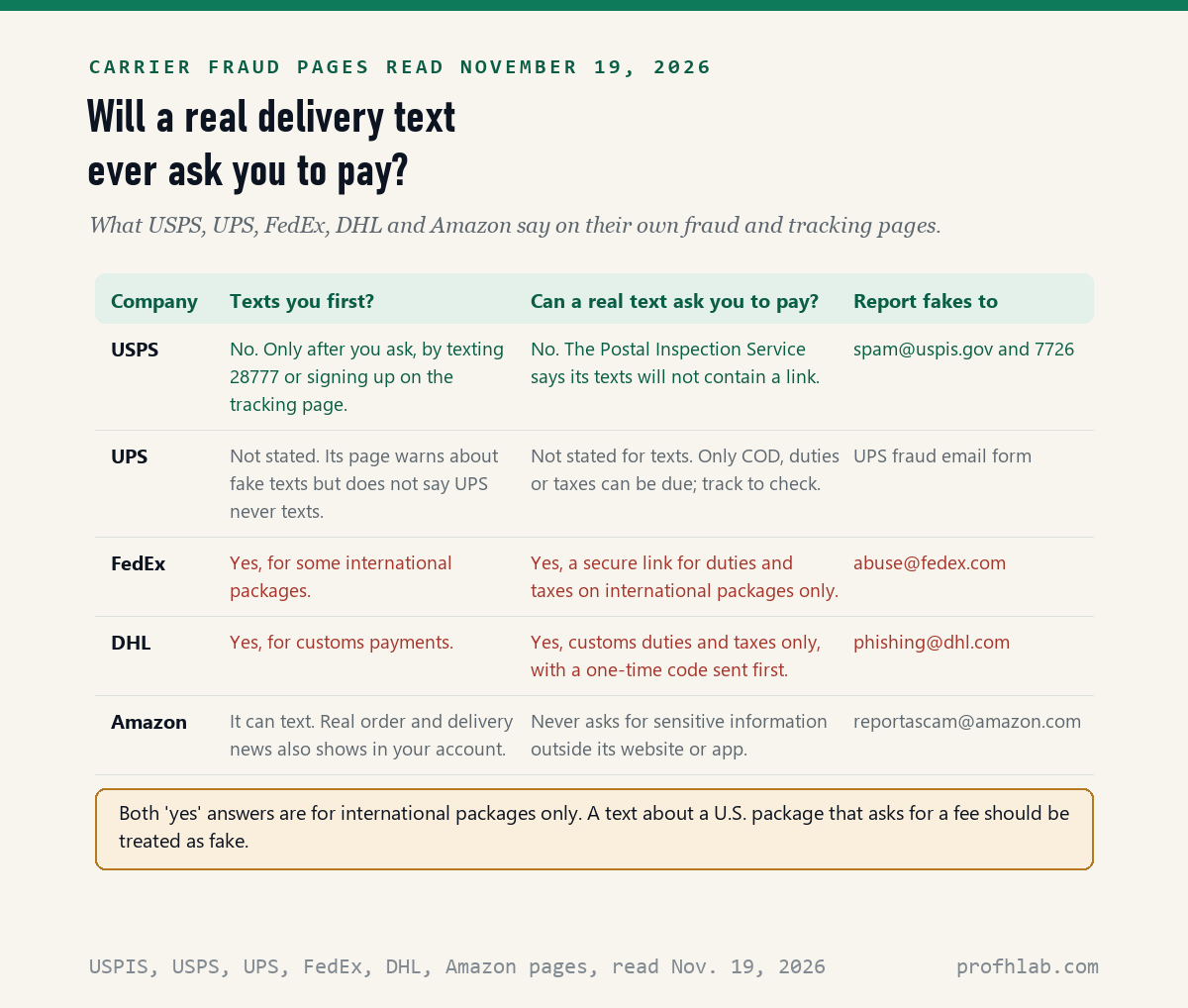
No: on November 19, 2026, the U.S. Postal Inspection Service’s own scam page said USPS will not text you about a package unless you first asked for tracking with a tracking number, and that a real USPS text “will NOT contain a link.” We read the fraud and tracking pages of 5 companies that deliver packages the same day, and only 2 of them, FedEx and DHL, say a real text can ever ask you to pay.
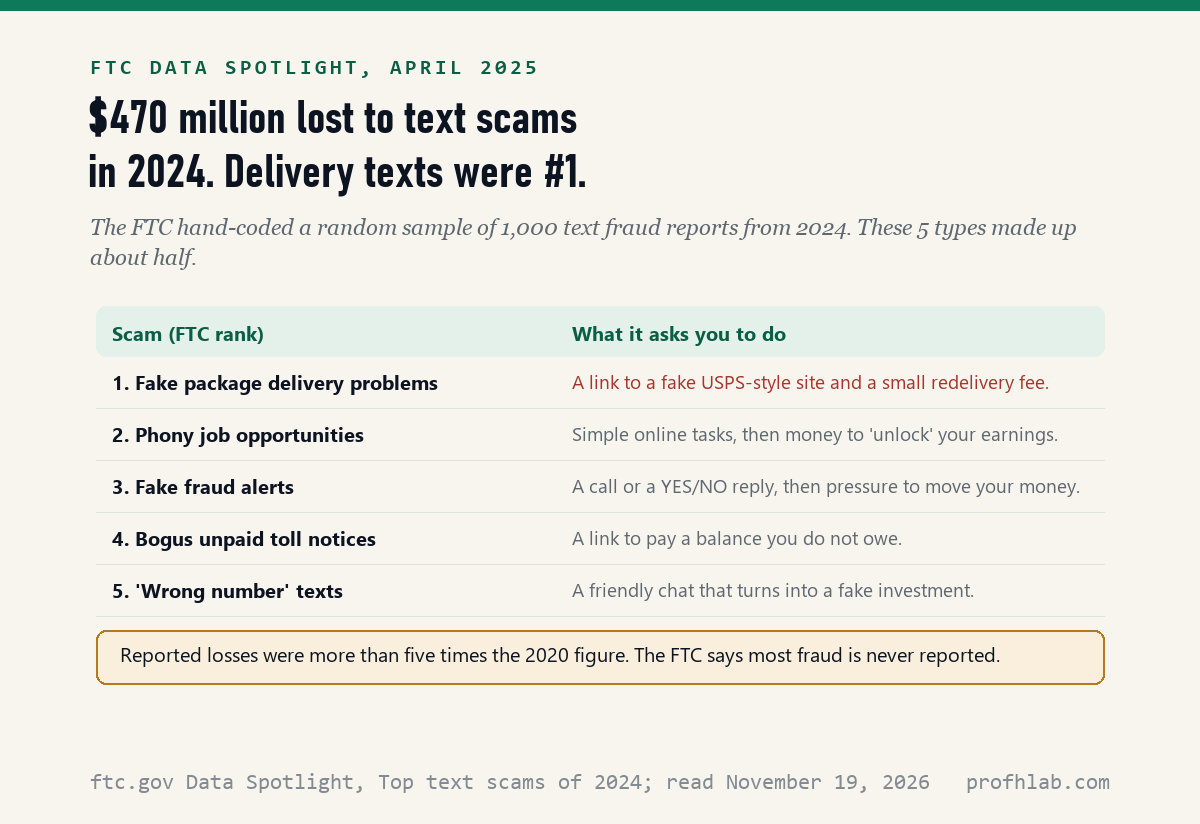
Both of those exceptions are for customs duties on packages coming from another country. So if a text says your U.S. package is stuck and asks for a small fee, you can treat it as fake. The Federal Trade Commission ranked fake delivery texts the most reported text scam of 2024. It is not your fault if one fooled you for a second; they are built to look ordinary.
What we checked on November 19, 2026
We read the Postal Inspection Service page on package tracking text scams, the USPS Text Tracking FAQs, the fraud pages of UPS, FedEx and DHL, and two Amazon scam-advice pages on aboutamazon.com. We also read the FTC’s April 2025 Data Spotlight on the top text scams of 2024.
One page did not open for us: Amazon’s customer help page on spotting fake texts showed an access notice to our automated reader, so we quote nothing from it. We did not receive, click or test any scam text for this guide.
Written and checked by Prof. H. An AI assistant helped draft this article and ran the page reads; every quote was read on the source’s own page on the date shown.
Does USPS text you about a package if you never signed up?
No: the Postal Inspection Service page we read on November 19, 2026 says USPS sends texts only after a customer requests the service “with a tracking number,” and those texts carry no link.
Think of USPS texts like a call-back you booked yourself. The Postal Service does not ring first. According to the USPS Text Tracking FAQs, there are two ways to book one: text your tracking number to 28777 (which spells 2USPS), or sign up for text updates after you track a package on usps.com. If you did neither, a text that claims to be from USPS did not come from USPS.
The inspectors add two details worth keeping. USPS uses 5-digit short codes for its texts, and “USPS does not charge for these services.” A message from a long phone number or an email address, asking for a redelivery fee, fails on both counts.
Does USPS text you to reschedule delivery? Only if you asked for texts on that package. To sort out a delivery, type usps.com into your browser yourself and track the package there, rather than using any link in a message.

Does UPS text you, or is it a scam?
UPS’s “Protect Yourself From Fraud and Scams” page, read on November 19, 2026, opens with this advice: if a text, call or email “seems suspicious,” do not respond to it.
Here is the honest gap we found. The UPS page warns about fake texts and offers a file of example scam texts, but it never says whether UPS sends texts itself. Its main promise reads: UPS “does not request payments, personal information, financial information” in an unsolicited way through “email, mail, phone, or fax.” Text messages are not on that list, so we cannot tell you UPS never texts.
What UPS does say is useful. “Only a few packages require money for delivery”: cash on delivery, duties or taxes. UPS says tracking your package is the safest way to see if any fee is due. To report a fake, UPS offers an email form on that page.
Does FedEx text you to pay duties?
Yes, but only for international packages: FedEx’s fraud page said on November 19, 2026 that it “may contact you via email or SMS with a secure link to pay applicable duties and taxes.”
Duties are the import taxes a country charges on goods from abroad. If you ordered a sweater from a shop in Canada or Europe, a real duty request is possible. If your package is coming from inside the U.S., there are no duties to pay.
FedEx also names a scam it was seeing that day. Its page carried a warning to watch for emails or texts that send you to a web address ending in “.shop.” FedEx says it never requests payment or personal information “in exchange for releasing a package,” and asks people to forward suspicious messages to abuse@fedex.com.
DHL says almost the same thing. Its fraud page says “the only payments DHL requests via email or SMS are for customs duties and taxes,” and that a one-time code goes to the receiver’s registered contact before payment. Report DHL fakes to phishing@dhl.com.
Why is Amazon texting me about a delivery?
Amazon does send texts, and its scam-trends page, read on November 19, 2026, gives a simple test: “Genuine communication from Amazon about an order or delivery can be seen in your account.”
So the check takes one minute. Open the Amazon app or type amazon.com yourself, go to Your Orders, and look for the package the text mentions. If it is not there, the text is not real. Amazon also suggests turning on notifications for the Amazon shopping app, so a real text arrives with a matching app alert.
Amazon’s numbers show why this matters before the holidays. In a post dated December 8, 2025, Amazon said that from September to November 2025, the most common trick in U.S. impersonation reports was a claim of package delivery problems, at 34%. Amazon says it will never request sensitive information outside its website or app. Report fakes to reportascam@amazon.com.
What should you do after clicking a fake USPS link?
Call your bank or card company first: the Postal Inspection Service page, read on November 19, 2026, says to notify your financial institution if you interacted with the link at all, “even if you did not click ‘submit.’”
Then work down this short list. Every step comes from the inspectors’ page or the FTC’s text-scam page.
- Call the bank or card company using the number on the back of your card, not a number from the text.
- Forward the text to 7726, which spells SPAM. The FTC says this helps your phone company block similar messages.
- Report it inside your messages app. The FTC names both Apple Messages and Google Messages as places to report it.
- Email the Postal Inspection Service at spam@uspis.gov. Copy the text without tapping the link, add a screenshot showing the sender’s number and date, and say whether you lost money.
- Report it to the FTC at ReportFraud.ftc.gov.
- Check the real package by typing usps.com yourself and entering your tracking number.
The FTC explains why speed matters. Many people reported paying a small “redelivery fee” that turned out to be a trick to get their card number or even their Social Security number.

Postal inspectors explain smishing in under a minute
Smishing is the inspectors’ word for phishing by text message: a fake message built to get your passwords, card numbers or Social Security number. The newer clip below comes from the same official channel.
Fake websites, scam calls and AI voices use the same pressure
Delivery texts are one door. Our guides cover the others: how to tell if a shopping website is fake, how to tell if a Facebook ad is fake, why scam ads keep showing up on YouTube and what happens if you say yes on a scam call.
- Voices and phone calls: new AI phone scams, how to tell if you are talking to AI on the phone and iPhone call screening.
- Family protection: family safe word examples and AI scams aimed at seniors.
- The bigger picture: how many seniors are scammed every year and why so many Medicare calls arrive.
- Holiday shopping: whether ChatGPT has a Black Friday sale and how to turn off AI on Amazon.
If you want help from AI without the risk, start with ChatGPT for beginners over 50, the AI tools we suggest for seniors and what is safe to tell ChatGPT. All our beginner guides are on the Start Here page; we also track AI hiring on the AI jobs tracker, and you can send a question to Ask Prof. H.
Short answers on USPS, UPS, FedEx and Amazon texts
Does USPS text you about a package?
Only if you asked. The Postal Inspection Service says USPS texts only after you request tracking with a tracking number, by texting 28777 or signing up on usps.com, and a real USPS text will not contain a link.
Does USPS text you to reschedule delivery?
Not unless you signed up for texts on that package. Type usps.com yourself and track the package there. Do not use a link in a text.
Does UPS text you or is it a scam?
UPS’s fraud page, read November 19, 2026, does not say whether UPS sends texts. It says to ignore suspicious texts and that only cash on delivery, duties or taxes can be due. Track the package on ups.com to check.
Does FedEx text you to pay duties?
It can, for international packages only. FedEx says it may send an email or text with a secure link for duties and taxes. A package shipped within the U.S. does not go through customs, so a duty request for one is a warning sign.
Does Amazon text you about delivery?
Yes, Amazon can text. Amazon says real order and delivery messages also appear in your account, so check Your Orders in the app before you tap anything.
Why do I keep getting USPS scam texts?
The FTC does not say why one person gets more than another. It does say fake delivery texts were the most reported text scam of 2024. Forward each one to 7726 and report it in your messages app.
Seven company and government pages behind this guide
- U.S. Postal Inspection Service, Smishing: Package Tracking Text Scams; read November 19, 2026.
- USPS, USPS Text Tracking FAQs; read November 19, 2026.
- UPS, Protect Yourself From Fraud and Scams; read November 19, 2026.
- FedEx, How to recognize and help prevent fraud; read November 19, 2026.
- DHL, Fraud Awareness; read November 19, 2026.
- Amazon, Tracking the latest scam trends and Tips to stay safe and avoid scams when shopping at Amazon (updated June 8, 2026); read November 19, 2026.
- Federal Trade Commission, Top text scams of 2024, Data Spotlight, April 2025; read November 19, 2026.
- Not read: Amazon’s customer help page on identifying fake calls, texts and emails showed an access notice to our reader on November 19, 2026.
Prof.’s H Newsletter
One short email a month, with the numbers in it
What actually moved in AI hiring, AI prices, and the scams aimed at older Americans. Counted here, dated, and linked to the source. One email a month, and your address goes nowhere else.