Is an AI Certificate Worth It? 0 of 2,974 AI Job Postings Ask for One
Not as a way in — and the number is a clean zero. On Wednesday, September 2, 2026 we read every United States job posting on the boards of twenty AI, robotics and self-driving companies: 2,974 openings. The number that name an AI certificate, a machine-learning certificate, a generative-AI certificate or a prompt-engineering certificate is none of them.
That is not because these employers ignore credentials. 194 postings name a specific one. The credential they name most often is a CPA — an accounting license — followed by Six Sigma belts, confined-space training, arc-flash training and an electrician’s license. Meanwhile 1,962,291 people have enrolled in Google AI Essentials, a four-hour Coursera certificate, which not one of those 2,974 postings mentions.
At a glance · read September 2, 2026
- 2,974 US openings read in full, from 20 company boards (3,741 worldwide).
- 0 name an AI or machine-learning certificate, under four separate search patterns.
- 194 (6.5%) name any specific credential. The most common is a CPA.
- Trades and technician roles name a credential 13× more often than engineering and research roles — 32.0% against 2.4%.
- Nationally, only 2.5% of employed Americans hold a certification without a license; 21.6% hold a license.
- Anthropic prints “Formal certifications or education credentials” in a list of things candidates need not have.
The short answer
An AI certificate is worth what a good four hours of study is worth: real, but small, and almost entirely to you rather than to a hiring system. It is not a key. Nobody at these companies is holding a door that opens when you show it.
If that sounds harsh, notice what we are not saying. We are not saying the courses are bad, or that the people selling them are dishonest. Google AI Essentials is a competent introduction with a 4.8 rating across 25,206 reviews. We are saying something narrower and more checkable: no employer in this market has written the certificate into a job posting, so no screening step can be looking for it.
That distinction matters because of how these things are sold. The pitch is almost always about hiring — stand out, get noticed, land the role. The evidence for that pitch is the one thing nobody checks, and it is the easiest thing in the world to check. You just read the job postings.
What we actually did
We pulled the full description text of every opening on twenty public job boards — OpenAI, Anthropic, xAI, Google DeepMind, Scale AI, Mercor, Perplexity, Cohere, Sierra, ElevenLabs, Cursor, Cognition, Replit, Figure AI, Apptronik, Agility Robotics, 1X, Physical Intelligence, Waymo and Nuro. After removing non-US locations and stub postings with almost no text, 2,974 remained. The same pull feeds our live AI jobs tracker, and the method is written up on how we count.
A zero is the most fragile finding in journalism, because a zero is what a broken search looks like. So we tried four separate ways to break it:
| What we searched for | Postings found | What the hits turned out to be |
|---|---|---|
| “certif…” within 120 characters of AI, ML, deep learning, data science or prompt | 2 | One role that designs certification programs; one that lists certifications as unnecessary. |
| Coursera, Udacity, edX, DataCamp, Udemy, nanodegree, bootcamp | 2 | An internal “sales bootcamp” and a battery-certification engineer. Neither is a credential. |
| Google AI Essentials, AWS Certified Machine Learning, Azure AI Engineer, TensorFlow Developer Certificate | 0 | — |
| micro-credential, professional certificate, digital badge | 0 | — |
Full text of 2,974 live US postings, read September 2, 2026.
Four nets, cast as wide as we could make them, and the biggest catch was a posting saying you do not need one. That is about as robust as a zero gets.
What these employers do ask for
This is the part that surprised us. AI companies are not credential-blind. They just want an entirely different family of credential from the one being marketed to people who want to work in AI.
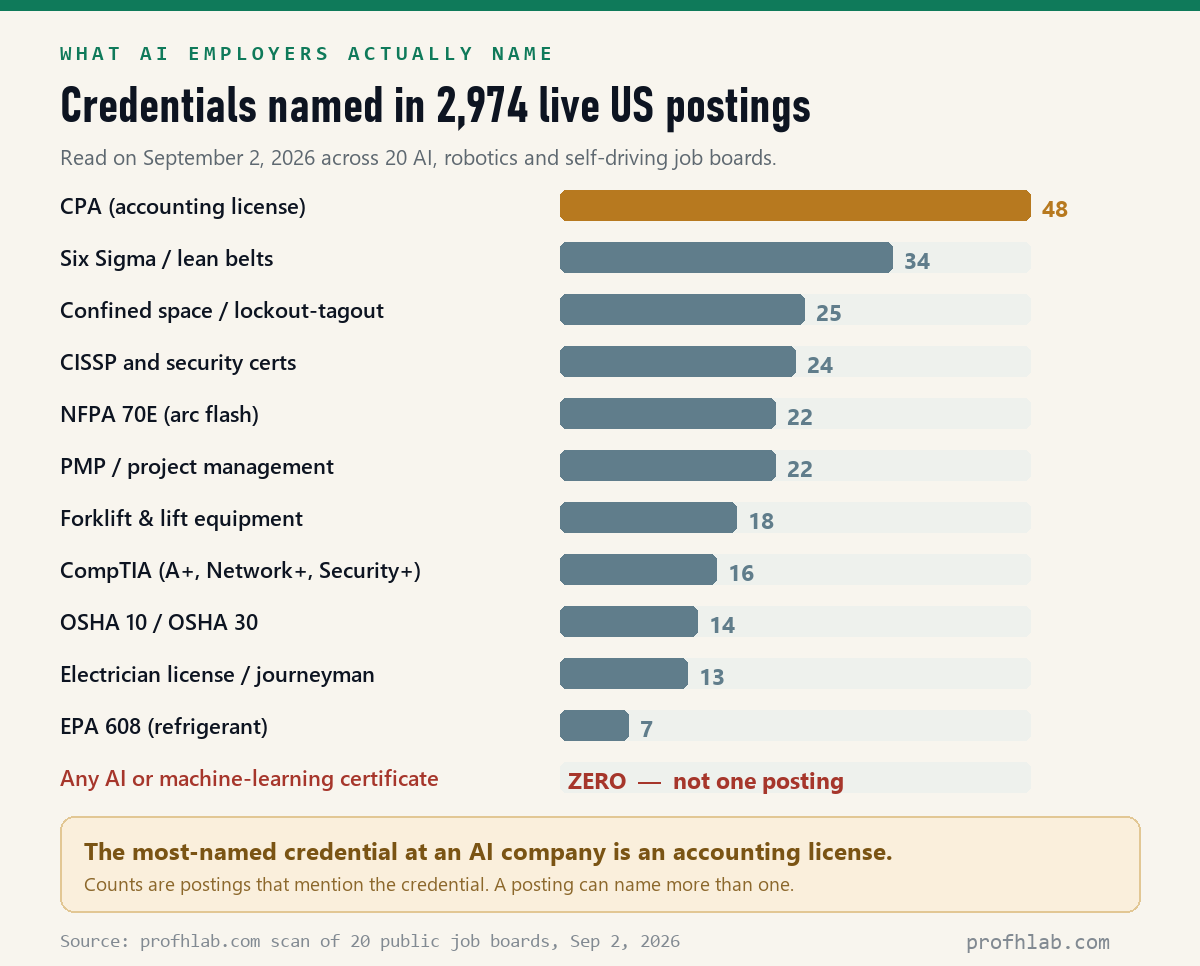
The single most-named credential across the AI industry is a CPA. It appears in 41 postings — 18 at Anthropic, 7 at OpenAI, 5 at Waymo, and the rest scattered across Scale AI, Sierra, ElevenLabs, Apptronik and Agility Robotics. Every one of them is an accounting, tax, audit or controls job. Frontier labs are hiring finance departments, and finance departments run on a license issued by a state board.
Below the CPA the list reads like a construction site: Six Sigma belts (34), confined space and lockout/tagout (25), NFPA 70E arc-flash (22), forklift and lift equipment (18), OSHA 10 and OSHA 30 (14), an electrician’s license or journeyman card (13), EPA 608 refrigerant handling (7). The IT certifications people actually recognize — CompTIA A+, Network+, Security+, Cisco’s CCNA — show up 16 times, almost always on data-center and IT technician roles.
Read that list again and something becomes obvious. Nearly all of it is either required by law to touch the equipment or required by an insurer to walk onto the site. Nobody at xAI asks for an OSHA 30 card because it demonstrates commitment to learning. They ask because you cannot be on that job without it.
Half the time, “certificate” is not even about a person
Here is a wrinkle we did not expect, and it is worth knowing if you ever search job boards for the word yourself. 294 postings use certificate or license language somewhere. When we read the sentence around every single mention, they split three ways:
- 246 postings (84%) mean a human credential.
- 40 postings (14%) mean a product or regulatory certification — UL listings, ISO 9001, SOC 2, FedRAMP. The thing being certified is a device or a company, not you.
- 8 postings (3%) mean a cryptographic certificate: TLS, x.509, certificate issuance, key management, certificate lifecycle. At OpenAI, “certificate handling” is a security engineering skill.
So if you filter a job board for “certificate” and feel encouraged by the number of results, roughly one in six of them is about machines authenticating other machines. It is a small joke the industry is playing on itself: the word has quietly changed owners.
Two doors into the same company
The averages hide the only finding here with real career consequences. Split the 2,974 postings by what kind of job they are, and the credential question gets two completely different answers from the same employers.
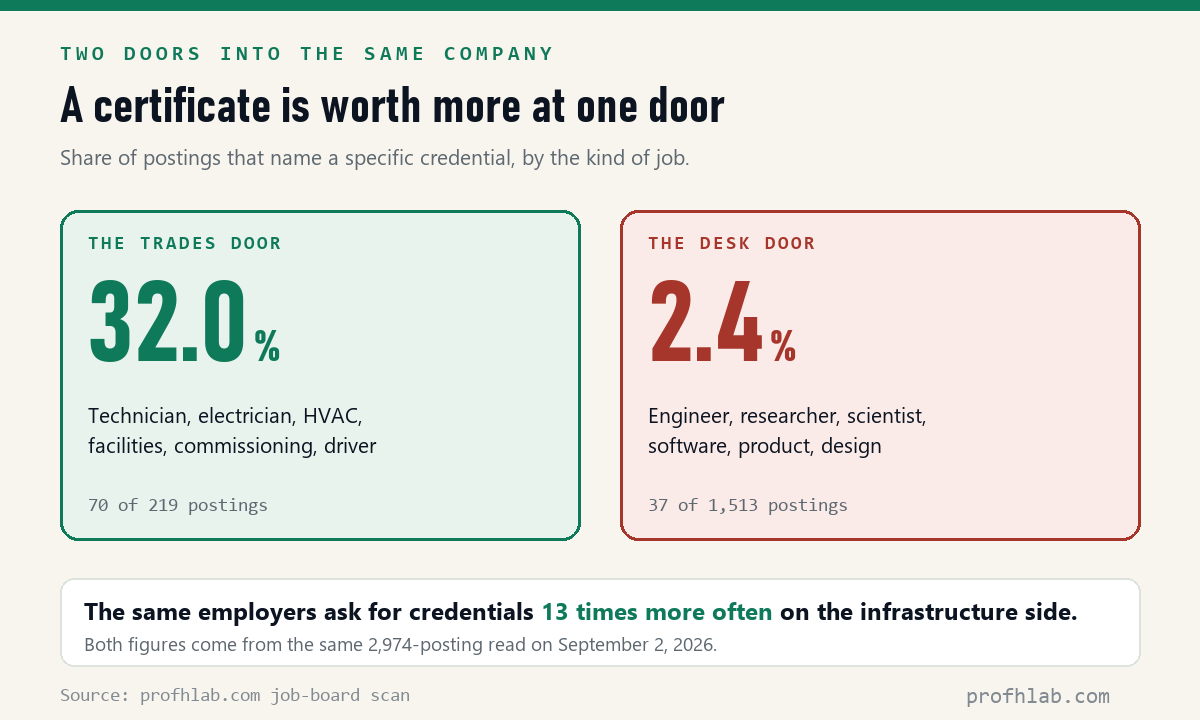
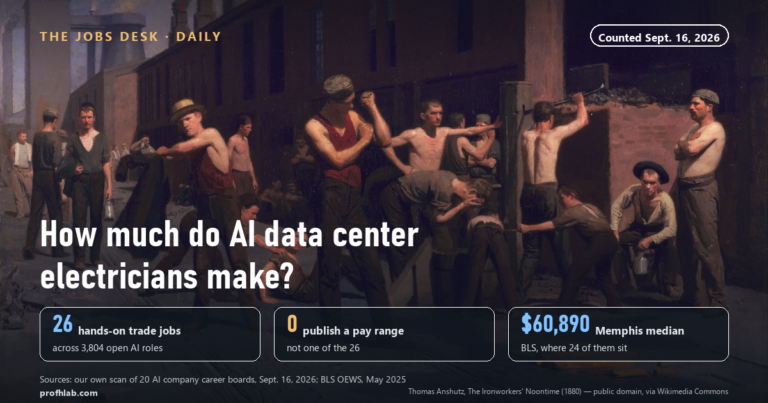
Among 219 postings with a trades or technician title — technician, electrician, HVAC, facilities, commissioning, driver — 70 name a specific credential (32.0%). Among 1,513 engineering, research, software, product and design postings, 37 do (2.4%).
That is a thirteen-fold gap inside the same companies, often inside the same building. And it points at the practical answer buried under the marketing: a certificate is worth something at the infrastructure door and almost nothing at the desk door — and it is not an AI certificate either way. It is an OSHA card, an EPA 608, a CompTIA A+, an electrician’s license.

Anthropic prints the answer in its own postings
Most employers leave you to infer what they do not care about. Anthropic writes it down. Four of its live US postings carry a heading that reads “Candidates need not have”, and underneath it, as a bullet:
Formal certifications or education credentials
Anthropic, Staff Software Engineer, Claude Design, live September 2, 2026. The same block appears on its Research Engineer, Machine Learning (Reinforcement Learning), Research Engineer / Scientist, Alignment, and Staff Software Engineer, Product postings.
The bullet directly below it is “Direct machine learning or AI research experience” — also not required, for a research engineering job at an AI lab. Whatever else you make of that, it tells you where certificates sit in the ranking. They are listed alongside the thing the company is willing to teach you.
So why do people with certificates earn more?
Because they do, and any honest answer has to deal with it. The workforce data firm Revelio Labs published an analysis on June 23, 2026 finding that people who hold an AI certification earn an average premium of about $8,000 against matched peers, controlling for occupation and seniority. They also change roles slightly more often (78.5% against 76.1%) and get promoted meaningfully more often (38.9% against 32.5%). Revelio also found AI certifications grew roughly 20× since ChatGPT launched, to nearly 30% of all certifications by 2026.
Revelio flags the catch themselves, and it is the whole ball game: these are correlations, and certification-seekers already skew toward higher earnings before they take anything. Our finding and theirs are not in conflict. Ours says no employer screens for it. Theirs says the kind of person who buys one tends to do well. Both can be true at once, and if both are true, the certificate is measuring something rather than causing it.
There is a close precedent worth holding next to this. In Skills-Based Hiring: The Long Road from Pronouncements to Practice (February 14, 2024), the Burning Glass Institute and the Harvard Business School Project on Managing the Future of Work looked at the wave of companies announcing they had dropped degree requirements, and concluded that “sustained hiring changes remain elusive for most.” What a company writes in a posting and what its hiring actually does are different measurements. We only claim the first one. It is just that on certificates, the first one is a zero.
The federal numbers say the same thing in a different language
The Bureau of Labor Statistics has asked about this since 2015, and it draws a line most people never notice. A certification is issued by a non-governmental body. A license is awarded by a government agency and conveys legal authority to work in an occupation. One is a claim about you. The other is permission.
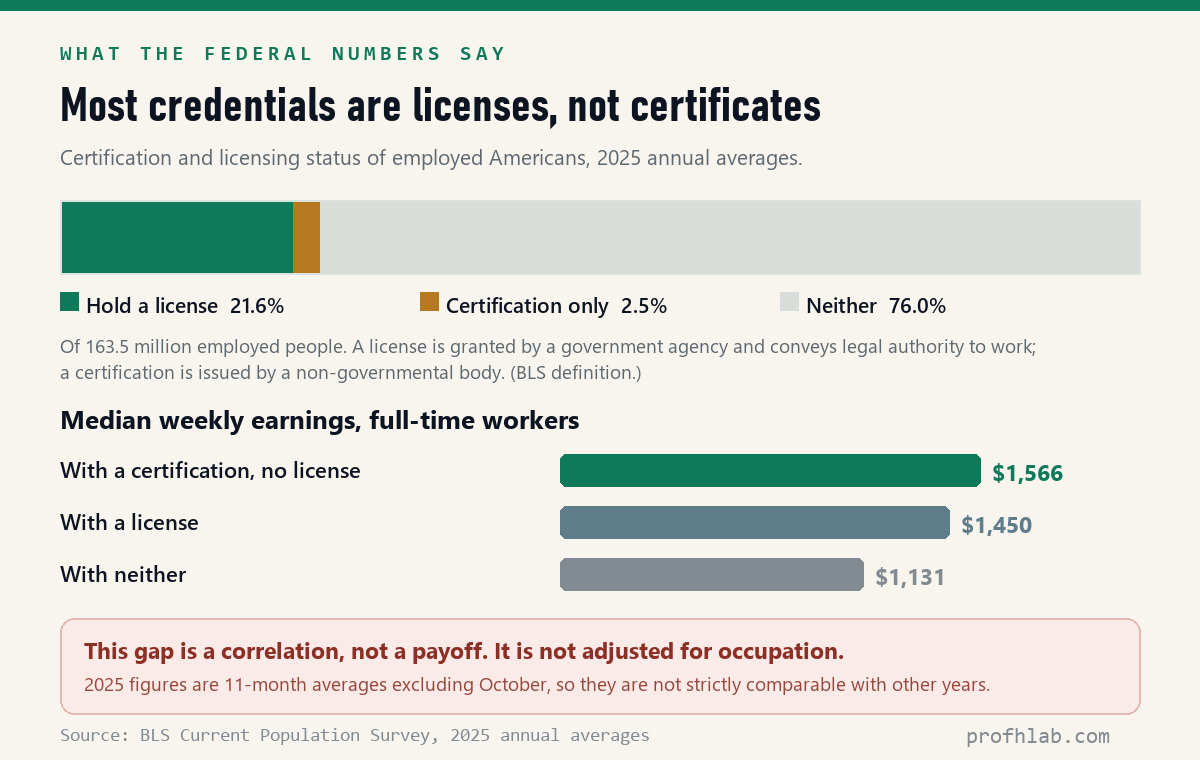
Of 163.5 million employed Americans in 2025, 21.6% hold a license and only 2.5% hold a certification without one. The credential economy people talk about is overwhelmingly a licensing economy, and licensing is concentrated exactly where the law puts it: 71.3% of healthcare practitioners hold a license, 59.8% of legal occupations, 18.8% of installation, maintenance and repair.
One number cuts against us, and we would rather show it than hide it. Computer and mathematical occupations have the highest certification-without-license rate of any group at 6.9% — nearly three times the national average. IT certifications are a genuinely real thing in the broader technology labour market. But even there, 86.7% of workers hold neither a certification nor a license, and in our job-board read the IT certifications that surfaced were on data-center and helpdesk technician roles, not on AI roles.
On earnings, BLS reports median weekly pay of $1,566 for full-time workers with a certification and no license, against $1,131 for workers with neither — a gap of about $22,600 a year. Treat that number gently. It is not adjusted for occupation, so it is largely telling you that credentialled occupations pay better, not that the credential paid. Note too that the 2025 figures are 11-month averages excluding October, because data was not collected during the federal shutdown, so they are not strictly comparable with other years.
One step deeper: a certificate is a receipt, a license is a key
Put the three pieces of evidence side by side and a single explanation covers all of them.
A license appears in job postings because the employer has no choice. The state will not let an unlicensed person pull medium-voltage cable, and the insurer will not let an untrained person into a confined space. When you see NFPA 70E in an xAI posting, you are not looking at a hiring preference. You are looking at a legal constraint that got copied into a job ad.
A certificate appears in job postings only when the employer believes it predicts something they cannot otherwise see. For a helpdesk role, CompTIA A+ is a cheap signal that you have touched hardware. For a machine learning role, there is no comparable shortage of signal — the candidate has a GitHub, a portfolio, a take-home, an interview loop that will find out in ninety minutes what any certificate could have implied. The certificate is not rejected. It is simply redundant.
Which reframes the buying decision usefully. The right question is not “will this certificate get me hired.” It is “is there a gate here, and who controls it?” If the answer is a government agency or an insurer, the credential is the point. If the answer is a hiring manager who will look at your work, the credential is a receipt for four hours you spent — useful to you, invisible to them.

The doors that were actually open today
Here are live openings from the same scan where a credential genuinely matters and a four-year degree is not the entry condition. Pay ranges are exactly as the employer published them; where a company publishes nothing, we say so rather than guessing. Every link goes to the employer’s own site.
| Employer | Role | Location | Published pay | Credential language in the posting |
|---|---|---|---|---|
| OpenAI | Site Operations Technician | San Francisco | $157,000–$221,000 | “Associate’s degree, technical certification, military experience, or equivalent practical experience” |
| OpenAI | Datacenter Networking Technician | San Francisco | $157,000–$221,000 | “Industry certifications such as BICSI, CCNA/CCNP, or equivalent” |
| xAI | IT Services Technician | Seattle, WA | $68,400–$102,600 | “CompTIA A+, Network+, Microsoft Certified Professional, or ITIL” — preferred |
| xAI | IT Services Technician | Memphis, TN | $61,200–$91,800 | Same list, same wording |
| xAI | Journeyman Electrician | Memphis, TN | Range not published | “Current OSHA 10 and OSHA 30 training” |
| xAI | Associate Data Center Operations Technician | Memphis, TN | Range not published | “High school diploma or equivalency certificate. 0–2 years of experience” |
| Figure AI | Facilities Technician | San Jose, CA | Range not published | EPA 608 refrigerant handling and electrical licensing |
| Nuro | Associate Fleet Technician | Bay Area, CA | Range not published | “Bonus Points”: ASE, CompTIA, or a vocational certificate |
| Scale AI | Senior Technician, Robotics | San Francisco, CA | $134,400–$168,000 | Six Sigma and structured problem-solving methods |
All nine confirmed live on the employer’s own domain on September 2, 2026. Postings close without notice — the official page always wins.
How to read this desk. We are not recruiters, we take no money from employers, and we have no affiliate relationship with any course, certificate or training provider named on this page. Postings can close at any time; the employer’s own page is the only authority on what a job requires.
Trades need OSHA or CompTIA; desk jobs need a portfolio
- Decide which door you are walking through first. Infrastructure and technician work is where a credential still moves you. Desk work is where a portfolio does. Our data center technician guide and robotics technician guide both break the requirements down role by role.
- If you are going through the trades door, buy the credential the law asks for. OSHA 10 and OSHA 30, EPA 608, CompTIA A+ or Network+, a state electrical apprenticeship. These are named in live postings today, at the prices the issuing bodies publish.
- If you are going through the desk door, spend the same money on something you can show. Nobody screens for the certificate; everybody looks at the work. See what to put on your resume and how far a degree actually gets you.
- Take the free version first. Google AI Essentials can be audited without paying; the $49 monthly Coursera charge buys the graded work and the certificate itself. If the learning is the point, you may not need the receipt.
- Check the market before you commit. Our AI jobs tracker is rebuilt every day from these same twenty boards, with entry-level counts and published pay bands.
Security+ and CCNA pay off at the data center, not in AI research
“Does any of this change if I already work in IT?” Somewhat, and the federal data is the reason. Computer and mathematical occupations carry the highest certification rate in the country at 6.9%. Within IT, a Security+ or a CCNA is a recognized currency. What our scan shows is that this currency does not convert at the AI-research counter — it converts at the data-center counter, which is a real and well-paid place to be.
“What about employers outside these twenty?” Fair challenge. Our twenty are AI-native companies, so they are the strictest possible test of the claim “an AI certificate helps you get an AI job.” A traditional enterprise adopting AI may screen differently, and we have not measured that. We would rather tell you the boundary of what we counted than let you assume it covers everything.
“Is the whole certificate market a scam, then?” No, and we would push back on anyone who says so. A four-hour Google course at $49 that teaches you to write better prompts is a fair trade for what it is. The problem is not the product; it is the promise attached to it. When a course is sold on career outcomes, ask the seller for their evidence, and notice how rarely it is job postings. We keep a running eye on the shakier end of this market in our look at AI training jobs.
Why AI data centers are a blue-collar hiring boom

Google AI Essentials and other courses: for learning, not hiring
Is an AI certificate worth it?
Worth it for learning, not as a hiring key. Across 2,974 live US job postings at twenty AI and robotics companies read on September 2, 2026, exactly zero named an AI certificate. If you want the knowledge, a $49 four-hour course is a reasonable purchase. If you are buying it to pass a screen, there is no screen to pass.
Is the Google AI certificate worth it?
Google AI Essentials is a five-course, roughly four-hour beginner specialization on Coursera rated 4.8 from 25,206 reviews, with 1,962,291 enrollments as of September 2, 2026. Coursera charges $49 per month after a 7-day free trial, and much of the material can be audited free. It teaches prompting and responsible use competently. It did not appear in any of the 2,974 postings we read.
Can you get a job in AI with a certificate?
You can get a job in AI without a degree, and a certificate is unlikely to be the thing that does it. The reachable roles in our scan are technician, data-center operations, fleet and facilities jobs — and the credentials those name are trade and safety credentials, not AI ones. The highest published band we found with no degree requirement was $157,000–$221,000, for an OpenAI Site Operations Technician.
Which certification is best for AI?
Judged by what employers actually write down, none of the AI-branded ones, because none appear. If you are aiming at the infrastructure side of AI, the certifications that do appear are CompTIA A+ and Network+, Cisco CCNA, BICSI, OSHA 10 and 30, EPA 608 and NFPA 70E training. If you are aiming at research or software, employers are looking at your work instead.
Is an AI prompting certificate worth it?
Prompt engineering as a titled job barely exists in this market, and prompting certificates appeared in none of the postings we read. Prompting is a skill worth having and a poor thing to build a credential around, because it is verified in about five minutes of conversation. Learn it; do not pay extra for the certificate part.
Do AI certifications increase salary?
Holders earn more, but the evidence is correlational. Revelio Labs found an $8,000 average premium against matched peers in June 2026, and noted themselves that certification-seekers already skew toward higher earnings. Nationally, BLS reports $1,566 median weekly pay for workers with a certification and no license against $1,131 for those with neither, unadjusted for occupation.
Is there any recognized certification for artificial intelligence?
There is no licensing body for AI work, which is the root of the whole question. Nobody grants legal authority to practise AI the way a state grants it to an electrician or an accountant. Vendor certifications from Google, Microsoft, IBM and AWS exist and are the closest thing to standard, but recognition in job postings at AI-native companies was zero in our September 2, 2026 read.
What is the difference between a certification and a license?
The Bureau of Labor Statistics defines it precisely: a certification is issued by a non-governmental body and says you have a skill; a license is awarded by a government agency and conveys legal authority to work in an occupation. In 2025, 21.6% of employed Americans held a license and 2.5% held a certification without one. That gap explains most of what we found in the postings.
Cite this
Prof H Lab read the full text of 2,974 live US job postings across twenty AI, robotics and self-driving company boards on September 2, 2026. None named an AI or machine-learning certificate. 194 named a specific credential; the most frequent was a CPA. Trades and technician roles named a credential in 32.0% of postings against 2.4% for engineering and research roles. Daily counts: profhlab.com/ai-jobs-tracker. Method: profhlab.com/how-we-count.
Ask the desk
If you are weighing a specific course against a specific job you want, tell us which ones and we will read the postings for that role and answer on the page. Requests go on The Jobs Desk, and we answer them with live postings, not opinions.
Related reading: which AI companies are hiring right now, which AI company pays the most, is Anthropic hiring right now, how to get a job at OpenAI or Anthropic, what xAI pays in Memphis, national laboratory jobs with no degree, federal jobs with no experience, and will AI take my job. New here? Start at Start Here or browse the FAQ. One short email a month, no spam.
Prof.’s H Newsletter
One short email a month, with the numbers in it
What actually moved in AI hiring, AI prices, and the scams aimed at older Americans. Counted here, dated, and linked to the source. One email a month, and your address goes nowhere else.