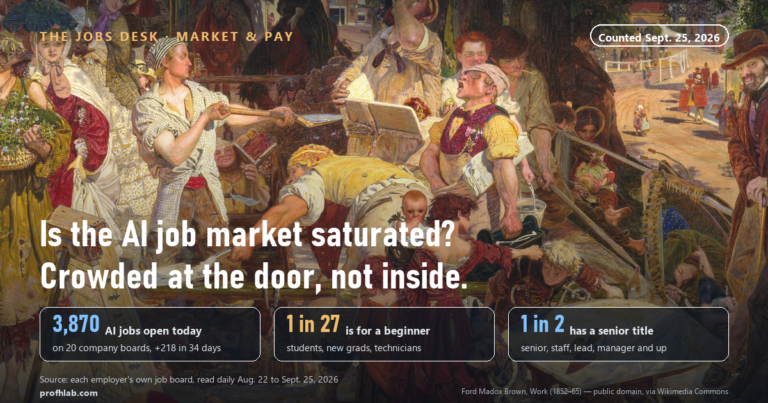
Part-Time AI Jobs, Work From Home: 30 of 3,754 Openings Qualify (September 2026)
They exist, there are thirty of them today, and they pay $35 to $100 an hour. On Thursday, September 3, 2026 we read every live posting on the job boards of twenty AI, robotics and self-driving companies — 3,754 openings. Thirty of them are genuine part-time work you can do from home in the United States. All thirty belong to one job family at one employer, and the employer publishes the hourly rate on the posting.
The strange part is the arithmetic underneath. Of those 3,754 postings, exactly four carry the employer’s own “part-time” tag, and all four are in Britain and Germany. The number tagged part-time and open in the United States is zero, and it has been zero on every one of the last ten daily reads. The thirty real ones are not tagged at all. You only find them by opening the posting and reading the paragraph near the bottom.
At a glance · read September 3, 2026
- 3,754 live postings read across 20 company boards; 2,970 open to US candidates.
- 4 postings carry a “part-time” employment tag. 0 of those 4 are open in the US — and that has held for ten straight days.
- 30 postings describe part-time or contractor terms in the posting text, at $35–$100 an hour for US candidates.
- The contractor terms, verbatim: “no fixed commitments required… most projects may require at least 10 hours per week… Contractors have full flexibility to set their own hours.”
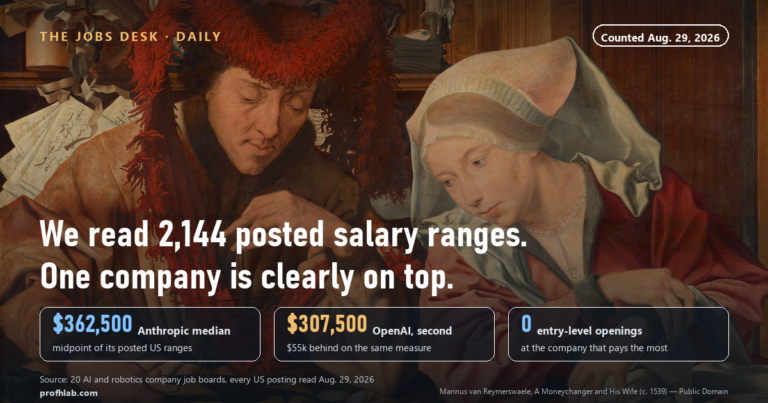
- 821 remote roles are open to US candidates — but the 629 that publish a range advertise a median floor of $239,000. Exactly one of the 821 is entry-level.
- 14 of these part-time tracks closed in the last ten days. Two opened.
The short answer, and the one place it comes from
If you want part-time AI work you can do from your own home in the United States, and you want it from a real company with a published rate rather than a marketplace, there is essentially one place to look right now: the AI Tutor postings on the board of SpaceXAI — the entity formed when SpaceX acquired xAI in February 2026, whose board still sits at the old /xai/ address.
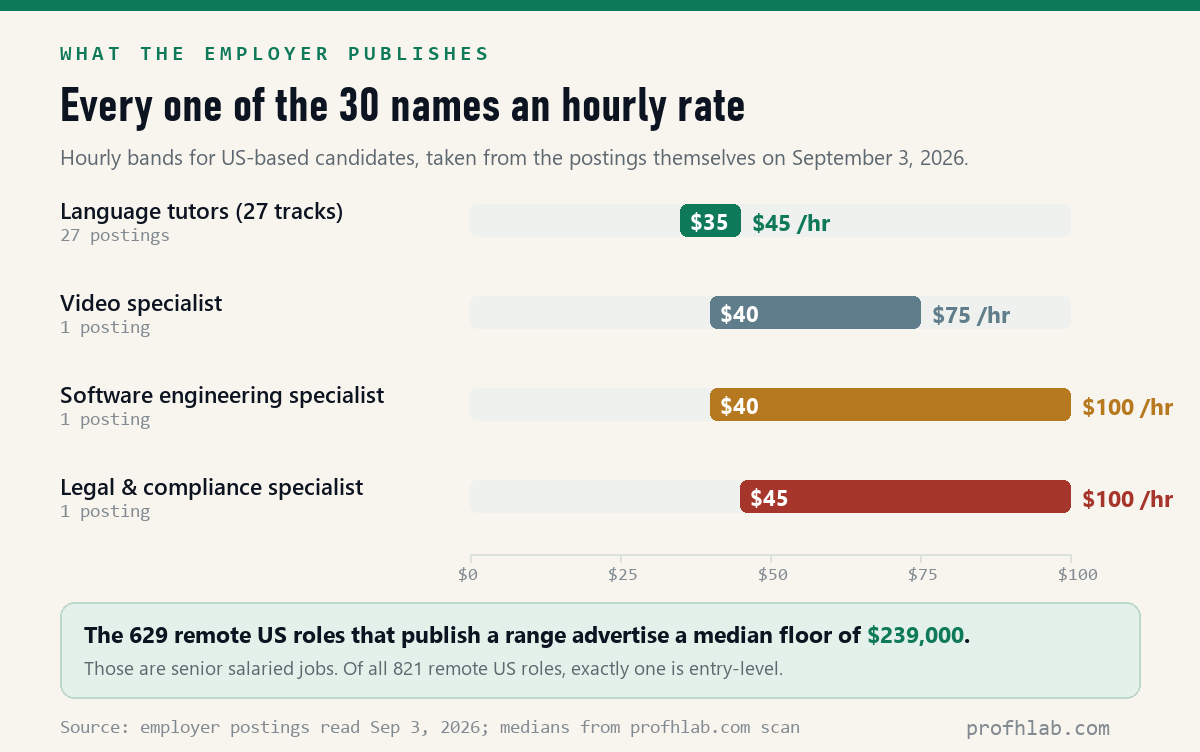
There were 30 of them when we read the board on September 3. Twenty-seven are language tracks. Three are subject tracks: video, software engineering, and legal and compliance. Every single one publishes an hourly band for US-based candidates, which is rarer than it sounds — most of the 3,754 postings we read publish an annual salary or nothing at all.
What each track pays, and how many are open
| Track | Open today | US hourly band | What it actually asks for | Posting |
|---|---|---|---|---|
| Language tutor | 27 | $35–$45 | Native proficiency in the language, plus English at B2 or better, and a clear recording voice | Spanish |
| Video specialist | 1 | $40–$75 | A portfolio of edited video, motion graphics or VFX; Premiere, Resolve, After Effects or Nuke | Video |
| Software engineering | 1 | $40–$100 | Professional engineering experience, deep expertise in at least one language, testing and profiling | Software |
| Legal & compliance | 1 | $45–$100 | Practising or former legal and compliance background | Legal |
Bands are the figures printed under “US-based candidates” on each posting, read September 3, 2026. Postings close without notice.
The 27 language tracks open on September 3 were Arabic, Bulgarian, Catalan, Croatian, Czech, Danish, Dutch, Farsi, Finnish, French, Hausa, Hebrew, Hindi, Igbo, Indonesian, Khmer, Malay, Norwegian, Portuguese, Serbian, Sinhala, Slovak, Slovenian, Sorani Kurdish, Spanish, Thai and Yoruba.
Notice what is not on that list. There is no English track. The work is teaching a model to handle a language that is not English well, so the qualification the postings actually name is native proficiency in the second language, with English at B2 as the working language. If you grew up bilingual and have never thought of that as a marketable skill, this is the page where it becomes one.

The terms, in the employer’s own words
We are quoting rather than summarising here, because this is the paragraph that decides whether the job is actually part-time, and it is the paragraph that aggregator listings strip out.
| The question | What the posting says |
|---|---|
| Is it part-time? | “Tutor roles may be offered as full-time, part-time, or contractor positions, depending on role needs and candidate fit.” 29 of the 30 carry this line; the French track says “full-time or contractor.” |
| How many hours? | “hours will vary widely based on project scope and contractor availability, with no fixed commitments required. On average, most projects may require at least 10 hours per week… Contractors have full flexibility to set their own hours.” |
| Where can I live? | Most say “remotely from any location worldwide”; the French track says the United States and Canada. All add: “we are unable to hire in Wyoming and Illinois at this time.” |
| Visa sponsorship? | “We are unable to provide visa sponsorship.” |
| What computer? | “your computer must be a Chromebook, a Mac with macOS 11.0 or later, or Windows 10 or later.” No hardware purchase is requested. |
| Benefits? | “Benefits for eligible U.S.-based positions include health insurance, 401(k) plan, and paid sick leave” — eligibility varies by employment type, so a contractor should assume none. |
Quotations taken from the SpaceXAI postings on September 3, 2026. Read the posting you are applying to; wording differs between tracks.
Two states are excluded, and the postings do not say why. If you live in Wyoming or Illinois, this door is shut today regardless of how well you qualify — which is worth knowing before you spend an evening on the application.
Why “part-time” almost never appears on an AI job board
Here is the count that surprised us. Job boards have a structured employment-type field — full-time, part-time, contract, intern — and employers fill it in. Across all 3,754 postings, the field says part-time exactly four times: an ElevenLabs transcription and subtitling role in Germany, and dubbing, audiobook and translation roles in the United Kingdom. All four are freelance. None is open in the United States.
We checked whether that was a one-day accident. It is not. We have read these same boards every day since August 25, and the count of US postings tagged part-time has been zero on all ten of those days, while the remote count sat between 1,184 and 1,210 the whole time.
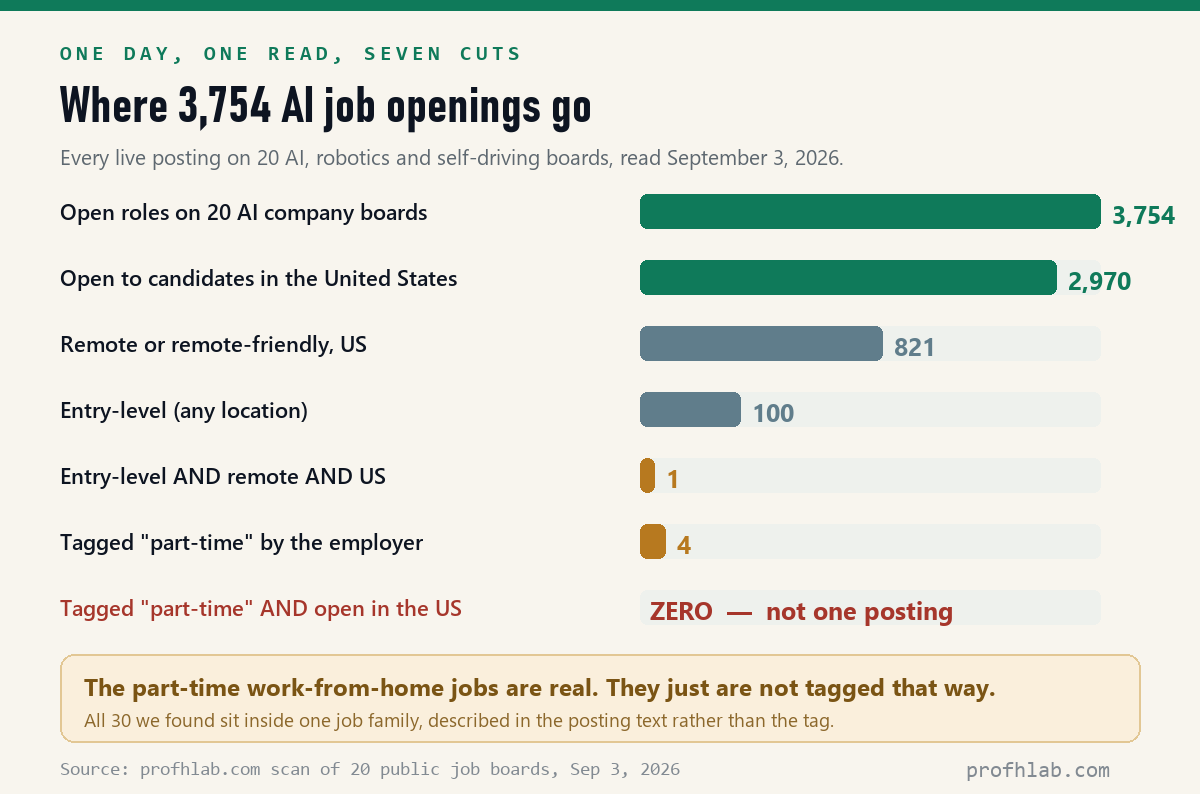
The middle of that chart is where most search advice quietly goes wrong. “Remote AI jobs” are abundant — 821 of them are open to US candidates right now. But the 629 of those that publish a salary range advertise a median floor of $239,000, because they are senior salaried engineering, research and go-to-market jobs. Of all 821, exactly one is entry-level: a research fellowship at Mercor advertised at $40,000–$80,000. Remote is not the scarce thing. Part-time is, and so is entry-level.
That gap is also why the same handful of companies keep showing up in our other counts — the ones that pay the most are hiring for the salaried door, not this one. If you want the salaried door instead, we have written separately about how people actually get in at OpenAI and Anthropic and about what one company’s board looks like week to week.
The catch: fourteen of these closed in ten days
Because we snapshot these boards daily, we can compare the same job family against itself. On August 25 there were 42 tutor postings. On September 3 there are 30. Fourteen closed and two opened in between.
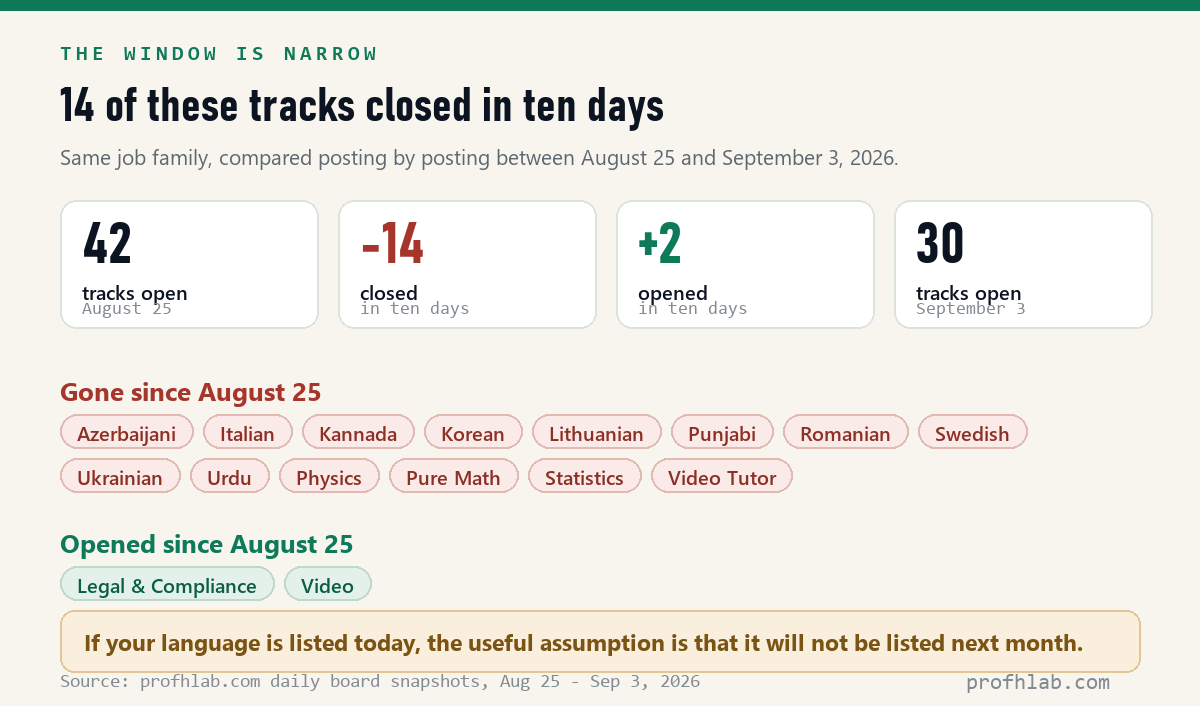
Three subject tracks — physics, pure mathematics and statistics — disappeared in that same stretch. Two new ones appeared: legal and compliance, and video. The practical reading is not that the programme is shrinking, but that each individual track has a short life. A language gets staffed and the posting comes down. If your language is on today’s list, the useful assumption is that it will not be on next month’s.
There is a mismatch worth flagging too: the board files all thirty under the location label “Remote International,” while the text of the posting says most of them can be worked from anywhere including the United States. If you filtered that board by country, you would filter these thirty away. That is exactly the sort of thing our AI Jobs Tracker exists to catch, and it is why we read posting text rather than trusting summary fields — the method is written up on how we count.
Where the other “2,000 part-time AI jobs” come from
Search this phrase and the first page is entirely job aggregators and one vendor’s recruiting community. Their counts are far larger than ours, and the difference is not that they know something we do not. We count one thing narrowly: live postings on employers’ own boards, read in full, on a stated date. An aggregator counts every listing it has ingested, including reposts, staffing-agency duplicates, roles that merely mention AI, and roles that have already closed.
Underneath the aggregators sits a second layer that genuinely does offer flexible paid work: the AI data marketplaces, where you sign up as a contributor rather than apply for a posting. That layer is real, it is much larger than thirty, and it comes with its own problems — unpredictable task supply, pay that is quoted per task rather than per hour, and account closures without explanation. We took that layer apart separately in are AI training jobs legit, and nothing there has changed this week.
Underneath that sits the layer you have to be careful about. The FTC’s own figures: reported losses to job scams went from $90 million in 2020 to $286 million in 2023, more than a threefold rise, with $223 million reported in the first half of 2024 alone. “Task” scams — the ones that ask you to complete small paid jobs and then to deposit your own money to unlock more — went from about 5,000 reports in all of 2023 to about 20,000 in the first half of 2024. Work-from-home AI work is the exact bait those use.
Four rules that hold for every posting on this page
- You never pay to work. Not for training, not for equipment, not to “unlock” tasks. Ever.
- Never deposit a cheque and send part of it on. The cheque clears, then it does not, and the money is yours to repay.
- A text or WhatsApp message is not a job offer. Real employers do not hire through unsolicited texts.
- Apply only on the employer’s own domain. Every link in this article goes to the company’s own board, and you can check that in the address bar.
What we are, and are not. We are not recruiters. We take no money from any employer named here, and we are not paid if you apply. Postings can close at any hour without notice, and the official page always wins over anything we write. Nothing here is legal, immigration or tax advice — contractor status in particular has tax consequences you should take to a professional.

Your next two hours, if this is the door you want
- Check your state first. Wyoming and Illinois are excluded on every one of these postings today. Two minutes saved.
- Find your language on the list above and open that posting directly. If it is gone, that track has been staffed — check again in a few weeks rather than applying to a different language you do not speak natively.
- Record two minutes of clean audio before you apply. The language tracks ask for “clear, natural vocal delivery” and several ask for voice samples. Your phone in a quiet room is enough.
- Say the word “contractor” in your first message. The postings say the same role can be offered full-time, part-time or contract. Which one you get depends partly on what you ask for.
- Do the maths on 10 hours. At the base band that is roughly $350–$450 a week before tax, with no guarantee of task volume. Decide whether that is worth it to you before, not after.
- If none of the thirty fits, read our piece on the marketplace layer next, and keep an eye on the tracker, which we refresh every day.
Three things people ask after they see the rate
“Is $35 an hour good for this kind of work?” Compared with per-task marketplace pay, yes, and it is the reason we put this posting family first. Compared with the salaried roles on the same boards, it is a different job with a different ceiling — the median advertised floor for remote US roles at these companies is $239,000, and those are full-time positions requiring years of specialist experience. Both facts are true at once.
“Does this lead anywhere?” Honestly, we do not have evidence either way, and we will not pretend otherwise. What we can say is that the same boards carry technician routes and robotics roles that do not require a degree, and that a doctorate is required far less often than people assume. Whether tutoring is a step onto that ladder is not something a job board can tell you.
“What about federal or lab work from home?” Different system, different rules, and worth knowing about — we covered the entry route in getting a federal job with no experience and the lab route in national laboratory jobs without a degree. Very little of it is part-time or remote, but the pay bands are published and the hiring paths are stated plainly.

Why fake job offers arrive by text, and what they signal
What people type into Google before they land here
Are there part time AI jobs you can work from home?
Yes, but far fewer than listing sites suggest. Reading every posting on twenty AI company boards on September 3, 2026, we found 30 that describe part-time or contractor terms and are open to US candidates, paying $35 to $100 an hour. Only four postings out of 3,754 carry a formal part-time tag, and none of those four is open in the United States.
Are there part time AI jobs with no experience?
Not on these boards, no. The 30 part-time roles we found all require something specific: native proficiency in a second language, a video editing portfolio, professional software engineering experience, or a legal and compliance background. None of them is a no-experience job. What they do not require is a degree in AI or a certificate — the qualification is the skill you already have.
How much do AI training jobs pay?
Where the employer publishes a rate, the answer today is $35 to $45 an hour for language work, $40 to $75 for video, $40 to $100 for software engineering and $45 to $100 for legal and compliance. Those are the printed US bands on the 30 postings we read on September 3, 2026. Marketplace platforms usually quote per task rather than per hour, which is a different and less predictable arrangement.
Are remote AI training jobs legit?
The ones on an employer’s own job board are. The test is not the job title, it is the route: if you reached the application through the company’s own domain, and nobody has asked you for money, a cheque deposit or an app download, you are in a normal hiring process. We went through this in detail in are AI training jobs legit.
Are there work from home AI jobs with no experience?
Across 3,754 live postings on September 3, 2026, exactly one role was entry-level, remote and open in the United States: a research fellowship at Mercor advertised at $40,000–$80,000. That is one out of 821 remote US roles. The honest answer is that the entry-level remote AI job barely exists at these companies, and anyone promising you a list of them is counting something else.
Can you do AI tutor work part time?
The postings say so directly: “Tutor roles may be offered as full-time, part-time, or contractor positions.” For the contractor version, the posting adds that there are “no fixed commitments required,” that most projects need at least 10 hours a week to deliver effectively, and that contractors set their own hours. Which arrangement you are offered depends on the role and on you, so raise it early.
Which AI companies are hiring for remote roles right now?
On September 3, 2026 the 821 remote roles open to US candidates were concentrated at OpenAI (400), ElevenLabs (84), Anthropic (75), Replit (62), Cohere (46) and Perplexity (42), with the remaining 112 spread across seven other boards. Almost all are senior salaried positions. Our live counts sit on the AI Jobs Tracker, and the broader picture is in which AI companies are hiring right now.
Do I need a certificate to get one of these jobs?
No. None of the 30 postings asks for an AI certificate, and when we searched all 2,974 US postings on these boards on September 2, 2026, not one named an AI or machine-learning certificate. Nor does listing ChatGPT on a resume do the work people hope it does.
Tell us your state and your hours
If you tell us where you live, roughly how many hours a week you have, and what you are good at, we will go and read the boards for you and post what we find. There is no fee and no sign-up — leave a request on The Jobs Desk. General AI questions go to Ask, and if you are new here, Start Here lays out what this site does. Recent scam patterns are tracked in AI Scam Watch, and if you are helping a parent or grandparent with any of this, our beginner’s guide is the gentler starting point.
Cite this: profhlab.com read 3,754 live postings on 20 AI, robotics and self-driving company job boards on September 3, 2026. Four carried a part-time employment tag, none of them open in the United States; 30 postings described part-time or contractor terms in the posting text at $35–$100 an hour. Daily counts: profhlab.com/ai-jobs-tracker. Method: profhlab.com/how-we-count.
Sources. Live postings read September 3, 2026 on the public boards of OpenAI, Anthropic, SpaceXAI, Google DeepMind, Scale AI, Mercor, Perplexity, Cohere, Sierra, ElevenLabs, Cursor, Cognition, Replit, Figure AI, Apptronik, Agility Robotics, 1X, Physical Intelligence, Waymo and Nuro. Scam figures from the FTC data spotlight on gamified job scams. Merger context from xAI’s own announcement. Photographs by Shixart1985 via Wikimedia Commons, licensed CC BY 2.0. Featured artwork: Johannes Vermeer, The Geographer (1668–69), public domain. One short email a month, no spam, unsubscribe any time.
Prof.’s H Newsletter
One short email a month, with the numbers in it
What actually moved in AI hiring, AI prices, and the scams aimed at older Americans. Counted here, dated, and linked to the source. One email a month, and your address goes nowhere else.