Family Safe Word Examples: 4 of 9 Official Pages Recommend One, and All 9 Say Check the Story Yourself
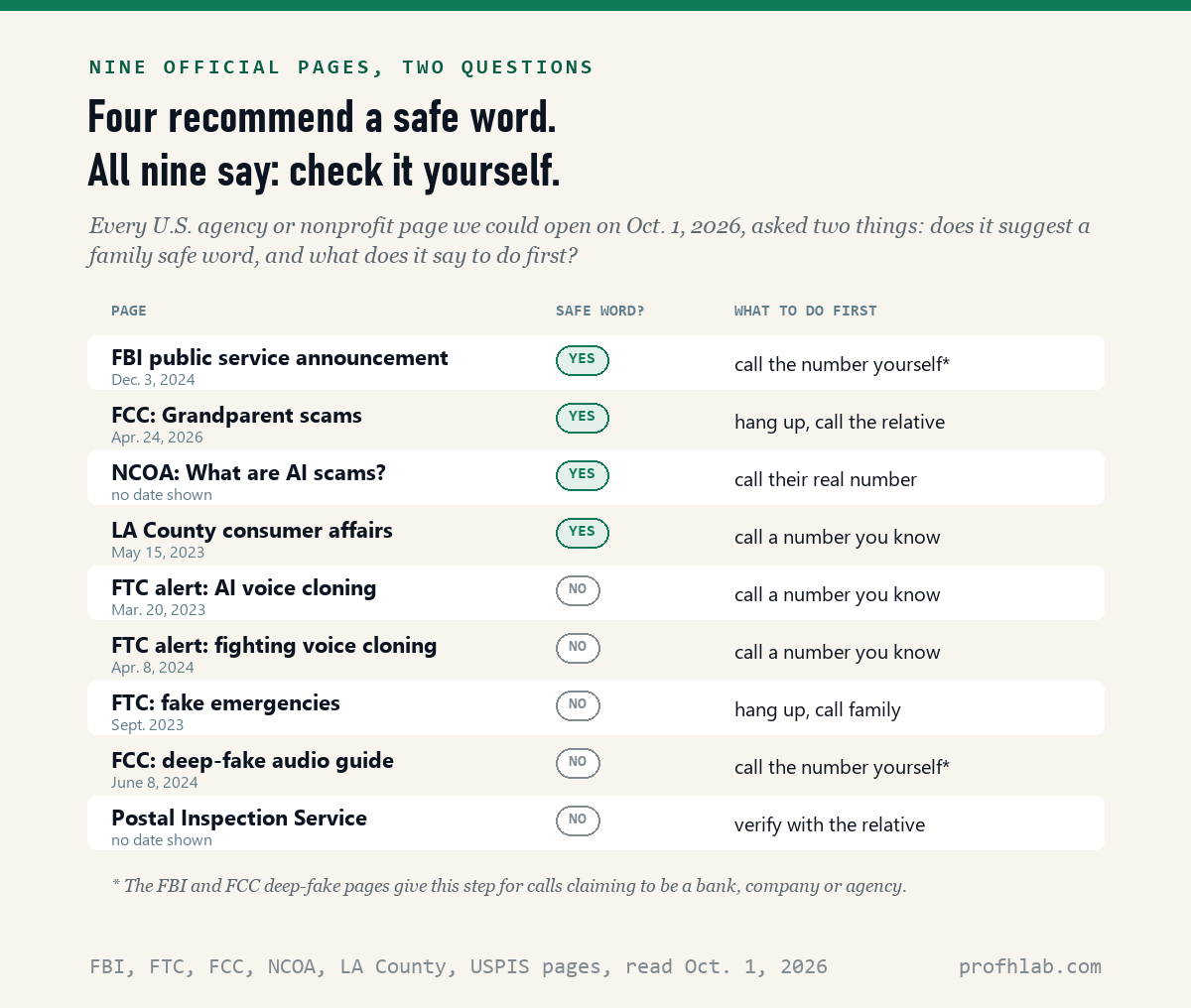
A family safe word helps, but it is the second lock, not the first: on October 1, 2026 we read nine official U.S. pages about family emergency scams, and 4 of the 9 recommend a safe word while all 9 tell you to check the story through a contact you start yourself. So the best family safe word examples come with one rule attached. If the caller cannot give the word, you hang up and call the person on the number already in your phone.
This guide shows how to pick a word a cloned voice cannot guess, how to ask for it on a frightening call, and what to do if Grandma forgets it. It also shows why you should not copy any example you read online, including ours.
How we checked this
We read nine pages from the FBI, the Federal Trade Commission, the Federal Communications Commission, the National Council on Aging, Los Angeles County’s consumer affairs office and the U.S. Postal Inspection Service. For each we asked two questions: does it suggest a family safe word, and what does it tell you to do first? We also read the FBI’s 2025 Internet Crime Report.
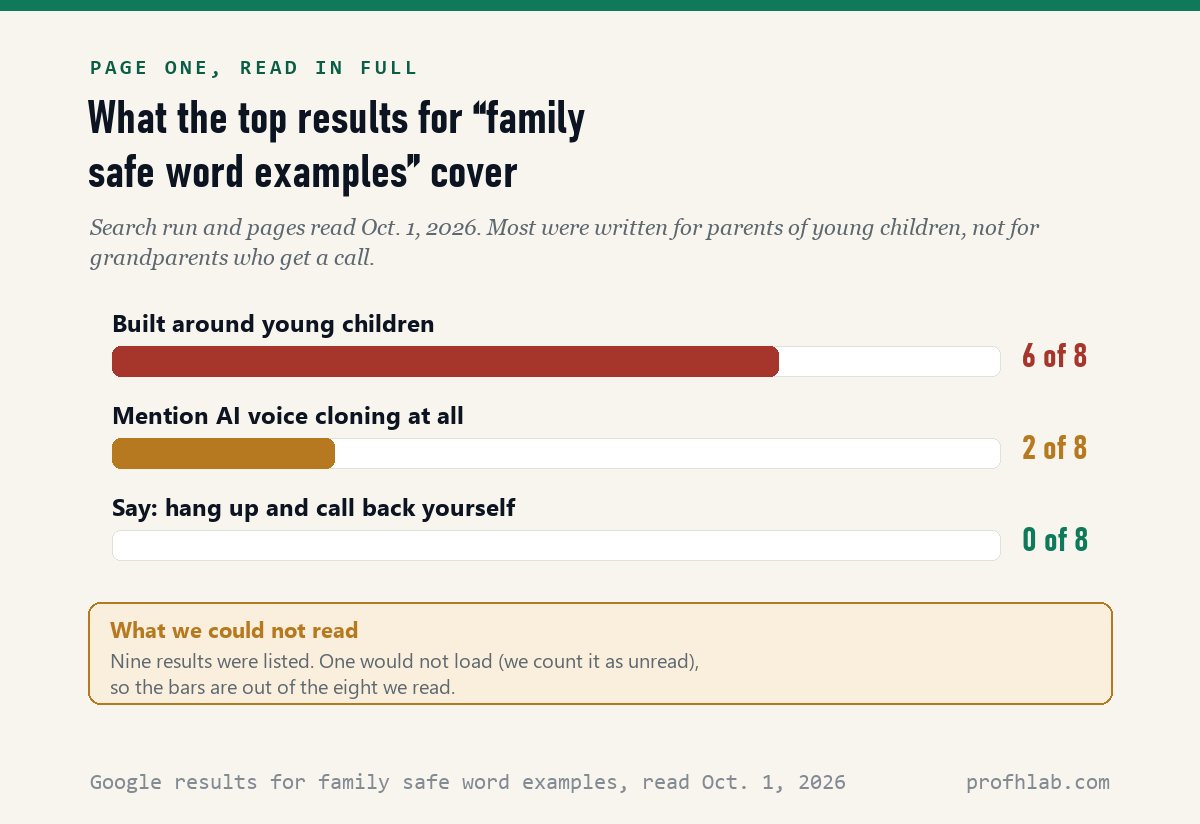
Then we searched Google for “family safe word examples” and read every first-page result that would open: eight of nine. Two AARP pages and an American Bar Association story blocked our reader, so we quote nothing from them. Everything was read on October 1, 2026.
An AI assistant helped draft this article and ran the page reads. Every quotation below was read on the source’s own page on the date shown.
What is a family safe word, and does it stop AI voice scams?
A family safe word is a word or phrase your family agrees on ahead of time, so a caller who claims to be your grandson can prove it. The FBI’s public service announcement I-120324-PSA, dated December 3, 2024, says it plainly: “Create a secret word or phrase with your family to verify their identity.”
The reason is the voice. The FTC’s consumer alert published March 20, 2023 says a scammer needs only “a short audio clip of your family member’s voice” and a voice-cloning program. Its advice in one line: “Don’t trust the voice.”
The losses are real. In the FBI’s 2025 Internet Crime Report, people 60 and older reported $352,496,231 in losses the FBI tagged as AI-related. It is the first year that tag appears in the report’s three-year table; 2024 and 2023 show an asterisk for “not captured.”
A safe word does not stop the call from coming. It gives you a fast, calm way to find out who is really on the line.
Why do all nine official pages say to call back first?
Because calling back works even when the word fails. All nine pages we read tell you to check the story yourself, and eight of them say to do it by placing a phone call yourself. A scammer can guess or fish for a word. A scammer cannot answer your grandson’s real phone.
The FTC is the clearest example. Its three consumer pages on these scams never mention a safe word. Each says to call the person on “a phone number you know is theirs.” Its “fake emergencies” page adds that you should call someone else in the family “even if the caller said to keep it a secret.”
The FCC puts both tools on one page. Its grandparent-scam alert, last updated April 24, 2026, says to hang up and “call the relative who is supposed to be in trouble,” then: “Consider using a ‘safe word’ that only you and your family members know.” If the caller can’t remember it, “it may be a scammer.”
Two of the nine give the call-back step for a different caller. The FBI notice and the FCC’s deep-fake guide say to look up the number of the bank, company or agency that claims to be calling, and call it directly. The idea is the same: you place the call.
What makes a good family safe word?
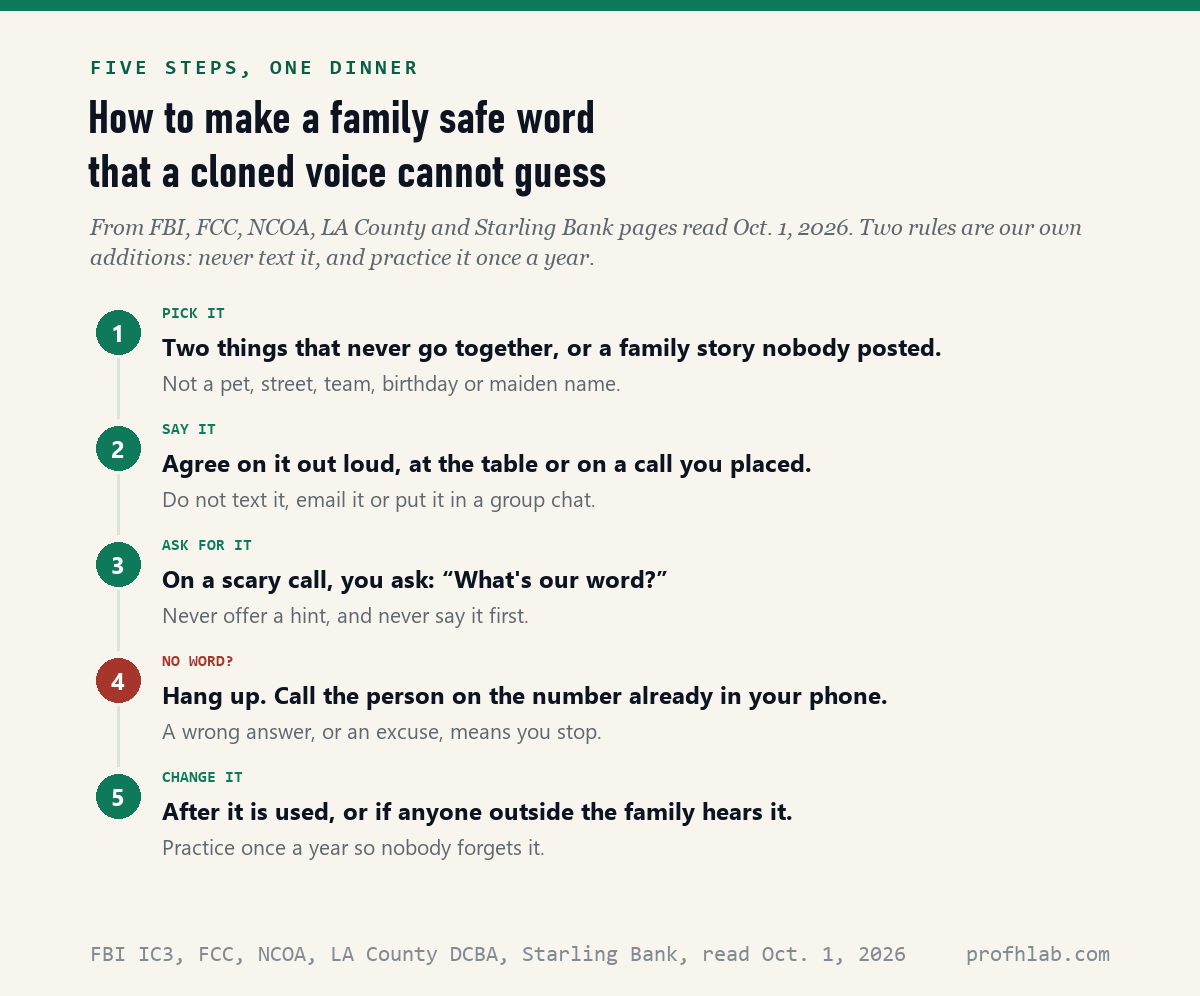
A good family safe word is something a stranger could not find online and could not guess from your life. Starling Bank’s safe-word guide, updated January 5, 2026, warns against asking “something that a criminal could guess by looking through social media.” That rules out the usual password answers.
Avoid: pet names, street names, school mascots, favorite teams, birthdays and maiden names. Many of these sit on social media, in obituaries or in old data breaches.
Choose: two ordinary things that never go together, a made-up word, or a small family story that nobody ever posted. It should be easy to say under stress, and odd enough that nobody would say it by accident.
Keep it spoken. None of the nine official pages tells you where to store the word. Our own rule is to agree on it out loud and never text or email it, because a hacked phone or inbox would hand it over. That is our advice, not an agency’s.
Family safe word examples: which kinds work, and why not copy ours?
Any word printed online is a word a scammer can read. One first-page result for this search is a 2019 Moms.com list titled “20 Funniest Code Words Families Have Come Up With,” drawn from families’ posts on Instagram and Reddit. Any family on that list would need a new word.
So treat the examples below as patterns. The words in quotes are ones we made up for this page. Because they are published here, do not use them.
- Two things that never meet: an object from the kitchen plus a place or animal, like “teapot canoe.” Pick yours by pointing at two things in different rooms.
- A made-up word: a nonsense word a grandchild invents, like “glimberwick.” Children are good at these, and they remember them.
- A private family moment: a short phrase from a story that never left the house, like “the night the porch swing fell.” Skip anything that ever appeared in a photo caption.
- A question and answer: you ask an odd question and only family knows the reply, like “How is the blue truck?” “Still needs tires.” Starling suggests a personal question, such as the last film you watched together.
A question pair has one advantage. The real answer never comes up in normal talk, so you can ask it without sounding suspicious.
Why are most search results about kids instead of phone scams?
Because “safe word” began as a child-safety idea. Of the eight first-page results we could read on October 1, 2026, six were written mainly for parents of young children: code words for school pickup, or for a child who wants to leave a party.
Only two of the eight mentioned AI voice cloning at all. None of the eight told readers to hang up and call back on a known number, the one step every official page shares. That gap is why we wrote this page for grandparents.
How do you use the safe word on a real call without tipping off the caller?
Ask for it. Never offer it. Say, “What’s our word?” and wait. Do not say “Is it the canoe one?” because a guess plus your hint can sound like a right answer.
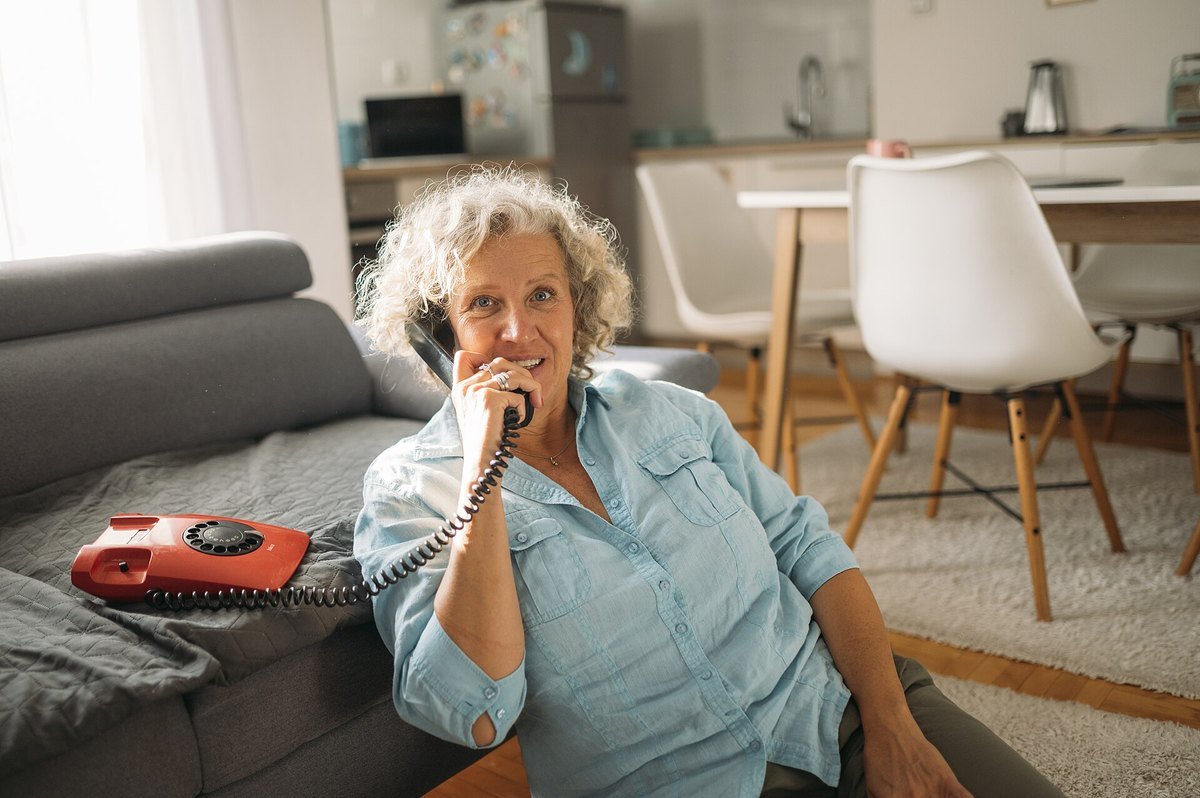
Expect pressure. The FCC says the caller may ask you “please don’t let mom and dad know,” and may hand the phone to someone posing as a lawyer or court official. A real grandchild in trouble can still say the word. A scammer will stall, change the subject or say the line is bad.
If the word is wrong, or missing, stop. Hang up and call your grandchild on the number saved in your phone. If you cannot reach them, the FTC says to try another family member or their friends.
What if Grandma forgets the safe word in a real emergency?
Then the call-back step carries the load, which is why it comes first. A real emergency survives a five-minute check. You can call your grandson, his parent or his roommate, and the truth usually comes out quickly.
This is also why the FTC’s pages lean on calling back instead of a word. A word can be forgotten under stress. A number saved in your phone does not change. Our suggestion, not an agency rule: practice the word once a year, perhaps at a birthday, so nobody blanks on it.
Change the word after it is ever used on a real call, or if someone outside the family hears it. Starling’s guide says to change it “immediately if you think you could have given it out to a scammer or a non-family member.”
Should the safe word go in a text, an email or a notebook?
None of the nine official pages answers this, so here is our reasoning, labeled as such. A text or email can be read by anyone who gets into the account. A paper card by the phone is safer from hackers but can be read by a visitor.
Our recommendation: say it out loud at a family meal or on a call you placed, and let each person keep it in memory. For someone with memory trouble, a card kept in a wallet is a reasonable middle ground, as long as it is not stored next to the phone.
Save the numbers, pick the word, and agree: no word, no money
- Save numbers. Make sure every grandchild, child and their partner is saved in your phone under a name you recognize. This is the call-back step, and it needs the numbers first.
- Pick the word together. Use one of the four patterns above. Let the youngest person who can remember it help choose.
- Agree on the rule. No word, no money. Everyone says it out loud, so nobody feels rude asking for it later.
- Practice once. One person pretends to be in trouble on the phone; the other asks for the word and then hangs up to call back.
- Know where to report. The FTC takes reports at ReportFraud.ftc.gov, and the FBI at ic3.gov. If money already left, call your bank right away.
A good safe word, and what to do when the caller lacks it
What is a good family safe word?
Something a stranger could not find online or guess from your life: two unrelated things, a made-up word, or a private family phrase. Avoid pet names, streets, teams, birthdays and maiden names.
Does a family safe word really stop AI voice scams?
It helps you catch one. The FBI recommends a secret word or phrase, and 4 of the 9 official pages we read suggest one. All 9 say to verify first through a contact you start yourself, such as calling a number you already have.
What should I do if the caller does not know the safe word?
Hang up. Call the person on the number saved in your phone. If you cannot reach them, call another family member or their friends, as the FTC advises.
Should a safe word be shared by text?
The official pages we read do not say. Our advice is to agree on it out loud and not text or email it, because anyone who gets into the account could read it.
How often should we change our family safe word?
Starling Bank’s guide says to change it every now and again, and immediately if it may have reached a scammer. We suggest changing it after any real use.
A British bank’s safe-phrase video, with a U.S. caveat
These scams also arrive as pictures, ads and messages
The full pattern behind these calls is in our guide to AI scams that target older adults. For the call itself, see how to tell if a phone call is AI and what happens if you say yes on a scam call. Our September 2026 scam watch lists recent cases.
Scams also arrive as pictures, ads and messages. Learn how to tell if a picture is AI-generated, how to spot a fake Facebook ad, why scam ads keep appearing on YouTube and how to tell if an email was written by AI.
On an iPhone, call screening decides which unknown callers ring through. If you use WhatsApp, read whether Meta AI reads your messages. For happier uses of AI with family, try making AI photos with grandparents.
New to all of this? Begin at Start Here, try ChatGPT for the first time after 50, or see the AI tools we rate for seniors. Send a question on the Ask page. Our method is at How We Count.
FBI and FTC warnings behind the safe-word advice
- FBI Internet Crime Complaint Center, Criminals Use Generative Artificial Intelligence to Facilitate Financial Fraud (I-120324-PSA), December 3, 2024. Read October 1, 2026.
- FBI, 2025 Internet Crime Report (PDF), Elder Fraud section and three-year comparison table. Read October 1, 2026.
- FTC Consumer Alert, Scammers use AI to enhance their family emergency schemes, March 20, 2023; Fighting back against harmful voice cloning, April 8, 2024; and Scammers Use Fake Emergencies To Steal Your Money, September 2023. Read October 1, 2026.
- FCC, ‘Grandparent’ Scams Get More Sophisticated, updated April 24, 2026, and Deep-Fake Audio and Video Links Make Robocalls and Scam Texts Harder to Spot, reviewed June 8, 2024. Read October 1, 2026.
- National Council on Aging, What Are AI Scams? (no date shown on the page). Read October 1, 2026.
- Los Angeles County Department of Consumer and Business Affairs, Scammers Use AI to Enhance Family Emergency Scams, May 15, 2023. Read October 1, 2026.
- U.S. Postal Inspection Service, Grandparent Scams (no date shown). Read October 1, 2026.
- Starling Bank, Family safe words: Protecting against WhatsApp scams, updated January 5, 2026. Read October 1, 2026.
- Google first-page results for “family safe word examples,” nine listed October 1, 2026: eight opened and read; waywiser.com returned a server error and is counted as unread. AARP’s two scam pages and an American Bar Association story also refused our reader, and we quote nothing from them.
This page describes what public agency and company pages say; it is not legal or financial advice. If you sent money, call your bank first. Corrections and questions go to the Ask page.
Prof.’s H Newsletter
One short email a month, with the numbers in it
What actually moved in AI hiring, AI prices, and the scams aimed at older Americans. Counted here, dated, and linked to the source. One email a month, and your address goes nowhere else.