How Much Power Does an AI Data Center Use? 120 kW a Rack, 812,000 Homes per Gigawatt, and the GPUs and HBM Inside (Oct. 2026)
One modern AI server rack uses about 120 kilowatts, according to NVIDIA’s own user guide, and a 1-gigawatt AI campus running flat out all year would use as much electricity as about 812,000 average US homes. Altogether, US data centers used 192 terawatt-hours in 2024, 4.7% of the nation’s electricity, and Lawrence Berkeley National Laboratory’s June 2026 reference case has them at 11.8% by 2030. The homes figure is our arithmetic from Energy Information Administration data, shown below.
What we read, October 2, 2026
- Government: Lawrence Berkeley National Laboratory’s June 2026 update (we checked its key figures in the PDF), the Energy Department’s summary of the 2024 report and the EIA’s household electricity data.
- Chip makers: NVIDIA’s product pages and user guides, Google, AWS and Microsoft chip pages, and SK hynix’s second-quarter 2026 results.
- Estimates: Epoch AI’s Frontier Data Centers database, the International Energy Agency’s Energy and AI report, TrendForce, Counterpoint and SemiAnalysis.
- Water: Google’s 2026 environmental report, Meta’s 2025 data index and Microsoft’s 2025 fact sheet and blog posts.
An AI assistant helped draft this piece and run the page reads; every quote was read on the source’s own page on the date shown.
This is part 2 of our six-part guide to AI data centers.
The complete guide answers 51 questions in one place. The series also covers how they are built, where they are going, Musk’s plan for space, local communities and Big Tech, rules and the outlook.
How much power does an AI data center use?
From about 100 megawatts for a large single building to 1 gigawatt or more for the biggest campuses: Epoch AI estimated on October 2, 2026 that xAI’s Colossus 2 in Memphis runs about 946 MW of computer power, and Meta has announced 5 GW for its Louisiana campus. The International Energy Agency says a typical AI-focused data center “consumes as much electricity as 100,000 households.”
Here is what those sizes mean in plain numbers. We assume racks of NVIDIA’s GB200 NVL72 design at about 120 kW each with 72 GPUs, and the EIA’s average US home use of 10,791 kilowatt-hours a year. A full gigawatt for a year is 8.76 billion kWh, and 8.76 billion divided by 10,791 is about 812,000 homes.
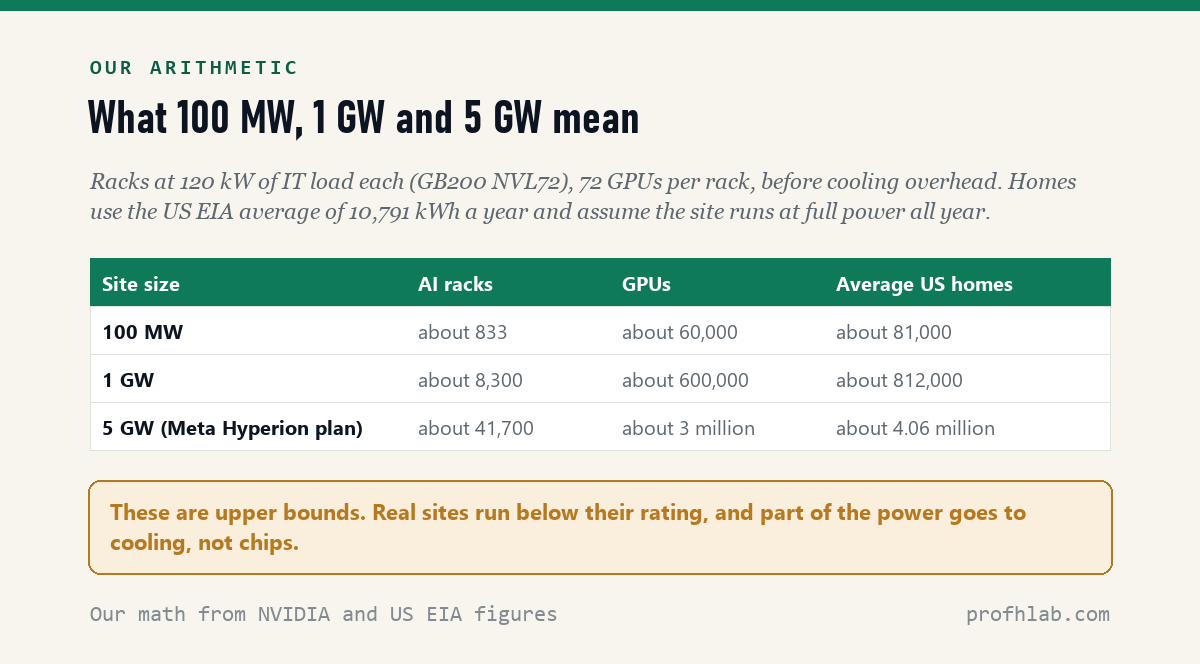
Watch which megawatt a headline means. Epoch AI reports IT power, what the computers draw; total facility power at the meter runs 20% to 50% higher, Epoch says. A “1 GW campus” in the news can mean either. When in doubt, assume the larger meter figure is the one your utility has to supply.
How much electricity do US data centers use in total?
About 192 terawatt-hours in 2024, or 4.7% of all US electricity, according to Lawrence Berkeley National Laboratory’s June 2026 update. Its reference case reaches 649 TWh, or 11.8%, by 2030, with a range of 9.5% to 15.3%. That would require about 148 gigawatts of grid connections for data centers by 2030, the lab estimates.
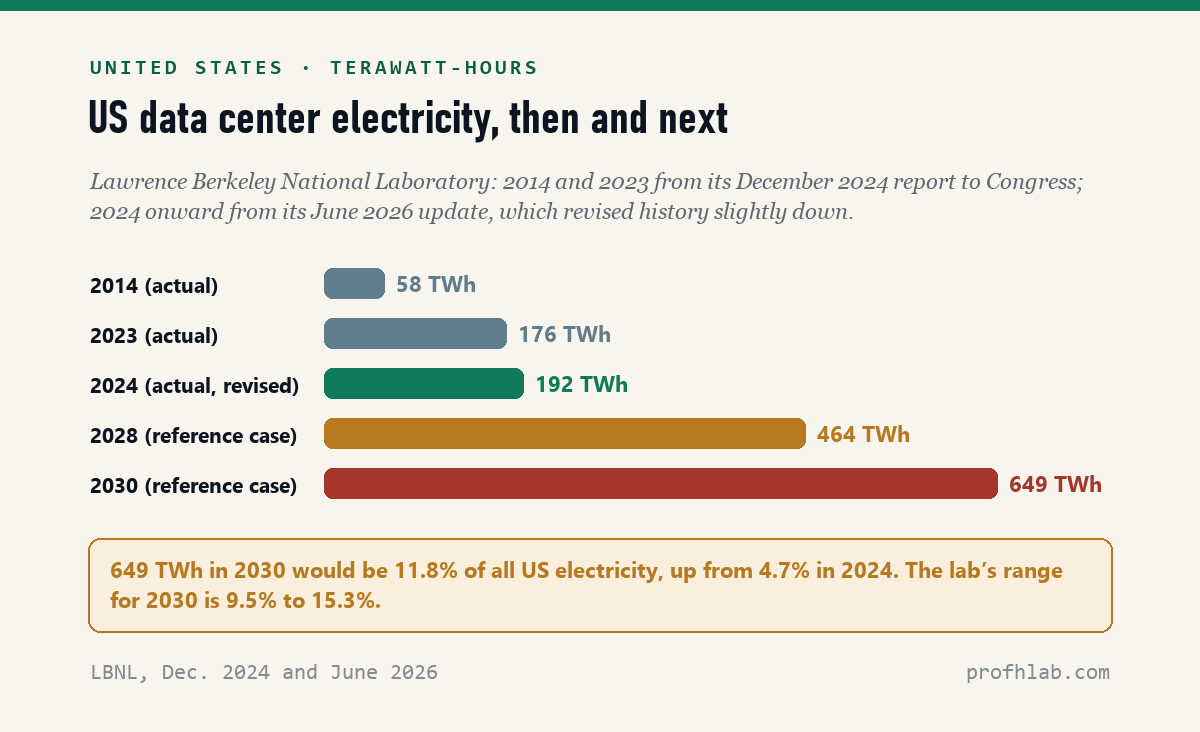
AI is the reason. Berkeley Lab’s 2024 report found AI server electricity rose from under 2 TWh in 2017 to more than 40 TWh in 2023. Its 2026 update says that in 2030, “AI servers account for 84% of total server energy use and 55% of total data center energy use.” Worldwide, the IEA expects data center use to “more than double to around 945 TWh by 2030,” from about 415 TWh in 2024.
For a household, this is the part that reaches your bill. The IEA says US data centers “account for nearly half of electricity demand growth between now and 2030.” Our post is my electric bill going up because of AI covers who pays.
How much power does one AI GPU use?
An NVIDIA H100 chip is rated at up to 700 watts, but once you count the whole server, rack and building, each GPU accounts for 1.3 to 2.5 kilowatts. NVIDIA’s 8-GPU DGX H100 server draws up to 10.2 kW, about 1.28 kW per GPU. A GB200 NVL72 rack at about 120 kW works out to about 1.67 kW per GPU. NVIDIA sizes a 100 MW site at about 40,000 of its next Rubin GPUs, or 2.5 kW each.
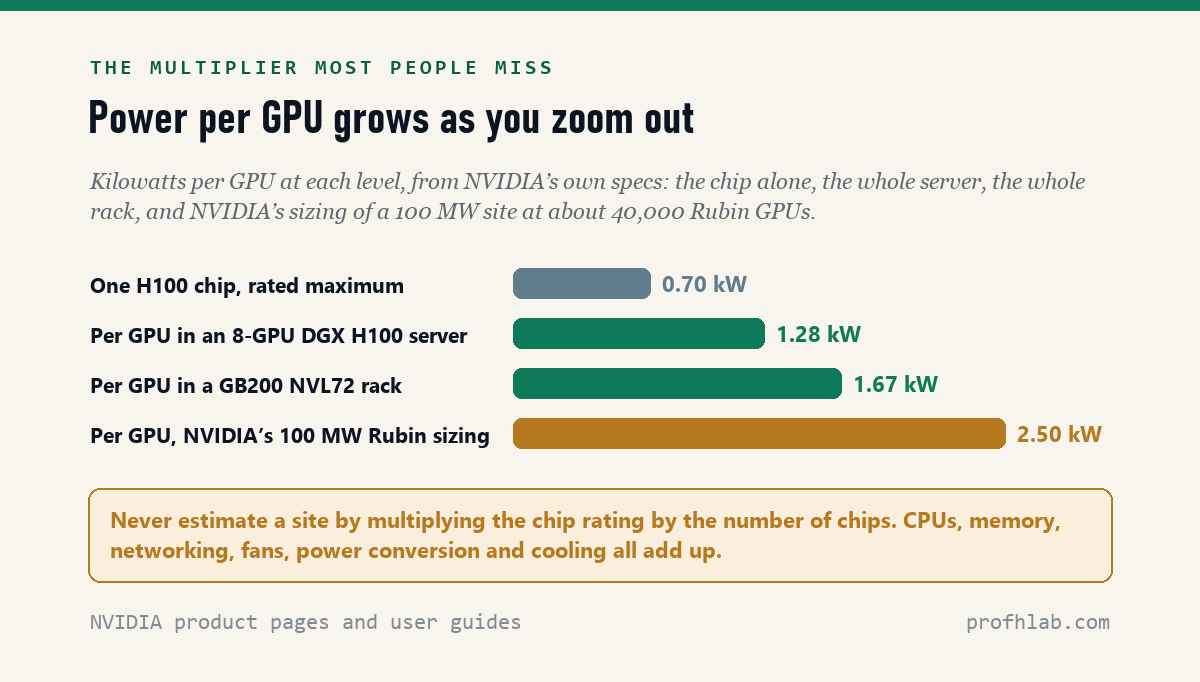
Newer chips draw more. NVIDIA’s product pages we read list no single power rating for its Blackwell GPUs; Tom’s Hardware reported a range of about 1,000 to 1,400 watts per GPU. NVIDIA says today’s 54-volt rack power hits physical limits “As racks exceed 200 kilowatts,” which is why it is moving to 800-volt power for 1 MW racks from 2027.
That density is why AI data centers switched to liquid. SemiAnalysis put it simply in 2024: “Moving well past 40kW per rack is the primary reason why liquid cooling is required for GB200.” Our post on how AI data centers are built explains the cooling options.
How many GPUs are in the biggest AI data centers?
Hundreds of thousands: xAI’s first Colossus in Memphis launched with 100,000 NVIDIA Hopper GPUs in 2024, and Epoch AI now estimates Colossus 2 runs about 440,000 Blackwell GPUs on 946 MW of IT power. Microsoft says its Wisconsin Fairwater site holds “hundreds of thousands” of NVIDIA GB200 GPUs.
Estimates and company claims can differ a lot. For Fairwater Wisconsin, Epoch’s satellite-and-permit estimate as of October 2, 2026 is about 176,400 Blackwell chips on 369 MW, while Microsoft uses “hundreds of thousands.” Both can be true at different points in a phased build. We report each with its source.
The chips are the most expensive part. NVIDIA publishes no list prices, but CEO Jensen Huang told CNBC in March 2024 that Blackwell GPUs would cost $30,000 to $40,000 each, and analysts put H100s at $25,000 to $40,000. At those prices, 440,000 GPUs would cost roughly $13 billion to $18 billion; that is our multiplication of the quoted range, not a reported price.
How much memory, or HBM, does an AI chip need?
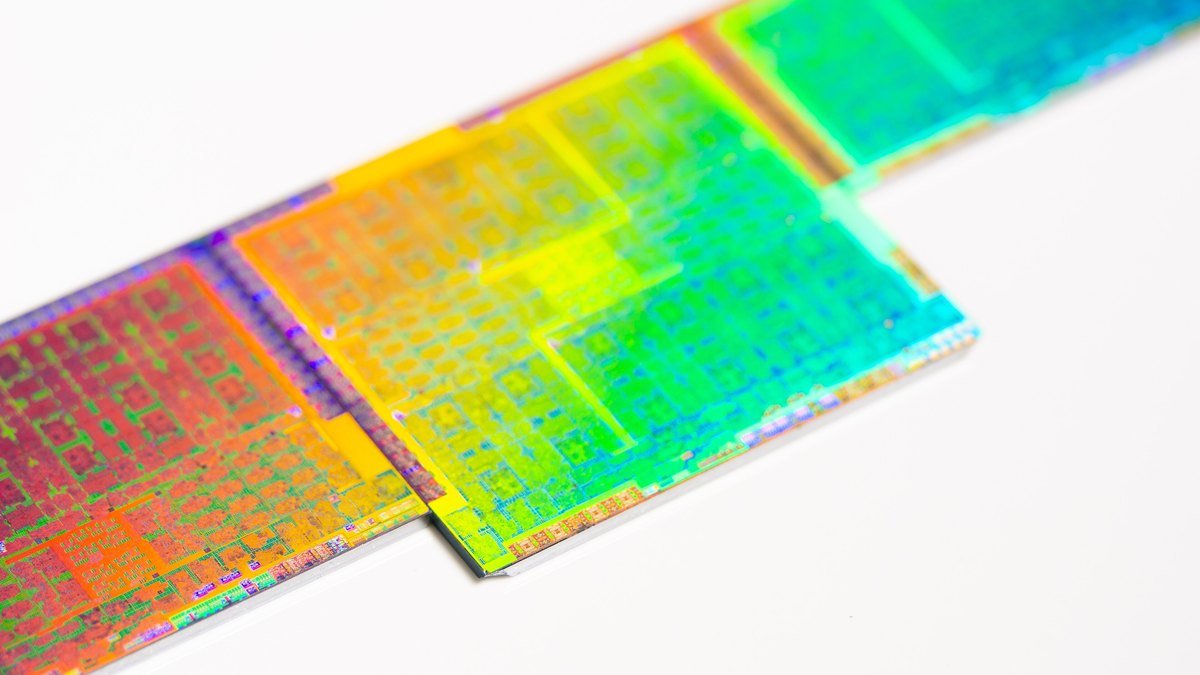
Between 80 and 288 gigabytes of high-bandwidth memory per chip: the H100 has 80 GB, the H200 141 GB, the B200 is listed at 192 GB, and NVIDIA’s Blackwell Ultra and next Rubin chips carry 288 GB each. One GB200 NVL72 rack holds 13.4 terabytes of HBM3e, according to NVIDIA’s product page.
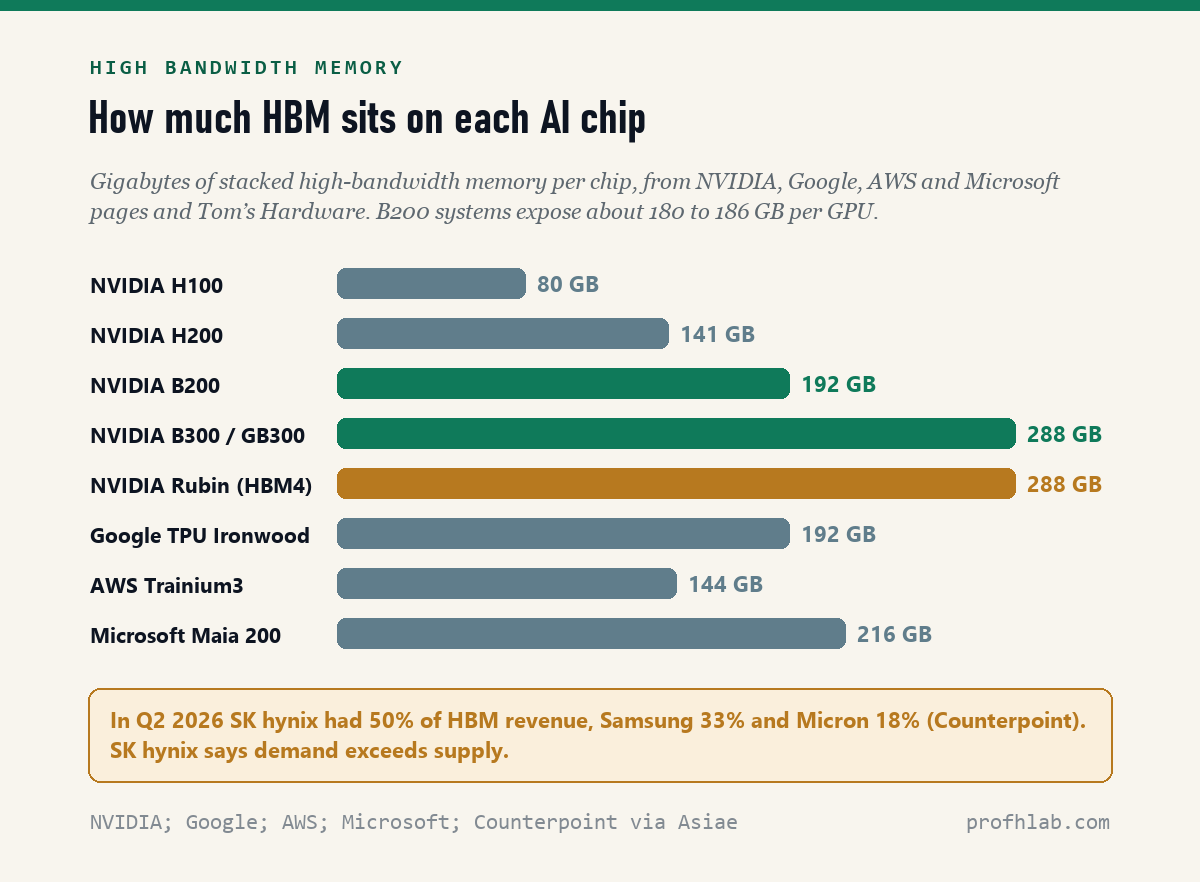
Only three companies make HBM. In the second quarter of 2026, SK hynix had 50% of HBM revenue, Samsung 33% and Micron 18%, according to Counterpoint Research as reported by The Asia Business Daily. SK hynix said in its July 29, 2026 results that it operates “In a market environment where customer demand exceeds supply capabilities,” and that it began mass shipments of the next generation, HBM4, in the second quarter.
The shortage reaches ordinary buyers. TrendForce estimated in June 2026 that HBM will take 30% of the world’s DRAM wafers by the end of 2027, and expects HBM contract prices to “surge multiples higher in 2027.” In September it forecast regular DRAM contract prices up 10% to 15% in the fourth quarter, citing server memory undersupply from “constraints in component supply, packaging and testing capacity.” Our post on what comes after HBM goes deeper.
What do CPUs and custom chips do in an AI data center?
CPUs run the system around the GPUs: in NVIDIA’s GB200, one Grace CPU with 72 Arm cores is paired with two Blackwell GPUs, so a 72-GPU rack has 36 CPUs; older 8-GPU servers use two Intel Xeon chips. Big companies also design their own AI accelerators to rely less on NVIDIA.
| Custom chip | Company | Memory per chip | Notable fact |
|---|---|---|---|
| TPU Ironwood | 192 GB | A pod of 9,216 chips uses nearly 10 MW | |
| Trainium3 | Amazon (AWS) | 144 GB | Servers scale up to 144 chips |
| Maia 200 | Microsoft | 216 GB | 750 W, closed-loop liquid cooled |
| MTIA | Meta | Not confirmed | Four generations built with Broadcom |
Amazon’s Indiana campus for Anthropic shows how far custom chips have come. Epoch AI estimates it runs about 1.045 million Trainium2 chips on about 910 MW, making it the second-largest AI site it tracks by power. Our US map lists the other giants.
How do thousands of AI chips work as one computer?
Through very fast links: NVIDIA’s fifth-generation NVLink gives each GPU 1.8 terabytes per second of bandwidth and ties a 72-GPU rack together at 130 TB/s, while each newer Blackwell Ultra GPU gets an 800-gigabit network link to the rest of the building. Between racks, operators choose InfiniBand or high-speed Ethernet.
Both work at scale. Meta built one 24,576-GPU cluster on each in 2024, and xAI’s first Colossus runs on NVIDIA’s Spectrum-X Ethernet. An industry group, the Ultra Ethernet Consortium, released its first specification on June 11, 2025, an open Ethernet-based stack for AI. NVIDIA is also moving optics inside its switches, claiming 3.5 times better power efficiency than plug-in transceivers.
How much water does an AI data center use?
It depends almost entirely on the cooling design: Google’s data centers consumed about 10.5 billion gallons of water in 2025, roughly 0.25 gallons per kilowatt-hour by our division of its own figures, while Microsoft says its new designs since August 2024 use zero water for cooling. Berkeley Lab estimated US data centers directly used about 17 billion gallons for cooling in 2023, as reported by The Conversation.
| Company | What it reports | Figure |
|---|---|---|
| Data center water consumed, 2025 | 10,523 million gallons (company total up 34% from 2024) | |
| Largest single site, Council Bluffs, Iowa | 1,346 million gallons in 2025 | |
| Meta | Data center water, 2024 | 2,974 megaliters; 0.19 L per kWh (withdrawal basis) |
| Microsoft | Water use efficiency, 2025 | 0.27 L per kWh; about 90% of its owned fleet low- or zero-water |
These numbers are not directly comparable. Google reports water consumed, Meta reports withdrawals divided by computer power, and Microsoft changed its method in fiscal 2024. Indirect water, used at the power plants that make the electricity, is much larger: Berkeley Lab estimated about 211 billion gallons in 2023, as The Conversation reported. Closed-loop cooling has a trade-off too; Microsoft says it means “a nominal increase in our annual energy usage.”
What is PUE, and why does it matter for AI data centers?
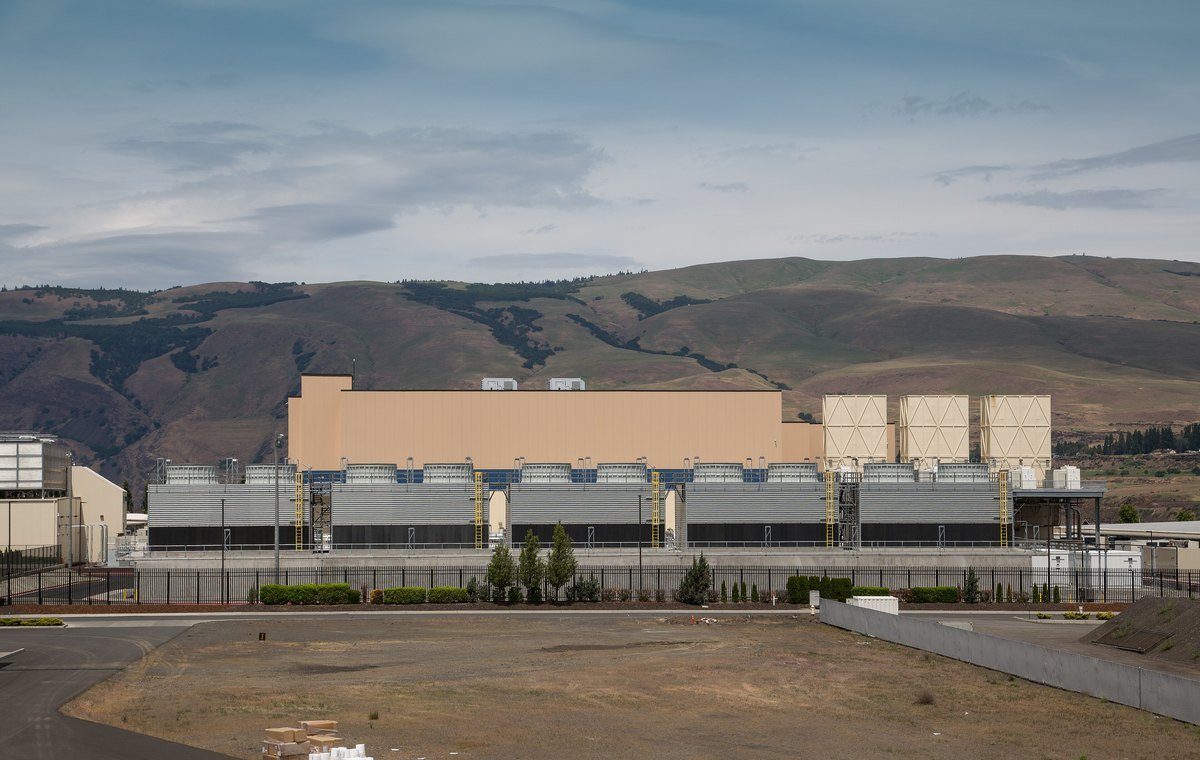
PUE, or power usage effectiveness, is total facility power divided by the power the computers use; Google’s fleet averaged 1.09 in 2025, while Uptime Institute’s 2026 survey average was 1.52. For 100 MW of computers, that is the difference between about 109 MW and about 152 MW at the meter. Berkeley Lab estimates facilities serving AI equipment averaged 1.145 in 2024.
AI buildings tend to score well because liquid cooling moves heat efficiently. Meta reported a data center PUE of 1.08 in 2024. A low PUE does not mean low power, though: it only says how little is wasted around the computers, not how much the computers use.

Kilowatt-hours per day and HBM per chip, worked out
How much power does an AI data center use per day?
A 100 MW site running at full power uses 2.4 million kWh a day (100,000 kW times 24 hours); a 1 GW site uses 24 million kWh a day. Real sites run below their rating, so these are upper bounds.
How many homes can 1 gigawatt power?
About 812,000 average US homes if the site drew a full gigawatt all year: 8.76 billion kWh divided by the EIA’s 10,791 kWh per home. That is our arithmetic and an upper bound.
How much power does an AI data center use compared to a city?
The IEA says a typical AI-focused data center uses as much electricity as 100,000 households, and the largest under construction will use 20 times as much, roughly 2 million households’ worth.
How much power does one AI server rack use?
About 120 kW for an NVIDIA GB200 NVL72 rack with 72 GPUs, per NVIDIA’s user guide. A typical rack in Uptime Institute’s 2026 survey drew about 11 kW.
How much power does a GPU use?
An H100 chip is rated up to 700 W. Counting its share of the server, NVIDIA’s DGX H100 works out to about 1.28 kW per GPU, and NVIDIA’s 100 MW site sizing works out to 2.5 kW per Rubin GPU.
How many GPUs are in an AI data center?
From tens of thousands to hundreds of thousands. xAI’s first Colossus launched with 100,000 GPUs; Epoch AI estimates Colossus 2 runs about 440,000. At 120 kW per 72-GPU rack, 100 MW of racks holds about 60,000 GPUs.
How much HBM is in an H100, H200 and B200?
80 GB in the H100, 141 GB in the H200, and 192 GB listed for the B200, with NVIDIA’s systems exposing about 180 to 186 GB per B200. Blackwell Ultra (B300/GB300) and Rubin carry 288 GB.
Who makes HBM memory?
SK hynix, Samsung and Micron. In the second quarter of 2026 their shares of HBM revenue were 50%, 33% and 18%, according to Counterpoint Research.
Why is memory getting more expensive?
AI chips need huge amounts of HBM, which takes factory capacity from regular DRAM. TrendForce expects HBM to use 30% of DRAM wafers by the end of 2027 and forecast regular DRAM contract prices up 10% to 15% in the fourth quarter of 2026.
How much does an NVIDIA AI chip cost?
NVIDIA publishes no list price. Jensen Huang told CNBC in March 2024 that Blackwell would cost $30,000 to $40,000 per unit, and analysts estimated the H100 at $25,000 to $40,000.
How much water does an AI data center use?
It depends on cooling. Google’s data centers consumed about 10.5 billion gallons in 2025, about 0.25 gallons per kWh by our division; Microsoft’s closed-loop designs since 2024 use no water for cooling after the first fill.
How much water does an AI data center use per day?
Our rough estimate at Google’s 2025 fleet average: a 100 MW site at full power uses 2.4 million kWh a day, times 0.25 gallons is about 600,000 gallons a day. Closed-loop sites use far less; evaporative sites in hot climates can use more.
What percentage of US electricity do data centers use?
4.7% in 2024, according to Lawrence Berkeley National Laboratory’s June 2026 update, up from 4.4% in 2023 in its earlier report. Its reference case reaches 11.8% by 2030.
What is PUE in a data center?
Power usage effectiveness: total facility power divided by computer power. 1.0 would be perfect. Google’s fleet averaged 1.09 in 2025 and Uptime Institute’s 2026 industry average was 1.52.
Three traps that catch most data center power math
Chip and rack figures are NVIDIA’s, Google’s, AWS’s and Microsoft’s published specs; NVIDIA’s efficiency claims are its own. GPU counts for specific sites are Epoch AI estimates from satellite images and permits unless a company states them. US totals come from Berkeley Lab, and global totals from the IEA. Every per-GPU, per-home and per-day figure marked as ours is simple division you can redo.
Three traps catch most readers. A chip’s rating is not what the building draws. Computer power (IT) is not power at the meter. And company water figures use different definitions. We name the definition each time. We left out widely repeated numbers we could not confirm, including a per-rack price for NVIDIA’s next systems and some AMD and Meta chip specs.
Where the power goes next: sites, neighbors and electricians’ pay
The complete guide to AI data centers answers 51 questions in one place. To see where all this power is going, read where AI data centers are being built; for the neighbors’ side, are data centers good for local communities. For the chip industry behind it, see Samsung’s chip and device businesses compared, ASML in Korea, chip equipment makers compared and the Physical AI library.
All this power needs people to install and run it. See how much AI data center electricians make and how to become a data center technician, then browse openings on our jobs board.
Cite this
An NVIDIA GB200 NVL72 AI rack draws about 120 kW (NVIDIA); a 1 GW campus at full power equals about 812,000 average US homes (profhlab arithmetic from EIA data); and US data centers used 192 TWh, 4.7% of US electricity, in 2024, with a reference-case 11.8% by 2030 (Lawrence Berkeley National Laboratory, June 2026). Source: profhlab.com, How Much Power Does an AI Data Center Use?
Sources read on October 2, 2026: LBNL, US Data Center Energy Usage Report: 2025 Update, June 2026; DOE, December 20, 2024; EIA, household electricity FAQ; IEA Energy and AI, April 2025; NVIDIA DGX GB rack user guide; NVIDIA DGX H100 user guide; NVIDIA Vera Rubin NVL72; NVIDIA, May 20, 2025.
Also read on October 2, 2026: Epoch AI Frontier Data Centers; SK hynix, July 29, 2026; The Asia Business Daily citing Counterpoint, September 3, 2026; TrendForce, June 2, 2026; TrendForce, September 30, 2026; Google 2026 Environmental Report; Microsoft, December 9, 2024; The Conversation, August 19, 2025; CNBC, March 19, 2024; Google data center efficiency. Photos via Wikimedia Commons under the licenses shown.
Prof.’s H Newsletter
One short email a month, with the numbers in it
What actually moved in AI hiring, AI prices, and the scams aimed at older Americans. Counted here, dated, and linked to the source. One email a month, and your address goes nowhere else.