Why Does Elon Musk Want Data Centers in Space? What He Says vs What SpaceX Told the SEC (Oct. 2026)
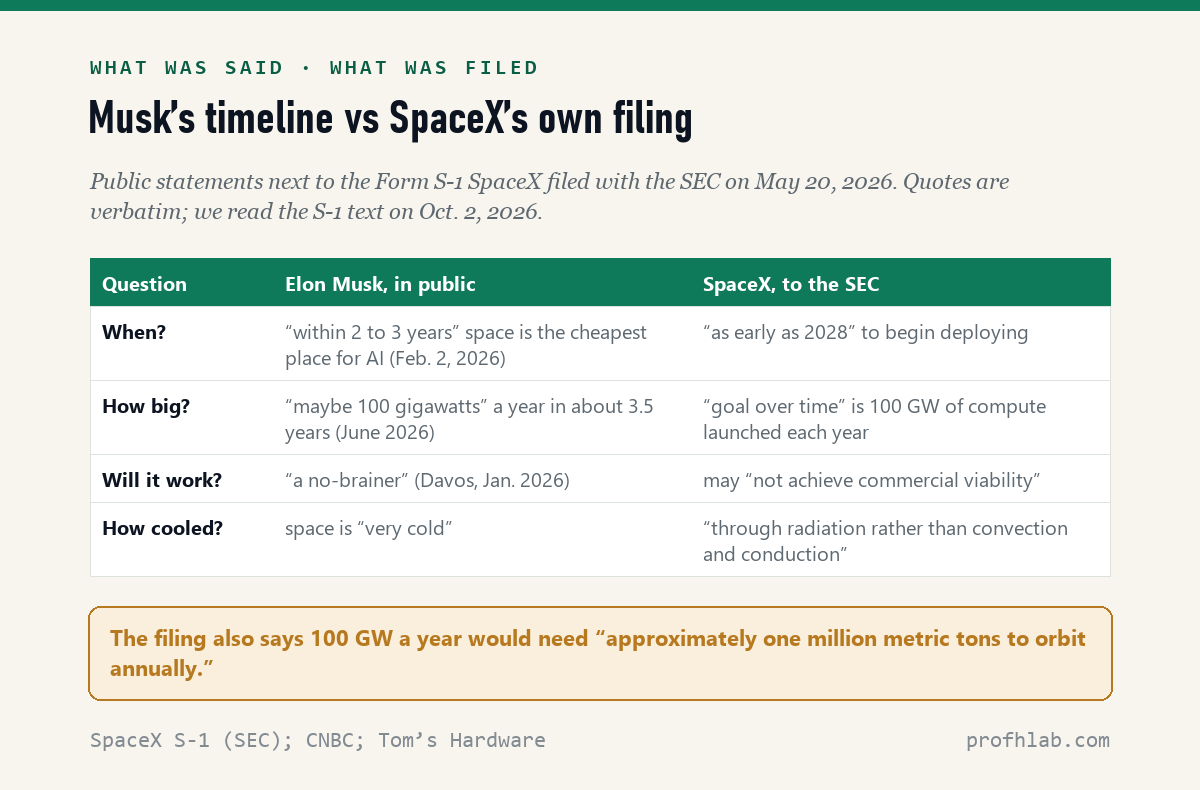
Elon Musk wants data centers in space because he argues that sunlight in orbit is nearly constant and that power, land and angry neighbors on Earth are running out; on February 2, 2026 he said “within 2 to 3 years, the lowest cost way to generate AI compute will be in space.” His own company is more careful. SpaceX’s SEC filing of May 20, 2026 says it expects to start deploying orbital AI compute satellites “as early as 2028,” and that the effort “may not achieve commercial viability.”
What we read, October 2, 2026
- SpaceX’s Form S-1 on SEC EDGAR, filed May 20, 2026. We downloaded the full text and searched it for every quote below.
- SpaceX’s FCC application of January 30, 2026, as reported by DatacenterDynamics and Via Satellite.
- Google’s Project Suncatcher research blog and paper, and coverage of its October 1, 2026 launch.
- Independent analyses from IEEE Spectrum, ABI Research, SemiAnalysis, Brookings and astronomers quoted by Space.com.
An AI assistant helped draft this piece and run the page reads; every quote was read on the source’s own page on the date shown. Where we read a Musk quote in a news report rather than the original post or video, we name the report.
This is part 4 of our six-part guide to AI data centers.
Start with what an AI data center is, then how they are built, how much power and memory they need, where they are going in the US, what they mean for neighbors and who is building the most, and the rules.
Why does Elon Musk want data centers in space?
Musk gives three reasons in his public statements: solar panels make far more energy in orbit, power on Earth keeps getting harder to add, and SpaceX’s rockets and Starlink satellites give it a head start. At Davos in January 2026, according to a published transcript, he said “any given solar panel will do five times the energy in space than on the ground.”
The second reason is the one most readers will recognize from home. At an event in Austin in 2026, CNBC reported him saying that “Increasing power on Earth becomes harder over time and more expensive over time.” Our post on where AI data centers are being built shows why: Texas alone had about 474 gigawatts of requests to connect to its grid by August 2026.
The third reason is corporate. In February 2026 SpaceX acquired Musk’s AI company, xAI; the S-1 says “We acquired xAI in February 2026 as the foundational platform for our AI segment.” A company that launches rockets and already runs the largest satellite network now also needs AI computing. Putting that computing in orbit would use all three businesses at once. That last point is our reading, not a SpaceX statement.
Not everyone accepts the pitch. Analyst Tim Farrar of TMF Associates told CNBC in February 2026 that the merger was about money for xAI, and CNBC’s headline that day said data centers in space “are still a dream.”
What exactly has SpaceX filed and planned?
SpaceX asked the Federal Communications Commission on January 30, 2026 for permission to launch up to one million data center satellites, and its May 20, 2026 SEC filing sets a long-term goal: “to launch 100 gigawatts of compute to space each year.” The FCC application, as reported by DatacenterDynamics, gave no deployment timeline.
The S-1 spells out the scale. Reaching 100 GW a year “will require thousands of launches per year and the transport of approximately one million metric tons to orbit annually.” It adds a hedge: “we believe we can be economically successful at significantly more modest volumes.” Early satellites would generate “100 kilowatts of compute power,” in a dawn-to-dusk orbit that keeps them in sunlight.
To show how big 100 GW is, the filing offers its own comparison. If run continuously, the power plants needed for 100 GW of compute “could generate approximately one-fifth of the annual power production in the United States,” which it puts at 4.4 thousand terawatt-hours in 2025, citing the Energy Information Administration.
On June 8, 2026, SpaceX showed a planned “Gigasat” factory in Bastrop, Texas, and an “AI1” satellite with about 150 kW of peak computing, Tom’s Hardware reported. In the video, Musk set the pace: roughly a gigawatt a year “by the end of next year,” then “maybe 100 gigawatts” in about three and a half years.
Are data centers in space actually possible?
Small ones already exist: Starcloud ran an AI model on one Nvidia H100 in orbit in December 2025, and Google launched four of its TPU chips on a test satellite on October 1, 2026. Gigawatt-scale ones do not. Nothing in orbit today is close to the size of an Earth data center, and SpaceX’s own filing calls the technology “unproven.”
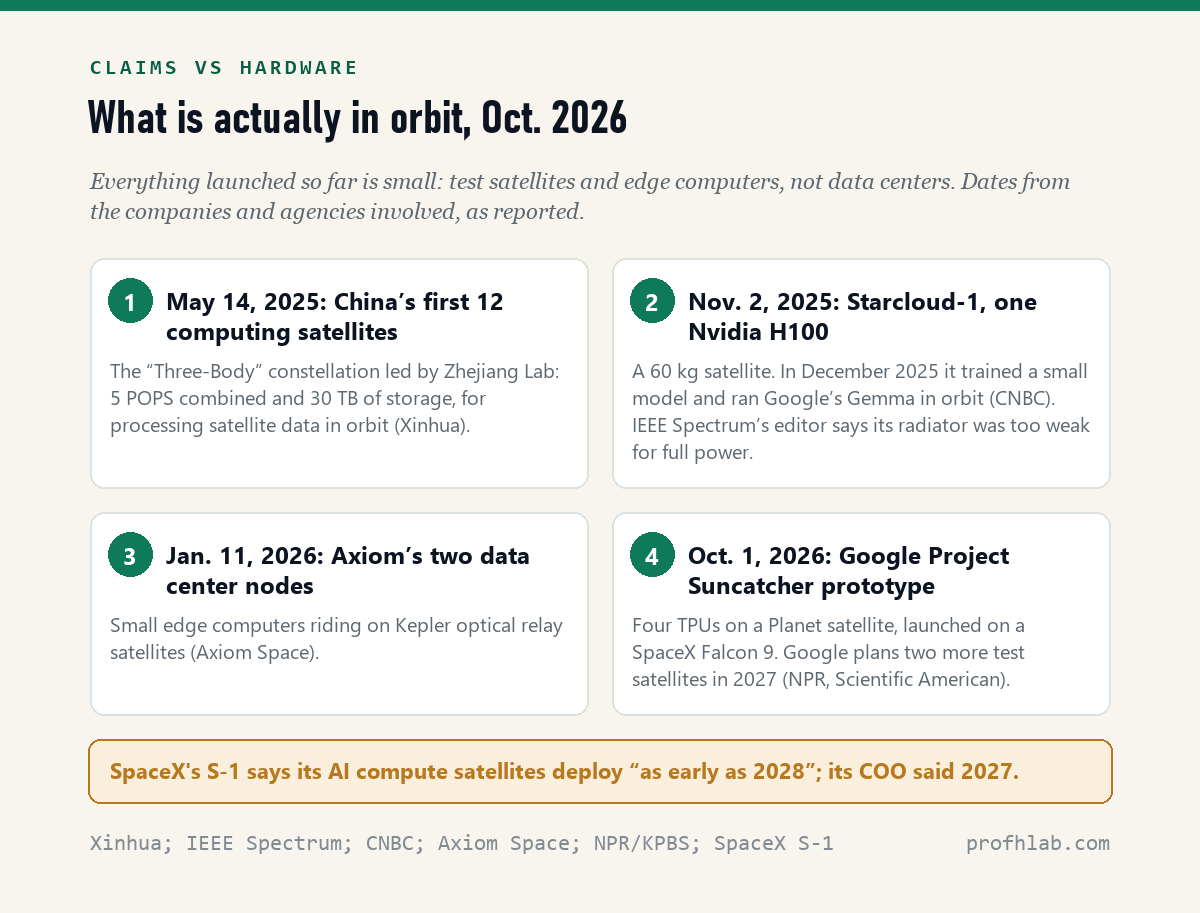
Google is the most careful player. Its Project Suncatcher, announced November 4, 2025, studies “compact constellations of solar-powered satellites, carrying Google TPUs and connected by free-space optical links.” After the October 1 launch, project lead Travis Beals told NPR: “I don’t see this being something where it’s cheaper to do this in the next five years.”
How do you cool a computer in space?
Only by radiating heat away from large panels, because space has no air for fans to push: ABI Research analyst Andrew Cavalier told IEEE Spectrum in June 2026 that one 40 kW AI rack needs about 80 square meters of radiator, “roughly the size of a pickleball court.” SpaceX’s S-1 agrees on the physics: “thermal control must be accomplished through radiation rather than convection and conduction.”
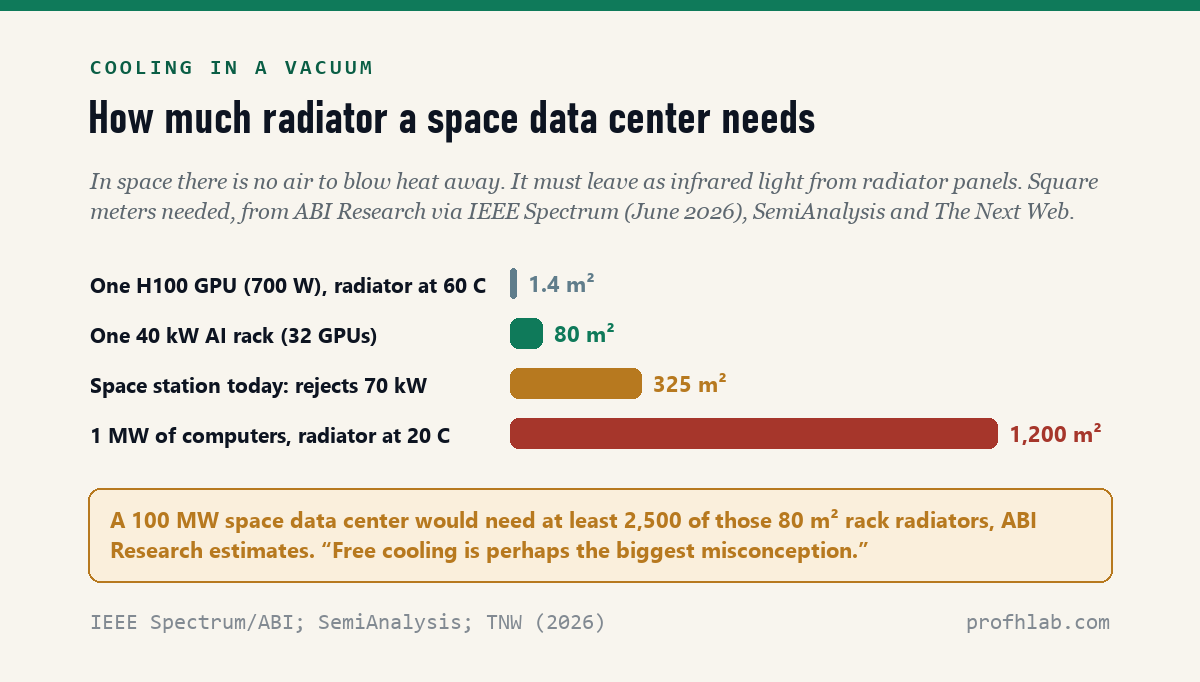
This is the part of the pitch that surprises most people. Space is cold, but it is also empty, and an empty vacuum is a good insulator. On Earth, a data center can blow air or pump water past hot chips. In orbit, the only exit is infrared light. Cavalier’s summary: “Free cooling is perhaps the biggest misconception.”
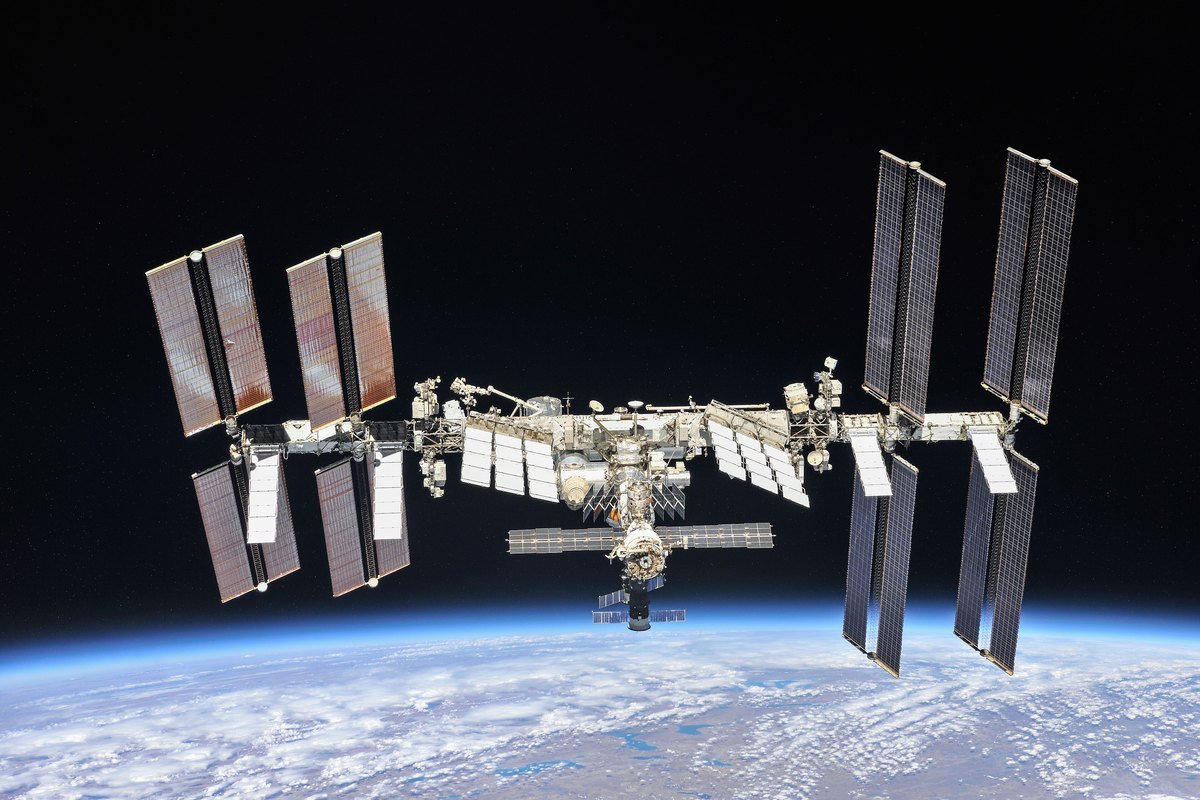
The International Space Station is the best real-world benchmark. SemiAnalysis notes its radiators reject only about 70 kW using 325 square meters, which it calls “about half of what is required to cool a 140kW GB300 NVL72 rack.” Our post on how much power an AI data center uses explains why racks now draw 120 to 140 kW.
How much would a data center in space cost compared with one on Earth?
Several times more today: SemiAnalysis estimated in June 2026 that running one top Nvidia GPU in orbit costs about $8.64 an hour against $2.37 on the ground, with the two reaching parity around 2040 in its base case. ABI Research, via IEEE Spectrum, put the gap at “at least an order of magnitude” per GPU per year, even assuming very cheap Starship launches.
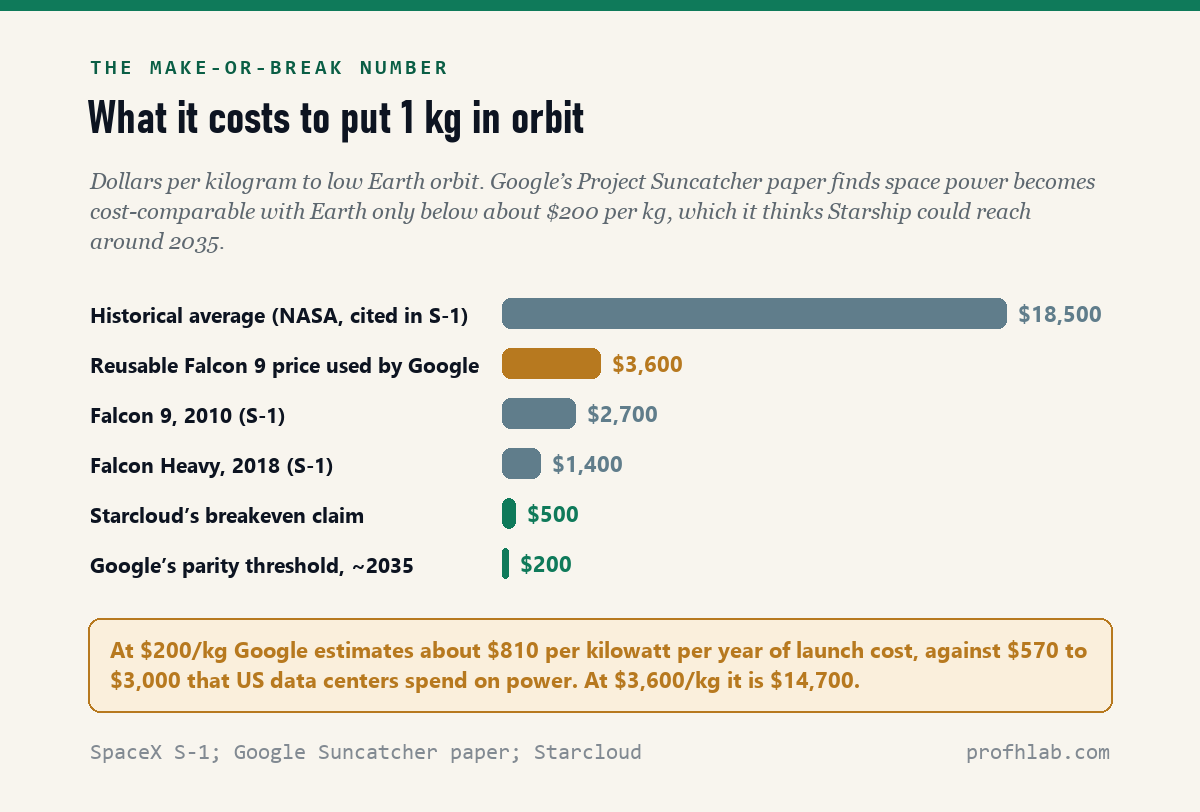
The whole case turns on launch price. Google’s Suncatcher paper uses $3,600 per kilogram for a reusable Falcon 9 today and finds space power becomes comparable with Earth only below about $200 per kilogram. It projects that could happen around 2035 if Starship flies about 180 times a year. At $200, Google estimates about $810 per kilowatt per year in launch cost, against $570 to $3,000 that US data centers spend on power.
| Estimate | In orbit | On Earth | Who and when |
|---|---|---|---|
| Cost per GPU-hour (B300) | $8.64 | $2.37 | SemiAnalysis, June 3, 2026 |
| Cost per billion AI tokens | $590 | $135 | SemiAnalysis, June 3, 2026 |
| Cost per GPU-year | At least 10x | 1x | ABI Research via IEEE Spectrum, June 11, 2026 |
| When space gets cheaper | Around 2040 (base case); “within 2 to 3 years” (Musk) | SemiAnalysis; Musk, Feb. 2, 2026 | |
What are the biggest problems with data centers in orbit?
Beyond cooling and launch cost, experts list four: radiation that damages chips, no way to send a technician, delays when data hops between satellites, and the risk of crowding orbit and the night sky. Brookings’ June 2026 paper went further and called the gap between the pitch and the engineering a governance risk.
- Radiation. Google beamed protons at its Trillium TPU at UC Davis. Its memory showed errors after 2 krad and the chip had no hard failures up to 15 krad, beyond a five-year dose. Good news, but only for one chip design.
- Repairs. Google’s paper is blunt: replacing failed chips by hand is easy on Earth and “obviously impracticable in space.” The fix is spare hardware launched up front.
- Delay. SemiAnalysis says hops between satellites “can accumulate 30-80ms of one-way delay.” That is fine for training a model, less so for some real-time uses.
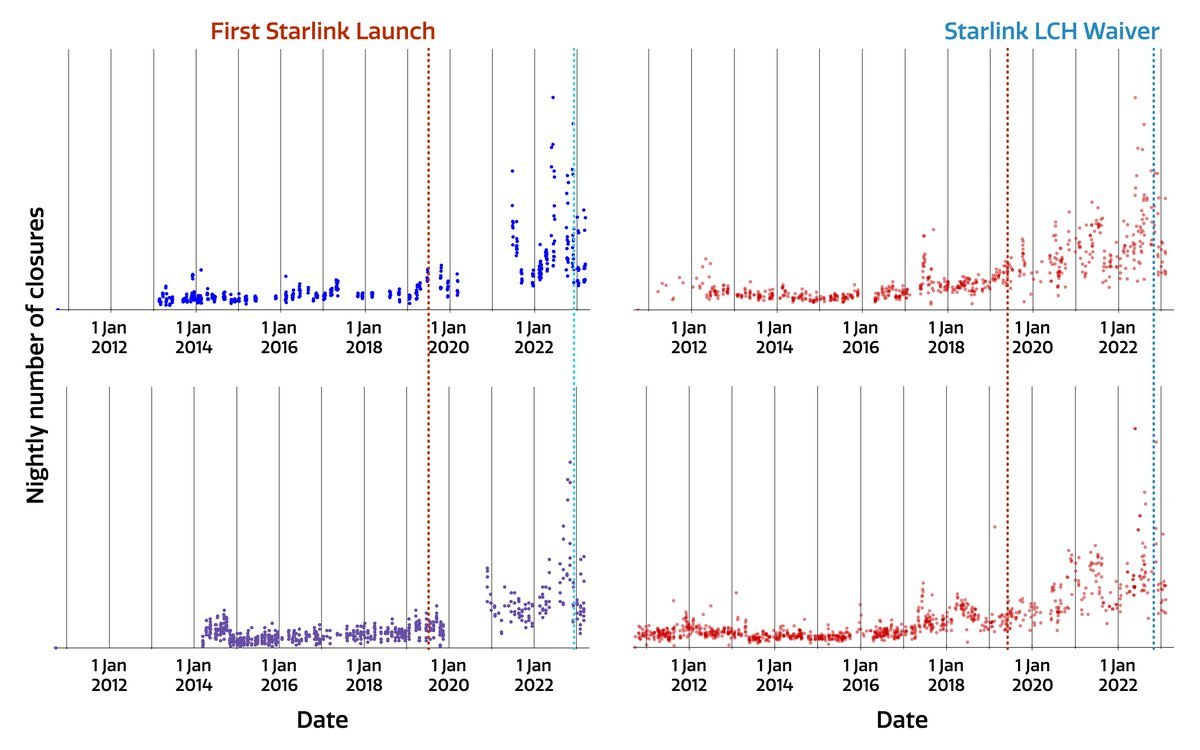
- Debris and the sky. Astronomer John Barentine told Space.com a million satellites could put tens of thousands of star-bright objects in view at once.
Scale is the hidden problem. IEEE Spectrum’s editor in chief, Harry Goldstein, noted in July 2026 that about 7,000 orbital launches have happened in all of history. A million satellites at 60 per Starship would take about 16,666 launches. SpaceX flew a record 165 orbital missions in 2025.
Who else is trying to build data centers in space?
At least five other groups have hardware in orbit or filings in hand as of October 2026: Google, Blue Origin, Starcloud, Axiom Space and China’s Three-Body Computing Constellation. Their plans range from a few test satellites to filings for tens of thousands.
| Who | What they have done | What they plan |
|---|---|---|
| SpaceX (with xAI) | FCC request for up to 1 million satellites (Jan. 2026) | First deployment “as early as 2028” |
| Google, Project Suncatcher | Test satellite with four TPUs launched Oct. 1, 2026 | Two more test satellites in 2027 |
| Blue Origin, Project Sunrise | FCC filing for up to 51,600 satellites (Mar. 2026) | Network deployment hoped for late 2027 |
| Starcloud | One H100 in orbit since Nov. 2025 | Filing for 88,000 satellites |
| Axiom Space | Two small nodes launched Jan. 11, 2026 | “kilowatts to megawatts” by 2030 and beyond |
| China, Three-Body constellation | 12 satellites launched May 14, 2025 | “thousands of satellites” |
Jeff Bezos, whose Blue Origin is the main US rival, thinks the idea is real but the clock is wrong. He told CNBC in May 2026: “People would talk about two or three years. That’s probably a little ambitious.” Europe studied it earlier: the EU-funded ASCEND study led by Thales Alenia Space in 2024 set an ambition to “deploy one gigawatt before 2050.”
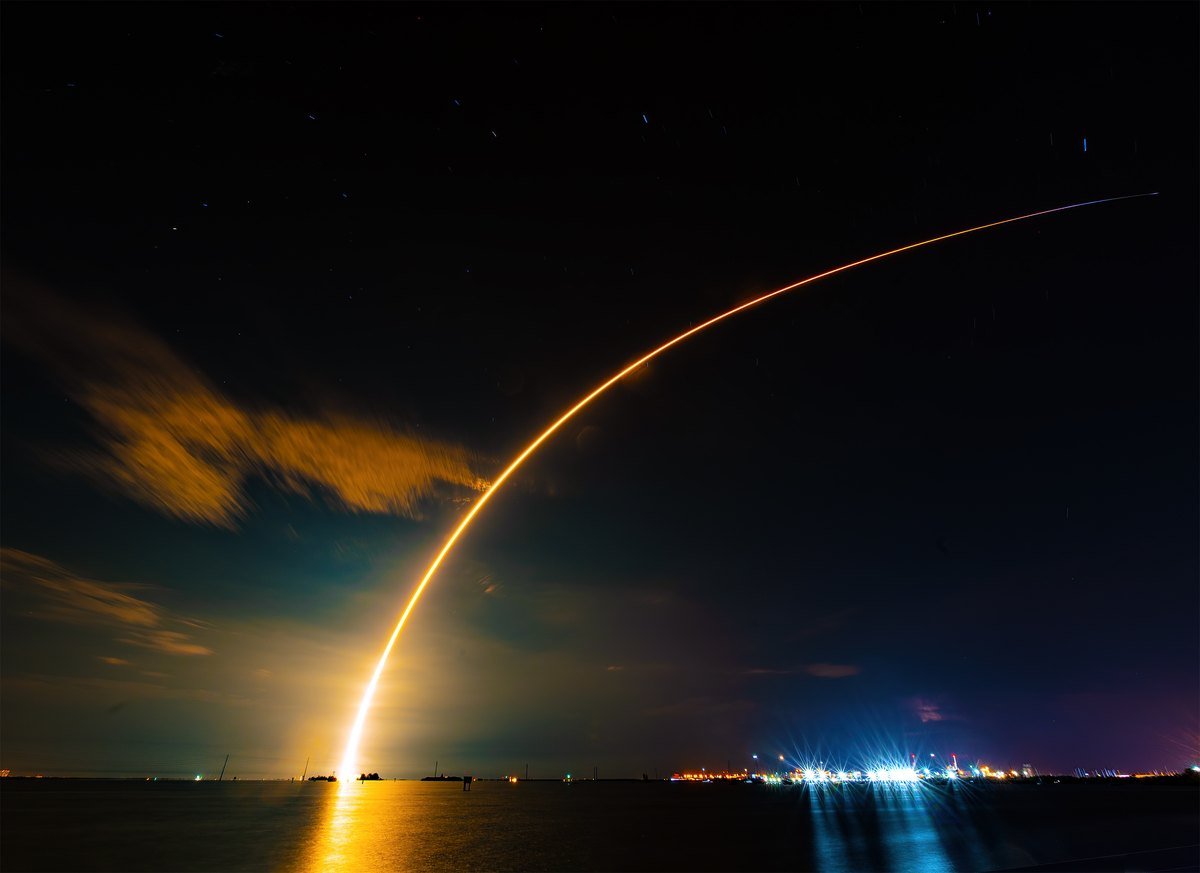
What are the pros and cons of data centers in space?
The strongest argument for them is near-constant sunlight with no land, water or local permits; the strongest argument against is that every watt of heat must be radiated away and every kilogram must be launched. Here is the case on both sides, each item tied to a named source.
| For | Against |
|---|---|
| Up to 8x the yearly energy per solar panel in the right orbit (Google) | Radiators the size of courts for each rack (ABI Research) |
| No land, water, grid hookup or zoning fight | Launch still far above the roughly $200/kg parity line (Google) |
| Useful now for processing satellite data in orbit (ABI Research, Axiom) | No repairs; chips age in two to three years (Google, TNW) |
| Launch prices already fell from $18,500/kg to about $1,400–3,600 (S-1, Google) | Debris, re-entry pollution and a brighter night sky (Space.com, Brookings) |
One more point cuts both ways. Even in orbit, the chips themselves still have to be made, and the world is short of them. Our posts on high-bandwidth memory and chip equipment makers explain that bottleneck, which no orbit solves.
What would space data centers mean for people on the ground?
If they ever work at scale, they could ease the local fights over power, water and noise that now block projects on Earth; until then, they do not change your electric bill or your county’s zoning agenda. CNBC reported in June 2026 that more than 100 data center moratoriums had been proposed, and Heatmap’s May 2026 poll found about 7 in 10 Americans would oppose one nearby.
That frustration is part of the appeal. But on any realistic timeline in the sources above, the AI data centers built in the next five years will be on the ground, in places like Texas, Louisiana and Ohio. Our guide for local communities covers what residents are doing about them now, and whether AI is raising your power bill covers the cost side.
Can chips survive radiation, and can orbit beat Earth on cost?
Are data centers in space possible?
Small ones already exist. Starcloud ran AI models on one Nvidia H100 in orbit in December 2025, and Google launched a test satellite with four TPUs on October 1, 2026. Gigawatt-scale ones are unproven, and SpaceX’s own SEC filing says they “may not achieve commercial viability.”
Why does Elon Musk want to put AI data centers in space?
He says solar panels make about five times more energy in orbit, that adding power on Earth keeps getting harder, and that space will be the cheapest place for AI computing “within 2 to 3 years.” SpaceX, which acquired his AI company xAI in February 2026, would build and launch the satellites.
When will SpaceX launch data centers into space?
SpaceX’s S-1 filed May 20, 2026 says it expects to begin deploying orbital AI compute satellites “as early as 2028.” CNBC reported in October 2026 that SpaceXCNBC reported in October 2026 that SpaceX’s president Gwynne Shotwell spokersquo;s Gwynne Shotwell spoke of deploying “supercompute in space” in 2027.
How many satellites does SpaceX want for data centers?
Up to one million, in its January 30, 2026 application to the FCC, at altitudes of 500 to 2,000 km. For comparison, DatacenterDynamics put the number of active satellites in orbit at the time at about 14,000.
How do you cool a computer in space?
With radiator panels that shed heat as infrared light, since there is no air. ABI Research estimates one 700 W H100 needs about 1.4 square meters of radiator at 60 C, and one 40 kW rack about 80 square meters.
Isn’t space cold, so cooling should be free?
Space is cold but empty, and a vacuum insulates. “Free cooling is perhaps the biggest misconception,” ABI Research’s Andrew Cavalier told IEEE Spectrum. The space station rejects only about 70 kW with 325 square meters of radiators, per SemiAnalysis.
Is a data center in space cheaper than one on Earth?
Not today. SemiAnalysis estimated $8.64 per GPU-hour in orbit against $2.37 on the ground in June 2026, with parity around 2040 in its base case. Google’s Suncatcher lead said it will not be cheaper within five years.
How much does it cost to launch something into orbit?
Google’s Suncatcher paper uses $3,600 per kilogram for a reusable Falcon 9 today. SpaceX’s S-1 cites about $2,700 per kilogram for Falcon 9 in 2010 and a historical average of $18,500. Google says space data centers need under about $200.
Will radiation destroy AI chips in orbit?
Not necessarily. Google’s Trillium TPU showed memory errors only after 2 krad and no hard failures up to 15 krad in proton-beam tests, beyond an expected five-year dose of 750 rad. Radiation still degrades solar panels and radiator coatings over time.
Is Google building data centers in space?
It is testing. Google’s Project Suncatcher launched its first prototype satellite, with four TPUs aboard a Planet satellite, on a SpaceX rocket on October 1, 2026, and plans two more test satellites in 2027.
Is Jeff Bezos building data centers in space?
Blue Origin filed with the FCC in March 2026 for Project Sunrise, up to 51,600 data center satellites. Bezos called Musk’s two-to-three-year timeline “a little ambitious” in May 2026.
Would space data centers hurt astronomy?
Astronomers say yes. John Barentine told Space.com in March 2026 that a million such satellites could put tens of thousands of star-bright moving objects in the sky at once, and that old satellites would re-enter the atmosphere about every three minutes.
We found every S-1 quote in SpaceX’s filing on EDGAR
Every SpaceX quote attributed to the S-1 was found in the filing’s text on SEC EDGAR on October 2, 2026. Musk’s spoken quotes come from news reports or a published Davos transcript, which we name each time; we did not open his posts on X directly. Cost figures are estimates by the named analysts, not measured prices.
We left out claims we could not confirm on a primary page, including several widely repeated figures about Starlink V3 computing power and China’s eventual satellite count. Plans change fast in this field. Check the date on anything you repeat.
The same build on Earth, and xAI’s Memphis site
Go back to the complete guide to AI data centers, or read how AI data centers are built on Earth for the comparison. For the companies behind these plans, see who is building the most AI data centers, xAI’s Memphis jobs and pay and our SpaceX explainer. The wider Physical AI library has more, and Physical AI explained sets the context. If you want to work on any of this, browse space, robotics and AI roles on our jobs board and apply on the employer’s site.
Cite this
Elon Musk said on February 2, 2026 that space will be the lowest-cost place for AI compute within 2 to 3 years; SpaceX’s SEC filing of May 20, 2026 says deployment could begin “as early as 2028” and “may not achieve commercial viability,” and SemiAnalysis estimated orbital GPU time at $8.64 an hour against $2.37 on Earth. Source: profhlab.com, Why Does Elon Musk Want Data Centers in Space?
Sources read on October 2, 2026: SpaceX Form S-1, SEC EDGAR, filed May 20, 2026; DatacenterDynamics, January 31, 2026; CNBC, February 2, 2026; Tom’s Hardware, June 9, 2026; Google Research, November 4, 2025; Suncatcher paper, arXiv 2511.19468.
Also read on October 2, 2026: IEEE Spectrum, June 11, 2026; IEEE Spectrum, July 1, 2026; SemiAnalysis, June 3, 2026; Brookings, June 25, 2026; Space.com, March 13, 2026; CNBC, May 20, 2026; CNBC, October 1, 2026; NPR via KPBS, October 1, 2026; GeekWire, March 21, 2026. Images via Wikimedia Commons under the licenses shown.
Prof.’s H Newsletter
One short email a month, with the numbers in it
What actually moved in AI hiring, AI prices, and the scams aimed at older Americans. Counted here, dated, and linked to the source. One email a month, and your address goes nowhere else.