Can AI Write an Obituary? Yes, but 5 of 10 Government Pages Say Leave Out the Birth Date
Yes: AI chatbots and free funeral-site tools can draft an obituary, but on October 20, 2026 we read 10 government consumer pages, and 5 of them tell families to keep the exact birth date out of it. Four of the 10 also say to leave out the home address. The AI is not the risk. The details you hand it, and then print, are.
If you are writing about someone you just lost, and the blank page feels too heavy, using AI for a first draft is a reasonable choice. Nobody needs to know. This guide shows what to type, what to leave out, and how to check the draft before it goes to the funeral home or the paper.
What we checked on October 20, 2026
We read 10 government consumer pages on death and identity theft: 4 federal (IRS, FTC, Social Security Administration, USA.gov) and 6 from 4 state offices (3 from the New York Department of State, plus the Michigan, Iowa and California attorneys general). We also read Experian’s obituary guide, the pages of 2 free AI obituary writers (Tribute and Funeralwise) and The Washington Post’s August 3, 2025 report on AI obituary tools.
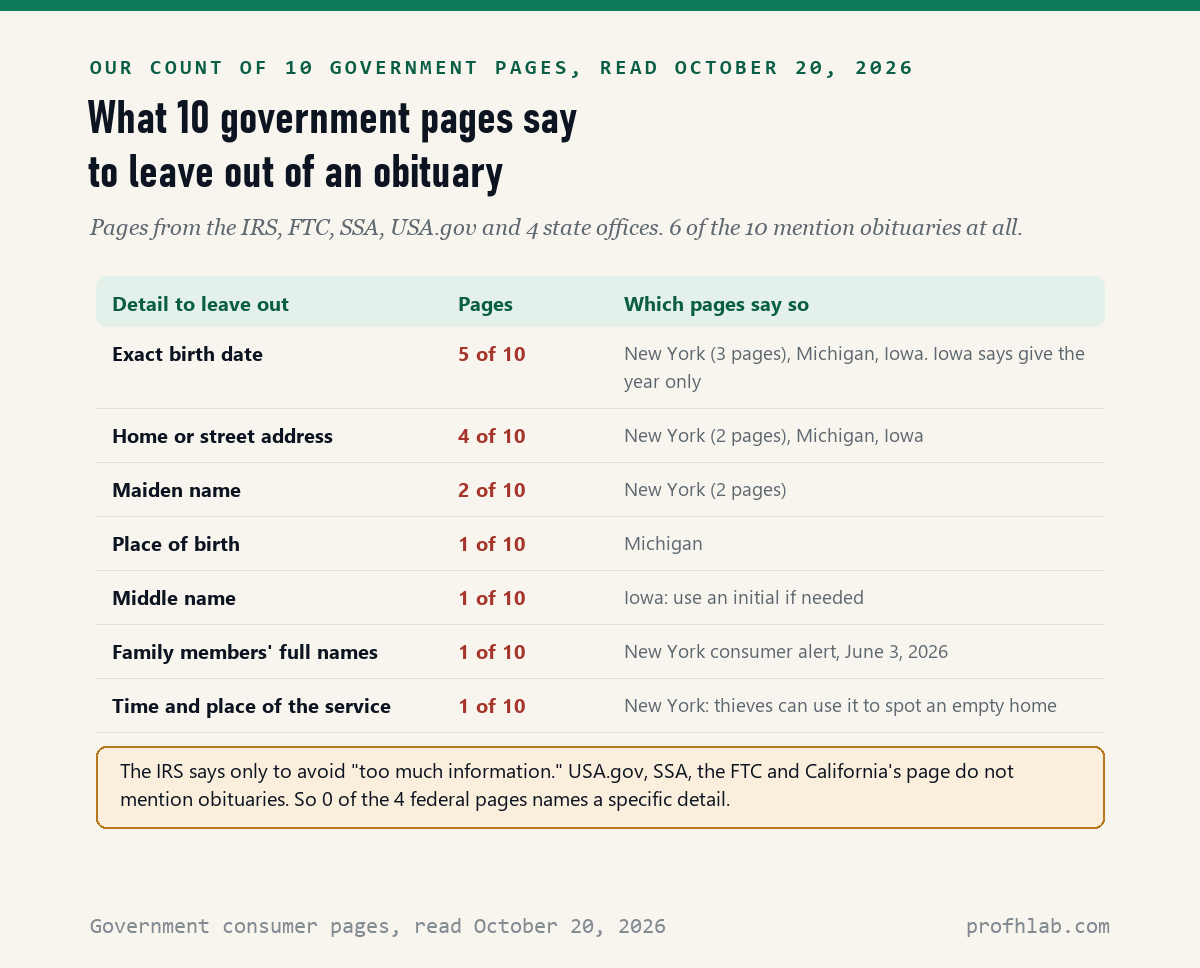
Our own count: 6 of the 10 government pages mention obituaries at all, 5 name the birth date as something to leave out, 4 name the address, and 0 of the 4 federal pages names any specific detail. We did not test any AI tool ourselves, and nothing here is legal advice. Two pages we tried, from AARP and Massachusetts, did not open for us, so they are not in the count.
Written and checked by Prof. H. An AI assistant helped draft this article and ran the page reads; every quote was read on the source’s own page on the date shown.
Can AI write an obituary?
Yes: a chatbot such as ChatGPT, or a free writer on a funeral website, turns a list of facts into an obituary draft, and The Washington Post reported on August 3, 2025 that funeral homes and grieving families already use them this way. What the AI cannot do is know the person. It only knows what you type.
Think of it like a skilled typist who never met your mother. Give the typist good notes and you get a clean page back. Give the typist thin notes and the typist fills the gaps with nice-sounding guesses. That second part is the real danger, and we show the evidence below.
Funeral software makers now build these writers in. Tribute Technology’s page, read October 20, 2026, calls its Obituary Writer “Fast and free to use for the family.” Funeralwise says its AI Obituary Writer is “available to all Funeralwise visitors” and asks about the person’s “name, family, life highlights, personality.”
Is it disrespectful to use AI for an obituary?
Not by itself. An obituary is a familiar form, and The Washington Post noted that funeral staff have long gathered the details and written them for families. A first draft from AI is a starting point. The love shows in what you add, cut and correct, and in the stories only your family knows.
Five state pages agree on one detail: skip the exact birth date
New York, Michigan and Iowa all say it: of the 10 government pages we read on October 20, 2026, 5 name the birth date as something to keep out of an obituary, and Iowa’s attorney general suggests printing “only the year.” A full birth date plus a name and a town is a big step toward someone’s identity.
Here is what each page says, in its own words:
- Michigan Department of Attorney General, “Identity Theft: Deceased Victims” (no date shown): “Do not include information such as the date of birth, place of birth, or address of the deceased individual.”
- New York Department of State, “After Death ‘Ghosting’ Scam” (no date shown): “Avoid listing birth date, maiden name, or other personal identifiers in obituaries.”
- New York Department of State, consumer alert dated June 3, 2026: be mindful about “addresses, birth dates, maiden names, or family members’ full names.”
- Iowa Attorney General, “Protecting the Deceased From Identity Theft!” (no date shown): leave out “month and day of birth (use only the year) and middle names (use an initial if needed).”
Experian, one of the 3 credit bureaus, adds one more idea in its February 2, 2022 guide: “Consider only using the first names of relatives.” It also suggests naming military service “but not their regiment number.”
Is it safe to put the home address in an obituary?
No: 4 of the 10 government pages we read on October 20, 2026 say to leave the address out, and New York’s “Key Steps” page warns that a date of birth and street address “can be used to research additional personal information and to open new bank and credit accounts.” Naming the town is enough for friends to know who it is.
The same New York page raises a second worry: the time and place of the memorial service “can be used by thieves to identify a vacant home address for possible robbery.” If the obituary lists the service, ask a neighbor or relative to stay at the house during it.
What about the cause of death?
None of the 10 government pages we read tells you to include or leave out the cause of death. That choice is about family privacy, not identity theft. Many families simply write “after a short illness” or leave it out.
How do you ask ChatGPT to write an obituary without risky details?
Give it a short list of facts you would be happy to see in print, then tell it to use only those facts. The Washington Post reported on August 3, 2025 that when it tested the Tribute tool on a Florida funeral home’s site, it “invented fake nicknames, preferences and life events.” A tight request leaves less room for that.
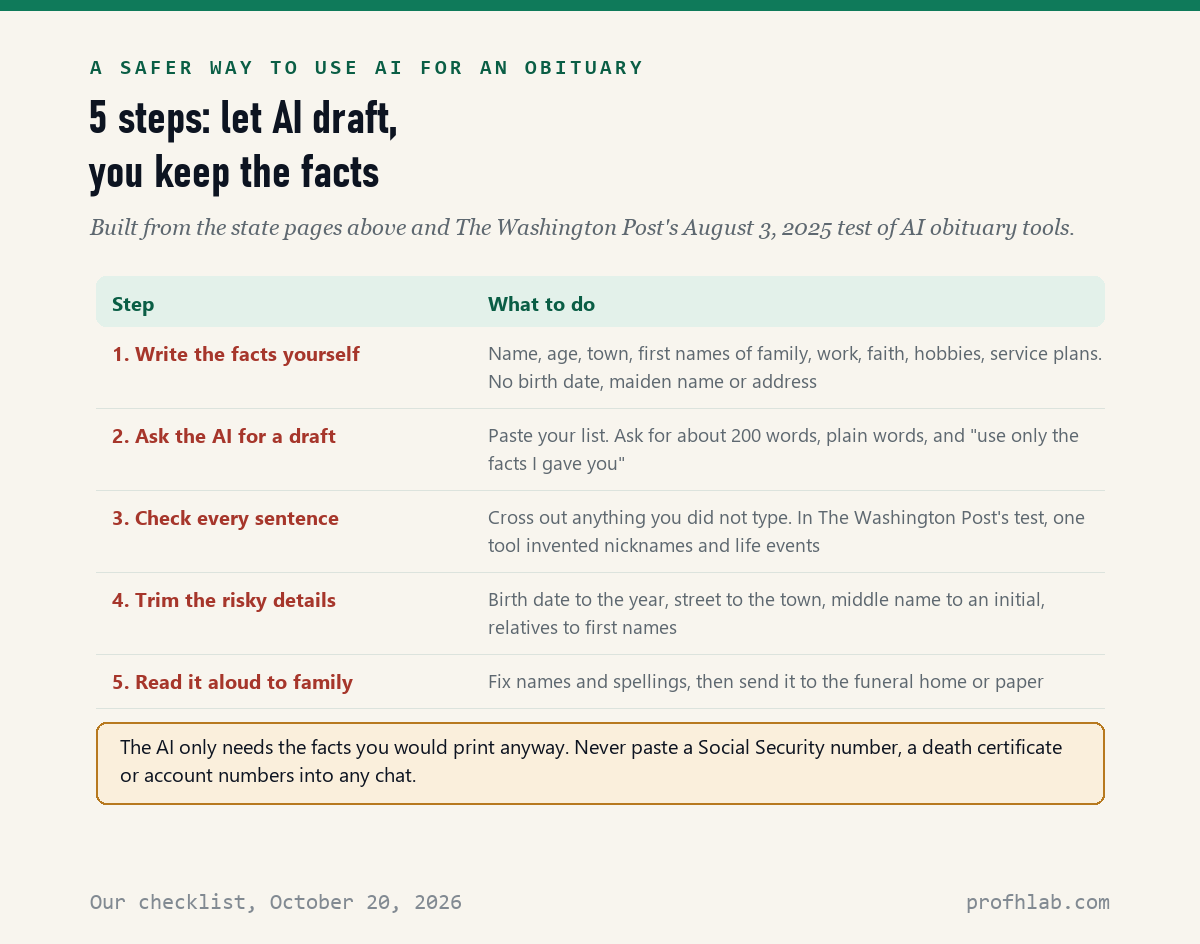
Here is a request you can copy and change. The facts in brackets are yours to fill in:
Copy this request
“Please write an obituary of about 200 words in plain, warm language. Use only the facts below. Do not add any detail, nickname, quote or event that is not in my list. If something seems missing, ask me instead of guessing. Facts: [first and last name], age [number], of [town, state]. Worked as [job] for [years]. Loved [2 or 3 hobbies]. Survived by [relationship and first name, for example: wife Mary, sons Tom and Dan, 5 grandchildren]. Service: [day, place, time].”
Notice what is missing from that list: no birth date, no birthplace, no maiden name, no street, no middle name. You can add the birth year if you like. Iowa’s page says the year alone is fine.
Should I type the birth date into ChatGPT itself?
You do not need to. The chatbot only needs what you plan to print. Social Security numbers, death certificates and account numbers never belong in any chat. Our guide on whether it is safe to give ChatGPT your personal information covers what each company says it keeps.
Check every sentence the AI writes against your own list
Read the draft line by line with your fact list beside it, and strike any phrase you did not supply: the Post’s August 3, 2025 test found a tool saying a man was “born on a chilly day” and quoting Groucho Marx, despite being given none of that. Pretty phrases are the easiest place for mistakes to hide.
Watch for these common slips:
- Words you never used, like “passed peacefully” or “surrounded by loved ones”
- A hobby, club or award you did not mention
- A wrong number of grandchildren or a misspelled name
- A church, school or employer you did not name
Tribute’s own page agrees. It says each draft “requires close review and revision according to the user’s preferences and circumstances.” Then read the final version aloud to one family member. A second pair of ears is the simplest check on names and spellings.
What federal agencies say about obituaries, which is very little
Very little: of the 4 federal pages we read on October 20, 2026, only the IRS mentions obituaries, and it says only “Avoid putting too much information in an obituary that identity thieves could use” (page last reviewed June 4, 2026). It does not name a single detail. The specific lists all come from state offices.
The other federal pages cover different steps, which still matter:
- Social Security Administration, “What to do when someone dies”: “Funeral homes generally tell us when someone dies.” No mention of obituaries.
- USA.gov, “Agencies to notify when someone dies,” last updated August 31, 2026: lists agencies to tell, including returning the person’s passport. No mention of obituaries.
- FTC, June 15, 2023 alert: imposters pose as the funeral home and demand more money “immediately.” Its rule: “Anyone who pressures you to pay or give them your personal information is a scammer.”
- California Attorney General, Consumer Information Sheet 3C, June 2014: explains how to alert the credit bureaus about a death, without obituary advice.
In short, the federal pages help with what to do after the death. For what to print, the state pages are the ones to follow.
When a stranger copies the obituary: fake flower and donation pages
Once an obituary is online, others can copy it: the New York Department of State’s June 3, 2026 alert says some scammers “steal or create fake obituaries to get grieving loved ones to send scammers money for flowers, donations, or memorial items which don’t exist.” Keeping the obituary short gives them less to work with.
Three habits help:
- Send flowers and gifts only through the funeral home you chose, using a number you already have.
- Tell relatives where the real obituary lives, so they can spot a copy.
- If someone calls saying they are the funeral home and money is due right now, hang up and call the funeral home back, as the FTC advises.
Our guide to AI scams targeting seniors and family safe word examples cover the phone side of these tricks.
Legacy.com on obituary basics and CNET on AI-made fake obituaries
One video shows how a traditional obituary is built; the other explains why AI-written fake obituaries spread online. We checked view counts and that each plays on other sites on October 20, 2026.
Free generator, ChatGPT or Gemini: short answers to the exact searches
Is there a free AI obituary generator?
Yes. On October 20, 2026, Tribute Technology said its Obituary Writer is free for families, and Funeralwise said its AI Obituary Writer is available to all its visitors. The Washington Post found a writer on a Florida funeral home’s website, and families also use general chatbots such as ChatGPT.
Can ChatGPT write an obituary for my mother?
Yes. Give it a short list of facts, ask for plain language, and tell it to use only your facts. Leave out her exact birth date, maiden name and address, which state consumer pages from New York, Michigan and Iowa warn against printing.
What should you not put in an obituary?
The exact birth date, home address, maiden name, place of birth and full middle name, according to the New York, Michigan and Iowa pages we read on October 20, 2026. New York also lists family members full names. Use the birth year, the town, initials and first names instead.
How long should an obituary be?
None of the government pages we read sets a length, and New York only says to keep obituaries brief. Newspapers set their own limits and prices, so ask the paper or funeral home before you write. Our sample request asks for about 200 words; change it to fit the paper.
Do I have to say AI helped write the obituary?
No rule we found requires it. The Washington Post reported on August 3, 2025 that some funeral homes use ChatGPT for obituaries without telling clients. If you check every line and add your own memories, the words are yours.
Is an obituary the same as a eulogy?
No. An obituary is a published notice that stays online, so the identity theft advice applies to it. A eulogy is spoken once at the service. Our eulogy guide covers that part, and it can be warmer and more personal.
Guides for the weeks after a loss, and for using AI with care
Each guide below names the pages it quotes and the date we read them.
- How to use AI to write a eulogy, the spoken companion to this guide
- How to use ChatGPT to write a memoir, for the longer life story
- How to use ChatGPT for genealogy research
- How to make AI photos with grandparents who have died
- How to write letters and emails with ChatGPT, including sympathy notes
- Can I use AI to write a will?
- Is it safe to upload medical records to ChatGPT?
- Are deleted ChatGPT chats really deleted?
- New AI phone scams and how to tell if a phone call is AI
- What happens if you say yes on a scam call?
- Why am I getting so many Medicare calls?
- How to use ChatGPT for beginners over 50
- The best AI tools for seniors
A safety note. Grief makes everyone easier to rush. If a caller, text or website asks for money soon after a death, stop and call the funeral home or a relative on a number you already know. New to AI? Start at Start Here. We also count real AI job postings on our AI jobs tracker.
Where the obituary advice comes from: IRS, FTC, SSA, USA.gov, 4 states, Experian and the Post
- IRS, Identity theft guide for individuals, last reviewed June 4, 2026, read October 20, 2026.
- FTC Consumer Advice, Imposters prey on families preparing for the funeral of a loved one, June 15, 2023, read October 20, 2026.
- Social Security Administration, What to do when someone dies (no date shown), read October 20, 2026.
- USA.gov, Agencies to notify when someone dies, last updated August 31, 2026, read October 20, 2026.
- New York Department of State, After Death “Ghosting” Scam (no date shown), read October 20, 2026.
- New York Department of State, Consumer alert on funeral fraud and end-of-life identity theft, June 3, 2026, read October 20, 2026.
- New York Department of State, Key Steps to Protecting a Deceased Loved One’s Identity (no date shown), read October 20, 2026.
- Michigan Department of Attorney General, Identity Theft: Deceased Victims (no date shown), read October 20, 2026.
- Iowa Attorney General, Protecting the Deceased From Identity Theft! (PDF, no date shown), read October 20, 2026.
- California Attorney General, Identity Theft and the Deceased, Consumer Information Sheet 3C, June 2014, read October 20, 2026.
- Experian, What You Need to Know About Obituaries and Identity Theft, February 2, 2022, read October 20, 2026.
- Tribute Technology, Tribute Obituary Writer, read October 20, 2026.
- Funeralwise, We Built a Tool to Help You Write an Obituary, read October 20, 2026.
- Drew Harwell, The Washington Post, “The rise of AI tools that write about you when you die,” August 3, 2025, read in the Anchorage Daily News reprint on October 20, 2026.
Featured image: Gerard ter Borch, Woman Writing a Letter, about 1655, Mauritshuis, The Hague, public domain, via Wikimedia Commons, cropped.
About the author. Prof. H writes profhlab’s AI for Beginners guides for readers who are new to AI or over 50. Each guide is built from the pages it quotes, read on the date shown. Did a state page change, or did you find another official page with obituary advice? Tell us on the Ask page and we will update the count with a dated correction. More about Prof. H on the About page.
Prof.’s H Newsletter
One short email a month, with the numbers in it
What actually moved in AI hiring, AI prices, and the scams aimed at older Americans. Counted here, dated, and linked to the source. One email a month, and your address goes nowhere else.