How to Write Letters and Emails with ChatGPT: Sympathy Notes, Complaints, and the Appeal That Wins
The short version: any letter you’ve been putting off — the complaint, the thank-you, the condolence card you don’t know how to start, the insurance appeal that feels like homework — takes about ten minutes with ChatGPT and three blanks: who it’s for, what happened, how you want to sound. This guide gives you the prompts for each one, one privacy rule that protects you, and a Medicare appeal section with numbers no other letter-writing page will show you. Everything re-verified September 12, 2026.
The short answer: ChatGPT letter writing is free. The free plan is $0 a month and includes unlimited text chats — and a letter is nothing but text — so every letter on this page, from the complaint to the apology to the Medicare appeal, costs nothing. Each one takes about ten minutes and the same three blanks: who it’s for, what happened, how you want to sound.
Ten copy-and-paste prompts below, each with the length to ask for. Every price, deadline and figure on this page was re-checked against the original source today. Last verified: September 12, 2026.
Why trust this: I’m a professor of AI and robotics and a former Samsung researcher, with no affiliate ties to anything here. My rule for AI writing is the same one I teach: the machine finds the words, but the judgment — and sometimes the handwriting — stays yours.
First, the one privacy rule
Letters are full of personal details — that’s what makes them letters. So before any prompt, one rule, and it isn’t optional:
Never paste your Social Security number, Medicare number, bank or account numbers, or any password into ChatGPT. OpenAI’s own help pages say it plainly: don’t share sensitive information in your conversations. And on free accounts, chats can be used to train the model unless you turn that off.
The working method is simple — draft with brackets:
- In the chat, write [MY MEDICARE NUMBER], [ACCOUNT NUMBER], [MY ADDRESS] wherever a real number would go.
- Copy the finished letter out to paper or your email — then fill in the real numbers there. The numbers live on the letter, never in the chat.
- Two settings worth one minute: Settings → Data Controls → turn off “Improve the model for everyone” stops your chats being used for training. And a Temporary Chat (the option is in the model menu at the top) isn’t used for training and is deleted within 30 days — a good habit for anything personal.
The whole trick: fill three blanks
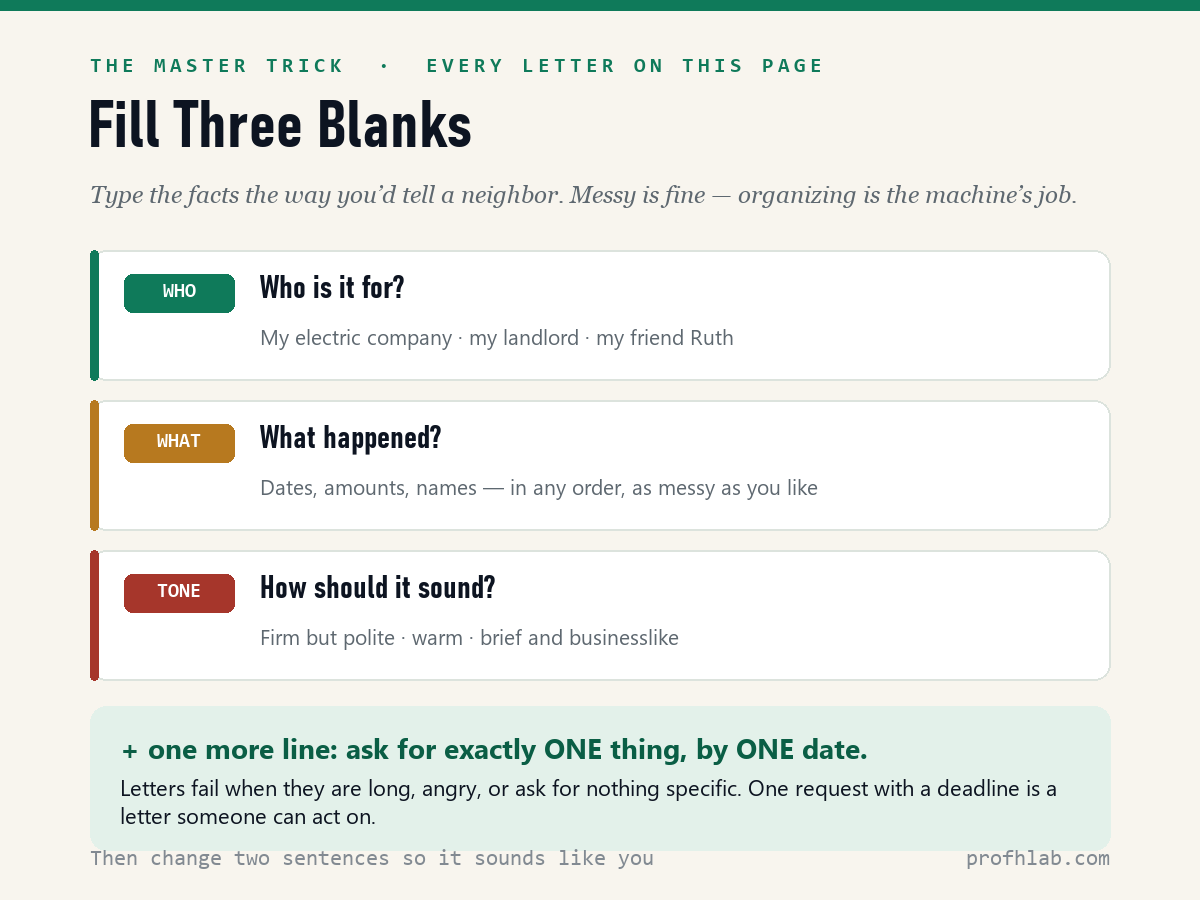
Every letter on this page is the same prompt wearing different clothes:
Write a [letter / email] to [WHO — my electric company / my landlord / my friend Ruth].
Here's what happened: [THE FACTS — dates, amounts, names, in any order; messy is fine].
I want to sound [TONE — firm but polite / warm / brief and businesslike].
Keep it under [LENGTH — 150 words]. Ask for exactly one thing: [WHAT I WANT].
Messy input is genuinely fine — that’s the point. Type the facts the way you’d tell a neighbor, and let the machine do the organizing. Then read the draft and change two sentences so it sounds like you (more on that at the end).
Is ChatGPT letter writing free?
Yes, and you do not need to think hard about it. OpenAI’s pricing page lists the free plan at $0 a month with unlimited text chats (checked September 12, 2026). Letters are text. Nothing on this page needs a paid account.
The paid tiers exist — Go at $8, Plus at $20, Pro at $100 a month — and what they buy is more image generation, longer memory, more file uploads and the heavier reasoning models. Useful things, none of them a letter. One detail worth knowing before you upgrade out of habit: OpenAI’s own page notes that the Go plan may include ads.
So the honest advice is the boring one: write the letter on the free account. If you find yourself writing letters every week and hitting limits on the extras, that is the moment to pay — not before.
Pick the letter you need
Every prompt below sets a length, because length is the single setting that most changes whether a letter works. Ten minutes each.
| The letter you need | Length to ask for | Where it is |
|---|---|---|
| A complaint that gets a refund | Under 200 words, with a subject line | Letter 1 |
| A sympathy or condolence card | 50 to 80 words | Letter 2 |
| A Medicare or insurance appeal | Under 300 words | Letter 3 |
| An apology | Under 120 words | The apology letter |
| A thank-you note | 60 words | The thank-you note |
| A thank-you after a job interview | Under 150 words, within 24 hours | The thank-you note |
| Any email, including a reply | Under 120 words, subject line first | Writing an email |
| A repair request to a landlord | Under 120 words | Three more |
| A message to the doctor’s office | Three sentences | Three more |
| Saying no without apologizing three times | Your draft, rewritten | Three more |
Letter 1 — the complaint that gets results
Write a complaint letter to [COMPANY]. The facts: I was billed [$X] on [DATE] for [WHAT]. I called on [DATE] and was told [WHAT THEY SAID]. Nothing has changed. I want to sound firm, calm, and impossible to ignore — no threats, no sarcasm. End by asking for exactly one thing: [REFUND / REPAIR / CORRECTED BILL] by [DATE]. Under 200 words, with a subject line.
Why this works: complaints fail when they’re long, angry, or ask for nothing specific. Dates, amounts, one request, one deadline — that’s a letter a company can act on. If the first draft is too soft, the follow-up is one line: “Make it firmer, still polite.”
What a good result looks like — a typical draft (yours will carry your facts):
Subject: Billing error on account [ACCOUNT NUMBER] — request for corrected bill
Dear Customer Service,
On March 4 I was billed $187.50 for a service call that never took place. I called on March 6 and was told the charge would be reviewed; a month later it remains on my account.
Please issue a corrected bill by April 15. I have been a customer for eleven years and would like to stay one.
Sincerely,
[MY NAME]
How to judge any complaint draft in ten seconds — three questions:
- One ask? If the letter requests two things, the company picks the cheaper one.
- A date? “Soon” is not a deadline. April 15 is.
- Nothing to argue with? Every sentence should be a checkable fact or a clear request — cut anything that merely vents.
Letter 2 — the condolence note, and why you’ll copy it by hand
This is the letter people put off longest, and the etiquette people say the biggest mistake isn’t writing the wrong thing — it’s not sending anything at all. Daniel Post Senning of the Emily Post family, asked about condolences, is blunt: a written note matters, and “snail mail is better than email” — a card says I took the time to do this for you.
So here is the honest division of labor: let the AI help you find the words. Then copy them onto the card in your own handwriting, and mail it. Nobody needs to know how the words arrived. The hand is what they’ll keep.
Help me write a short condolence note to [NAME], whose [husband / mother / son] [NAME] died. One specific memory I have: [MEMORY — even something small, like his laugh at church suppers]. I want it warm, simple, and honest — 50 to 80 words. No clichés: do not use "in a better place," "everything happens for a reason," "at least," or "I know how you feel." End with one concrete offer of help I can actually keep: [BRINGING DINNER THURSDAY / DRIVING TO THE SERVICE].
Three lines worth keeping in your head even without the AI:
- Name the person who died. Grieving people ache to hear the name spoken.
- One true memory beats three beautiful sentences. “I’ll always see him waving from the porch” outlives any poetry.
- Offer one specific thing — dinner on a day, a ride, the lawn — not “let me know if you need anything,” which politely asks the griever to do the work.
The shape on the page — about sixty words, and that is plenty:
Dear Ruth,
I am so sorry about Walter. I keep thinking of him waving from the porch when we drove past — he made the whole street feel friendlier.
I’m bringing dinner Thursday and won’t stay unless you’d like company. Thinking of you every day this week.
With love,
[YOUR NAME]
That’s the shape, not a script — swap in your memory and your Thursday, and it stops being anyone else’s letter. Then the part the AI can’t do: your handwriting, an envelope, a stamp.
Letter 3 — the Medicare appeal, with the numbers nobody shows you
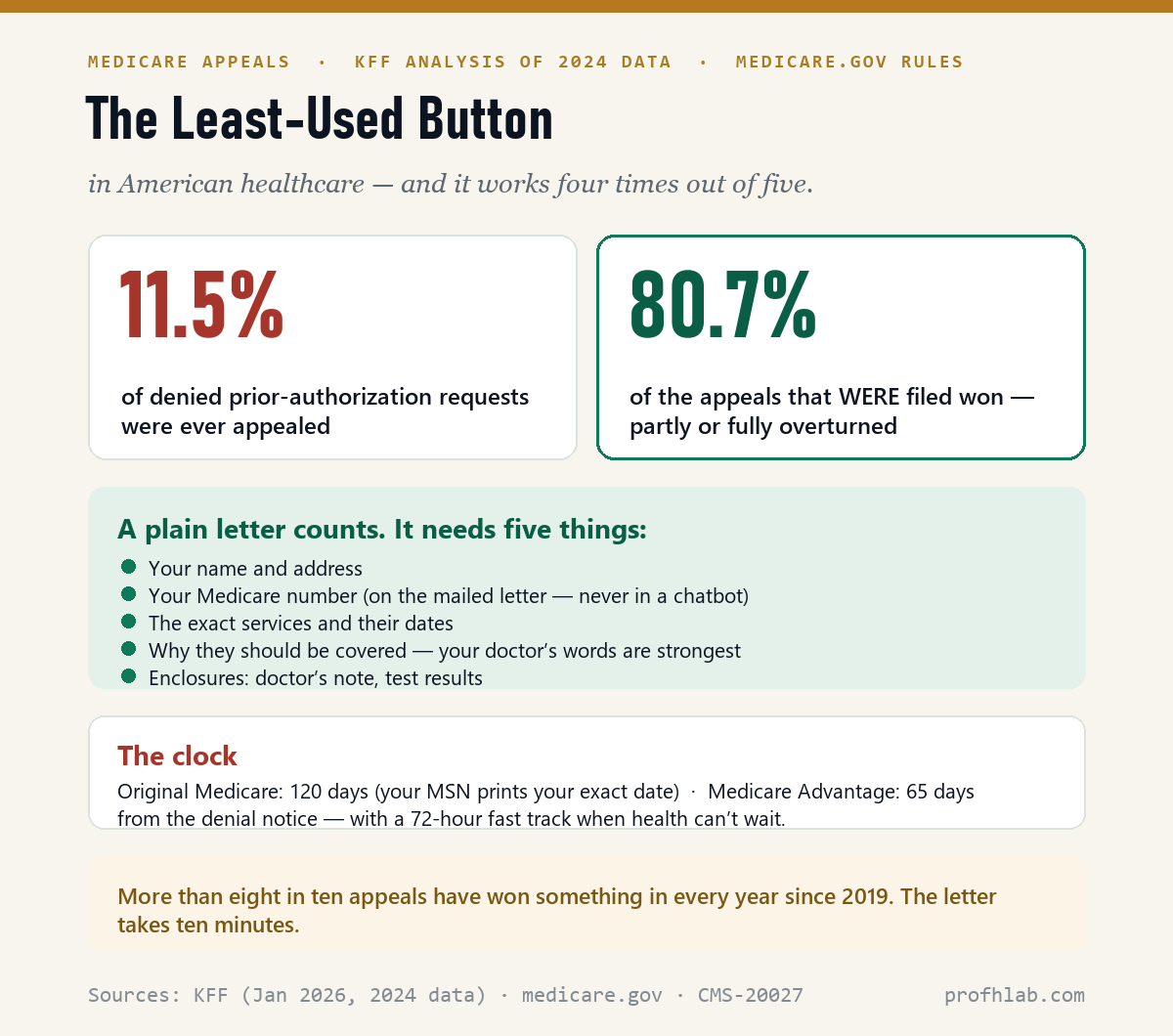
Here is the statistic this whole article exists for. KFF analyzed Medicare Advantage denials for 2024 and found that only 11.5% of denied prior-authorization requests were ever appealed. Of the appeals that were filed, 80.7% were partly or fully overturned. That has held for six straight years — more than eight in ten appeals win something, and the scale is not small: Medicare Advantage plans denied 4.1 million prior-authorization requests that year, 7.7% of everything submitted (KFF, re-checked September 12, 2026).
Appealing is the least-used button in American healthcare, and it works four times out of five. The reason people don’t press it is that it feels like a legal document. It isn’t. Medicare’s own site says a written request — a plain letter — counts, as long as it contains:
- Your name and address,
- Your Medicare number (written on the mailed letter — per the rule above, not pasted into the chat),
- The exact items or services you’re appealing and their dates,
- Why they should be covered — your doctor’s words are the strongest material here,
- Anything supporting it: a doctor’s note, test results.
The prompt:
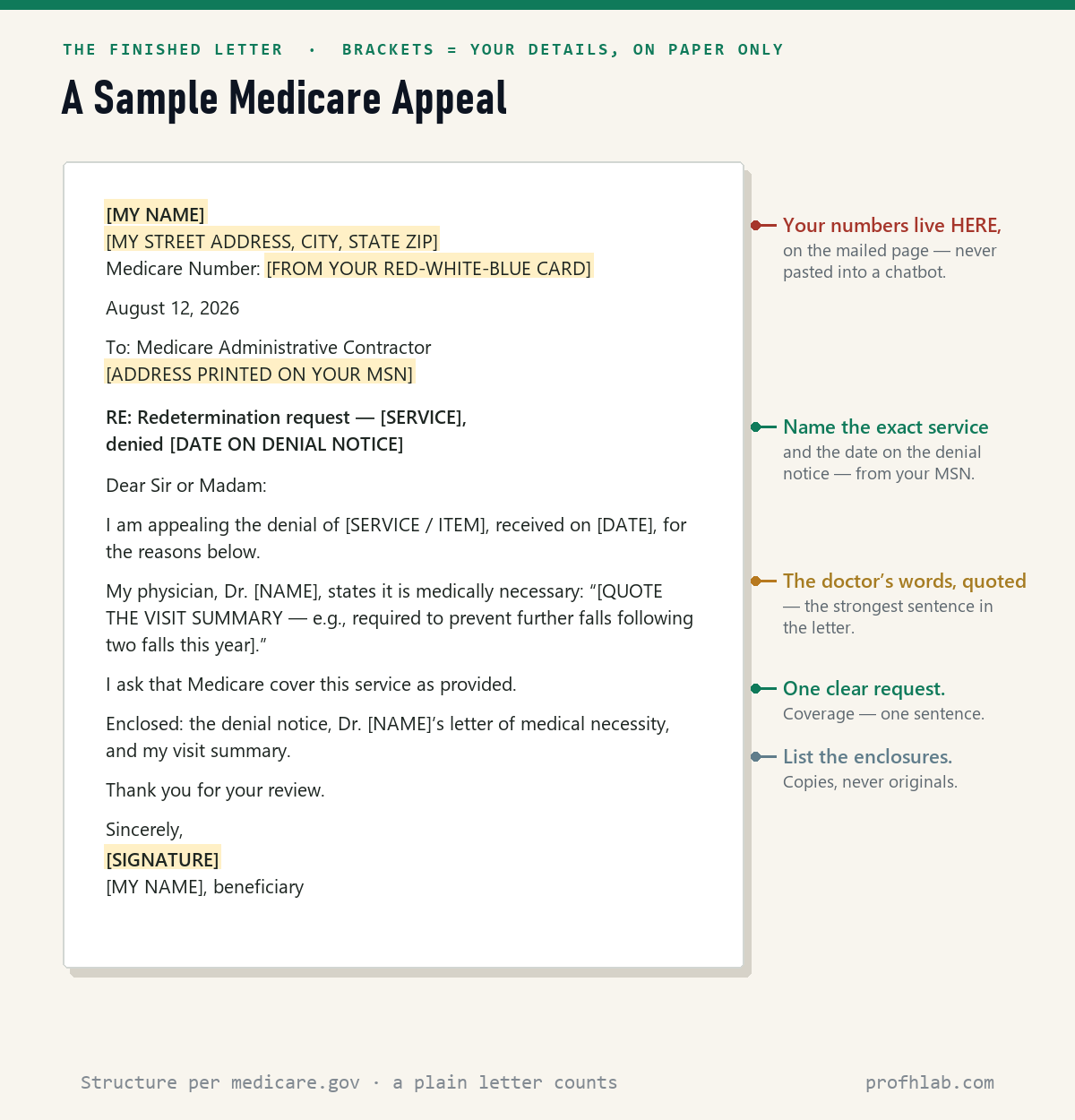
Write a Medicare appeal letter. The facts: Medicare denied [SERVICE / ITEM] on [DATE OF DENIAL NOTICE]. My doctor, Dr. [NAME], says it is medically necessary because [DOCTOR'S REASON — quote the visit summary if you have it]. My relevant history: [BRIEF — e.g., two falls this year]. Tone: plain, firm, respectful — no legal jargon. Structure: what was denied, why it is medically necessary, what I am asking for (coverage), and a list of what I am enclosing. Use [MY NAME], [MY ADDRESS], and [MEDICARE NUMBER] as placeholders. Under 300 words.
And here is what the finished letter looks like on the page — the highlighted spots are where your real details go, on paper, never in the chat:
The clock, honestly stated:
- Original Medicare: your exact deadline is printed on your Medicare Summary Notice; the standard window is 120 days from the initial determination (the official form itself asks you to explain only if you’re past 120). One dated correction to older guides: paper MSNs now arrive every six months, not quarterly — so don’t wait for the mail to tell you; you can see claims anytime at Medicare.gov.
- Medicare Advantage: shorter — 65 days from the date on the denial notice, and the plan must answer on a clock (72 hours if your health can’t wait).
- Two details almost no guide prints, and both buy you time. For Original Medicare the 120 days runs from the day you received the determination, and Medicare presumes you received it five calendar days after the date printed on the notice — so the real outside edge is 125 days from that date. And once you file, the contractor generally has 60 days to answer you. One more, since it decides whether you ever see the notice: a paper Medicare Summary Notice only arrives if you had a claim in that six-month period, so a quiet mailbox is not proof that nothing was denied. Claims appear at Medicare.gov as they process.
There are five appeal levels in all, but most cases end at the first or second. Level one is called a “Redetermination” — if you’d rather use the official form than a letter, it’s CMS-20027.
And the same skeleton — facts, doctor’s reasoning, one request, enclosures — works for any insurance denial letter: dental, homeowner’s, an explanation-of-benefits surprise. The deadline changes; the letter doesn’t.
Three more you’ll use this year
Write a short letter to my landlord requesting a repair: [WHAT'S BROKEN] since [DATE], reported on [DATE]. Polite, firm, asks for a repair date in writing. Under 120 words.
Write a brief message to my doctor's office asking for [AN APPOINTMENT / A MEDICATION REFILL / MY TEST RESULTS]. Include: name [MY NAME], date of birth [DOB], and the best way to reach me [PHONE]. Three sentences.
Typical result: “Hello, this is [MY NAME], date of birth [DOB]. I’m due for a refill of my blood-pressure medication and my pharmacy shows no refills left. Could you send a new prescription to my pharmacy, or let me know if I need a visit first? Best number for me: [PHONE].” — polite, complete, and the office can act on it without calling you back twice.
Rewrite this reply so it is polite but says no clearly, without apologizing three times: [PASTE YOUR DRAFT].
The apology letter, and the one word that ruins it
Apologies fail in a way you can see coming from across the room. They apologize for the other person’s feelings instead of for the thing that was done. I’m sorry if you were upset is not an apology; it is a sentence that quietly puts the fault on the person reading it.
The word to hunt for is if. Cut the sentence it lives in and the letter usually improves on the spot.
Write a short apology letter to [NAME] for [WHAT I DID — plainly, no softening]. Apologize for the action, not for how they felt: never use "I'm sorry if" or "I'm sorry you felt." No excuses and no explaining why it happened. Include three things: what I did, that I understand what it cost them, and one specific thing I will do differently. Warm, plain, under 120 words. Sign it [MY NAME].
How to judge the draft in ten seconds — the same three-question test as the complaint, pointed the other way:
- Does it name the actual thing? “I’m sorry about the other night” names nothing. “I’m sorry I left before your toast” does.
- Does the word “if” appear? Delete that sentence and do not replace it.
- Does it explain? Explanation reads as defense. Traffic, work and a bad week all belong in a different letter.
What about sixty words looks like:
Dear Ruth,

I'm sorry I missed Anna's graduation. You had told me the date twice, and I still let it go by without a word, and I know how much the day meant to you both.

I've put the next one in my calendar myself. If there's a photograph to be had, I'd love one.

Love,
[MY NAME]
One caution before you send it. A letter is a document. If the thing you are apologizing for involves money, insurance or a dispute anyone might later argue about — a dented car, a damaged item, a complaint at work — keep the letter to the relationship and do not narrate fault in writing. Talk to your insurer or your HR office first. That is general information, not legal advice, and it is worth ten minutes of asking.
The thank-you note, including the one after a job interview
A thank-you note has one job: to prove you noticed something specific. A note that could have been sent to anybody reads as a chore discharged, which is worse than no note at all.
Write a warm thank-you note to [NAME] for [WHAT THEY DID]. One specific detail I want included: [DETAIL — what they said, what they brought, how long they stayed]. 60 words. It should sound like a real person, not a greeting card. No "words cannot express."
The interview version is a different letter with the same spine, and it is the one people most often get wrong by writing too much. Send it within 24 hours, by email, and use it to do one thing the interview did not let you do: connect something they actually said to something you have actually done.
Write a thank-you email after a job interview for [ROLE] at [COMPANY], to [INTERVIEWER NAME]. One specific thing we discussed: [THE MOMENT — a problem they described, a question that made me think]. Connect it to one thing I have actually done: [MY EXPERIENCE]. Warm but businesslike, under 150 words, with a subject line. No flattery and no restating my whole resume.
If the interview was for an AI, robotics or data role, it is worth knowing what else is open before you answer an offer — our AI jobs tracker counts live openings at the major employers every day, and the jobs board lets you filter them.
Writing an email with ChatGPT — and whether it works inside Gmail
Every prompt on this page works for email. Email only asks two extra things of you: put the subject line first, and cut the length roughly in half. People read letters. They scan email.
Write an email to [WHO] about [WHAT]. Here's what happened: [THE FACTS — messy is fine]. I want to sound [TONE]. Start with a subject line of six words or fewer. Under 120 words. Ask for exactly one thing: [WHAT I WANT], by [DATE].
Two follow-ups do most of the remaining work. When a draft is bloated: “Cut this to half the length and keep the ask.” When you are replying to something difficult, paste their message in first:
Here is an email I received: [PASTE IT]. Write a reply that is [TONE — calm and firm / friendly / brief]. I want to say: [YOUR POINTS]. Do not apologize for things that are not my fault. Under 100 words.
Does ChatGPT work inside Gmail? No — and it is better to know that than to hunt for a button that is not there. ChatGPT lives at chatgpt.com in its own tab. You write the email there, copy it, and paste it into Gmail. That is the whole workflow, and it costs nothing.
What does live inside Gmail is Google’s own assistant. Gmail’s “Help me write” drafts and polishes messages in the compose window, and Google opened it to everyone in February 2026. One limit that catches people out: on a personal Google account the feature is United States only (Google’s Gmail Help pages, checked September 12, 2026). If you would rather not switch tabs, that is the tool to use — and if you want the two assistants compared properly, we did that in ChatGPT vs Claude vs Gemini for writing.
The two-minute edit that makes it yours
- Read it out loud once. Anywhere you stumble, the machine wrote it — change those words to yours.
- Swap in one phrase only you would say. If your letters always end “take care now,” end this one that way.
- Add one detail the AI couldn’t know. The date of the church supper. The name of the dog. That detail is the signature no font can fake.
The test: if every sentence could have been written by anyone, it isn’t finished. Two changed sentences is usually enough.
Watch someone do it
A patient, senior-paced ChatGPT walkthrough from a channel built for exactly this audience (346,000 views):
And a brisk, current one specifically on writing email with ChatGPT, from March 2026:
Where this article stops
This guide helps you write a clearer letter. It is general information — not legal advice — and it cannot weigh the facts of your specific case. Two free, official services can: 1-800-MEDICARE (open 24/7) and your State Health Insurance Assistance Program (SHIP), whose trained counselors help with appeals every day at no charge. For anything involving large sums or deadlines you have already missed, start there.
Is it free, is it private, and do Medicare appeals really work?
Can ChatGPT write a letter for me for free?
Yes — a free account drafts letters and emails with no meaningful limit for text. Give it the three blanks (who, what happened, tone), then change two sentences so it sounds like you.
Is it safe to put personal information into ChatGPT?
Follow the bracket rule: never paste your SSN, Medicare number, account numbers, or passwords — OpenAI’s own pages say not to share sensitive information, and free-account chats can train the model unless you turn it off (Settings → Data Controls → “Improve the model for everyone”). Draft with [BRACKETS]; fill in real numbers only on the letter itself.
What should I write in a condolence card?
Short and true: say you’re sorry, name the person who died, share one specific memory, offer one concrete help. Avoid “at least,” “in a better place,” and “I know how you feel.” Draft with AI if the words won’t come — then copy it by hand and mail it. The handwriting is the part they keep.
Can I appeal a Medicare denial with just a letter?
Yes. Medicare accepts a written request as long as it has your name, address, Medicare number, the exact services and dates, and why they should be covered — attach your doctor’s note. The official form (CMS-20027) exists if you prefer it, but a plain letter counts.
How long do I have to appeal a Medicare denial?
Original Medicare: the deadline is printed on your Medicare Summary Notice — the standard window is 120 days. Medicare Advantage: 65 days from the date on the denial notice, with fast tracks (72 hours) when health can’t wait. The letter takes ten minutes; don’t give the deadline a chance.
Do Medicare appeals actually work?
Four times out of five. KFF’s analysis of 2024 data: only 11.5% of denied prior-authorization requests were appealed, but 80.7% of appeals were partly or fully overturned — a rate that has held above eight in ten for six years running.
How do I end a letter?
Official: Sincerely or Respectfully. Friendly-but-businesslike: Best regards. Personal: Warmly, With love, Thinking of you. When unsure, Sincerely is never wrong — and ChatGPT will match the closing to the tone if you ask.
How do I get ChatGPT to write a letter?
Give it three blanks and a length. Type: Write a letter to [WHO]. Here’s what happened: [THE FACTS, in any order]. I want to sound [TONE]. Under [LENGTH] words, asking for exactly one thing: [WHAT I WANT]. Messy facts are fine — organizing them is the machine’s job. Then change two sentences so it sounds like you.
Is there a free ChatGPT letter writer?
ChatGPT itself is the free letter writer — you do not need a separate tool or a paid site. OpenAI’s pricing page lists the free plan at $0 a month with unlimited text chats (checked September 12, 2026), and a letter is only text. Be wary of “free AI letter writer” sites that ask for an account and your personal details before showing you the draft.
Can ChatGPT write an apology letter?
Yes, and the instruction that matters most is a negative one: tell it never to write “I’m sorry if” or “I’m sorry you felt.” Those apologize for the other person’s reaction instead of for what you did. Ask it to name the action, say what it cost the other person, and promise one specific thing — under 120 words, no excuses. If money, insurance or a workplace dispute is involved, keep fault out of writing and ask your insurer or HR first.
How do I get ChatGPT to write an email?
Use the same prompt as a letter, with two changes: ask for the subject line first, and halve the length. Write an email to [WHO] about [WHAT]. The facts: […]. Tone: […]. Subject line of six words or fewer. Under 120 words. Ask for exactly one thing. If the draft is bloated, the follow-up is one line: “Cut this to half the length and keep the ask.”
Does ChatGPT work inside Gmail?
No. ChatGPT runs in its own tab at chatgpt.com; you write the email there and paste it into Gmail. What is built into Gmail is Google’s own assistant — “Help me write,” which drafts and polishes in the compose window and which Google opened to everyone in February 2026. On a personal Google account that feature is United States only (Gmail Help, checked September 12, 2026).
Can ChatGPT write a thank-you note after an interview?
Yes, and the rule is send it within 24 hours by email. Ask for under 150 words with a subject line, and give it one specific moment from the interview to connect to one thing you have actually done. Tell it explicitly not to restate your resume and not to flatter — those are the two failure modes of an AI-drafted thank-you, and hiring managers read a great many of them.
Let it draft, keep your numbers off it, and send the appeal
The letters that matter most are the ones that never get sent — the condolence you couldn’t start, the appeal that looked like homework. Three blanks, one privacy rule, ten minutes. Let the machine find the words, keep the numbers on the paper, sign it with a detail only you know — and send it. Especially the appeal. Four out of five.
I explain AI in plain English — one short, friendly email a month. Unsubscribe anytime.
The never-share rule from the scam side, plus photos and formulas
- How to use ChatGPT, step by step, for beginners over 50 — every screen, nothing assumed.
- AI scams targeting seniors — the same “never share your numbers” rule, on the receiving end.
- How to restore old family photos with AI — the exact prompts, and the face check before you frame anything.
- ChatGPT for Excel — formulas from plain English — no memorizing, ever.
- How to Plan a Trip with ChatGPT — five prompts to a relaxed itinerary.
- Prep for a Doctor Visit with ChatGPT — one printed page: timeline, meds, top three questions.
About the author
Prof. H is a professor of AI and robotics, a former Samsung researcher, and the author of dozens of textbooks on AI and automation. He writes hands-on, no-hype guides to AI tools. More about the author →
Full index
Every guide in the Generative AI library
Start with AI, at any age
- ChatGPT, step by step (over 50)
- Free AI tools that actually help
- AI scams & the family safe word
- Restore old family photos
- ▸ Write any letter with ChatGPT (you are here)
AI writing tools, reviewed
Curious about robots, humanoids, and the chips inside them? Physical AI library →
Prof.’s H Newsletter
One short email a month, with the numbers in it
What actually moved in AI hiring, AI prices, and the scams aimed at older Americans. Counted here, dated, and linked to the source. One email a month, and your address goes nowhere else.