AI Jobs That Don’t Require Coding: 940 Are Open, and 0 Are Called “Prompt Engineer”
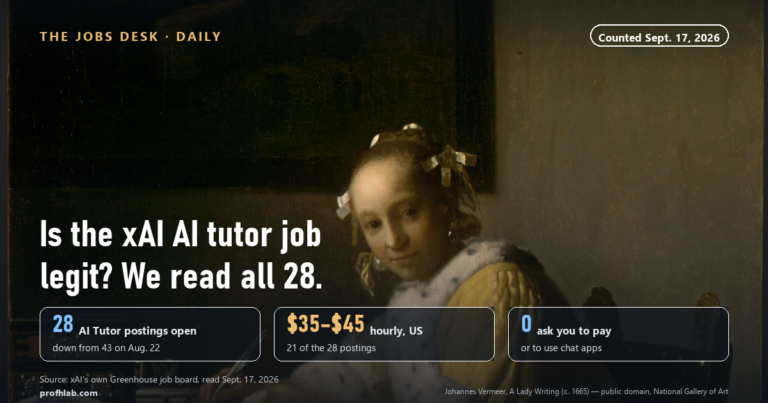
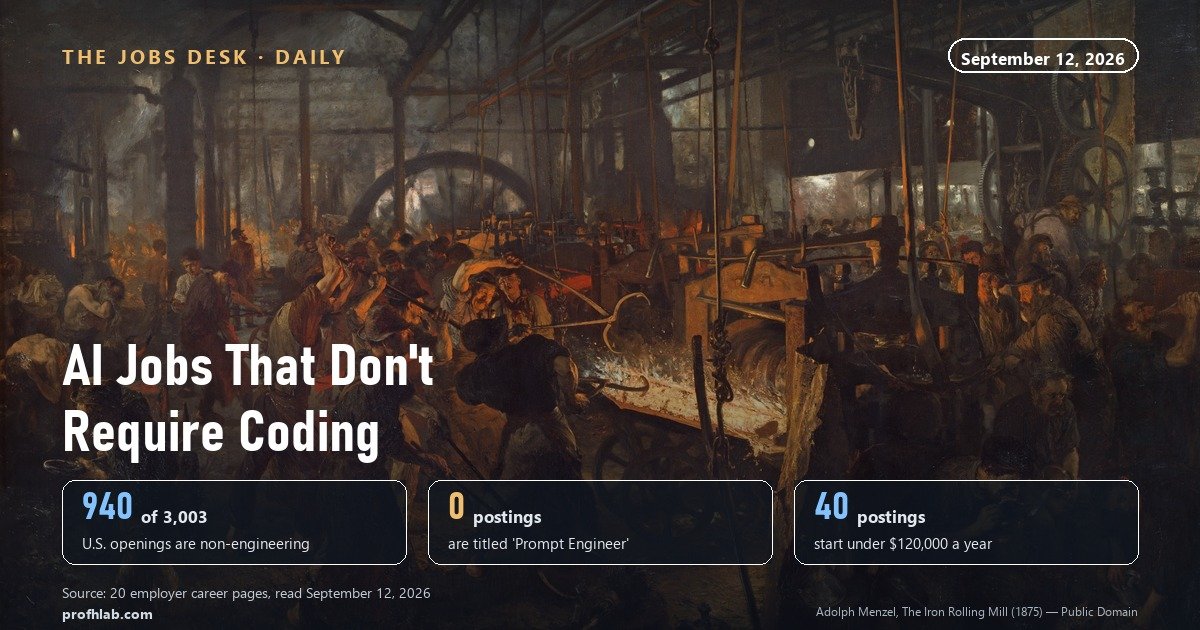
Yes — 940 of the 3,003 open U.S. jobs we counted at 20 AI and robotics employers on September 12, 2026 are in roles that do not write code. That is 31.3% of everything open. But almost none of them are called what the guides tell you to search for: zero of the 3,792 postings in today’s scan are titled “Prompt Engineer,” and zero are titled “AI Ethicist,” “AI Trainer,” “AI Content Designer” or “AI Marketer.”
What we counted on September 12, 2026
We pulled every live posting from the public career feeds of 20 AI, robotics and autonomy employers — 3,792 postings, 3,003 of them in the United States — and sorted every U.S. title by whether the job implies writing code.
- 940 non-engineering titles (31.3%) · 1,245 engineering titles (41.5%).
- 0 postings titled Prompt Engineer, AI Ethicist, AI Trainer, AI Content Designer or AI Marketer.
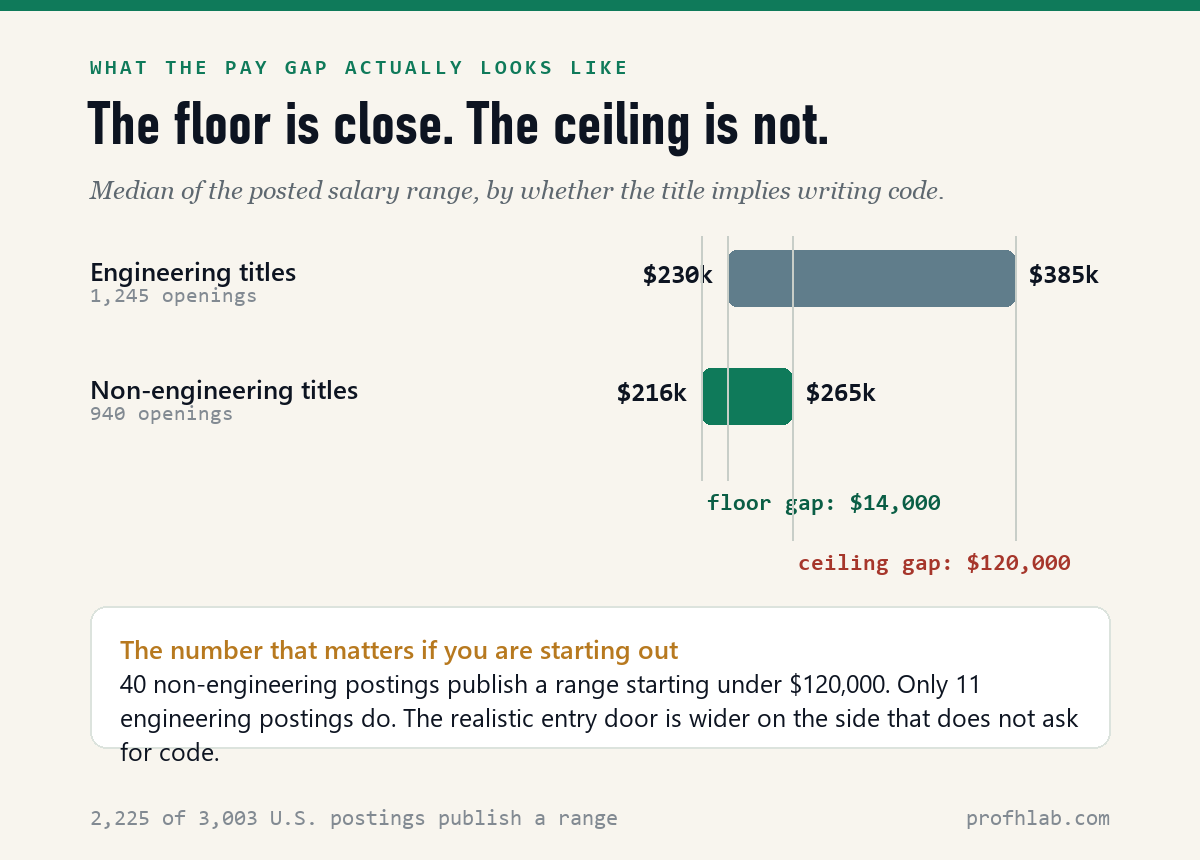
- Median posted range: $216,000–$265,000 non-engineering, $230,000–$385,000 engineering.
- 40 non-engineering postings publish a range starting under $120,000. Only 11 engineering postings do.
The five job titles every guide names, and how many exist
Search the phrase in this headline and you get the same article nine times. Forbes names AI Strategist and Prompt Engineer. edX names AI product manager, AI ethicist, AI content writer, AI marketer, AI trainer. Google’s own AI Overview, sitting above all of them on September 12, names Prompt Engineer, AI Trainer and AI Ethicist as top no-code AI jobs.
Not one of those articles counts a single job posting. So we did. We searched all 3,792 postings — job titles and the employer’s own department labels — for each promised title.
| Title the guides tell you to look for | Postings with it | What we found instead |
|---|---|---|
| Prompt Engineer | 0 | One posting has the word “prompts” in it at all: Anthropic’s Product Designer, Evals & Prompts — a design job. |
| AI Ethicist | 0 | The work exists under other names: 81 legal, policy, trust and safety roles. |
| AI Trainer | 0 | Not one posting uses the word “trainer.” Departments called Human Data (29) and Data Operations (12) do this work. |
| AI Content Designer | 0 | 108 marketing, brand and communications roles, none using that phrase. |
| AI Marketer | 0 | The actual titles are Product Marketing Manager, Brand Lead, Lifecycle Marketing Manager. |
| Data Annotator | 1 | One, in 3,792. |
| AI Strategist | 3 | And here is the catch, below. |
Searched across all 3,792 postings, job titles and department labels, September 12, 2026.
The AI Strategist detail is the most useful thing in this table. Three exist. Anthropic’s is filed under the Applied AI department. Perplexity’s two — AI Strategist, Legal and AI Strategist, Financial Services — are filed by the employer under Sales. The one glamorous title on the list that actually exists is, at two employers out of three, a sales job wearing a better name. If you want that work, the useful search term is not “AI strategist.” It is “solutions” or “account executive.”
What the work is actually called
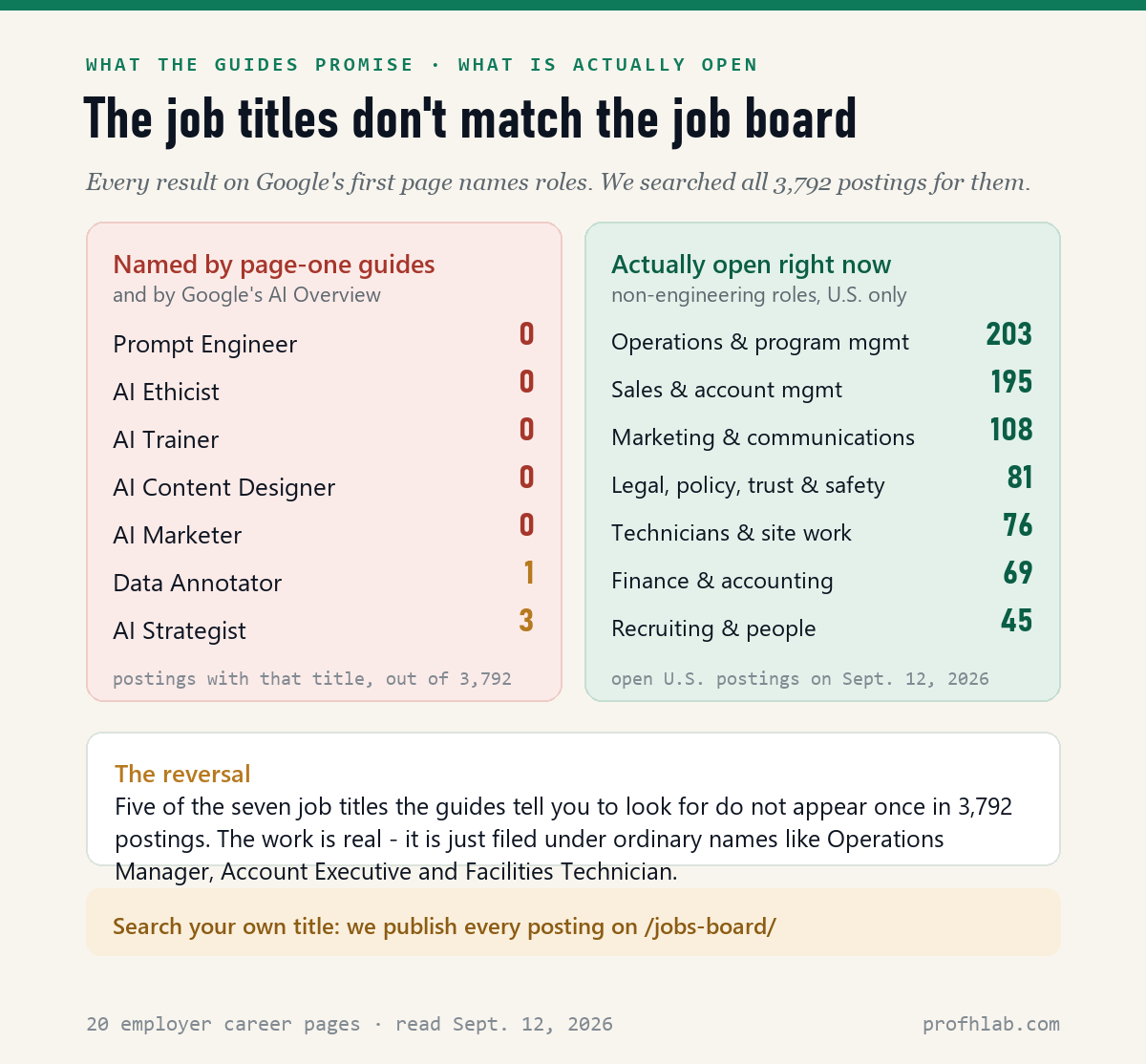
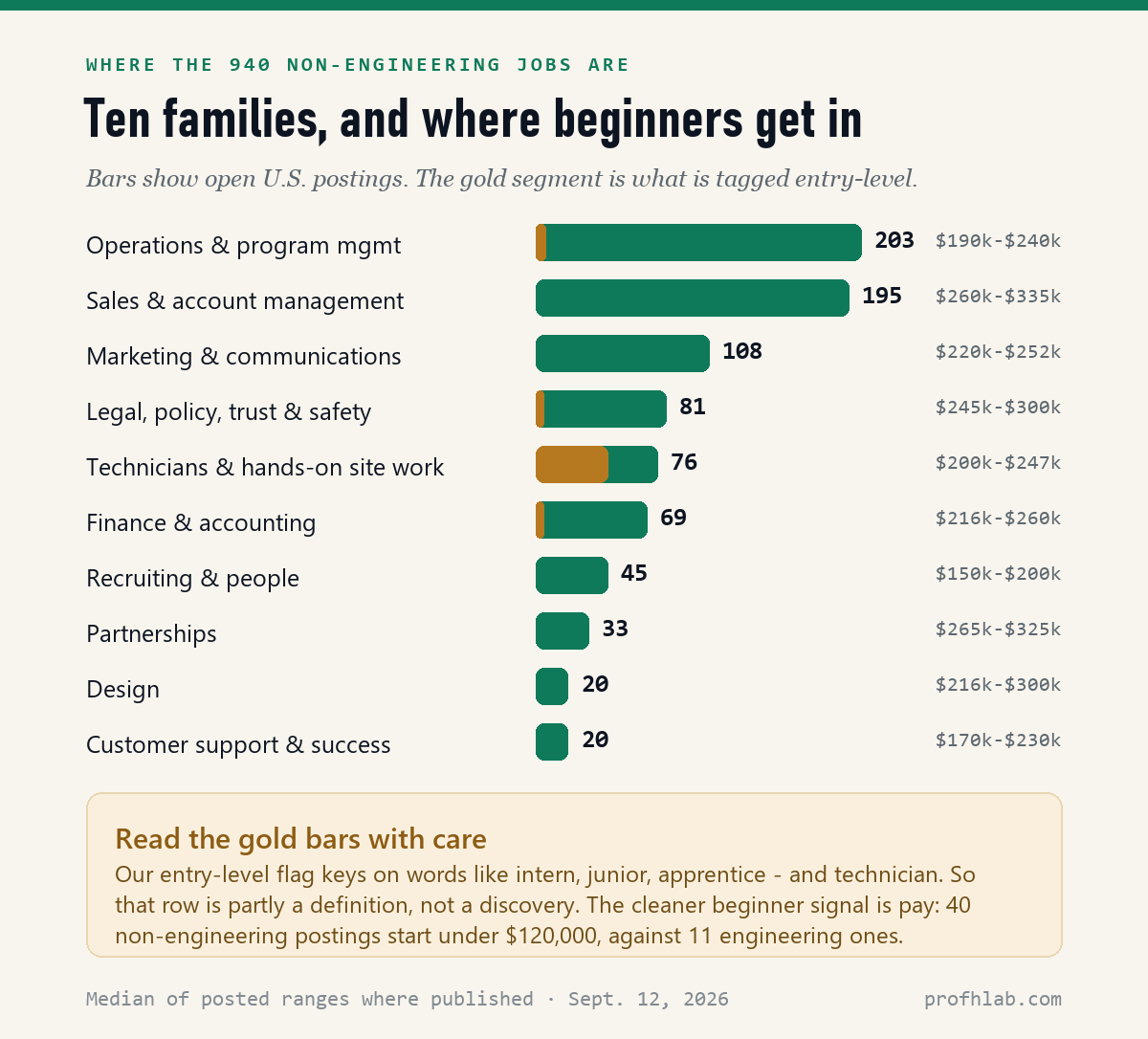
Here are the 940 non-engineering openings, sorted into families. Nothing in this table is exotic. These are the ordinary functions every company of any size has ever needed, attached to companies that happen to build AI.
| Role family | Open now | Remote | Median posted range |
|---|---|---|---|
| Operations & program management | 203 | 56 | $190,000–$240,000 |
| Sales & account management | 195 | 99 | $260,000–$335,000 |
| Marketing & communications | 108 | 62 | $220,000–$252,000 |
| Legal, policy, trust & safety | 81 | 20 | $245,000–$300,000 |
| Technicians & hands-on site work | 76 | 0 | $200,000–$247,000 |
| Finance & accounting | 69 | 29 | $216,000–$260,000 |
| Recruiting & people | 45 | 7 | $150,000–$200,000 |
| Partnerships | 33 | 17 | $265,000–$325,000 |
| Design | 20 | 12 | $216,000–$300,000 |
| Customer support & success | 20 | 8 | $170,000–$230,000 |
| Everything else | 90 | 26 | — |
U.S. postings only. Medians use the 645 non-engineering postings that publish a range.
Read that list again with the guides in mind. The largest single family is operations and program management — 203 openings, the most boring words in the English language, and more than fifty times as many openings as all seven promised titles combined (203 against 4). The second largest is sales. If you are hunting for non-coding work in AI and you have not typed the words “account executive” or “program manager” into a career page, you have not started looking yet.
How we decided what counts as a job without coding
You should be able to disagree with us, so here is the rule. We read each U.S. job title and checked it against two word lists. If it contains an engineering word (engineer, developer, software, scientist, machine learning, backend, compiler and so on) and no business-function word, it goes in engineering. If it contains a business-function word (sales, recruiting, counsel, marketing, technician, operations, finance, policy and so on) and no engineering word, it goes in non-engineering. Titles that sit honestly on the fence get their own bucket.
| Bucket | Count | What is in it |
|---|---|---|
| Engineering | 1,245 (41.5%) | Software Engineer, Research Scientist, Performance Engineer. |
| Non-engineering | 940 (31.3%) | Account Executive, Recruiter, Counsel, Facilities Technician. |
| Depends on the team | 374 (12.5%) | Product Manager, Technical Program Manager, Solutions Architect, Forward Deployed Engineer. |
| Cannot tell from the title | 444 (14.8%) | Compute Infrastructure Lead, Economist, Chief of Staff, Deal Lead. |
Two honest caveats. A title is not a job description — plenty of operations roles quietly expect you to write SQL, and some “engineer” titles at these companies are mostly customer work. And 27% of postings sit in the two uncertain buckets, which is a lot. We would rather show you that number than quietly round it into whichever column made the headline bigger. The 940 figure is the floor, not the ceiling: the true count of jobs you could do without writing code is somewhere between 940 and roughly 1,750.

The pay question: the floor is close, the ceiling is not
The usual claim is that non-technical AI roles pay a fraction of engineering roles. In the postings that publish a range, that is half right. The median starting figure is $216,000 for non-engineering and $230,000 for engineering — a gap of $14,000. The median top of the range is $265,000 against $385,000 — a gap of $120,000. You enter at a similar number. You stop climbing much sooner.
Now the caveat that makes those numbers usable. These are twenty frontier AI and robotics employers, not the American economy. A $216,000 median says what OpenAI and Anthropic pay a marketing manager in San Francisco; it says nothing about what an AI-adjacent operations job pays in Ohio. Read it as the top of the market, and read the width of these ranges with the same suspicion we applied when we asked why salary ranges are so wide. A published range is an advertisement, not an offer.
Where someone without a technical background actually gets in
Medians are a bad guide for a beginner, because the median job wants eight years of experience. The better question is: which open postings publish a starting figure a career-changer could plausibly be offered? Forty non-engineering postings publish a range starting under $120,000. Eleven engineering postings do. The door is nearly four times wider on the side that does not ask for code.
These were live and returning HTTP 200 when we checked them on September 12, 2026.
| Employer | Role | Where | Posted range |
|---|---|---|---|
| Agility Robotics | Service Technician II | Salem, OR | $60,000–$78,000 |
| xAI | IT Services Technician | Memphis, TN | $61,200–$91,800 |
| xAI | Client Account Manager | Austin, Los Angeles, New York | $65,000–$110,000 |
| Scale AI | Business Development Representative, Partnerships | New York, NY | $68,000–$85,000 |
| Perplexity | Business Development Representative | Remote (San Francisco) | $75,000–$120,000 |
| Scale AI | Recruiting Coordinator (contract) | San Francisco, New York | $76,000–$90,000 |
| Cognition | Workplace & Engagement Coordinator | New York City | $80,000–$110,000 |
| Figure AI | Recruiting Coordinator | San Jose, CA | $80,000–$110,000 |
| Cohere | Talent Sourcer | Remote (New York) | $80,000–$125,000 |
| Agility Robotics | Campus Program Recruiter | Remote | $85,000–$133,000 |
| Scale AI | Senior Accountant | San Francisco, CA | $95,200–$130,000 |
Eleven of the 40. Links go to the employer’s own posting. Postings close without notice.
Three patterns are worth naming. Recruiting coordinator appears twice, at Scale AI and Figure AI, at nearly the same money — it is the most reliably repeated junior non-technical opening in this dataset. Business development representative appears twice, and BDR is the classic no-degree-required door into a technology company. And the cheapest postings are hands-on: a service technician in Salem, Oregon at $60,000 and an IT technician in Memphis at $61,200. We have written separately about becoming a data center technician with no experience and about what xAI actually pays in Memphis, because that campus is now one of the largest sources of non-degree AI-adjacent work in the country.

So is prompt engineering a real job?
On this evidence, not as a job title. Zero of 3,792 postings across twenty of the most prominent AI employers in the world advertise for one. That is not proof the skill is worthless — it plainly is not, and it appears inside the requirements of plenty of jobs that are titled something else. But there is a difference between a skill and a vacancy, and the guides that tell you to “become a prompt engineer” are selling you a vacancy that these employers are not posting.
This matches something we found earlier: zero of 2,974 AI postings asked for an AI certificate, and zero of 3,004 job titles used the words “entry level”. There is a whole advice industry built on job titles that employers do not use. The fix is the same every time: stop reading about the jobs and read the jobs.
What to do with this
- Throw away the title list. Searching “prompt engineer” or “AI ethicist” on these twenty career pages returns nothing today. Searching operations, account, coordinator, counsel, recruiter or technician returns hundreds.
- Search by your existing function, not by AI. You are not changing careers into AI. You are taking the job you already do to an employer that happens to build AI. That is a far shorter move, and it is the one the 940 openings are actually advertising for.
- Filter our board by pay, then by entry. Open the Jobs Board, which carries all 3,792 postings with an apply link to the employer’s own site, and sort by lowest published pay. That is where the beginner-accessible roles cluster.
- Check the two repeat openings first — recruiting coordinator and business development representative. Both appeared at two different employers in a single day’s scan, which means they turn over and will be posted again.
- Apply through the employer’s own domain, always. Every link in this article goes to a greenhouse.io, ashbyhq.com or company URL. Nothing else is a real application.
If you want to go deeper
“Would I be a second-class citizen at an AI company?” The pay data says partly yes: same entry point, lower ceiling. But note which families pay the most on our table — sales at $260,000–$335,000 and partnerships at $265,000–$325,000 both out-earn the non-engineering median by a wide margin, and sales out-earns the engineering floor. Commercial roles at these companies are not a consolation prize.
“Which of these can I do from home?” 336 of the 940 are remote, against 231 of the 1,245 engineering roles — proportionally, non-engineering work at these companies is roughly twice as likely to be remote. The exception is absolute: 0 of the 76 technician roles are remote, for obvious reasons. We went through this in detail in are AI engineer jobs remote and part-time AI jobs you can do from home.
“Is the no-coding share growing or shrinking?” We cannot tell you yet, honestly. Today is the first day we have classified the whole board this way. We will re-run it and report the direction rather than guess at it now — that is the sort of thing the AI Jobs Tracker exists to make possible.

Cite this
On September 12, 2026, 940 of 3,003 open U.S. jobs (31.3%) at 20 AI, robotics and autonomy employers were in non-engineering roles, while 0 of 3,792 total postings were titled “Prompt Engineer,” “AI Ethicist,” “AI Trainer,” “AI Content Designer” or “AI Marketer.” Median posted range was $216,000–$265,000 for non-engineering roles against $230,000–$385,000 for engineering roles. Source: Prof H Lab, AI Jobs Tracker.
How we counted, and what this cannot tell you
Postings come from the public Greenhouse and Ashby feeds of 20 AI, robotics and autonomy employers, read on September 12, 2026: 3,792 postings, 3,003 of them U.S. Classification is by job title against published word lists, described above and reproducible from the counts in every table here. Pay medians use only postings that publish a range — 645 of the 940 non-engineering and 966 of the 1,245 engineering roles — so every pay figure silently excludes the employers least willing to say, a bias we measured directly in why job postings do not show salary.
What this cannot tell you: it is twenty employers, not the labour market. Every figure here describes frontier AI and robotics companies, which skew to San Francisco, New York and a handful of data-centre sites, and which pay far above the national median for the same functions. It also measures titles, not duties — we did not read 3,792 job descriptions, and a title can hide a coding requirement or invent one. And our entry-level flag is a keyword heuristic whose keywords include “technician,” so we have deliberately leaned on published pay floors rather than that flag wherever a beginner is the audience.
We are not recruiters, we take no money from any employer named here, and postings close without notice — the employer’s own page always wins. Today’s full dataset is on the AI Jobs Tracker and the searchable Jobs Board. Questions about a specific search go to the Jobs Desk, and we answer them in public.
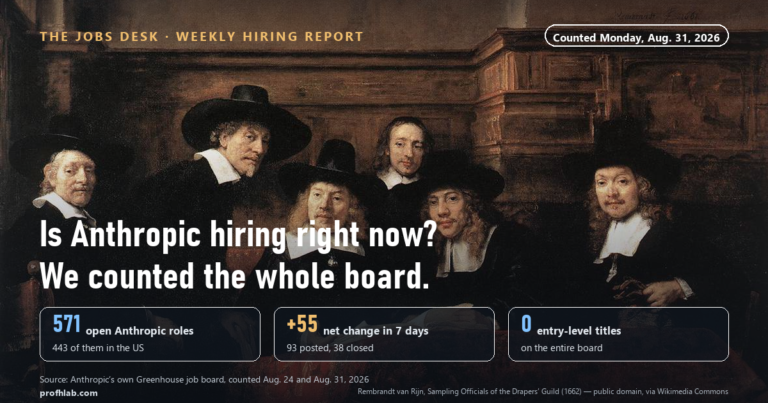
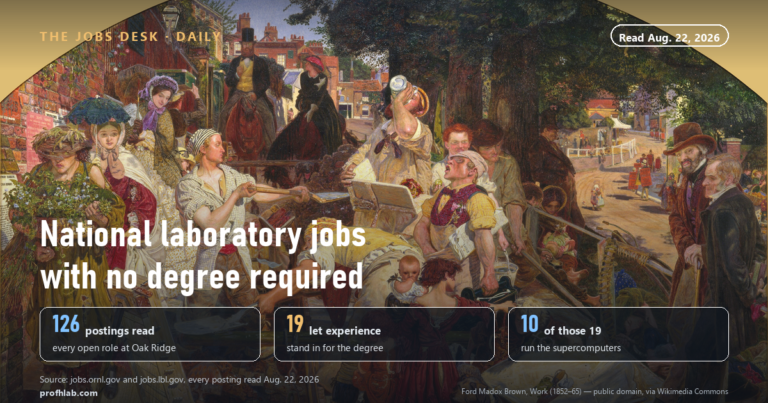
More from this desk: which AI companies are hiring right now · do you need a PhD to work in AI · which AI company pays the most · AI jobs for people over 50 · do you need a degree to be a robotics technician · are AI training jobs legit · how to get a job at OpenAI or Anthropic · should I put ChatGPT on my resume · is Anthropic hiring right now · national laboratory jobs with no degree · how to get a federal job with no experience · should I apply to old job postings · will AI take my job · when do summer 2027 internships open.
Frequently asked questions
Which AI job does not require coding?
On September 12, 2026 the largest non-engineering families open at 20 AI employers were operations and program management (203 openings), sales and account management (195), marketing and communications (108), legal, policy, trust and safety (81), technicians and hands-on site work (76), and finance and accounting (69). None of these are AI-specific job titles, which is exactly why people miss them.
Is prompt engineering a real job?
Not as an advertised job title at these employers. Zero of 3,792 live postings we read on September 12, 2026 were titled Prompt Engineer, and only one posting contained the word prompts at all. The skill shows up inside other roles; the vacancy does not exist under that name.
What is the easiest AI job to get?
We cannot tell you what is easy, but we can tell you where the widest doors are. Forty non-engineering postings publish a starting figure under $120,000 against eleven engineering ones, and two junior titles repeated across different employers in a single day: recruiting coordinator and business development representative. Hands-on technician work at data centre sites is the largest cluster that does not require a degree.
Do you need to know Python for AI?
For the 1,245 engineering roles, effectively yes. For the 940 non-engineering roles, the title does not imply it, though individual postings may still ask for basic SQL or spreadsheet fluency. We classified titles, not job descriptions, so check the requirements section of any specific posting before you rule yourself out or in.
Can you get into AI without a tech background?
The data suggests the move that works is lateral, not a career change. Roughly one in three open jobs at these companies is an ordinary business function. Taking the function you already perform to an employer that happens to build AI is a shorter path than retraining into a technical role.
Do AI jobs without coding pay less?
Less at the top, barely less at the bottom. The median posted range was $216,000 to $265,000 for non-engineering roles and $230,000 to $385,000 for engineering roles on September 12, 2026 — a $14,000 gap at the floor and a $120,000 gap at the ceiling. Sales and partnerships roles were exceptions that out-earned the non-engineering median substantially.
Are there entry-level AI jobs that do not require coding?
Yes, but far fewer than the guides imply. Of the 40 non-engineering postings publishing a range under $120,000 on September 12, 2026, the accessible ones clustered in recruiting coordination, business development, workplace operations, accounting and technician work. Live examples that day started at $60,000 for a robotics service technician in Oregon.
Which AI companies hire non-technical people?
All of the ones we track. The largest non-engineering employers in our September 12, 2026 scan were OpenAI (194 such openings), Anthropic (177), xAI (75), ElevenLabs (62), Sierra (52) and Waymo (48). Nineteen of the twenty employers had at least one.
Prof.’s H Newsletter
One short email a month, with the numbers in it
What actually moved in AI hiring, AI prices, and the scams aimed at older Americans. Counted here, dated, and linked to the source. One email a month, and your address goes nowhere else.