What Day of the Week Are Most Jobs Posted? We Timestamped 3,795 AI Openings
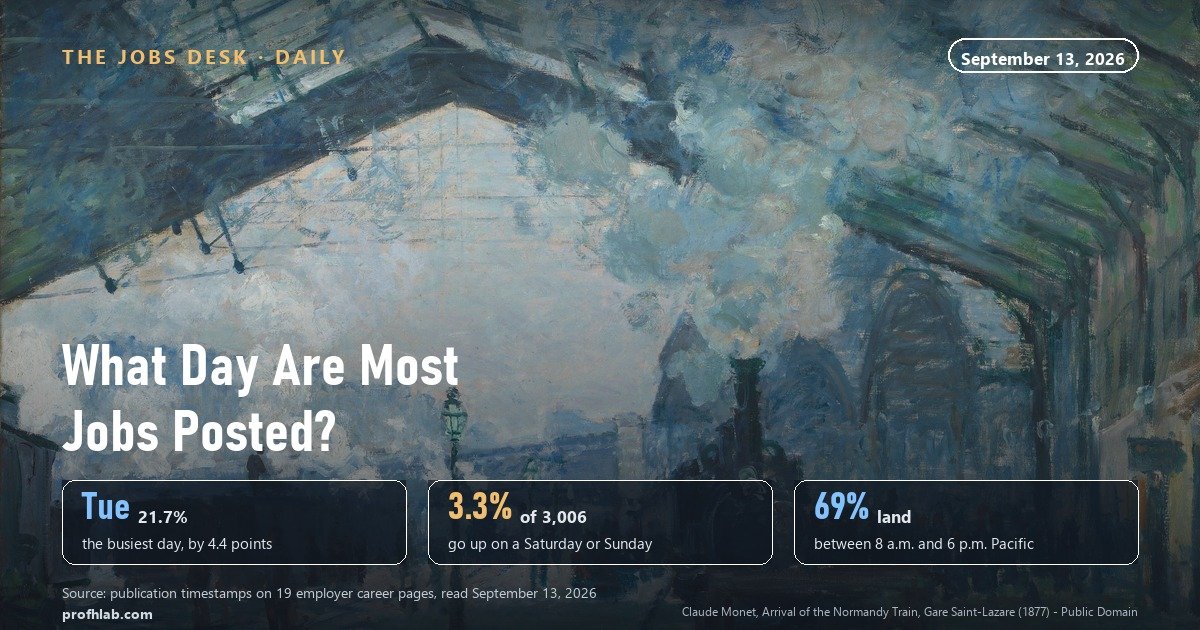
Tuesday — and by less than you would hope. We read the publication timestamp on all 3,795 openings at 19 AI, robotics and autonomy employers on September 13, 2026, and among the 3,006 United States roles, 21.7% went live on a Tuesday against 17.3% on a Monday, the quietest weekday. That is a spread of 4.4 percentage points across the whole working week. The gap that actually exists is the weekend: 3.3% of these jobs were published on a Saturday or a Sunday.
What we counted on September 13, 2026
Employer career feeds publish a machine-readable date for every posting. We collected all 3,795 live postings from 19 public feeds, kept the 3,006 in the United States, and bucketed each one by the day and hour it went live in the employer’s own time zone.
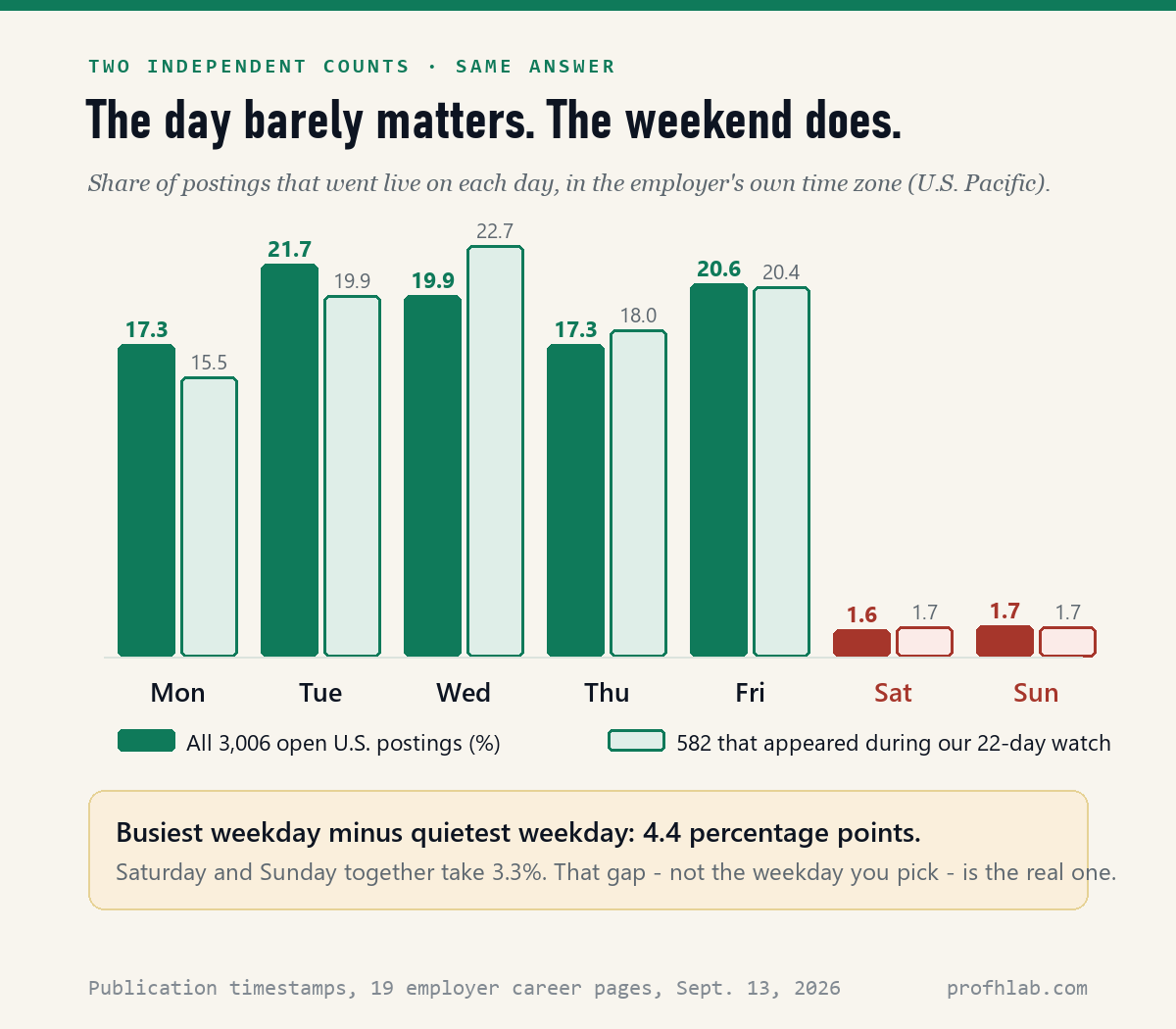
- Tuesday 21.7% · Friday 20.6% · Wednesday 19.9% · Monday 17.3% · Thursday 17.3%.
- Saturday 1.6% and Sunday 1.7% — together 99 postings out of 3,006.
- 69.0% were published between 8 a.m. and 6 p.m. Pacific; 37.6% in the four hours from 9 a.m. to 1 p.m.
- A second, independent sample — the 582 postings that appeared during our 22 days of daily scanning — produces the same shape.
So what day are most jobs posted?
Tuesday, in this dataset, on this day. Here is the whole week, twice over. The first column is every open United States role we can see right now. The second is the smaller group that appeared while we were watching, day by day, for 22 days — a different kind of sample, described further down.
| Day it went live | All 3,006 open U.S. roles | 582 that appeared during our watch | Rank |
|---|---|---|---|
| Monday | 519 · 17.3% | 90 · 15.5% | joint last weekday |
| Tuesday | 651 · 21.7% | 116 · 19.9% | 1st |
| Wednesday | 599 · 19.9% | 132 · 22.7% | 3rd |
| Thursday | 519 · 17.3% | 105 · 18.0% | joint last weekday |
| Friday | 619 · 20.6% | 119 · 20.4% | 2nd |
| Saturday | 47 · 1.6% | 10 · 1.7% | — |
| Sunday | 52 · 1.7% | 10 · 1.7% | — |
Publication timestamps from 19 employer career feeds, converted to U.S. Pacific time, read September 13, 2026.
A 4.4-point gap is not a strategy
The advice industry has been confident about this for years without counting anything. ResumeSpice tells readers Monday and Tuesday mornings are “widely considered” the best times. Goodwin Recruiting reports a “broader consensus” favouring Tuesday through Thursday. Indeed has a page on it. None of them publishes a count of postings by day, and the page currently ranking first in Google for this exact question is a roundup of job-search phone apps that never answers it.
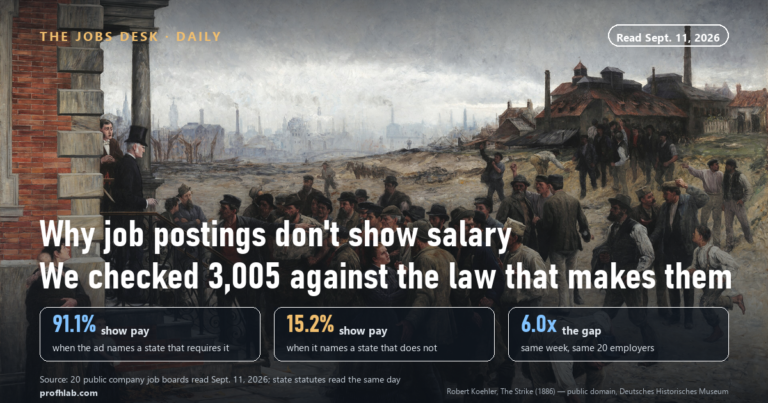
Now put a number on what the advice is worth. If Tuesday carries 21.7% of postings and Monday carries 17.3%, then choosing the “right” day changes your exposure by about one posting in twenty-three. For a job seeker sending five applications a week, that is a rounding error. It is not nothing — it is just so much smaller than the things nobody writes listicles about, like whether the posting publishes a salary range at all, which we found is still a coin flip.
The only cliff in the week is Friday night
Friday holds 20.6% of postings. Saturday holds 1.6%. That is a 92% collapse in a single night, and it is the only movement in the week that is not noise. Hiring is a job that people do at work. The systems that publish these postings run all weekend; the humans who press the button do not.
Monday is the slowest day to post and the best morning to look
This is the part that reconciles the popular advice with the data, and it took us a while to see it.
Monday is the quietest weekday for publishing. But if you open a job board once each weekday morning, Monday morning is the one time you are looking at three days of accumulation rather than one. Friday, Saturday and Sunday together account for 23.9% of all postings — 718 of the 3,006 — and on Monday morning none of them has had a working day of competition yet. On Tuesday morning you are looking at Monday alone: 17.3%.
The reframe. “Apply on Monday” turns out to be decent advice for a reason nobody states. It is not that Monday is when jobs appear — it is the day with the fewest new postings. It is that Monday morning is when the largest pile of postings you have not seen yet is sitting there, because the weekend put nothing on top of Friday’s batch.
The hour beats the day, and it is not close
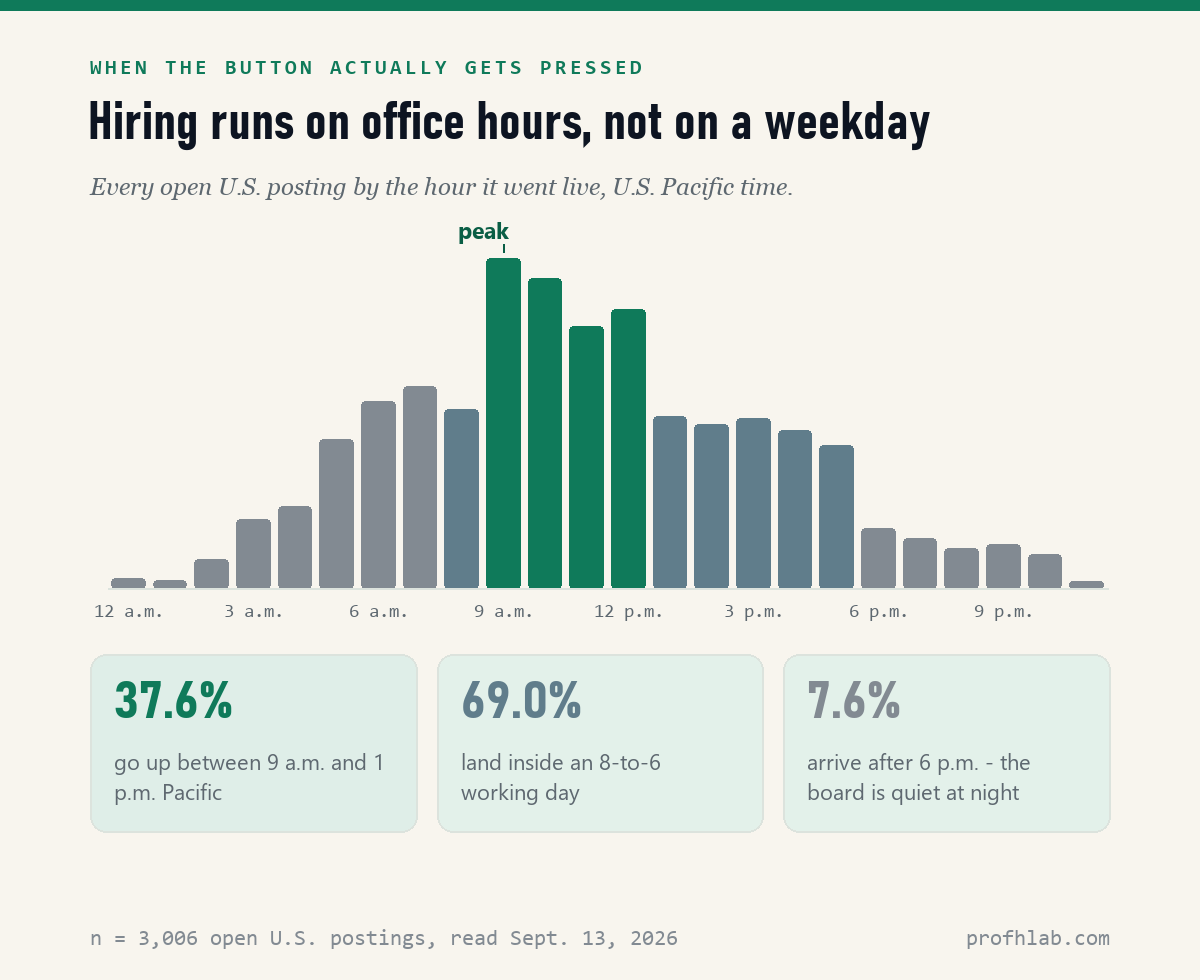
Spread the same 3,006 postings across the 24 hours of the day and the flat weekday line turns into a mountain. 37.6% of everything is published in the four hours between 9 a.m. and 1 p.m. Pacific. Take the whole working day, 8 a.m. to 6 p.m., and you have 69.0%. After 6 p.m. the board effectively closes: 7.6%.
| Window (U.S. Pacific) | Share of postings | What it means for you |
|---|---|---|
| 9 a.m. – 1 p.m. | 37.6% | A check at lunchtime Pacific catches most of that day’s new work |
| 8 a.m. – 6 p.m. | 69.0% | Hiring keeps office hours, wherever you happen to live |
| Before 9 a.m. | 29.2% | Much of this is East Coast teams already at their desks |
| After 6 p.m. | 7.6% | Checking at midnight buys you almost nothing |
Every employer runs its own week
Here is the finding that should end the genre. We split the same data by employer, for the 14 boards with at least 80 open United States roles. Their busiest days land on four different weekdays: Friday at five employers, Tuesday at four, Wednesday at four, and Monday at exactly one. The quietest day is a Monday at five of them and a Thursday at five more. Waymo is the lone Monday-peaking employer, at 22%. At 1X, Monday is the quietest day of the week at 7% while Tuesday takes 56% — the signature of a company that batches its postings rather than trickling them out.
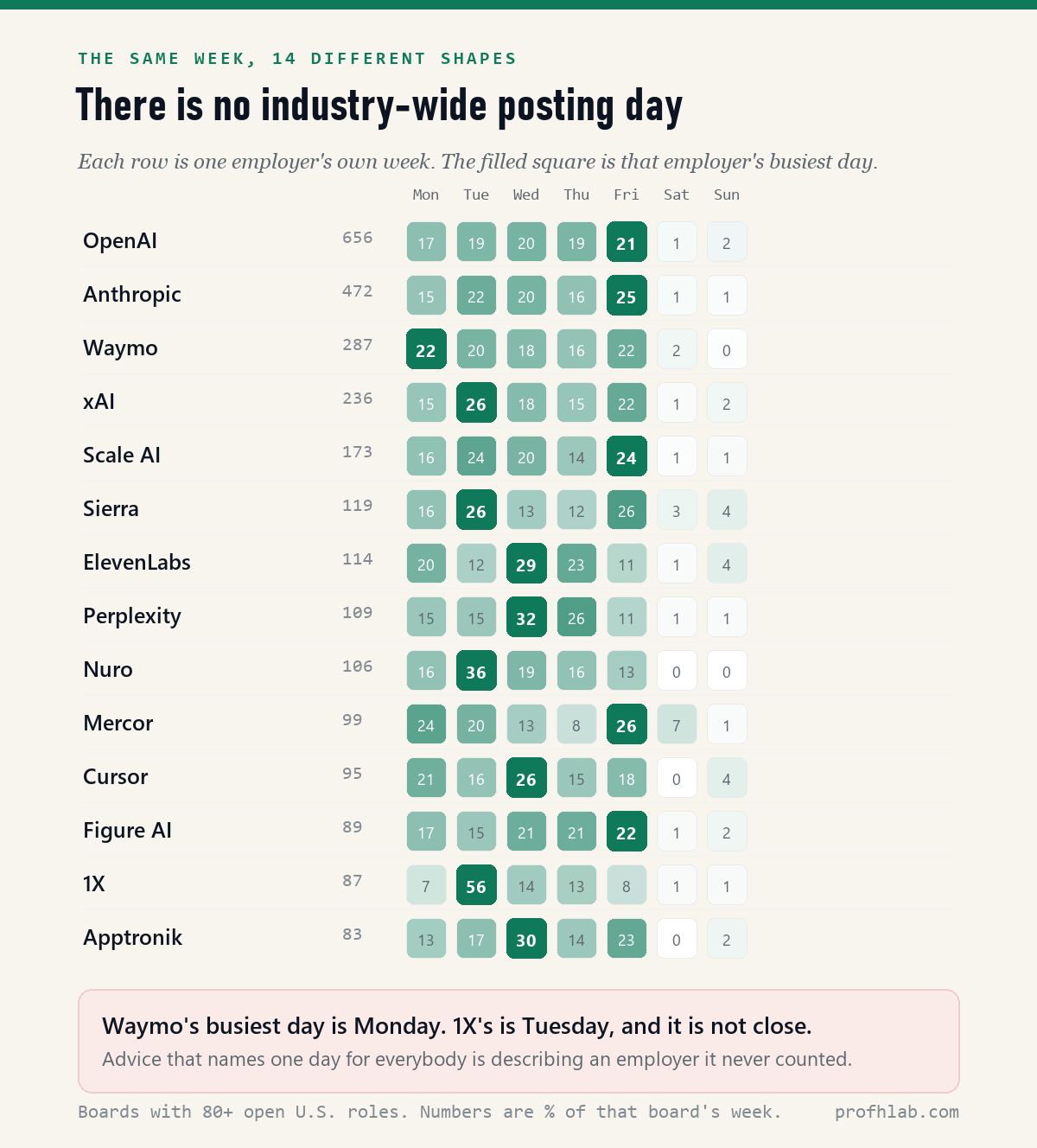
If you are aiming at one company — and most people reading our guide to applying at OpenAI or Anthropic are — the industry average is the wrong number. The company average is the right one, and the only way to get it is to watch that company’s own feed. That is what our AI Jobs Tracker does every morning, and you can browse every open role and apply on the employer’s own site from the board.
How we counted this, and the three ways it could be wrong
Every posting on a modern applicant tracking system carries a publication timestamp. We read that field directly from 19 public career feeds, kept the 3,006 postings located in the United States, and converted each timestamp to U.S. Pacific time. No estimates, no survey, no third-party aggregator. Three things could still bend the result, and you should know all of them.
- Survivorship. Our large sample is a snapshot of jobs still open. If roles posted on a Thursday were filled faster than roles posted on a Tuesday, Thursday would look quieter than it was. That is exactly why we ran the second count: the 582 postings we caught appearing between consecutive daily scans over 22 days cannot be filtered by how fast they close, and they produce the same shape. When two samples with opposite weaknesses agree, the shape is probably real.
- The date on the posting is not always the posting date. One feed format exposes a field that refreshes whenever anyone edits a listing, and another that records first publication. We used first publication. Reading the wrong one is a live hazard on job boards generally — it is the reason a listing can look new when it is not, which we took apart in our piece on old job postings.
- One time zone for everybody. We converted all timestamps to Pacific because most of these employers are headquartered there. For a team working from New York, every hour in our chart is three hours early. The weekday counts barely move under this choice; the hour chart would shift.
One thing we got wrong first, and fixed.
Our first pass at the 22-day sample read the posting date out of our own archived scan files. It returned three Monday postings in three weeks, which looked like a spectacular finding. It was an artifact: the field we were reading only exists in scans saved from September 6 onward, so the sample quietly shrank to a window containing exactly one Monday — Labor Day. We rebuilt it by joining each newly-appeared posting to the live timestamp on the employer’s feed, which is the number reported above. A statistic that arrives looking too good is usually measuring your own pipeline.
What to do with this
- Stop timing the send. Start timing the look. The day you click submit is worth 4.4 points. The day you check decides which postings you ever see at all.
- Check Monday morning, and again around midday Pacific. Monday morning clears the weekend backlog (23.9% of postings, none of it yet picked over). Midday Pacific catches the 9 a.m. to 1 p.m. peak on any weekday.
- Do not stay up for it. Only 7.6% of postings arrive after 6 p.m. Pacific. Refreshing a board at midnight is not diligence.
- For a specific employer, learn that employer’s week. Watch its own careers feed for a month, or use the tracker, which records the count for each company daily.
- Spend the saved effort on the things that actually move outcomes — whether you match the posted requirements, and whether you are applying to roles that are genuinely open to your experience level.
If you want to go deeper
Does the season matter more than the day? Considerably, in some fields. Academic hiring runs on an annual cycle rather than a weekly one — we dated all 45 open listings in when faculty jobs get posted, and the same is true of internships, where the summer 2027 openings follow a calendar you can plan around. A year has real structure. A week does not.
If timing barely matters, what does? On the evidence we have gathered so far: whether the role is real and open to you. Start with which roles do not require coding, how many are actually remote, whether you need a PhD and what the pay bands look like. If a listing asks you for money or moves you to a messaging app, it is not a job — see are AI training jobs legit.
Where else to look. Which AI companies are hiring right now · Is Anthropic hiring · Part-time and work-from-home roles · AI jobs for people over 50 · Why salary ranges are so wide · Becoming a data centre technician · Faculty search tracker.
Two videos on how the posting actually gets made
Questions people ask about when jobs go up
What day of the week are most jobs posted?
Tuesday, narrowly. Among 3,006 open U.S. roles at 19 AI, robotics and autonomy employers read on September 13, 2026, Tuesday carried 21.7%, Friday 20.6%, Wednesday 19.9%, and Monday and Thursday 17.3% each. The five weekdays sit within 4.4 percentage points of one another.
Are any jobs posted on weekends?
Very few. Saturday took 1.6% and Sunday 1.7%, together 99 postings out of 3,006. The drop from Friday to Saturday is 92%, the single largest change anywhere in the week.
What time of day are most jobs posted?
Late morning. 37.6% of postings went live between 9 a.m. and 1 p.m. U.S. Pacific time, and 69.0% inside an 8 a.m. to 6 p.m. working day. The single busiest hour was 9 a.m. Pacific.
Is Monday a good day to look for jobs?
Monday is the quietest weekday for new postings but the best morning to look, which is not a contradiction. Friday, Saturday and Sunday together produce 23.9% of postings, and on Monday morning that entire group is waiting and has not yet had a full working day of applicants.
Does the day I apply affect my chances?
We cannot measure that, and neither can anyone quoting a best day without outcome data. We counted when employers publish, not who gets hired. What our numbers do show is that the supply of postings is nearly flat across the working week, so any day-of-week effect on your odds would have to come from recruiter behaviour rather than from more jobs existing.
Do different companies post on different days?
Yes, and the differences are far larger than the industry average. Across the 14 employers with 80 or more open U.S. roles, the busiest day is Friday at five of them, Tuesday at four, Wednesday at four and Monday at just one. Waymo is that one, peaking on Monday at 22%, while 1X puts 56% of its week into Tuesday and only 7% into Monday.
How did you measure this?
We read the publication timestamp published by each employer applicant tracking system for all 3,795 live postings on 19 public career feeds, kept the 3,006 located in the United States, and converted each to U.S. Pacific time. We repeated the count on a second sample of 582 postings observed appearing during 22 consecutive daily scans, which removes survivorship bias, and the two agree.
Should I wait for a better day to send my application?
No. Waiting costs you days on a live posting in exchange for a difference of about one posting in twenty-three. If a role fits, apply on the day you find it, on the employer own site.
Cite this
profhlab US AI Jobs Desk, “What day of the week are most jobs posted?”, September 13, 2026. Of 3,006 open U.S. roles at 19 AI, robotics and autonomy employers, 21.7% were published on a Tuesday, 17.3% on a Monday and 3.3% across the weekend; 37.6% went live between 9 a.m. and 1 p.m. Pacific. https://profhlab.com/what-day-of-the-week-are-most-jobs-posted/
Before you use any of this
We are not recruiters, we take no money from employers, and postings can close at any time — the official page wins. Apply only on the employer own domain or a government site. Nobody legitimate will ask you to pay a fee, deposit a cheque, or move to a messaging app to continue.
Ask the desk
Tell us the role, the city and the hours you need, and we will look. Requests go to the Jobs Desk and we answer them on that page with links to the employer own listings. One short email a month, no fee, ever.
Written by Prof. H, who counted the timestamps himself on September 13, 2026. Data: 19 public employer career feeds. Methodology and daily figures: AI Jobs Tracker.
Prof.’s H Newsletter
One short email a month, with the numbers in it
What actually moved in AI hiring, AI prices, and the scams aimed at older Americans. Counted here, dated, and linked to the source. One email a month, and your address goes nowhere else.