Why Do Remote Jobs Have Location Requirements? We Read 453 Remote AI Job Postings on Oct. 8, 2026
Because “remote” on a job posting almost never means “anywhere”: on October 8, 2026 we read all 453 remote postings on 12 AI-company job boards, and 406 of them (90%) named a country, a city, an office-time quota, a time zone, a travel duty or states the company cannot hire in. Only 47 said nothing beyond “Remote.” The postings rarely explain why, and the reasons they do give are about taxes, the law and working hours.
What we checked on October 8, 2026
We pulled the full text of every open posting on the public job boards behind our AI jobs tracker, using each board’s own Greenhouse or Ashby feed, and kept every posting whose location line says remote.
- 3,825 open roles on 19 boards that answered. Google DeepMind’s US board returned an error, so it is unread, not zero.
- 453 of them (about 12%) are marked remote, on 12 boards. We read all 453, not a sample.
- Each location sentence our search matched was read by eye before it went into a count.
- FlexJobs’ own article on this question timed out both times we tried to open it, so we quote nothing from it.
Written and checked by Prof. H. An AI assistant helped draft this piece and run the page reads; every quote was read on the posting itself on October 8, 2026.
Why do remote jobs have location requirements?
The 453 remote AI postings we read on October 8, 2026 point to three kinds of reasons: where the employer can legally hire, which hours you can work, and how often you must show up in person. Few say so outright. xAI’s tutor postings are the plainest: the work may be done “from any location worldwide, subject to legal eligibility, time-zone compatibility, and role-specific needs.”
The legal side is mostly about payroll. A Virtual Vocations guide dated October 20, 2023, read on October 8, 2026, says employers with out-of-state staff are “responsible for withholding and paying income tax to each state in which their employees work.” Every new state means new accounts and filings. Licensed jobs, like nursing or law, add a second layer.
That is the job-board explanation. It fits what we saw, but no posting we read named taxes as its reason. We report it as the common explanation, not as the confirmed reason for any one company.

What do remote AI job postings actually require?
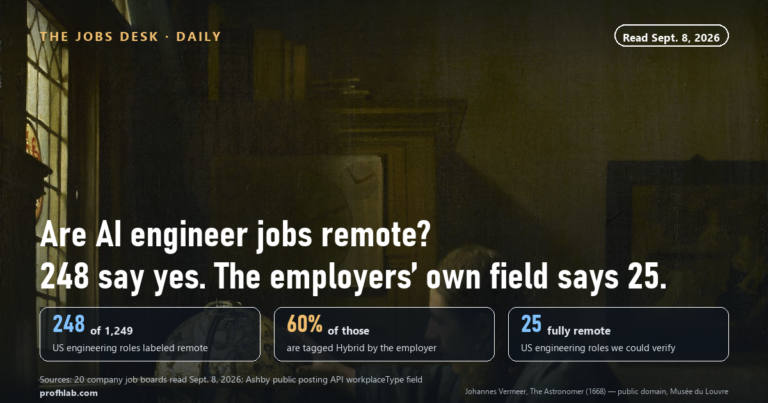
Most name a place before you read a word of the description: on October 8, 2026, 312 of the 453 remote AI postings put a country, city or region right in the location line, such as “Remote (United States)” or “Ontario – Remote.” Of those, 165 named only the United States. The rest named Canada, the UK and Europe, Asia-Pacific, Mexico, Colombia or the Gulf.
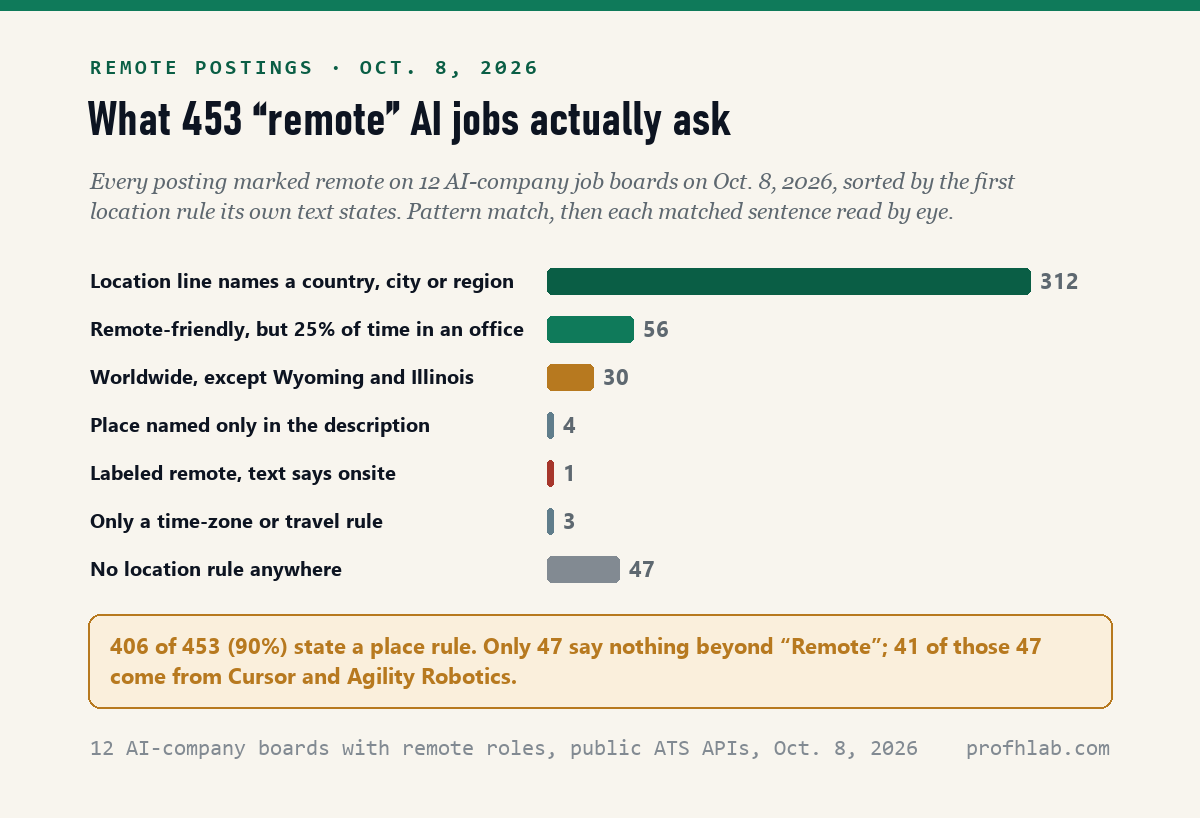
The other rules hide in the description. Anthropic’s 56 remote postings each say “we expect all staff to be in one of our offices at least 25% of the time.” xAI’s 30 tutor postings rule out two US states. ElevenLabs puts the place in a “Location” paragraph, such as “This role is remote but needs to be located within Poland.”
One posting contradicts itself. Agility Robotics lists its PCB Layout and Interconnect Engineer opening as “Remote,” and the description says: “This position is onsite in our Fremont office.” When the label and the text disagree, we would trust the text and ask the recruiter. Our guide to what hybrid means in a job posting covers the in-between cases.
A named city is not always a rule, either. Five Cohere postings labeled “Remote (London),” “Remote (Paris)” or “Remote (Toronto)” each say: “There are no restrictions on where you can be located for this role.” We still counted them by their label, so the 312 may slightly overstate firm rules.
Why can’t xAI hire AI tutors in Wyoming or Illinois?
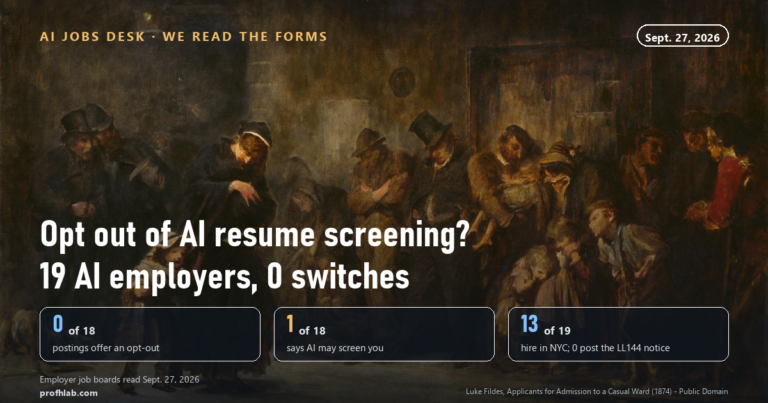
The postings do not say: all 30 xAI AI Tutor openings we read on October 8, 2026 carry the line “For US-based candidates, please note that we are unable to hire in Wyoming and Illinois at this time,” with no reason given. We found no explanation on xAI’s job pages and will not guess at one. If you live in either state, the line is your answer for now.
The same paragraph says tutor roles “may be offered as full-time, part-time, or contractor positions.” Twenty-nine of the 30 also say the work may be done from any location worldwide, which makes the two-state exception stand out. The tutors cover languages from Arabic to Yoruba, plus writing, design, video and software engineering.

Before you apply to any tutor or AI training listing, check that it is real. Our look at whether the xAI AI tutor job is legit and whether AI training jobs are legit lists the warning signs, and part-time AI jobs you can do from home covers the wider field.
Does remote-friendly mean you never go to the office?
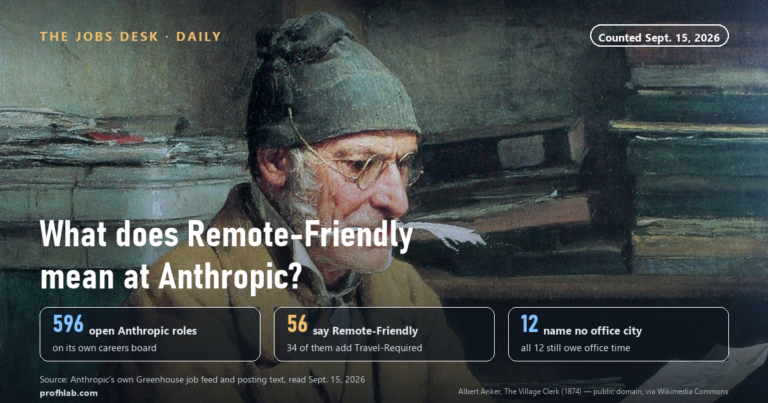
Not at Anthropic: every one of its 56 remote-friendly postings on October 8, 2026 said staff are expected in an office at least 25% of the time, and added that “some roles may require more time in our offices.” Thirty of the 56 also carry “Travel-Required” in the location line itself.
That is roughly one week in four, by our arithmetic, not a number Anthropic gives in days. Our earlier piece on what remote-friendly means at Anthropic goes deeper, and whether Anthropic is hiring covers the rest of its board.
OpenAI writes it differently. Its Technical Threat Investigator posting says: “While the role is remote, regular in-person engagement with our San Francisco (SF) headquarters will be expected.” Most of OpenAI’s 34 remote postings carry no such sentence, so a missing line does not prove there are no office visits. See whether OpenAI is still hiring for its full board.
Do remote jobs require you to work in a certain time zone?
Some do in writing: 46 of the 453 remote AI postings on October 8, 2026 set a time-zone condition, 30 at xAI and 16 at ElevenLabs. ElevenLabs’ Account Manager – Strategic posting says the job can be done from anywhere in the United States, “however the ability to operate in ET, CT, MT, or PT timezones is required.”

Only one of those 46 gives its reason. ElevenLabs’ Infrastructure Security Engineer posting says: “to facilitate working with the Security Team, we prefer candidates based in GMT to GMT+3 or UK.” In plain terms, the team wants your workday to overlap with theirs.
And one shows how these lines get written. ElevenLabs’ Data Scientist – Product Analytics posting, live on October 8, still had a template note in its location paragraph: “[please fill with specific location / timezone requirements].” Nobody had filled it in. If a posting is vague, it may simply be unfinished. Ask.
Do remote jobs pay less than office jobs?
Not on these boards: comparing posted US pay ranges at the same company on October 8, 2026, remote roles had a higher median at 4 of 6 companies and a lower one at 2. Sierra’s 17 remote postings had a median midpoint of $335,000 against $245,000 for its other 86 US postings. Waymo went the other way: $177,500 for 11 remote postings against $238,000.
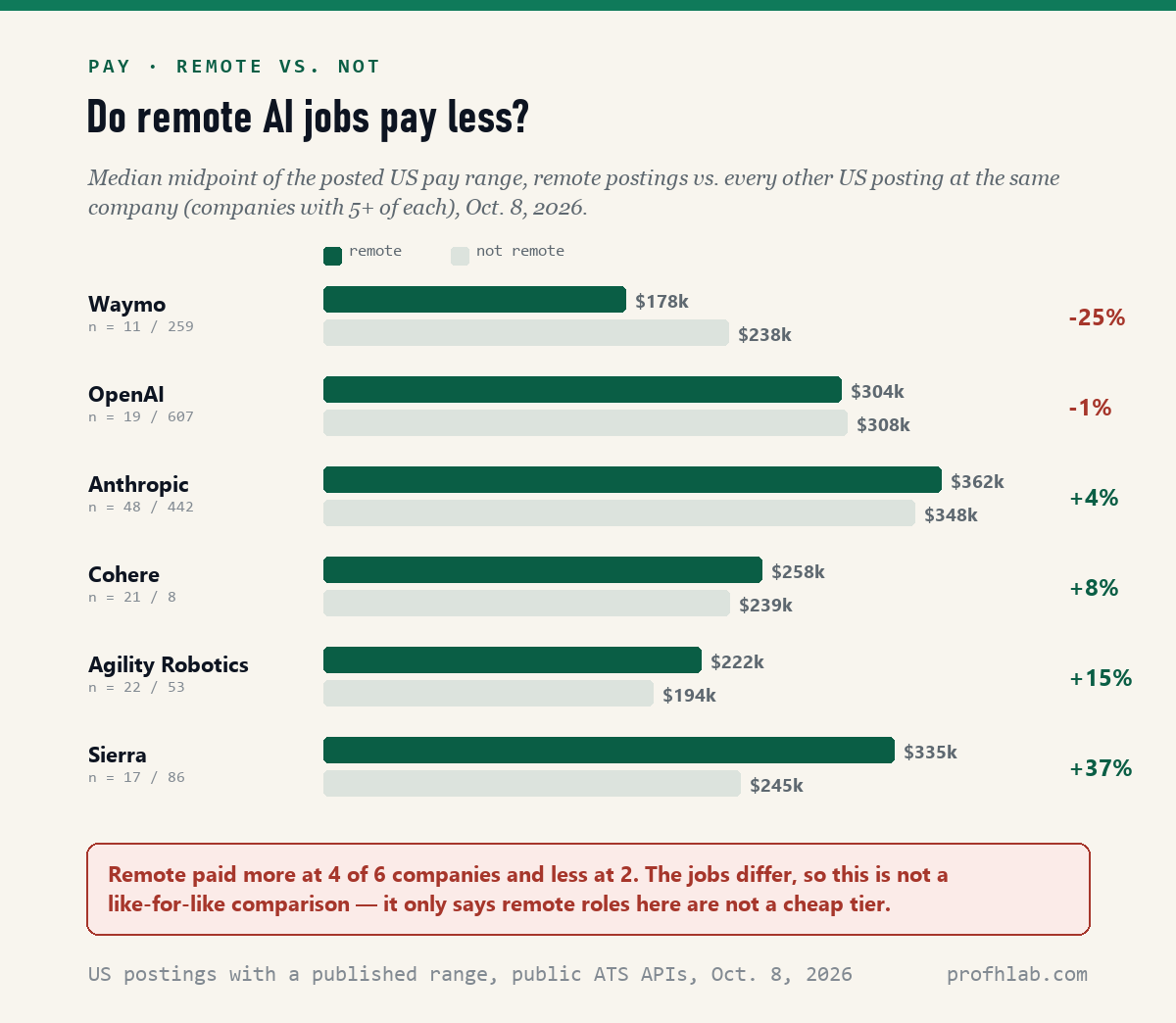
Treat this as a check, not a verdict. The remote jobs are different jobs from the office ones. At Sierra, 16 of the 17 remote postings with a range are enterprise sales director or leader roles. At Waymo, 4 of the 11 are software quality operations specialists. What the data does rule out is a fixed discount for working from home at these six companies.
Why some ranges are missing at all is its own story; see why job postings don’t show salary. If a form asks what you expect, our count on what to put for desired salary helps.
How do you check a remote job’s location rule before you apply?
Read the posting in this order, which is where the 406 rules we counted on October 8, 2026 actually sat: the location line, then any “Location” paragraph, then the closing fine print. Anthropic’s 25% line sits in the second half of each posting, and xAI’s state exclusion sits near the very end.
- Location line. “Remote (United States)” or “US – Remote” means a US address. A city in brackets may be a rule or a hint; the text decides.
- Location paragraph. Look for “needs to be located within,” a list of time zones, or an office you must live near.
- Fine print. Search the page for “office,” “travel,” “time zone” and the name of your state.
- Ask if it is silent. The 47 postings with no rule are the ones to ask about before you move.
Agility Robotics shows what a silent-looking posting can still say. Twenty of its postings labeled only “Remote” call the job “fully remote” with “the option to work hybrid if within a commutable distance” of Salem, Oregon, Pittsburgh or Fremont, California. That is an offer, not a rule, so 19 of them count as having no location rule; the twentieth also mentions travel.
Cursor is the other big group among the 47. Its 22 postings in that group read only “Remote” and name no country in the text. The board’s data feed lists a United States address for them; we did not check whether the page itself shows it.
To compare employers, see which AI companies are hiring remote workers, our September count of who means it. Or browse every open role and apply on the employer’s site on our jobs board.
FlexJobs on remote jobs that still name a place
This short video from the FlexJobs channel covers the same question in general terms, including taxes and licenses. We list it for context and did not use it for any count in this piece.
Wyoming, Illinois and other short answers on remote job locations
Why do some remote jobs require you to live in a certain state?
Mostly payroll and legal limits. Job-board guides say employers must withhold tax in each state where staff work. On October 8, 2026, 406 of 453 remote AI postings stated a place rule.
Can you work a remote job from a different state?
Only if the posting allows it. Read the location line and fine print, and ask the employer before you move, because the rule can change where you may work.
What does Remote US mean on a job posting?
It means you can work from home inside the United States. On October 8, 2026, 165 of 453 remote AI postings named only the US in the location line.
Why do remote jobs exclude certain states?
Employers rarely say. All 30 xAI AI Tutor postings on October 8, 2026 said xAI cannot hire in Wyoming and Illinois, with no reason given.
Do remote jobs pay less?
Not on AI company boards we read. On October 8, 2026, remote roles had a higher median posted pay at 4 of 6 companies and a lower one at 2.
More on how AI companies hire: which AI companies are hiring right now, whether Waymo is hiring, whether Figure AI is hiring, entry-level AI jobs with no experience, AI jobs for people over 50 and whether the AI job market is saturated. Applying to more than one opening? See whether you can apply to multiple jobs at the same company.
Have a posting you want us to read? Ask the desk, or visit the Jobs Desk. We are not recruiters and take no money from employers. Postings can close at any time; the employer’s own page wins. Never pay anyone to get hired, and apply only on the employer’s own site.
Cite this
On October 8, 2026, 406 of 453 remote job postings on 12 AI-company boards (90%) stated a location rule: a named country, city or region, an office-time quota, a time zone, travel, or excluded states. 47 stated none. Source: profhlab.com AI Jobs Desk, Why Do Remote Jobs Have Location Requirements?, with daily numbers on the AI jobs tracker.
How we counted: “Remote” means the posting’s location line contains the word remote, or the Ashby feed marks the workplace as remote. Each posting is placed in one group, by the first rule found in this order: Anthropic’s office-time line, a body that says onsite, xAI’s state exclusion, a place named in the location line, a place named in the location paragraph. Time-zone and travel rules were counted separately. Pay compares the midpoint of each posted US range.
Sources read October 8, 2026: Anthropic, Anthropic Fellows Program (office-time line); xAI, AI Tutor – German; ElevenLabs, Account Manager – Strategic; ElevenLabs, Infrastructure Security Engineer; ElevenLabs, Data Scientist – Product Analytics; ElevenLabs, Accounts Payable Specialist (Poland); OpenAI, Technical Threat Investigator; Agility Robotics, PCB Layout and Interconnect Engineer; Agility Robotics, Senior Business Recruiter; Cohere, Member of Technical Staff, Modeling; Cursor, Solutions Architect; Virtual Vocations, Why Do Telecommute Jobs Have a Location Requirement (dated October 20, 2023).
Prof.’s H Newsletter
One short email a month, with the numbers in it
What actually moved in AI hiring, AI prices, and the scams aimed at older Americans. Counted here, dated, and linked to the source. One email a month, and your address goes nowhere else.