How to Avoid Surveillance Pricing: What 8 Store Privacy Notices Say, and the Free Signal 4 of Them Name
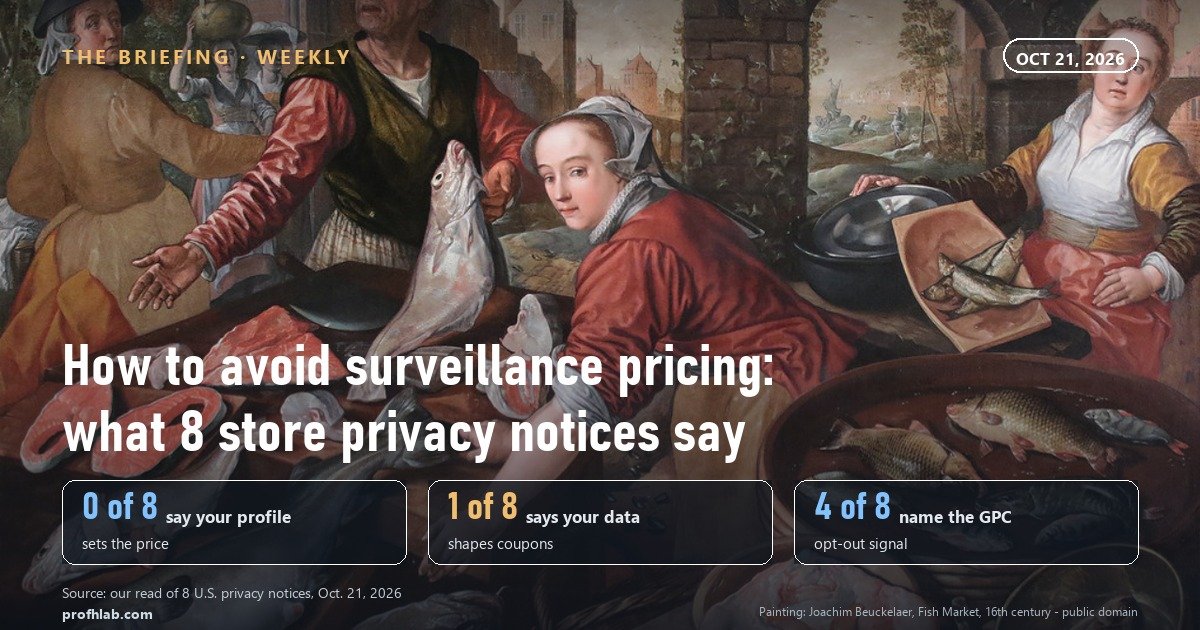
You cannot opt out of surveillance pricing everywhere, but you can shrink it: on October 21, 2026 we read the U.S. privacy notices of eight big shopping and ride apps, and 0 of 8 say your shopping history or demographics set an item’s price, 1 says how you browse shapes the digital coupons you see, and 4 name a free browser switch called Global Privacy Control.
This was the week the question got loud. The Associated Press reported on October 18, 2026 that legislators in at least 30 states considered pricing bills this year. Two state bans took effect on October 1. The coupon is where the quiet part lives.
What we checked on October 21, 2026
- The U.S. privacy notices of 12 retailers and apps. We could read 8 (Amazon, Costco, Delta, DoorDash, Instacart, Lyft, Uber, Walmart). Target and Kroger served a page shell to our script, Home Depot refused it (403) and Best Buy timed out. Those 4 are UNREAD, not zero.
- The signed text of Maryland Chapter 154 (2026) and Connecticut Public Act 26-64, from the two legislatures’ own sites.
- New York attorney general releases of November 5, 2025 and January 8, 2026; New Jersey’s July 23, 2026 signing release; Instacart’s own newsroom post.
- Firefox’s help page for Global Privacy Control, and a 2014 Northeastern University price study.
Written and checked by Prof. H. An AI assistant helped draft and run the page reads; every quote was read on the source’s own page on the date shown. This is consumer information, not legal advice.
How do I avoid surveillance pricing without giving up my apps?
Five habits cover most of it, and none costs money: send an opt-out signal, compare signed in against signed out, judge the coupon by the final price, look for the state warning label, and keep timed screenshots when two prices differ.
None of these guarantees the lowest price. What they do is turn a hunch into evidence. Surveillance pricing works because you only ever see your own number. The fix is to see a second one.
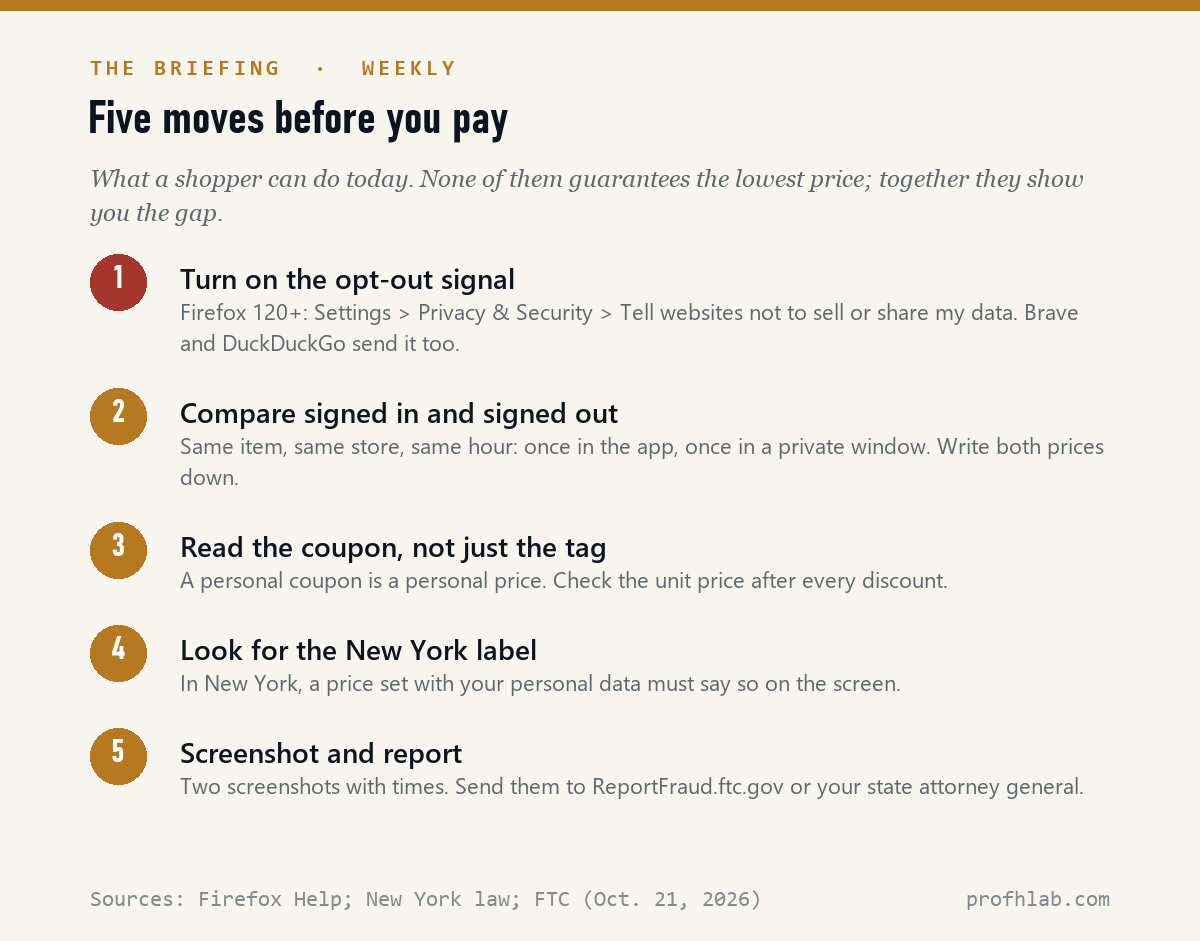
The signal is the easiest win. Firefox’s help page, read October 21, 2026, says the setting has existed since Firefox 120: Settings › Privacy & Security › Website Privacy Preferences › Tell websites not to sell or share my data. Mozilla is candid about the limit: “GPC is a signal, not a blocker.”
The Global Privacy Control project lists Brave, DuckDuckGo’s browser and Firefox, plus extensions such as Privacy Badger. Chrome and Edge are not on that list. Our Firefox AI settings guide walks through the same menu, and the Chrome and Edge guides show what those browsers do offer.
What do Walmart, Uber and Instacart say about my price?
Of the 8 privacy notices we read on October 21, 2026, none says it sets an item’s price from your shopping history or demographics; Uber and Lyft say personal data goes into the fare, Instacart says your browsing shapes its digital coupons, and Walmart promises not to charge more if you use your privacy rights.
| Company (notice dated) | What it says about your price | Names Global Privacy Control? |
|---|---|---|
| Uber (Sept. 17, 2026) | “Uber uses algorithms to determine the price you pay.” The listed factors are trip type, your location, distance, driver supply, time and traffic. | No |
| Lyft (July 1, 2026) | Personal information is used to “Calculate fares.” No factor list. | No |
| Instacart (Jan. 15, 2026) | Based on how you browse, “we display content, advertising, recommendations, digital coupons.” | Yes, “as required under applicable laws” |
| Walmart (Aug. 20, 2026) | Will not “charge different prices or rates” because you exercise privacy rights. | Yes; reaches your account if you are signed in |
| Costco (July 1, 2026) | Lists purchase price only as data it collects. | Yes; may not link it to your membership |
| DoorDash (July 1, 2026) | No statement about how prices are set. | Yes |
| Amazon (June 30, 2026) | Personal data used to recommend and “personalize your experience”; nothing on prices. | Not in the main notice |
| Delta (October 2026) | May use “machine learning, or other artificial intelligence-enabled technologies”; no word on fares. | No |
Source: each company’s U.S. privacy notice, read October 21, 2026. “No statement” means the notice does not describe how prices are set, not that the company does not do it.
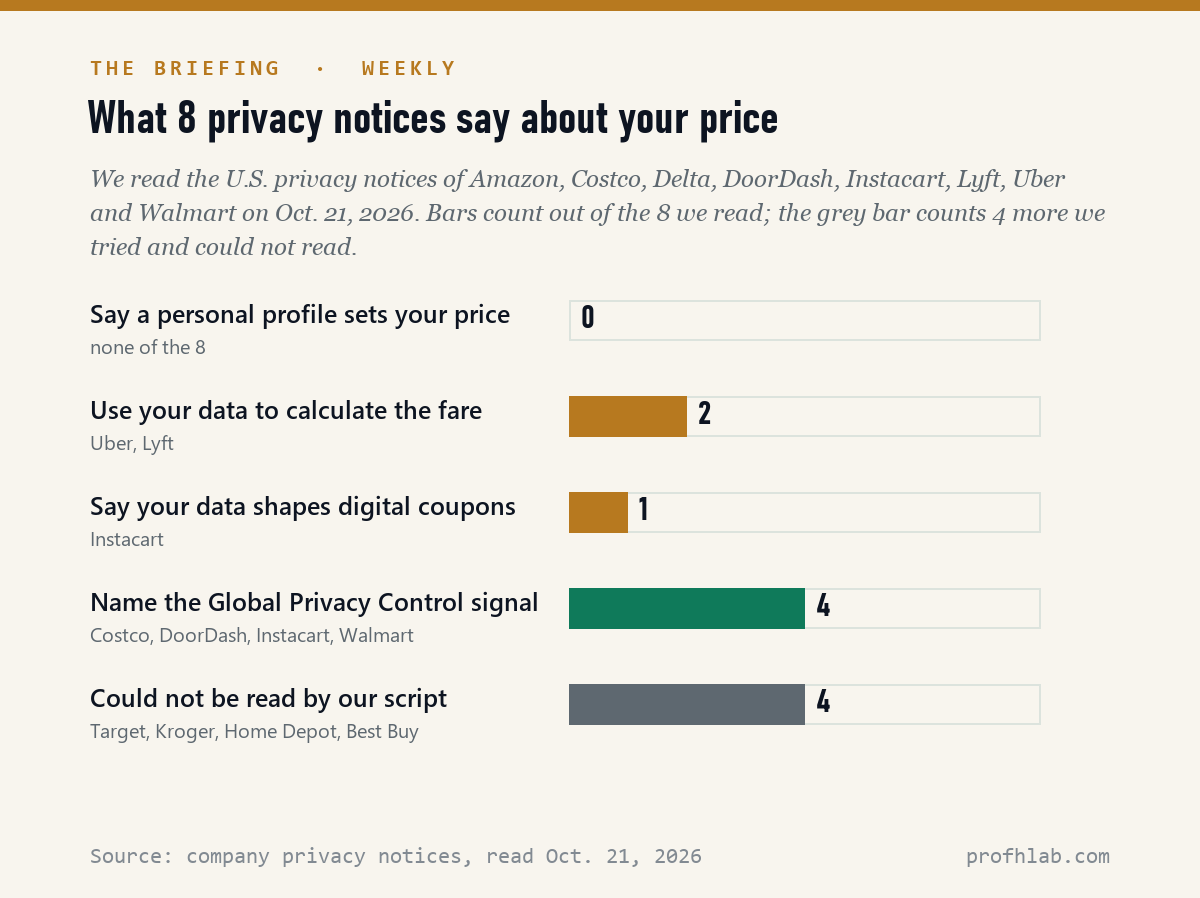
Two details matter more than the totals. Walmart’s notice says a signal sent while you are signed in “will extend to your Walmart account.” Costco warns the opposite: it “may not be able to associate a signal sent from your browser with your membership information.” So at Costco, use the Your Privacy Choices form as well.
For the other AI switches inside these accounts, see how to turn off AI on Amazon and what is safe to hand a chatbot.
Does incognito mode or a VPN get you a lower price?
There is no good evidence that it does on its own: the most cited test, a 2014 Northeastern University study of 300-plus real users on 16 sites, found personalization on 9, and on Orbitz and Cheaptickets the signed-in members were the ones shown cheaper hotels.
The study says those signed-in users saw different prices on about 5% of hotels, $12 cheaper on average. Signing out would have cost them money. Expedia and Hotels.com sorted users into test groups by cookie, so clearing cookies just reshuffled the group.
That study is 12 years old, and the tools have changed. We looked for a newer controlled test of private windows or VPNs and did not find one. Our inference: treat incognito as a second pair of eyes. Compare both views and buy the cheaper one.
Is a personal coupon the same as a personal price?
For your wallet, yes: a discount only you can see is a personal price, and the New York attorney general’s November 5, 2025 alert says such a discount is “more likely to be a personalized one set using your data.”
The biggest test so far was Instacart. Consumer Reports said on December 9, 2025 that a study with Groundwork Collaborative found the same item up to 23% apart, from the same store at the same time. Basket totals differed by about 7% on average.
The New York attorney general later put the volunteer count at 437 shoppers in four cities. Consumer Reports analyzed 193 high-quality submissions and estimated the swing at about $1,200 a year for a household of four. That is their estimate, not a bill anyone received.
Instacart’s answer came on December 21, 2025: “Instacart is ending all item price tests on our platform.” Retailers can no longer use its Eversight tool to run them. We did not run a new test, so we cannot say what every shopper sees today.
Refund and fee traps live in the same apps. Our Cleo AI refund guide covers a real FTC payout, and cancelling ChatGPT Plus covers a subscription you may have forgotten.
Which states ban surveillance pricing as of October 2026?
Two state bans are in force as of October 21, 2026, both since October 1: Maryland’s for grocery food and Connecticut’s for retail sellers and delivery apps. New Jersey has signed a grocery and necessities ban, and New York requires a warning label rather than a ban.
| State | What the law does | In force |
|---|---|---|
| Maryland, Ch. 154 (HB 895) | Large food stores (15,000 sq. ft. or more) and delivery apps may not use “surveillance personal data to set a higher price” for untaxed food. Other merchants must post a label. | Oct. 1, 2026 |
| Connecticut, P.A. 26-64 | “No retail seller or third-party delivery service” may engage in surveillance pricing. Opt-in loyalty and group discounts allowed. | Oct. 1, 2026 |
| New Jersey, Fair Price Protection Act | Bans personal-data pricing on groceries and other necessities; one-year pause on new electronic shelf labels. | Signed July 23, 2026; start date not in the release |
| New York, Gen. Bus. Law 349-a | No ban. A price set with your personal data must carry a printed warning. | Nov. 10, 2025 |
Sources: Maryland and Connecticut signed texts; New Jersey governor’s release; New York attorney general, all read October 21, 2026.
Maryland’s law has two soft spots worth knowing. Promotions and loyalty benefits are excluded from its definition of dynamic pricing. And the state must give a business 45 days to cure a violation before it can act. You cannot sue under it yourself; the text rules out a private right of action.
Colorado’s legislature passed a ban this year, but CBS Colorado reported in June that Gov. Jared Polis vetoed it. Our September piece on whether charging different prices is illegal covers the federal side in depth.
What does the warning label say, and where do you report a missing one?
New York’s label, required since November 10, 2025, reads “THIS PRICE WAS SET BY AN ALGORITHM USING YOUR PERSONAL DATA,” and the attorney general takes complaints online or at 1-800-771-7755; Maryland and Connecticut have their own wording.
| State | Exact required words |
|---|---|
| New York | THIS PRICE WAS SET BY AN ALGORITHM USING YOUR PERSONAL DATA |
| Maryland | THIS PRICE WAS SET BY AN ALGORITHM OR BY USING YOUR PERSONAL DATA |
| Connecticut | THIS PRICE WAS INCREASED BY A PRICE SETTING DEVICE USING YOUR PERSONAL DATA |
From the New York attorney general’s alert and the Maryland and Connecticut signed texts, read October 21, 2026.
Notice the Connecticut word: increased. The law skips the label when the same kind of device sets a discounted price online. A label that only appears when you pay more is, at least, honest about which direction matters.
The labels are rare in the wild. On January 8, 2026 the New York attorney general wrote that Instacart’s disclosures were “buried on a page only accessible by clicking on fine print.” Retailers are also challenging the New York law in the federal Second Circuit, Courthouse News reported; we found no ruling as of October 21, 2026.
Where to send a screenshot
- New York: attorney general consumer complaint, or 1-800-771-7755.
- Maryland and Connecticut: the attorney general, which enforces both new laws.
- Anywhere in the U.S.: ReportFraud.ftc.gov.
Send the item, the store, both prices and both times. A real regulator will never ask you to pay a fee to file. If a caller offers to “recover” an overcharge for a fee, see AI scams targeting seniors.
Federally, nothing is final. The FTC proposed an enforcement policy statement on personalized pricing on August 19, 2026. Its regulations.gov docket shows comments closed September 25, 2026, with 4,597 submissions received. There was no final statement as of October 21.
Before your next grocery order this week, try this once
One controlled comparison takes about ten minutes and tells you more than any article, including this one: pick three items you buy every week, price them two ways within the same hour, and write down the totals.
- Turn on Global Privacy Control in Firefox, Brave or DuckDuckGo.
- Price the three items in the store’s app while signed in. Screenshot it.
- Price them again in a private window, signed out, same store. Screenshot it.
- Add up each basket after coupons. Unit price, not the banner.
- If the gap is real and there is no label, file the screenshots with your attorney general.
A gap is not proof of illegal pricing. Location, delivery fees and loyalty prices can all move a total legally. But a gap you can show is a gap you can ask about, and four states now have written rules on prices set from personal data.
Other places AI touches your wallet this fall: the newest AI phone scams, turning off ChatGPT ads, and the AI price tracker we update by hand.
Six things shoppers ask about prices that follow them around
How do I avoid surveillance pricing?
You cannot switch it off everywhere, but you can see it and shrink it. Turn on Global Privacy Control in your browser, compare the same item signed in and signed out at the same hour, read the price after every app-only coupon, and keep two timed screenshots if the numbers differ. In New York, a price set with your personal data must carry a printed warning.
Does incognito mode stop surveillance pricing?
Not reliably. The best-known measurement, a 2014 Northeastern University study of 16 sites, found personalization on 9, and on two travel sites the signed-in shoppers were shown cheaper hotels. We found no controlled study showing that a private window alone lowers prices. Use it to compare, not as a shield.
Which states ban surveillance pricing?
As of October 21, 2026, Maryland and Connecticut have bans in effect since October 1, 2026. Maryland covers grocery food at large stores and delivery apps; Connecticut covers retail sellers and delivery services. New Jersey signed a grocery and necessities ban on July 23, 2026. New York requires a disclosure label instead of a ban.
What does THIS PRICE WAS SET BY AN ALGORITHM mean?
It is the warning New York has required since November 10, 2025 when a business sets a price with your personal data. The full New York text is THIS PRICE WAS SET BY AN ALGORITHM USING YOUR PERSONAL DATA. Maryland requires a similar line, THIS PRICE WAS SET BY AN ALGORITHM OR BY USING YOUR PERSONAL DATA.
Is Instacart still charging different prices?
Instacart said on December 21, 2025 that it was ending all item price tests on its platform and that retailers could no longer use its Eversight tool to run them. We did not run a new price test, so we cannot confirm what every shopper sees today.
Where do I report surveillance pricing?
In New York, file with the state attorney general online or call 1-800-771-7755. In Maryland and Connecticut, the attorney general enforces the new laws. Anywhere in the U.S., you can report it to the FTC at ReportFraud.ftc.gov. Include the item, the store, both prices and the times you saw them.
Cite this:
Of 8 large U.S. retailer and app privacy notices read on October 21, 2026 (Amazon, Costco, Delta, DoorDash, Instacart, Lyft, Uber, Walmart), 0 said shopping history or demographics set an item’s price, 1 (Instacart) said browsing shapes its digital coupons, and 4 named Global Privacy Control. Source: profhlab.com, The Briefing, October 21, 2026.
Eight privacy notices, three state laws and one 2014 study we read
- Uber Privacy Notice: Riders and Order Recipients, last updated September 17, 2026; read October 21, 2026
- Lyft Privacy Policy, last updated July 1, 2026; read October 21, 2026
- Instacart Privacy Policy, last updated January 15, 2026; read October 21, 2026
- Walmart Customer Privacy Notice, updated August 20, 2026; read October 21, 2026
- Costco Privacy Notice, last updated July 1, 2026; read October 21, 2026
- DoorDash Privacy Policy, last updated July 1, 2026; read October 21, 2026
- Amazon.com Privacy Notice, last updated June 30, 2026; read October 21, 2026
- Delta Air Lines Global Privacy Policy, October 2026; read October 21, 2026
- Maryland Laws 2026, Chapter 154 (HB 895), approved April 28, 2026, effective October 1, 2026; read October 21, 2026
- Connecticut Public Act 26-64 (SB 4), approved May 27, 2026, Sec. 11 effective October 1, 2026; read October 21, 2026
- New Jersey Governor, Fair Price Protection Act signing release, July 23, 2026; read October 21, 2026
- New York Attorney General, consumer alert on algorithmic pricing, November 5, 2025; read October 21, 2026
- New York Attorney General, letter to Instacart, January 8, 2026; read October 21, 2026
- Instacart, “Ending item price tests on Instacart,” December 21, 2025; read October 21, 2026
- Consumer Reports, Instacart pricing report release, December 9, 2025; read October 21, 2026
- Associated Press, “Consumer apprehension grows as US retailers adopt AI-assisted pricing tools,” October 18, 2026 (via KSL); read October 21, 2026
- FTC proposed enforcement policy statement on personalized pricing, docket FTC-2026-1057, posted August 19, 2026; checked October 21, 2026
- Firefox Help, Global Privacy Control; read October 21, 2026
- Global Privacy Control project, supported browsers list; read October 21, 2026
- Hannak et al., Measuring Price Discrimination and Steering on E-commerce Web Sites, IMC 2014 (Northeastern University)
- Counts are ours, from the saved notices. Method: how we count.
Next checks: a New York court ruling and the New Jersey start date
We will reread the four state texts and these eight notices when the Second Circuit rules on New York’s label, and again before New Jersey’s ban starts. If a notice adds pricing language, or one of the four UNREAD pages opens, this page gets a dated update.
More from this desk: The Briefing · stopping AI from reading your Gmail · Meta AI and WhatsApp · why the Medicare calls keep coming · AI deals we verified · Start here. One short email a month, if you want the next edition when it lands.
About the author. Prof. H teaches robotics and AI and writes The Briefing, a weekly read of where AI news reaches your wallet. Every document here was fetched and read on the date shown. This is general consumer information, not legal advice. Corrections and questions: ask here.
Prof.’s H Newsletter
One short email a month, with the numbers in it
What actually moved in AI hiring, AI prices, and the scams aimed at older Americans. Counted here, dated, and linked to the source. One email a month, and your address goes nowhere else.