Ψ0 (Psi-Zero), Explained: The Humanoid Foundation Model That Learns From Human Video
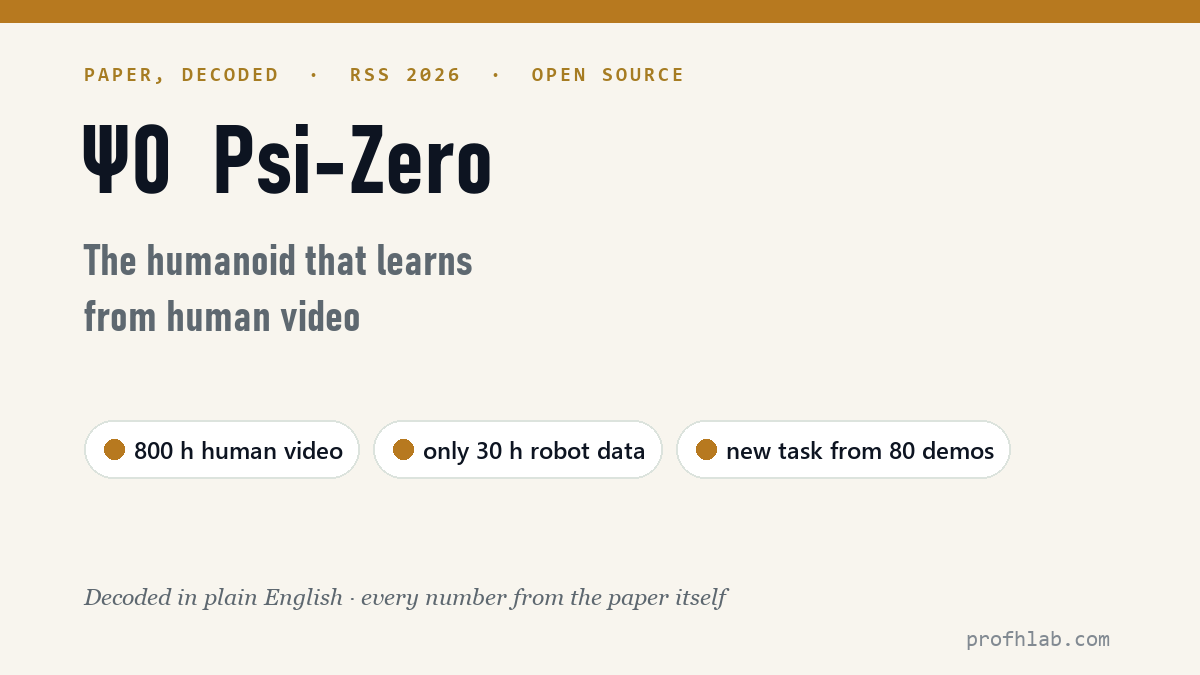
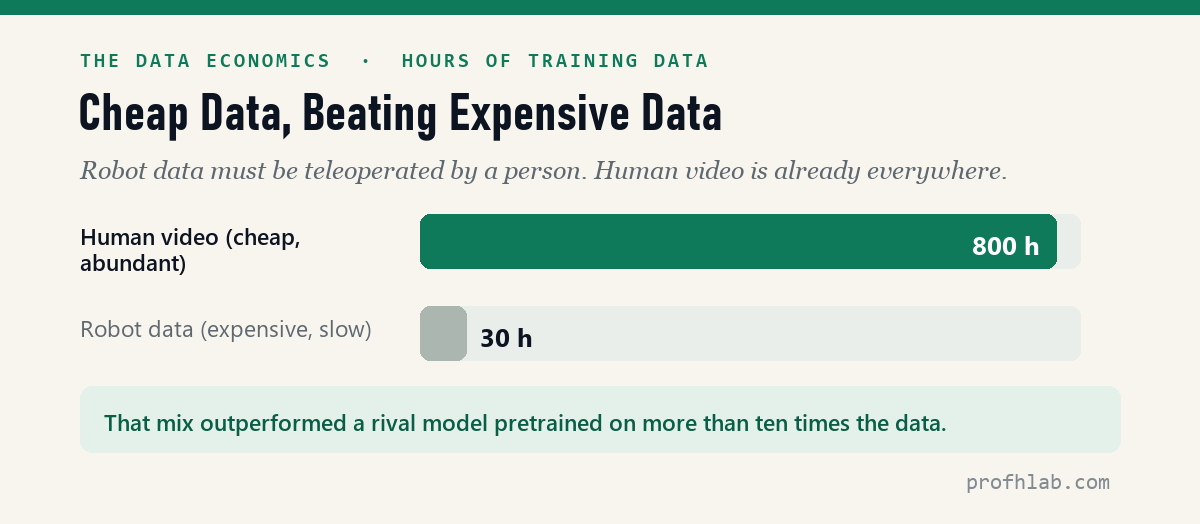
Making a robot smart comes down, in the end, to data. And the data that matters most — a person steering a robot by teleoperation, one demonstration at a time — is expensive and slow to collect. Ψ0 (Psi-Zero), a paper released in March 2026 and promptly accepted to RSS (Robotics: Science and Systems) 2026, one of the top venues in robot research, took a different route: 800 hours of first-person human video — the kind YouTube is full of — plus just 30 hours of real robot data.
With that combination it beat a competing model trained on more than ten times the data by over 40 percent in success rate. Today we take this paper apart at a general reader’s eye level.
| Item | Details |
| Original title | Ψ₀: An Open Foundation Model Towards Universal Humanoid Loco-Manipulation |
| Authors / affiliation | Songlin Wei, Hongyi Jing, Boqian Li and 12 others (corresponding authors Yue Wang, Marco Pavone) · Physical Superintelligence Lab |
| Release / acceptance | arXiv preprint released March 12, 2026 / accepted to RSS 2026 · model and code released as open source |
| DOI / link | arXiv:2603.12263 — arxiv.org/abs/2603.12263 |
Loco-manipulation? The word welds locomotion (walking) to manipulation (handling things with the hands). It names the ability to move and manipulate as one body — the way a person walks over, opens a door, picks something up, and carries it. A humanoid cannot become a real worker without it.
The core technique
Ψ0’s core idea is, unexpectedly, refusing to mix.
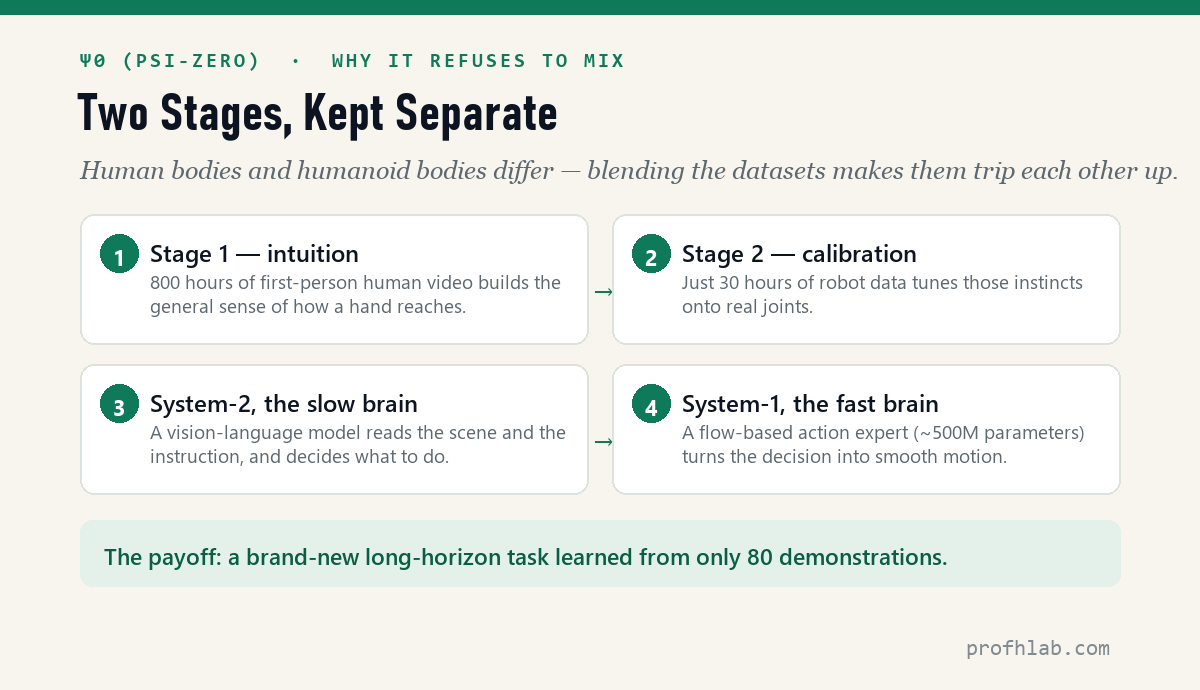
A lot of recent work has assumed that pouring human data and robot data into one pot and co-training on both is the way forward. The Ψ0 authors push back: a human body and a humanoid body differ fundamentally — in joint structure and in how they move — so blending the two datasets makes them trip each other up. It is like trying to stamp a right-hander’s and a left-hander’s handwriting habits into one person’s body at the same time.
So Ψ0 splits learning into two separate stages (staged training):
- Stage 1 — building intuition from human video: the model first studies 800 hours of first-person footage of people handling objects, absorbing the general visual-action sense of “in this situation, the hand reaches like this.”
- Stage 2 — calibrating hands and feet on robot data: on top of that, 30 hours of high-quality humanoid robot data fine-tune the model to drive real robot joints precisely.
The theory in plain words
Ψ0’s brain divides into two systems, like the human “fast brain / slow brain.”
- System-2 (the slow brain, in charge of understanding): a vision-language model (VLM) backbone that understands the camera view and a language command (“put the cup on the shelf”). It reads the situation and decides what needs doing.
- System-1 (the fast brain, in charge of execution): a flow-based action expert that turns that judgment into actual joint motion. It carries the diffusion/flow techniques used in image-generation AI (the Stable Diffusion family) over to robot motion generation — a module of roughly 500 million (500M) parameters that produces smooth, continuous movement.
Because Stage 1 pre-soaks the VLM backbone in human video in an autoregressive fashion, Stage 2 needs only a little robot data to lock in real-world competence quickly. The result: a completely new long-horizon task can be learned from just 80 demonstrations. Against the hundreds to thousands of demonstrations robot learning usually demands, that is a jolt.
Real-world results
The most attractive point is the data economics. Robot data has a severe bottleneck: a person has to teleoperate the robot and gather it stitch by stitch. Ψ0 cuts that expensive robot data down to 30 hours and fills the rest with cheap, abundant human video. According to the paper, this recipe outperformed even a model pre-trained on more than 10 times the data.
The natural application scenarios are repetitive walk-grasp-carry work: loading and unloading in warehouses, tidying and storage at home, tool use by service robots. The remaining limits are just as clear, though. Sourcing high-quality human video (first-person, with hand manipulation clearly visible) is itself no small task, and the paper’s performance numbers come from controlled settings — they have not been validated against the unpredictable variables of full household and industrial environments. And although the work has moved past the preprint stage into RSS acceptance, product-grade safety and reliability remain a separate, long road.
Why it matters
Industrially, the big fact is that Ψ0 is released open source. Smaller robot companies and labs that could never afford to develop a foundation model of their own now have a path: take this model and fine-tune it with a small amount of their own robot data.
Seen from Korea’s robot industry — the world’s densest robotics market — hardware-strong players such as Rainbow Robotics (humanoid platforms), Doosan Robotics (collaborative robots), and LG and Samsung (appliance and home robots) could use a data-efficient robot brain like Ψ0 as a lever to close the software gap quickly. The “learn from human video” direction also meshes well with the country’s strength in video and data infrastructure.
Who should care
- If you invest: robot competitiveness may shift from “who holds the most data” to “who learns best from the least.” Teams and companies with data-efficiency technology may get re-rated. (This is industry-trend information, not a recommendation to buy any particular stock.)
- If you study or research: image-generation AI (diffusion/flow) and robot control are meeting inside one model. Whichever field you are in, learning the other side’s techniques widens your opportunities.
- If you build products: rather than building a foundation model from scratch, taking an open model and fine-tuning it on “our robot’s data” may be the realistic winning move.
The 3–5 year view
The bridge Ψ0 built — from human video to robot motion — could redraw the robot-learning landscape three to five years out. The vast archive of first-person human activity video on the internet becomes the robot’s textbook, and a new task takes hours to teach instead of days. Humanoids that learned to walk, grasp, and carry from watching people, quietly settling into warehouses and homes — that picture stops being a distant one.
Not a robot you can buy, and why human video is only stage one
Is Ψ0 a robot that is already on sale?
No. Ψ0 is not a specific product but “brain” software — a foundation model that can sit on top of many different humanoids — and its code and model are released open source for research.
Can human video alone make a robot move perfectly?
Human video is the Stage 1 ingredient that builds the “feel”; precise real movement is completed in Stage 2, where 30 hours of robot data fine-tune the model. Keeping those two stages separate is the heart of this paper.
This edition examined Ψ0, a humanoid foundation model whose weapon is data efficiency. Next on this shelf: a recent paper on contact-rich manipulation that combines tactile sensing with force control.
Source: arxiv.org/abs/2603.12263 (project: psi-lab.ai/Psi0)
This article reinterprets published research for a general audience; for full details, see the original paper. The rest of the decoded-papers shelf lives on the Physical AI page.
NVIDIA introduces GR00T N1, its open humanoid foundation model
Full index
Every guide in the Physical AI library — 27 of them, grouped so you can find the one you need.
Start here
- Physical AI Foundations: World Models, Robot Foundation Models, and Sim2Real — From Zero
- Physical AI Explained: Why a Chatbot Knows the Cup Falls but a Robot Doesn’t
- The Physical AI Toolbox: Six Free Simulators, a $249 Hardware Ladder, and What the 2026 Papers Admit
Research papers, decoded
- RoboVLMs, Explained: What Actually Makes a Robot Foundation Model Work
- ▸ Ψ0 (Psi-Zero), Explained: The Humanoid Foundation Model That Learns From Human Video (you are here)
- MotionWAM, Explained: One-Shot Imagination Brings Real-Time Humanoid Loco-Manipulation
- XHugWBC, Explained: One Policy That Drives 12 Different Humanoids
- Vision-Tactile Pretraining, Explained: A Robot Hand Learns Human-Like Dexterity From a Webcam
- TouchWorld, Explained: A Robot Hand That Predicts Touch Before Making Contact
- HOUND and APT-RL, Explained: One Transformer Brain for Walking, Running, and Jumping in the Wild
Machines, priced
- Tesla Optimus V3 Release Date, Price and Specs: What Tesla Has Confirmed
- Buying a Humanoid Robot in 2026: What a Unitree R1 Really Costs, Retail vs Import
- Robot Dog Prices in 2026: From ≈$2,900 to ≈$71,000 — and Spot Still Has No Price Tag
- Tesla FSD Goes Subscription-Only in Korea — and the ‘5-Year Break-Even’ Everyone Quotes Is Wrong
Home robots, tested
- Narwal Freo Z10 Ultra Review: 18,000Pa, a 75°C Mop Wash, and Three Honest Drawbacks
- 22,000Pa vs 240 Air Watts: Robot Vacuum Suction Numbers, Decoded (2026)
- Robot Vacuum or Stick Vacuum? I Split Housework Into 10 Tasks — Only One Truly Overlaps
- The Sour Smell Isn’t the Mop: Robot Vacuum Odor by Zone, and a 7–9x Consumables Gap
- Drain Height Decides Your Robot Vacuum: Samsung 0.4 m, Roborock 50 cm, LG 1.5 m
- Robot Vacuum Repair Costs 2026: A $140 Fix and a 56.5% Resolution Rate
- Robot Vacuum Subscription vs Buying: What iRobot Select Really Costs
- Are Window-Cleaning Robots Worth It? The Break-Even vs Hiring a Pro
- Smart Speakers in 2026: The Hardware Is $99 — the Assistant Is the Real Price
- Serving Robot Costs in 2026: $399 a Month, and Why 73.3% Saw No Change
Chips & companies
- HBF and zHBM, Explained: Samsung and SK Hynix Give Opposite Answers to the Same Memory Problem
- Korea’s Chip Equipment Makers, Compared: Profits Fell 68% — So Why Did Pay Jump 29%?
- Samsung DS vs DX: One Company, a $450,000 Bonus Gap — and Why the Simple Story Is Wrong
- ASML Korea’s Starting Pay Is $31K — or $46K: Anatomy of a 2.15x Salary-Data Gap
Looking for the other library? Generative AI — tools, tested →
Prof.’s H Newsletter
One short email a month, with the numbers in it
What actually moved in AI hiring, AI prices, and the scams aimed at older Americans. Counted here, dated, and linked to the source. One email a month, and your address goes nowhere else.