Korea’s Chip Equipment Makers, Compared: Profits Fell 68% — So Why Did Pay Jump 29%?
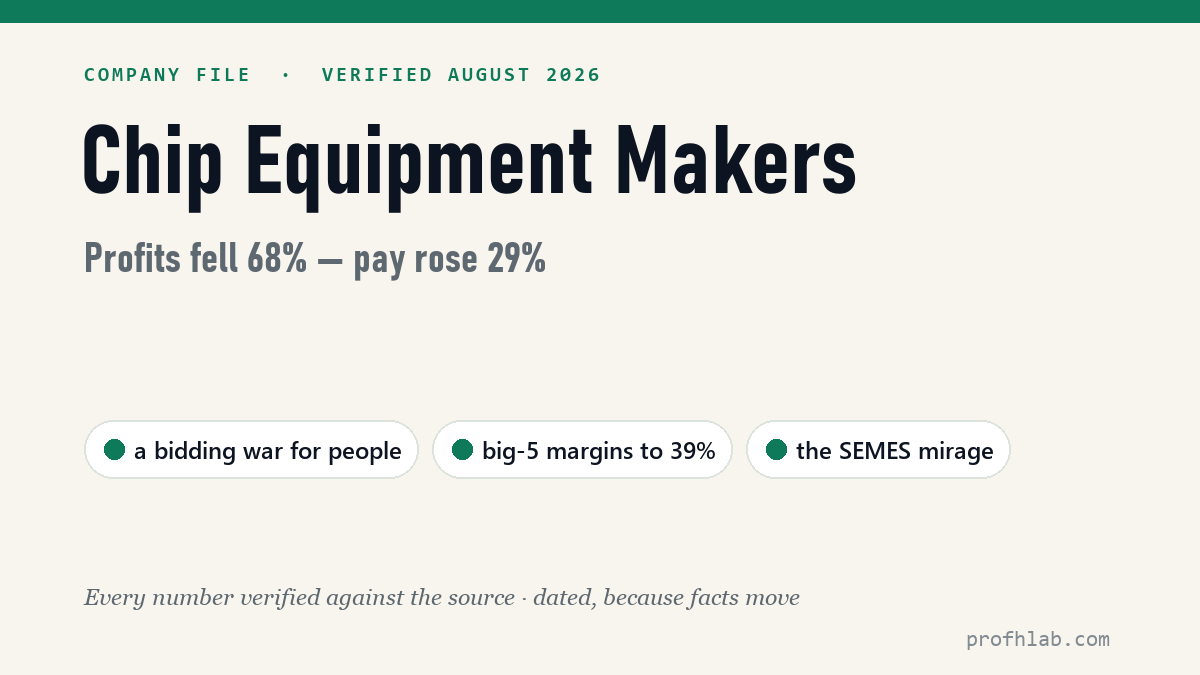
In March 2026, Jusung Engineering’s annual report landed on Korea’s public disclosure system. Operating profit: down 67.8% from the year before — the business had shrunk to a third of its former size. Numbers like that usually come with belt-tightening. But another line in the same filing read: average employee pay ₩93,000,000 (≈$66,000), up about 29% in a single year.
Not a misprint, and not an outlier. Leeno Industrial raised average pay 30.2% the same year, to ₩117,070,000 (≈$84,000). Wonik IPS and Hanmi Semiconductor both posted double-digit raises. A business daily that compiled the filings summed up the industry’s mood in one blunt idea: lose your key people and the whole project goes with them.
Who is taking the people? And what do raises like these reveal about how the chip-equipment business actually works? This is a company-level read of Korea’s semiconductor-equipment sector — the real pay figures, the two-tier structure, and a search-result mirage that exposes how the ecosystem is layered. Figures verified August 1, 2026; dollar figures are approximate, at about ₩1,400 per dollar.
The comparison: a two-times river between chipmakers and equipment makers
Start with the most basic question about the sector: what do these companies actually pay? Lined up from fiscal-2025 annual reports (filed March 2026):
| Tier | Company | 2025 average pay per employee | Year over year |
|---|---|---|---|
| Chipmaker | SK Hynix | ₩185M (≈$132,000) | +58.1% (from ₩117M) |
| Chipmaker | Samsung Electronics | ₩158M (≈$113,000) | +21.5% (from ₩130M) |
| Equipment / components | Leeno Industrial | ₩117.07M (≈$84,000) | +30.2% |
| Equipment | Jusung Engineering | ₩93M (≈$66,000) | About +29% |
Within one industry, a nearly two-fold gap separates the chipmakers from the firms that build their machines. Stop reading there and the conclusion writes itself: the chipmakers win. But the table hides a trap.
SK Hynix’s +58.1% is a bonus artifact. The near-₩70M (≈$50,000) jump from ₩117M was the HBM boom paying out, and nothing guarantees a repeat next year. The equipment makers’ raises are different in kind: Jusung raised pay in a year its earnings collapsed. That is not profit-sharing. It is spending to stop people from walking out the door.
Why they raised: a bidding war for Korean engineers
The reporting behind the filings names the pressure directly. First, Tesla: after announcing its “Terafab” chip-plant plan, Elon Musk said publicly that Tesla had hired Korean semiconductor staff. Second, the global equipment giants — Lam Research, KLA, Tokyo Electron — have made Korea a strategic base and are recruiting local talent.
Why is that existential for domestic equipment firms? Because in this industry the know-how does not live in the machines — it accumulates in the people who design and operate them. As one industry figure quoted in the coverage put it, a single key engineer leaving can shake an entire project.
And the money doing the bidding is serious. On FY2025 figures compiled by the Korea Economic Daily, the global big five — ASML, Applied Materials, Lam Research, Tokyo Electron, KLA — ran operating margins of 25.6% to 39.3%, with KLA on top at 39.3%. When companies that profitable start opening their wallets in Korea, domestic makers have no move but to counter-bid. Read structurally, the conclusion is simple: the market value of an equipment engineer in Korea is in a secular upcycle.
For scale: among the world’s top ten semiconductor-equipment companies, exactly one is Korean — SEMES, a Samsung subsidiary (Gartner rankings, via Financial News, 2024-08-13). Korea’s presence in the global rankings is thin. The crowding into that thin layer is the story.
What the hiring market reveals about pay structure
Averages describe the middle of a company; hiring notices describe its structure. A survey of the sector’s live openings in early August 2026 surfaced three patterns the ranking articles never show.
Domestic mid-tier firms publish exact numbers; the giants don’t. A subsidiary of the PSK group spelled out new-hire pay to the won: base of ₩35M (≈$25,000) for two-year-college graduates and ₩38M (≈$27,000) for university graduates — plus a skills-level allowance of up to ₩4.8M (≈$3,400) a year, travel stipends of ₩400,000–450,000 (≈$290–$320) a month, monthly housing support of ₩150,000 (≈$107), and short assignments to the U.S., Ireland, Japan, Taiwan, and Singapore. Judge these companies on base salary alone and you undercount real compensation substantially — layered allowances are a recurring feature of equipment-sector pay.
Degree requirements are looser than the industry’s image. Across nine live openings, five accepted first-time hires, one was fully open on education, and two accepted high-school graduates. The strict four-year-degree requirements clustered in the foreign-owned units (Axcelis Korea, SCREEN SPE Korea) — which, in exchange, state their terms unusually plainly, down to business-English expectations and blind-screening processes.
The experienced market trades in machine names, not school names. Hanmi Semiconductor’s experienced openings asked for five-plus years with MASTER CAM and 3- and 5-axis MCT machining; Wonik IPS wanted three-plus years of process-development work. The working currency of an equipment-sector career is the list of tools and software a person has actually run — SOLIDWORKS, AUTOCAD, CREO, MASTER CAM, wafer test, dry strip, electrical harness work — not the diploma.
The SEMES mirage: what a search for the biggest name really returns
Here is the trap that best exposes the ecosystem’s layering. SEMES is Korea’s largest equipment maker and its only global top-ten name — naturally one of the sector’s most-searched employers. Yet search the major job boards for “SEMES” and the number of postings from SEMES itself is zero. What surfaces instead:
- An IT-services firm hiring OA and asset-maintenance staff stationed inside SEMES’s Dongtan campus
- An outsourcing firm hiring settlement and office-support staff for SEMES sites in Dongtan and Hwaseong
- A tier-1 supplier’s electrical-distribution-panel manufacturing team
All three are legitimate openings with genuinely wide doors — high-school graduates and first-timers welcome. But a person who signs up thinking “I’m joining SEMES” wakes up employed by someone else: same building, different company on the contract. This resident-contractor structure is how the industry runs, and the postings are honest about it in their own dialect — a bracket like “[tier-1 supplier to Samsung]” is disclosure, while a big brand name in a title with no such bracket means the fine print holds the real employer.
Is the contractor layer a dead end? There is no basis to say so. Several live openings placed workers directly inside prime fabs — SK Hynix’s Icheon and Cheongju lines, SEMES’s Dongtan campus.
A commonly cited trajectory runs four to five years at an equipment maker or contractor, then a move into the customer’s facility organization; community write-ups (Winspec, 2026) describe the path as established, though no public statistics verify the rate, so treat it as “documented cases exist” rather than a rule. What is certain is the entry ticket: a work record listing the actual tool models a person ran on a prime line.
The honest read
Go back to that March filing. Approving a 29% raise in a year operating profit fell by two-thirds is, from an accountant’s chair, an almost indefensible number. It was signed anyway, for a simple reason: the equipment drawings stay on the company’s servers, but the reason the drawings look the way they do lives only in people’s heads.
That is the single most informative fact in the sector’s 2026 filings: this industry is pricing its people — upward, straight through a down cycle.
Do equipment makers pay half? Bonus cycles versus retention raises
Q. Do equipment makers really pay half of what the chipmakers do?
The averages say roughly yes — ₩93M–117M against ₩158M–185M — but the composition differs. The chipmaker figures lean heavily on bonus cycles (SK Hynix’s +58.1% year was an HBM-boom payout; the same company has paid far less after down years), while the equipment makers’ raises are structural retention spending that arrived even in a loss-making year. Accessibility differs in the same direction: the equipment tier hires far more first-timers, two-year-college graduates, and high-school graduates than the chipmakers do.
Q. If a famous company’s name appears in a posting title, is that who is hiring?
Usually not. In the sample above, every “SEMES” posting came from a contractor or supplier stationed at SEMES sites. The employer is the name in the company field, not the name in the title — and a posting that brackets the relationship, such as “[tier-1 supplier],” is the honest kind.
Sources: fiscal-2025 annual reports on DART, Korea’s disclosure system (filed March 2026); Daehan Kyungjae’s compilation of the filings; Korea Economic Daily’s big-five margin analysis; Financial News on the Gartner top-10 (2024-08-13); a live job-board survey conducted August 1, 2026. Figures verified August 1, 2026. Pay averages are all-employee figures and vary by role, site, and year.
Part of the Physical AI library — research decoded and machines compared, in plain English: profhlab.com/physical-ai.
See who controls which step of the chip equipment industry
Full index
Every guide in the Physical AI library — 27 of them, grouped so you can find the one you need.
Start here
- Physical AI Foundations: World Models, Robot Foundation Models, and Sim2Real — From Zero
- Physical AI Explained: Why a Chatbot Knows the Cup Falls but a Robot Doesn’t
- The Physical AI Toolbox: Six Free Simulators, a $249 Hardware Ladder, and What the 2026 Papers Admit
Research papers, decoded
- RoboVLMs, Explained: What Actually Makes a Robot Foundation Model Work
- Ψ0 (Psi-Zero), Explained: The Humanoid Foundation Model That Learns From Human Video
- MotionWAM, Explained: One-Shot Imagination Brings Real-Time Humanoid Loco-Manipulation
- XHugWBC, Explained: One Policy That Drives 12 Different Humanoids
- Vision-Tactile Pretraining, Explained: A Robot Hand Learns Human-Like Dexterity From a Webcam
- TouchWorld, Explained: A Robot Hand That Predicts Touch Before Making Contact
- HOUND and APT-RL, Explained: One Transformer Brain for Walking, Running, and Jumping in the Wild
Machines, priced
- Tesla Optimus V3 Release Date, Price and Specs: What Tesla Has Confirmed
- Buying a Humanoid Robot in 2026: What a Unitree R1 Really Costs, Retail vs Import
- Robot Dog Prices in 2026: From ≈$2,900 to ≈$71,000 — and Spot Still Has No Price Tag
- Tesla FSD Goes Subscription-Only in Korea — and the ‘5-Year Break-Even’ Everyone Quotes Is Wrong
Home robots, tested
- Narwal Freo Z10 Ultra Review: 18,000Pa, a 75°C Mop Wash, and Three Honest Drawbacks
- 22,000Pa vs 240 Air Watts: Robot Vacuum Suction Numbers, Decoded (2026)
- Robot Vacuum or Stick Vacuum? I Split Housework Into 10 Tasks — Only One Truly Overlaps
- The Sour Smell Isn’t the Mop: Robot Vacuum Odor by Zone, and a 7–9x Consumables Gap
- Drain Height Decides Your Robot Vacuum: Samsung 0.4 m, Roborock 50 cm, LG 1.5 m
- Robot Vacuum Repair Costs 2026: A $140 Fix and a 56.5% Resolution Rate
- Robot Vacuum Subscription vs Buying: What iRobot Select Really Costs
- Are Window-Cleaning Robots Worth It? The Break-Even vs Hiring a Pro
- Smart Speakers in 2026: The Hardware Is $99 — the Assistant Is the Real Price
- Serving Robot Costs in 2026: $399 a Month, and Why 73.3% Saw No Change
Chips & companies
- HBF and zHBM, Explained: Samsung and SK Hynix Give Opposite Answers to the Same Memory Problem
- ▸ Korea’s Chip Equipment Makers, Compared: Profits Fell 68% — So Why Did Pay Jump 29%? (you are here)
- Samsung DS vs DX: One Company, a $450,000 Bonus Gap — and Why the Simple Story Is Wrong
- ASML Korea’s Starting Pay Is $31K — or $46K: Anatomy of a 2.15x Salary-Data Gap
Looking for the other library? Generative AI — tools, tested →
Prof.’s H Newsletter
One short email a month, with the numbers in it
What actually moved in AI hiring, AI prices, and the scams aimed at older Americans. Counted here, dated, and linked to the source. One email a month, and your address goes nowhere else.