Samsung DS vs DX: One Company, a $450,000 Bonus Gap — and Why the Simple Story Is Wrong
On July 30, 2026, Samsung Electronics reported second-quarter results that read like two different companies stapled together. The DS division — semiconductors — earned ₩89.2 trillion (≈$64 billion) in operating profit. The DX division — smartphones, TVs, home appliances — lost ₩800 billion (≈$570 million), its first quarterly loss since DX was formed in 2021. One half of the company produced 99.7% of its operating profit. The other half printed a minus sign.
Strip away the headlines and what remains is a case study in how differently two halves of one company can be paid, measured, and lived in — and how the obvious conclusion (“semiconductors win”) turns out to be wrong in one direction and understated in another. Figures verified August 7, 2026; dollar figures are approximate, at about ₩1,400 per dollar.
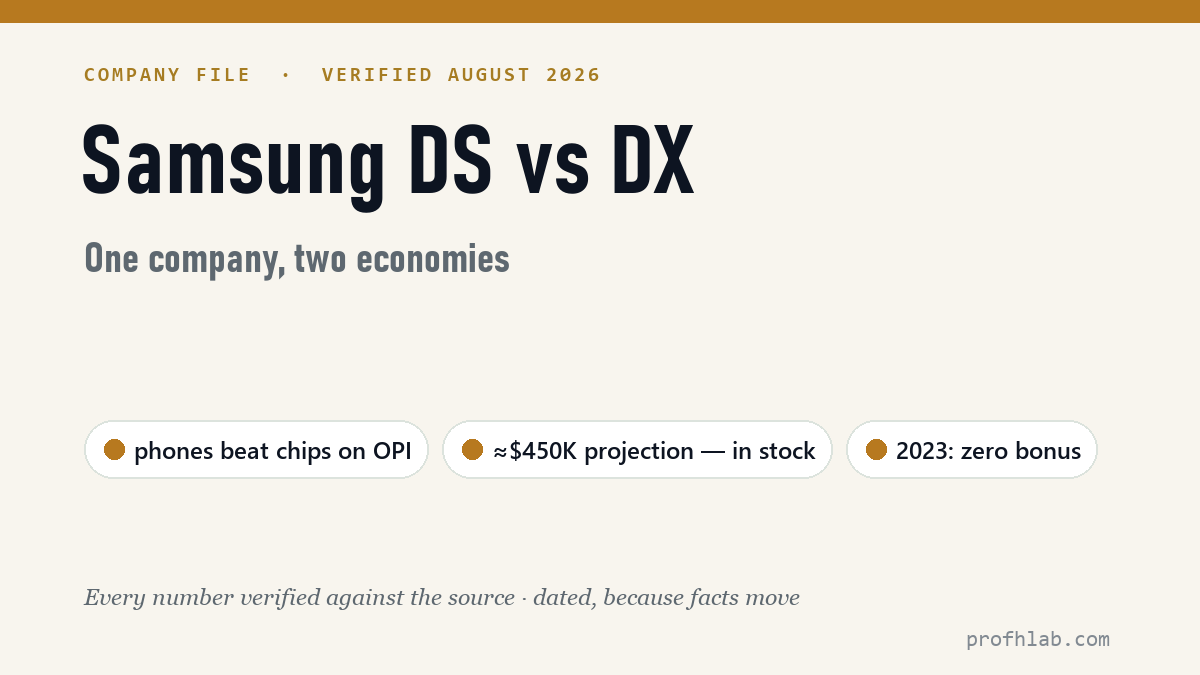
The short version: ① On 2025 results, the company’s profit-sharing bonus (OPI) actually paid out higher in DX’s mobile unit (50%, the cap) than in DS semiconductors (47%) — the “DS always pays more” folk wisdom fails on the recurring bonus. ② What creates the headline gap is a new DS-only special bonus created in May 2026 and effective from 2027, projected at ₩630M (≈$450,000) per person in memory versus about ₩6M (≈$4,300) in DX — paid entirely in stock. ③ The split runs deep enough that the two divisions operate separate recruiting systems, and group rules let a person apply to only one Samsung company per intake window. ④ The honest counterweight: DS posted a ₩14.88 trillion (≈$10.6 billion) loss in 2023 and paid zero bonus that year. This is a cycle business.
Three numbers that frame Samsung in 2026
₩89.2 trillion. DS’s Q2 operating profit — 99.7% of the company-wide ₩89.5 trillion (≈$64B), on record revenue of ₩171.5 trillion (≈$123B), with both DRAM and NAND at record sales and the company pointing to agentic-AI demand on the earnings call.
–₩800 billion. DX’s operating loss in the same quarter. Premium and AI products sold well and revenue grew — but component costs surged and profitability collapsed. The component in question is, in large part, memory. DS sold memory dear; DX bought it dear and put it into phones and TVs. Both entries sit in the same consolidated ledger.
₩450 million (≈$320,000). The cap on this year’s voluntary-exit package. Per an April 14 Digital Daily exclusive, Samsung ran a three-round program targeting employees born in the late 1960s to early 1970s, topping up the previous ₩350M (≈$250,000) package by roughly ₩100M (≈$71,000). The backdrop: in Q1, DS earned over ₩50 trillion (≈$36B) while DX earned under ₩3 trillion (≈$2.1B).
Record profits and buyouts happened at the same company in the same year. The signal is not “Samsung is struggling.” It is that which line of business you sit in, inside Samsung, now matters more than it ever has.
The bonus everyone gets wrong: OPI actually favored the phone unit
Samsung’s incentive pay runs on two axes. The established one is OPI (Overall Performance Incentive): if a unit beats its annual profit target, up to 20% of the excess funds a pool that pays each person up to 50% of annual salary, once a year in late January. The second axis — the new special bonus — comes in the next section.
For 2025 results, paid on January 30, 2026, the unit-by-unit OPI rates (published January 16 by the National Samsung Electronics Union):
| Division | Unit | OPI rate (2025 results) | On an assumed ₩53M (≈$38,000) salary |
|---|---|---|---|
| DX | MX (mobile) | 50% (the cap) | ≈₩26.5M (≈$19,000) |
| DX | Gumi support | 50% | ≈₩26.5M |
| DS | Semiconductor (memory · foundry · S.LSI) | 47% | ≈₩24.9M (≈$17,800) |
| DX | Suwon support | 39% | ≈₩20.7M (≈$14,800) |
| DX | SR (Samsung Research) · DPC | 37% | ≈₩19.6M (≈$14,000) |
| DX | TVs (VD) · appliances · network · medical devices | 12% | ≈₩6.4M (≈$4,500) |
| DS | CSS (system-semiconductor solutions) | 11% | ≈₩5.8M (≈$4,200) |
Read the table vertically and three things surface at once.
First, the top row is not DS. The Galaxy organization hit the 50% cap; semiconductors got 47%. Rank by division name and you get the answer wrong.
Second, the gaps inside each division dwarf the gap between them. Within DX, MX (50%) versus appliances and TVs (12%) is 38 points. Within DS, semiconductor (47%) versus CSS (11%) is 36 points. Between DS semiconductor and DX MX: three points. The economic unit that matters is the business unit, not the division.
Third, on the illustrative ₩53M salary, the January-paycheck difference between two same-cohort colleagues — one in MX, one in appliances — is about ₩20M (≈$14,000). (The ₩53M is the DS starting salary reported in a November 2022 pay-raise story; actual contracts vary. The column exists to give the percentages scale, not to promise take-home pay.)
The instrument behind the headline: a special bonus effective 2027
So where does “₩630M versus ₩6M” come from? Not from OPI — from a new instrument. Per Money Today’s May 27 report, Samsung created a special management bonus exclusive to the DS division:
| Feature | Terms | What it implies |
|---|---|---|
| Funding | 10.5% of DS operating profit | Tied to company profit, not salary — a different animal from the 50%-capped OPI |
| Split | 40% division-wide + 60% by unit | The better your unit earns, the more you get — memory concentration |
| Form | 100% company stock | Not cash; the value moves with the share price |
| Support organizations | 70% of the memory unit’s rate | Same division, 30% less for staff organizations |
| Loss-making units | 60% of the common rate | There is a floor case inside DS too |
| Effective | From 2027 | Payouts begin on future results, not past ones |
On the projected ₩340 trillion (≈$243B) full-year operating profit underpinning the report’s math, the per-person projections run: memory ₩630M; system LSI and foundry ₩180M (≈$129,000); DX, net of existing OPI, about ₩6M. That is where the more-than-hundred-fold figure comes from.
Now the fine print, plainly: these are average projections built on an earnings estimate. Actual payouts depend on confirmed results, rank, and performance reviews — and because they arrive as stock, they inherit every move of the share price. Nobody is being promised ₩630M.
What has already shown up in audited numbers: Samsung’s company-wide average pay reached ₩158M (≈$113,000) in 2025, up 21.5% from ₩130M (≈$93,000).
How deep the split runs
The pay tables are one symptom of a broader separation. DS operates its own dedicated recruiting site — nine business units and twenty job tracks documented, with a recommender that maps a degree and interests to a unit — while DX hires through the general Samsung portal. And group rules allow one application to one Samsung company per intake window. Administratively, the two halves behave like separate employers you must choose between.
Geography completes the picture. DS lives where the fabs are — Pyeongtaek, Hwaseong, Giheung, Onyang, Cheonan: cleanroom country, where facility and process roles commonly run shifts. DX centers on Suwon Digital City, Gumi, and Seoul R&D campuses — office and development work. A ₩20M bonus difference is loud; a two-hour daily commute difference and a shift rotation are louder, and they last longer than any single bonus year.
The honest read: four things the headline hides
① Semiconductors are a cycle. The division earning ₩89 trillion today lost ₩14.88 trillion in 2023 — and paid no bonus at all. When payouts resumed on 2024’s first-half turnaround, the memory, system LSI, and foundry rate was 14%. The same organization has lived 47% and 0% within three years, and the special bonus, being profit-linked, breaks the same way the cycle does.
② Stock is not cash. A grant’s value on the day it lands and its value on the day it is sold can differ materially.
③ Headlines move crowds. Bonus coverage at this scale reliably concentrates attention — and talent — on the star units, which changes the competitive math around them. Over any horizon longer than one cycle, fit beats headline-chasing.
④ Today’s DX is not forever-DX. The division is absorbing a component-cost shock and shrinking its workforce — but a leaner organization on the other side of a memory-price cycle can rebound, and its flagship unit hit the OPI cap this January. The 12% rows and the 50% row are the same division in the same year.
Mobile out-paid chips 50% to 47%; the big projections pay in stock
Q. So is DS simply the better-paid half of Samsung?
On the recurring bonus, no — the mobile unit out-paid semiconductors on 2025 results, 50% to 47%. On the new special bonus effective 2027, DS is structurally favored by design: 10.5% of division profit, distributed toward the earning units. One instrument rewards performance wherever it happens; the other rewards semiconductors specifically.
Q. Are the ₩630M projections real money?
They are projections on an earnings estimate, paid in stock, and they vary by unit, rank, and review. They mark the direction and scale of the new instrument — not a guaranteed payout. The 2023 zero-bonus year shows the downside case is real, not hypothetical.
Q. How can record profits and buyouts coexist?
Because the profit and the loss sit in different divisions of one company. The memory pricing that drove DS’s record quarter is the same component cost that crushed DX’s margin — one ledger, two opposite experiences, and the workforce program tracked the losing side.
Sources: Samsung Electronics Q2 2026 results and conference call; National Samsung Electronics Union OPI notice (2026-01-16); Money Today (2026-05-27) on the special bonus; Digital Daily (2026-04-14) on the exit package; fiscal-2025 annual report (average pay); Samsung’s DS recruiting site. Figures verified August 7, 2026. Bonus rates, projections, and programs can change; illustrative salary conversions are not payout promises.
Part of the Physical AI library — research decoded and machines compared, in plain English: profhlab.com/physical-ai.
Bloomberg on how Samsung’s chip division lost ground in AI memory
Full index
Every guide in the Physical AI library — 27 of them, grouped so you can find the one you need.
Start here
- Physical AI Foundations: World Models, Robot Foundation Models, and Sim2Real — From Zero
- Physical AI Explained: Why a Chatbot Knows the Cup Falls but a Robot Doesn’t
- The Physical AI Toolbox: Six Free Simulators, a $249 Hardware Ladder, and What the 2026 Papers Admit
Research papers, decoded
- RoboVLMs, Explained: What Actually Makes a Robot Foundation Model Work
- Ψ0 (Psi-Zero), Explained: The Humanoid Foundation Model That Learns From Human Video
- MotionWAM, Explained: One-Shot Imagination Brings Real-Time Humanoid Loco-Manipulation
- XHugWBC, Explained: One Policy That Drives 12 Different Humanoids
- Vision-Tactile Pretraining, Explained: A Robot Hand Learns Human-Like Dexterity From a Webcam
- TouchWorld, Explained: A Robot Hand That Predicts Touch Before Making Contact
- HOUND and APT-RL, Explained: One Transformer Brain for Walking, Running, and Jumping in the Wild
Machines, priced
- Tesla Optimus V3 Release Date, Price and Specs: What Tesla Has Confirmed
- Buying a Humanoid Robot in 2026: What a Unitree R1 Really Costs, Retail vs Import
- Robot Dog Prices in 2026: From ≈$2,900 to ≈$71,000 — and Spot Still Has No Price Tag
- Tesla FSD Goes Subscription-Only in Korea — and the ‘5-Year Break-Even’ Everyone Quotes Is Wrong
Home robots, tested
- Narwal Freo Z10 Ultra Review: 18,000Pa, a 75°C Mop Wash, and Three Honest Drawbacks
- 22,000Pa vs 240 Air Watts: Robot Vacuum Suction Numbers, Decoded (2026)
- Robot Vacuum or Stick Vacuum? I Split Housework Into 10 Tasks — Only One Truly Overlaps
- The Sour Smell Isn’t the Mop: Robot Vacuum Odor by Zone, and a 7–9x Consumables Gap
- Drain Height Decides Your Robot Vacuum: Samsung 0.4 m, Roborock 50 cm, LG 1.5 m
- Robot Vacuum Repair Costs 2026: A $140 Fix and a 56.5% Resolution Rate
- Robot Vacuum Subscription vs Buying: What iRobot Select Really Costs
- Are Window-Cleaning Robots Worth It? The Break-Even vs Hiring a Pro
- Smart Speakers in 2026: The Hardware Is $99 — the Assistant Is the Real Price
- Serving Robot Costs in 2026: $399 a Month, and Why 73.3% Saw No Change
Chips & companies
- HBF and zHBM, Explained: Samsung and SK Hynix Give Opposite Answers to the Same Memory Problem
- Korea’s Chip Equipment Makers, Compared: Profits Fell 68% — So Why Did Pay Jump 29%?
- ▸ Samsung DS vs DX: One Company, a $450,000 Bonus Gap — and Why the Simple Story Is Wrong (you are here)
- ASML Korea’s Starting Pay Is $31K — or $46K: Anatomy of a 2.15x Salary-Data Gap
Looking for the other library? Generative AI — tools, tested →
Prof.’s H Newsletter
One short email a month, with the numbers in it
What actually moved in AI hiring, AI prices, and the scams aimed at older Americans. Counted here, dated, and linked to the source. One email a month, and your address goes nowhere else.