The Sour Smell Isn’t the Mop: Robot Vacuum Odor by Zone, and a 7–9x Consumables Gap
About six months after the $1,070 robot vacuum moved in, you open the living-room door one evening and stop walking. It ran a cycle at lunchtime — you know it did — and yet there it is, lying along the floor: that particular sour smell, boiled mop and stale water mixed together. You open the app. Cleaning complete. Washing complete. Drying complete. The machine says it has done nothing wrong.
If that scene is familiar, let me give you the conclusion first. The smell is usually not coming from the mop. It is coming from the dirty-water tank and the gaps around the wash tray — and that zone does not get solved automatically, not even on a top-of-the-line model with a 100 °C wash.
Not knowing that is expensive. People trade up to a model advertised as odor-killing, and what actually happens is that the smell stays exactly where it was while the running cost quietly climbs past $145 a year.
So today: the smell taken apart zone by zone, and then the running cost — year one and year three — calculated to the won from the manufacturers’ own documents and real prices in their official stores. Replacement-interval tables are everywhere online. Almost nobody answers the question underneath them, which is “fine, so what does this cost me a year?” US replacement-part pricing verified August 11, 2026.
How this was checked
Costs are US replacement-part pricing, verified August 11, 2026. Replacement intervals come from the manufacturers’ own documents — Roborock and Samsung publish theirs; several brands do not publish any. The three-zone diagnosis is mine, and it does not expire when the models change.
The smell comes from three separate zones
Treat robot-vacuum odor as one problem and you will never fix it. There are three places it is generated, and each one has a completely different remedy.
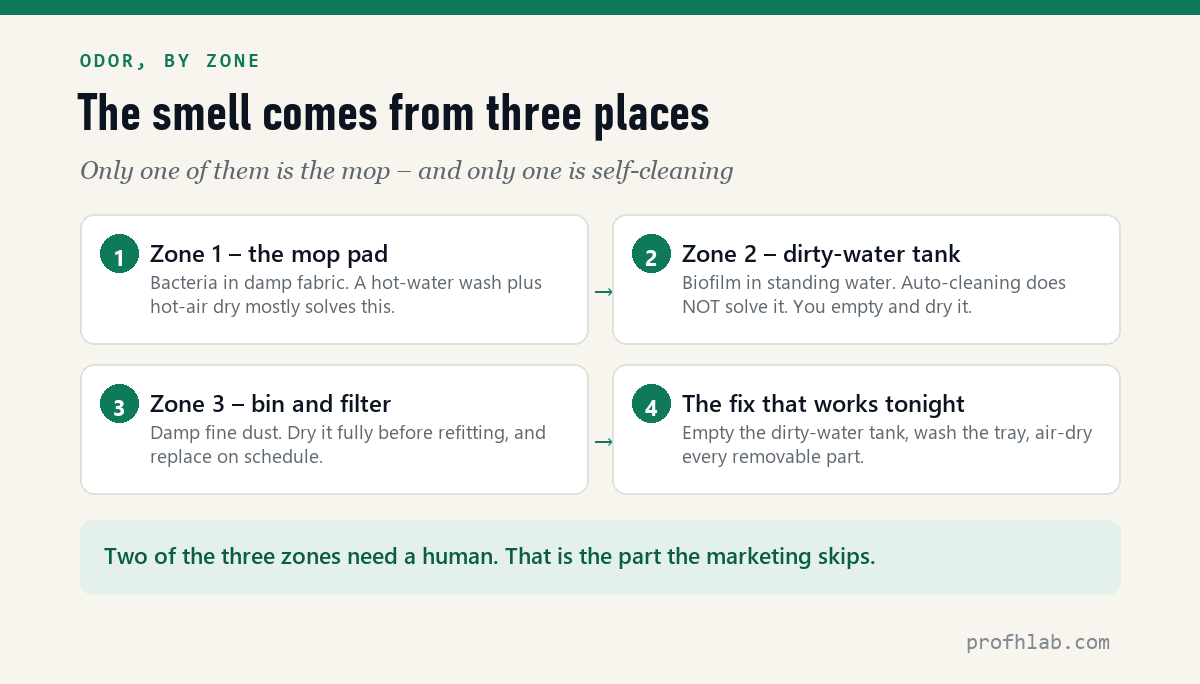
| Zone | What the smell actually is | Does auto-cleaning solve it? | What actually fixes it |
|---|---|---|---|
| Zone 1 — the mop | Bacteria and organic residue left in the fibers | Mostly, yes | Hot-water wash plus hot-air drying |
| Zone 2 — dirty-water tank, wash tray, rubber gasket | Biofilm growing in standing dirty water | No | A person emptying and drying it on a schedule — or a direct drain hookup |
| Zone 3 — dust bin and filter | Fine dust that has absorbed moisture | No | Dry completely before refitting; replace on schedule |
Zone 1 is the area the manufacturers have worked hardest on for several years. Samsung states in its official FAQ that the cleaning station on the Bespoke AI Steam washes at 65 °C without detergent and then sanitizes with 100 °C steam, killing 99.999% of harmful bacteria, with an average 97% odor-removal result verified by an international certification body. On the numbers alone, zone 1 looks like a war that has already been won.
The problem is zone 2. The answer is sitting in the maintenance schedule published in that same Samsung FAQ. Empty the dust bin every two to three months. Refill the clean-water tank every four days. And empty the dirty-water tank every six days. In other words, the manufacturer itself is telling you that a human has to put a hand on that tank every six days.
Boil the mop at 100 °C all you like — the dirty water that came off it is still sitting in a tank. In summer, six days is plenty of time for a biofilm to establish itself.
LG’s customer-support documents point at the same place. They tell you to detach the mop wash tray from the dock, rinse it in room-temperature water and wipe it dry, and to periodically clean the inside of the clean-water and dirty-water tanks with a cleaning brush. The word is scrub, not rinse — and that word choice tells you the manufacturer already assumes scale and grime are building up in there.
Which gives us the first practical conclusion. If your living room smells sour, don’t start by washing the mop. Peel back the rubber gasket on the dirty-water tank lid and look. In most homes there is a black band sitting right there.
If the smell is what you care about, what you should be buying is a direct hookup
Once you understand the structure, your buying criteria change. The specs everyone compares on the sheet are wash temperature (75 °C or 100 °C?) and drying temperature (40 °C or 55 °C?). Those are zone 1 specs. You are paying extra to improve a zone that is already mostly solved.
By contrast, a direct-plumb model — supply and drain piped straight in — removes the dirty-water tank as an object. Dirty water never pools in a container; it goes straight down the drain. Zone 2 stops being a question of habit and disappears structurally.
The fact that “robot vacuum direct drain smell” turns up in Google autocomplete is itself evidence of how many people are wrestling with this exact choice.
It is not a cure-all, of course. You need a spot where supply and drain plumbing can be reached — near the utility room or the boiler room — and the station’s position becomes fixed. I’ve gone through the actual installation conditions separately: the drain-height limit that decides which brands can even be fitted in your home, the 6 m pipe run, and what each manufacturer charges to do the work.
Short version, then:
- Smell is your top concern and you have somewhere the plumbing can reach → buy a direct-plumb model. The temperature-spec contest is a second-order problem.
- There is nowhere to plumb it in → decide on how easily you can get the dirty-water tank out and wash it. Go to a store and put your hands on it: how the lid opens, whether the gasket comes off. This is a movement you will repeat every six days for the life of the machine.
- You live in a studio or a small apartment and barely use the mop → a model with no mop station at all saves you the running cost as well.
Replacement intervals, cross-checked against the manufacturers’ own documents
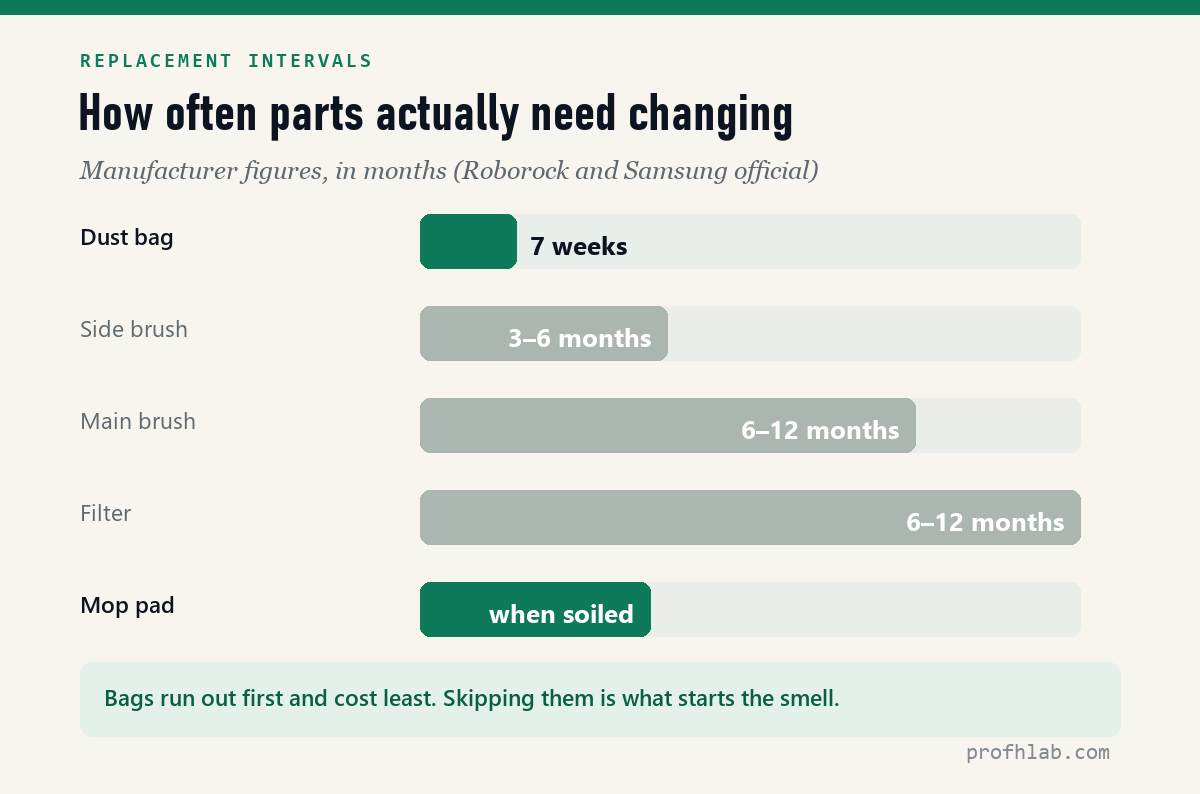
The interval tables floating around online come from all sorts of places, so I collected only what is written in official manufacturer documentation. Roborock’s official guidance for the S8 series says the following.
| Part | Cleaning interval | Replacement interval | Source |
|---|---|---|---|
| Side brush | Once a month | 3–6 months | Roborock official |
| Main brush | Once every two weeks | 6–12 months | Roborock official |
| Dust bag | — | 7 weeks recommended | Roborock official |
| Mop pad | Wash after every use | When soiled | Roborock official |
| Emptying the dust bin | Every 2–3 months | — | Samsung official FAQ |
| Emptying the dirty-water tank | Every 6 days | — | Samsung official FAQ |
| Refilling the clean-water tank | Every 4 days | — | Samsung official FAQ |
| Dust-bin filter | Wash with water, then dry completely | — | LG official support |
The number to look at twice is the seven-week dust bag. Over a year that is 7.4 bags — call it eight. Most people assume you swap the bag when it fills up, but the manufacturer’s recommendation is a time interval, independent of how full it is. Damp dust sitting in a bag for a long stretch is itself the cause of zone 3 odor.
What a year of consumables actually costs in the US
Here is the number nobody quotes at purchase. Keeping a full set of genuine parts fresh — main brush, side brush, filter, mop pads, dust bags — runs about $90 to $150 a year. Mix genuine parts where they matter (main brush and filter) with good third-party pads, bags and side brushes, and the same year runs about $45 to $75.
Dust bags dominate that bill more than people expect, because they are the one part with a hard schedule: roughly every seven weeks, which is about 7.4 bags a year. At typical US pricing that alone is $30 to $45 annually. Mop pads and filters follow at five or so each per year.
Add it up and consumables are running 10 to 15% of the machine’s purchase price every year. Over five years you will spend roughly half of what the robot cost, again, keeping it working properly. That is not a scandal — it is simply the part of the total that gets left out of the comparison when you are standing in the aisle.
The real fork in the road is the branded cleaning solution
The LG RoboKing AI All-in-One takes a branded cleaning solution. According to LG’s support pages, you open a cover on the dock and pour the solution in through a funnel, after which the machine doses it automatically into the mop-washing cycle at the end of every clean. Which means it is consumed in proportion to how much you clean.
A two-bottle set of the brand’s own cleaning solution runs about $35. Depending on how often you run the machine, one to two sets a year is realistic — so $35 to $70 a year lands on top of everything else. Which makes the totals look like this.
| Scenario | Annual consumables cost | Notes |
|---|---|---|
| Genuine consumables + branded solution | About $125–$160 | At manufacturer store prices; brushes excluded |
| Genuine consumables only (a brand with no solution) | $90 | Same assumptions |
| Third-party consumables set | About $18 | Lowest observed third-party kit price |
That last row will have caught your eye. The third-party consumables kit for the Roborock S8 Pro Plus, sold through third-party sellers, bundles five kinds of part: one main brush, four side brushes, two filters, five dust bags and five mop pads. Seventeen pieces for about $18, shipping included. That is roughly a year’s supply at that price.
Let me be clear that this is a different brand’s model, so it is not a one-for-one comparison. But the scale of the spending is unmistakable. Between “genuine parts plus branded solution” and “a third-party set” there is a gap of roughly seven to nine times. Compare the price of the machines alone and you will never see that number.
Now look at it as three-year cost of ownership
| Approach | Three-year consumables | What you give up |
|---|---|---|
| All genuine parts, plus the brand’s own cleaning solution | About $375–$660 | Nothing, except the money |
| Genuine brush and filter, third-party pads, bags and side brushes | About $135–$225 | Some fit-and-finish variability; check reviews per part |
| All third-party, plain water instead of solution | Under $135 | Mop washing works less well on greasy floors; watch for residue |
The honest read: the gap between the most expensive and cheapest approach is bigger than the gap between two robot vacuums a tier apart. People agonise over $200 at purchase and then spend that difference again in consumables without ever noticing.
Genuine or third-party — split the decision part by part
None of which means go third-party across the board. What it costs you when a part fails differs enormously from part to part. My own rules:
- Filters: buy genuine. This is the last gate holding fine dust back, and a fractional mismatch in dimensions lets dust escape around the edges — which then feeds zone 3 odor. At around $20 a year, scrimping here saves you a rounding error.
- Dust bags: third-party is worth considering. If the seal doesn’t match, though, dust escapes every time the robot docks — so if reviews mention a loose fit, skip it. At around $45 a year this is the biggest single line, so it is also where the savings are largest.
- Mop pads: third-party is fine. It is cloth, it wears out, and the washing and drying performance comes from the station regardless of whose cloth is fitted.
- Brushes: buy genuine. A third-party brush that is too stiff or the wrong length scratches floors and loads the motor.
- The branded solution: you can choose not to use it — but check your warranty first. Not using the specified consumables can be held against you in a service dispute. Saving $35 and then carrying a battery or motor repair yourself is a bad trade.
Three-step odor first aid you can do tonight
Before you buy anything new, here is what you can do with the machine you already own. The order matters.
- Empty the dirty-water tank, peel back the rubber gasket on the lid, wipe it, and let it dry completely. Rinse the tank and slot it straight back in and the moisture trapped behind the gasket starts the whole thing over. Use a brush, as LG’s guidance says, and you’ll know it is done.
- Take out the wash tray, rinse it in room-temperature water, and wipe it dry with a cloth. This is the plate the mop is scrubbed against, which makes it the part that stays wet longest.
- Wash the dust-bin filter and dry it completely before refitting. Put it back half-dry and that moisture rides the airflow through the whole house. Keep a spare filter and alternate between the two, and drying time stops being a problem.
If the smell survives all three steps, that is the moment to replace the mop — or to reconsider the machine itself. Doing it in the opposite order, and just buying mop after mop, is the most common waste of money in this category.
Can you skip the branded solution without risking the warranty?
Q. Can I skip the branded solution and just use water?
The machine will generally run. But you are rinsing the mop with no cleaning agent in the water, so bacterial removal in zone 1 drops — and not using the specified consumables can become the hook a warranty dispute hangs on. If you want to save the money, call the manufacturer’s support line first and ask specifically whether skipping the solution affects your warranty, then decide. With $35 to $70 a year at stake, one phone call is well worth its price.
Q. Can’t I just use a dust bag until it is full?
Roborock’s official recommendation is a seven-week cycle — a time interval, unrelated to how full the bag is. A bag is both where dust is stored and where moisture sits, so leave it too long in summer and that smell is released every time the robot docks. In a household that is sensitive to odor, moving earlier than seven weeks is the right call.
The closing
What we compare when we buy a robot vacuum is suction in Pa and wash temperature. Then, six months later, standing in the living room breathing in that sour smell, you find out what those numbers were about. They were the story of a single piece of cloth. What was actually making you miserable was a dirty-water tank that has to be emptied every six days, and roughly $150 a year leaking away quietly in the background.
Those Pa and temperature figures are still worth comparing, to be clear — I’ve pulled the flagship spec sheets apart on exactly those numbers separately. Just know which zone they are buying you.
The machine does the cleaning for you. It does not take care of itself for you. Before you go searching for a new model, go and peel back the rubber gasket on the dirty-water tank lid tonight. It might be the fastest way there is to save the price of a whole new robot.
Prices and store listings move constantly with the seller and the promotion, so re-check right before you buy.
Sources: manufacturer replacement-part listings and published US consumable-cost surveys, verified August 11, 2026; Roborock and Samsung official documentation for replacement intervals. Interval guidance is the manufacturers’ own; the cost totals are mine.
Part of the Physical AI library — research decoded and machines compared, in plain English: profhlab.com/physical-ai.
A hands-on walkthrough of base-station cleaning and odor control
Full index
Every guide in the Physical AI library — 27 of them, grouped so you can find the one you need.
Start here
- Physical AI Foundations: World Models, Robot Foundation Models, and Sim2Real — From Zero
- Physical AI Explained: Why a Chatbot Knows the Cup Falls but a Robot Doesn’t
- The Physical AI Toolbox: Six Free Simulators, a $249 Hardware Ladder, and What the 2026 Papers Admit
Research papers, decoded
- RoboVLMs, Explained: What Actually Makes a Robot Foundation Model Work
- Ψ0 (Psi-Zero), Explained: The Humanoid Foundation Model That Learns From Human Video
- MotionWAM, Explained: One-Shot Imagination Brings Real-Time Humanoid Loco-Manipulation
- XHugWBC, Explained: One Policy That Drives 12 Different Humanoids
- Vision-Tactile Pretraining, Explained: A Robot Hand Learns Human-Like Dexterity From a Webcam
- TouchWorld, Explained: A Robot Hand That Predicts Touch Before Making Contact
- HOUND and APT-RL, Explained: One Transformer Brain for Walking, Running, and Jumping in the Wild
Machines, priced
- Tesla Optimus V3 Release Date, Price and Specs: What Tesla Has Confirmed
- Buying a Humanoid Robot in 2026: What a Unitree R1 Really Costs, Retail vs Import
- Robot Dog Prices in 2026: From ≈$2,900 to ≈$71,000 — and Spot Still Has No Price Tag
- Tesla FSD Goes Subscription-Only in Korea — and the ‘5-Year Break-Even’ Everyone Quotes Is Wrong
Home robots, tested
- Narwal Freo Z10 Ultra Review: 18,000Pa, a 75°C Mop Wash, and Three Honest Drawbacks
- 22,000Pa vs 240 Air Watts: Robot Vacuum Suction Numbers, Decoded (2026)
- Robot Vacuum or Stick Vacuum? I Split Housework Into 10 Tasks — Only One Truly Overlaps
- ▸ The Sour Smell Isn’t the Mop: Robot Vacuum Odor by Zone, and a 7–9x Consumables Gap (you are here)
- Drain Height Decides Your Robot Vacuum: Samsung 0.4 m, Roborock 50 cm, LG 1.5 m
- Robot Vacuum Repair Costs 2026: A $140 Fix and a 56.5% Resolution Rate
- Robot Vacuum Subscription vs Buying: What iRobot Select Really Costs
- Are Window-Cleaning Robots Worth It? The Break-Even vs Hiring a Pro
- Smart Speakers in 2026: The Hardware Is $99 — the Assistant Is the Real Price
- Serving Robot Costs in 2026: $399 a Month, and Why 73.3% Saw No Change
Chips & companies
- HBF and zHBM, Explained: Samsung and SK Hynix Give Opposite Answers to the Same Memory Problem
- Korea’s Chip Equipment Makers, Compared: Profits Fell 68% — So Why Did Pay Jump 29%?
- Samsung DS vs DX: One Company, a $450,000 Bonus Gap — and Why the Simple Story Is Wrong
- ASML Korea’s Starting Pay Is $31K — or $46K: Anatomy of a 2.15x Salary-Data Gap
Looking for the other library? Generative AI — tools, tested →
Prof.’s H Newsletter
One short email a month, with the numbers in it
What actually moved in AI hiring, AI prices, and the scams aimed at older Americans. Counted here, dated, and linked to the source. One email a month, and your address goes nowhere else.