Drain Height Decides Your Robot Vacuum: Samsung 0.4 m, Roborock 50 cm, LG 1.5 m
There is a moment where the installer opens the door of the kitchen sink cabinet, looks inside, and shakes his head. The machine has already been delivered — it is sitting in the middle of the living room — but the pipes that are supposed to feed it clean water and carry the dirty water away don’t meet the conditions. A robot vacuum with an automatic water hookup isn’t really a product decision. It’s your plumbing being graded first.
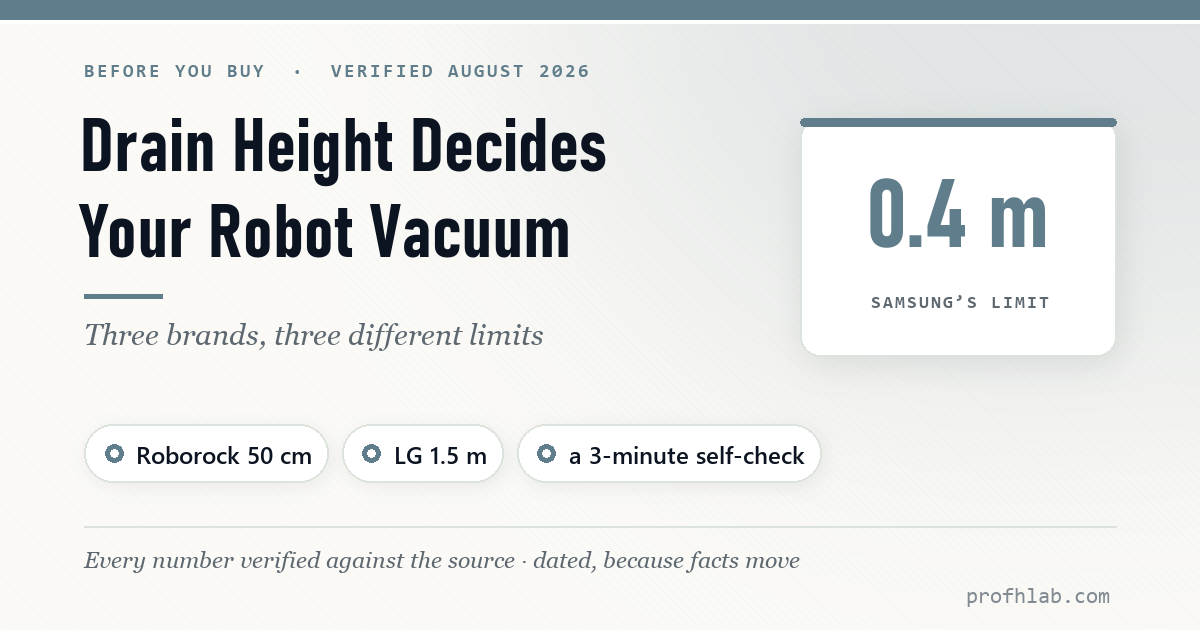
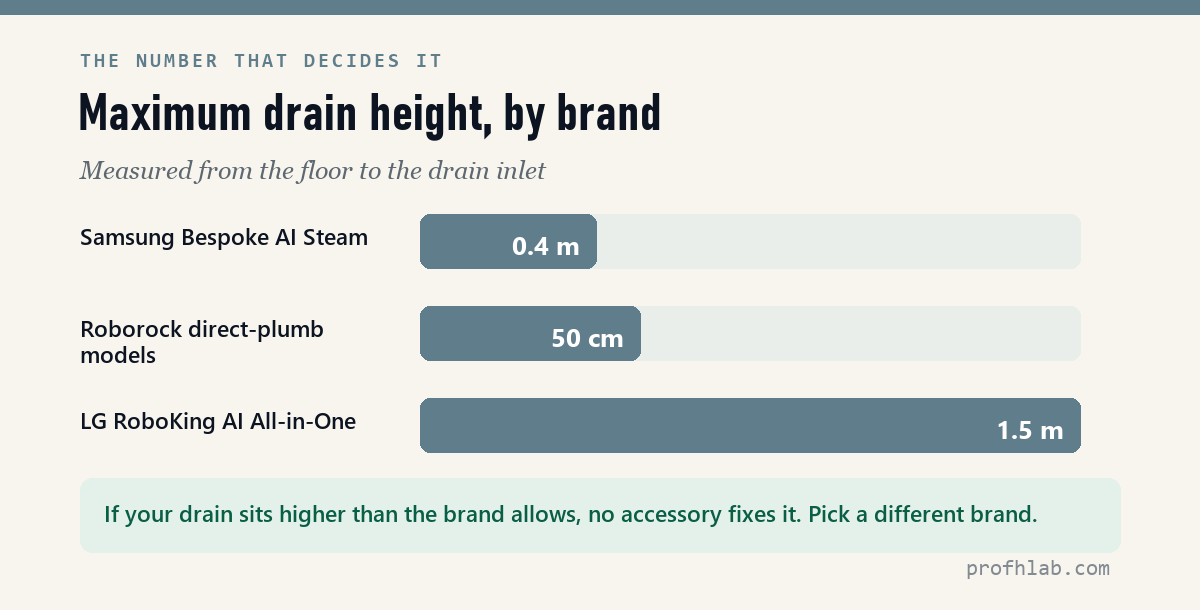
So here is the conclusion up front. Of all the conditions the manufacturers publish, exactly one decides pass or fail: the height of your drain. Samsung’s official installation guide fixes it at 0.4 m (about 16 inches) or less above the floor. Roborock says within 50 cm (about 20 inches). LG allows up to 1.5 m (about 5 feet).
In a home where the utility-room drain sits high off the floor, that means Samsung fails and LG passes — same house, same day, same tape measure. It is a 3.75x spread on a single number, and if you choose the brand before you know it, the whole plan collapses on installation day.
What follows is built on the manufacturers’ own published installation requirements, cross-checked against what US installers actually report. The figures that matter are dimensional, not financial: drain height, pipe run, water pressure and cabinet clearance. Those do not change with the exchange rate or the sale calendar.
One piece of context first, because it decides whether any of this applies to you. A plumbed dock has to sit within reach of both a water supply and a drain. In most US homes that means the laundry room, a utility sink, a garage, or a kitchen cabinet with a dishwasher line already run to it — and it means the robot has to be able to reach the rest of the house from there. If the only plumbing in your home is in bathrooms upstairs, stop reading and buy a tank-fill dock.
How this was checked
Installation requirements are the manufacturers’ own published figures. Costs are US: a plumber to tee into a supply line and drain runs about $150 to $400 depending on your area, and most kits from Roborock and Narwal ship with 6 m supply and drain lines and push-to-connect fittings. Verified August 11, 2026.
The three-minute self-check — can your home take it?
Answer “no” to any one of the five questions below and that brand is either difficult to install or comes with extra construction attached. Every condition here is written down in a manufacturer’s own document.
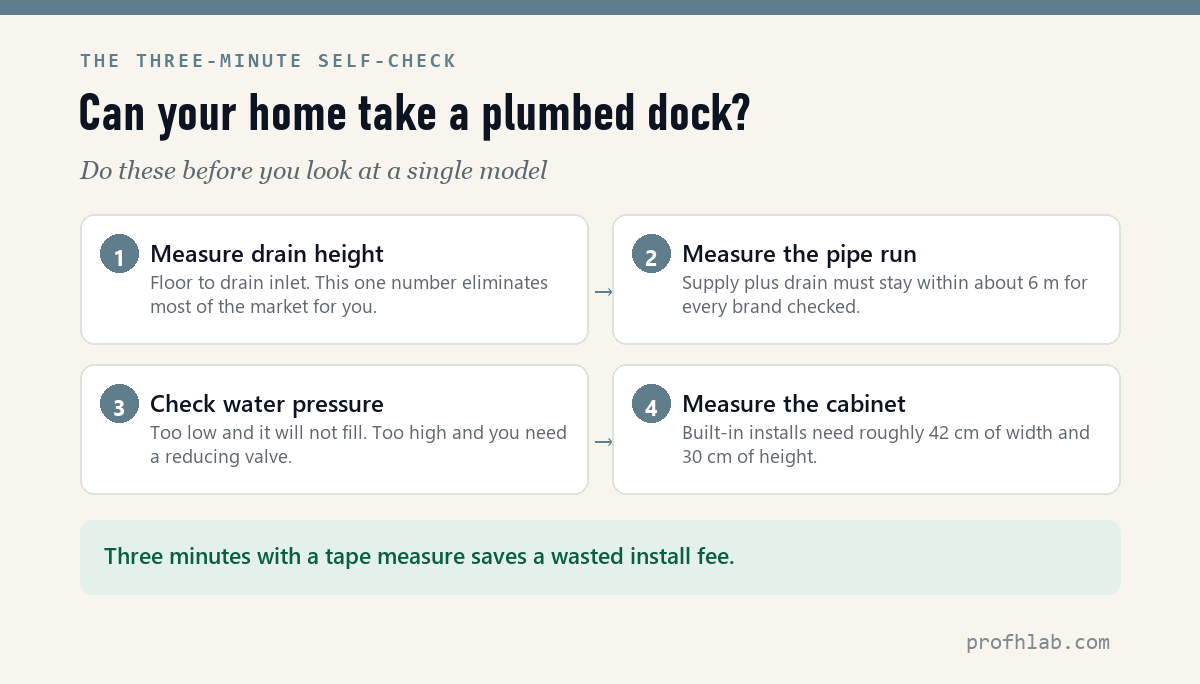
1) Is there room for the station within 6 m (about 20 feet) of a water supply point? Samsung specifies supply and drain runs of 6.0 m as standard and 8.0 m as the maximum. LG recommends installing within 6 m of the faucet. Roborock also sets 6 m from the water and drain fittings as a condition. All three brands land on 6 m as if they had agreed on it beforehand, and the reason is simple: past that distance the station’s pump can no longer push water through.
2) How high off the floor is your drain? This is the decisive one. Samsung 0.4 m or less, Roborock within 50 cm, LG up to 1.5 m. Take a tape measure to the mouth of the drain and you are done in three seconds.
3) Does the space drop below 5 °C (41 °F) in winter? LG states outright that a space falling below 5 °C cannot be installed because of freeze risk. Roborock likewise lists damp, cold bathrooms, balconies and outdoor spots as not installable. Samsung also excludes balconies for the same reason. If you had your eye on a spot on a balcony that hasn’t been enclosed and merged into the room, change the plan now.
4) Is the drain a sewer line or a storm-drain line? LG’s installation guide flatly rules out a drain environment that only has a storm-drain (rainwater) line. If you are reusing the washing machine’s drain you are usually fine, but some balcony floor drains turn out to be storm lines.
5) Is it municipal tap water? Homes running on groundwater or seawater are out with all three brands. Samsung adds one more: you cannot use a faucet that already has another maker’s dishwasher or water purifier connected to it. A surprising number of Korean kitchens have a purifier hanging off the single sink faucet, so go and look.
What the manufacturers actually require, side by side
| Requirement | Samsung Bespoke AI Steam | LG RoboKing AI All-in-One | Roborock (direct-plumb models) |
|---|---|---|---|
| Maximum drain height | 0.4 m or less above the floor | 1.5 m or less | Within 50 cm |
| Supply and drain pipe run | 6.0 m standard, 8.0 m maximum | 6 m total or less | Within 6 m |
| Water pressure | Static 1.0–8.4 kgf/cm² | 0.5–12 kgf/cm² | 0.1–0.4 MPa (pressure-reducing valve required above that) |
| Free-standing clearance | 80 cm in front of the unit | 1.2 m in front, 0.5 m on each side | No thresholds or steps over 2 cm |
| Built-in base cabinet | Width ≥420 mm, height ≥335 mm, depth ≥600 mm | Width 450–600 mm recommended, height ≥800 mm, depth 600 mm recommended | Width 42 cm, height ≥30.5 cm |
| Ruled out entirely | Balcony; groundwater; no Wi-Fi; a faucet already feeding another maker’s purifier | Below 5 °C; direct sunlight; storm-drain-only line; no Wi-Fi | Bathroom; balcony; outdoors; direct sunlight; anywhere that can freeze |
Read the table down each column and the brands’ personalities come out. Samsung has designed around a built-in cabinet and has therefore specified the dimensions in fine detail — it even specifies the opening height the robot drives through, at 135 mm.
LG is the most generous brand on drain height and water pressure, but in exchange it looks at the furniture itself, insisting on things like a sink cabinet at least 800 mm tall. Roborock mostly cares about the floor area the station will sit on and whether there is a threshold in the way — the closest of the three to a genuinely free-standing design.
The real number isn’t the price tag — it’s the total
This is the heart of it. With a direct hookup, a fitting bill arrives behind the sticker price. And that bill differs by brand — and even by what kind of kitchen cabinets you happen to own.
| Setup | Lowest observed price | Official fitting and extras | Estimated total |
|---|---|---|---|
| Roborock S10 MaxV Ultra, direct plumb | $990 — 36,000 Pa | Installation included when bought through official online sellers (no extra charge) | $990 |
| LG RoboKing AI All-in-One B95AWBTH | $1,210 — 10,000 Pa | Standard-size cabinet $115 / storage cabinet $170; drilling natural stone $35, ceramic $80 | $1,210–$1,460 |
| Samsung Bespoke AI Steam Ultra, automatic fill and drain | $1,360 — 22,000 Pa | Base cabinet-reform fee $155 added; non-standard cabinet $65 and countertop drilling $20 charged separately | $1,360–$1,590 |
| Dreame (X50 Ultra line) direct-plumb kit | Robot sold separately + kit $180 | Kit-with-installation package $250 | Robot price + $180–$250 |
Prices are as of August 1, 2026, taken from manufacturer stores and current retail listings, and they move constantly with the seller and the promotion. Re-check right before you buy.
What you should read off this table is not the ranking — it is the structure. Buy a Roborock from an official online seller and an engineer from Hyundai Rental Service, the brand’s Korean installation partner, comes out, plumbs it in, and charges nothing extra. Samsung and LG, by contrast, have turned “work that touches your kitchen cabinets” into a formal service — which means they bill for it, item by item.
On Samsung’s schedule, the $160 base reform fee is joined, depending on the situation, by $60 for a non-standard cabinet, $70 to fabricate a new door, $40 to relocate a cabinet, and $20 to drill the countertop. LG charges $110 for a standard cabinet, $150 for other cabinet types and $170 for a storage cabinet, plus $65 if the floor needs leveling and $20 to cut the cabinet channel.
Which is why the widely quoted “$40–$110 to install” is really the DIY number — buy the kit, clamp it onto the washing machine’s drain hose, done. Built-in work inside a kitchen base cabinet realistically runs at least double that.
And this is the part that gets left out of the price comparison: fitting fees stack on top of the purchase price. If you were weighing buying outright against a rental subscription, the install line changes that arithmetic before you have even started.
If you rent, there is one more line in the math
If you are thinking about a direct hookup in a rented home, the item most people forget is the cost of putting everything back.
Samsung has absorbed that into the product offer. Buy an automatic fill-and-drain model and you can add a sink base-cabinet reform as an option — and the installation guide publishes a line item for restoring the stored cabinet when you move: $70.
The fact that a single partner firm handles the whole job, demolition through finishing, including the side panels, matters to a tenant too. Not everything qualifies, though: imported cabinetry, anything sitting under another maker’s oven, cabinets that bear directly on the floor, and jobs where the area needing floor leveling exceeds 700 mm × 700 mm are all excluded from the reform service.
LG’s drilling policy is clearer. Drilling the base cabinet, the panel or an engineered-stone countertop is free; natural stone costs $40 and ceramic $80. Turn that sentence around and it says the plain truth: this is work that puts a hole in your landlord’s countertop. It is not the kind of thing to go ahead with without the landlord’s consent.
The lowest-stress option is the Roborock or Dreame approach — a free-standing station plus a direct-plumb kit. It clamps onto the utility-room faucet and drain hose, so nothing gets cut, and when you move you unclip the kit and use it again in the next place. At around $180 for the Dreame kit, that route wins on total cost for anyone who moves every two years on a Korean lease cycle.
One more clause worth knowing. LG’s installation guide says installation is not possible where the hose has to run around or across the wall of a room. The plan where the station sits in the middle of the living room and the hose is dragged over to the utility room dies right here. In practice, a direct-plumb station lives in one of two rooms: the kitchen or the utility room.
Four picks — so what should you actually buy?
① You own the apartment and want it built into the kitchen cabinet → Samsung Bespoke AI Steam Ultra, automatic fill and drain. The only reason the $160 reform fee stops feeling like a waste is that the manufacturer’s own partner takes responsibility for cutting into your furniture and for the finish afterward. Samsung also staffs 117 service centers nationwide with people dedicated to robot vacuums, which counts for anyone thinking several years ahead. The catch: the 0.4 m drain-height limit is the tightest of the three, so question 2 of the self-check has to pass first.
② Total spend is what matters → a Roborock direct-plumb model. The S10 MaxV Ultra direct-plumb version sits around $990 and installation is included when you buy from an official seller. Suction is 36,000 Pa, the highest number in the table. A $0 fitting bill comes straight back as a $145–$210 difference against the others.
③ You rent, or you expect to move within two or three years → the Dreame kit type, or a Roborock free-standing station plus a kit. Not cutting the furniture, and being able to unclip the thing and take it with you, matters more than any performance spec on the box.
④ Your drain is high, or the utility-room plumbing is awkward → LG RoboKing AI All-in-One. A 1.5 m drain-height allowance is overwhelmingly the most generous of the three. Its 10,000 Pa loses the numbers contest, but if only one brand can physically be installed in your home, that brand is the right answer.
Four reasons I would not recommend a direct hookup
Honesty requires the drawbacks too.
First, the station’s location becomes permanent. With a tank model, if you don’t like where it sits you move it next week. A plumbed-in station is tied to the pipework. If you rearrange your kitchen often, that is a real constraint.
Second, the leak risk is not zero. It is the single most repeated complaint in DIY installation write-ups, and it is why Roborock, LG and Samsung all treat a visit from a trained engineer as the default. Paying for the installed package — $250 in Dreame’s case — beats saving $180 on the kit and then flooding the inside of your sink cabinet.
Third, a direct drain does not automatically solve the smell. Dumping dirty water on its own genuinely cuts the hours that water spends standing in a tank, but the gaps around the wash tray and the rubber gasket still need a human hand. Spend $1,430 expecting zero maintenance and disappointment follows. I’ve taken the odor problem apart zone by zone separately — which zones auto-cleaning really closes out, and which ones it never touches.
Fourth, in a studio or a small apartment, the return on the investment is poor. If the floor area is small enough that refilling a tank every four or five days is no burden, $140–$210 of fitting fees is better spent elsewhere.
Moving after plumbing it in, or buying the direct-plumb kit later
Q. What happens if I plumb one in and then move?
If it was a built-in job, put the restoration cost in your budget. Samsung publishes cabinet restoration at $70 as a formal line item, so at least it is predictable — but a countertop that has been drilled is hard to undo. The free-standing-plus-kit route is the least painful: disconnect the hoses and take the whole thing with you.
Q. Can I buy the direct-plumb kit separately and add it later?
It depends on the brand. LG supports buying a free-standing model first and adding only the fill-and-drain kit later. Dreame sells model-specific kits — for the X50 Ultra, X50s Pro Ultra, X40 Ultra, L10s Heat and others — at around $180 or $250 with installation. Compatibility is strictly by model, though, so before you buy the robot, check that a dedicated kit for that exact model is actually on sale.
Three minutes with a tape measure saves $140
A direct hookup really does change the experience of owning a robot vacuum. The twice-a-day walk to the bathroom carrying a water tank simply disappears. But this feature is not decided by the spec sheet. It is decided by the plumbing drawing of your own home.
So tonight, take a tape measure to the utility-room drain and get three numbers. How many centimeters the drain mouth sits above the floor. How many meters it is from the faucet to where the station would go. And whether that spot drops below 5 °C in winter. Those three numbers will delete half your shortlist before you have looked at a single review.
Once your plumbing has narrowed the field, then — and only then — is it worth arguing about suction and mopping specs. I’ve pulled apart the 2026 flagships on exactly those numbers separately: what a Pa figure does and doesn’t tell you, and where the four big brands actually rank once you stop reading the box. The payment button will still be there afterwards.
Sources: manufacturer installation guides and published specification sheets for the plumbed dock models sold in the US, verified August 11, 2026; US plumber cost ranges from published trade-pricing surveys; kit contents from Roborock and Narwal documentation.
Part of the Physical AI library — research decoded and machines compared, in plain English: profhlab.com/physical-ai.
SwitchBot, Roborock and Narwal docks plumbed into real water lines
Full index
Every guide in the Physical AI library — 27 of them, grouped so you can find the one you need.
Start here
- Physical AI Foundations: World Models, Robot Foundation Models, and Sim2Real — From Zero
- Physical AI Explained: Why a Chatbot Knows the Cup Falls but a Robot Doesn’t
- The Physical AI Toolbox: Six Free Simulators, a $249 Hardware Ladder, and What the 2026 Papers Admit
Research papers, decoded
- RoboVLMs, Explained: What Actually Makes a Robot Foundation Model Work
- Ψ0 (Psi-Zero), Explained: The Humanoid Foundation Model That Learns From Human Video
- MotionWAM, Explained: One-Shot Imagination Brings Real-Time Humanoid Loco-Manipulation
- XHugWBC, Explained: One Policy That Drives 12 Different Humanoids
- Vision-Tactile Pretraining, Explained: A Robot Hand Learns Human-Like Dexterity From a Webcam
- TouchWorld, Explained: A Robot Hand That Predicts Touch Before Making Contact
- HOUND and APT-RL, Explained: One Transformer Brain for Walking, Running, and Jumping in the Wild
Machines, priced
- Tesla Optimus V3 Release Date, Price and Specs: What Tesla Has Confirmed
- Buying a Humanoid Robot in 2026: What a Unitree R1 Really Costs, Retail vs Import
- Robot Dog Prices in 2026: From ≈$2,900 to ≈$71,000 — and Spot Still Has No Price Tag
- Tesla FSD Goes Subscription-Only in Korea — and the ‘5-Year Break-Even’ Everyone Quotes Is Wrong
Home robots, tested
- Narwal Freo Z10 Ultra Review: 18,000Pa, a 75°C Mop Wash, and Three Honest Drawbacks
- 22,000Pa vs 240 Air Watts: Robot Vacuum Suction Numbers, Decoded (2026)
- Robot Vacuum or Stick Vacuum? I Split Housework Into 10 Tasks — Only One Truly Overlaps
- The Sour Smell Isn’t the Mop: Robot Vacuum Odor by Zone, and a 7–9x Consumables Gap
- ▸ Drain Height Decides Your Robot Vacuum: Samsung 0.4 m, Roborock 50 cm, LG 1.5 m (you are here)
- Robot Vacuum Repair Costs 2026: A $140 Fix and a 56.5% Resolution Rate
- Robot Vacuum Subscription vs Buying: What iRobot Select Really Costs
- Are Window-Cleaning Robots Worth It? The Break-Even vs Hiring a Pro
- Smart Speakers in 2026: The Hardware Is $99 — the Assistant Is the Real Price
- Serving Robot Costs in 2026: $399 a Month, and Why 73.3% Saw No Change
Chips & companies
- HBF and zHBM, Explained: Samsung and SK Hynix Give Opposite Answers to the Same Memory Problem
- Korea’s Chip Equipment Makers, Compared: Profits Fell 68% — So Why Did Pay Jump 29%?
- Samsung DS vs DX: One Company, a $450,000 Bonus Gap — and Why the Simple Story Is Wrong
- ASML Korea’s Starting Pay Is $31K — or $46K: Anatomy of a 2.15x Salary-Data Gap
Looking for the other library? Generative AI — tools, tested →
Prof.’s H Newsletter
One short email a month, with the numbers in it
What actually moved in AI hiring, AI prices, and the scams aimed at older Americans. Counted here, dated, and linked to the source. One email a month, and your address goes nowhere else.