MotionWAM, Explained: One-Shot Imagination Brings Real-Time Humanoid Loco-Manipulation
Before doing anything, a person sketches it in their head: “if I do this, that will happen.” The attempt to plant that obvious-to-us process inside robots is the world model. Lately the field has gone a step further, binding the ability to imagine future video together with the ability to generate actions into one system: the World Action Model (WAM). But there was a fatal weakness. Imagining the future made these models so slow that they were unusable on a humanoid that actually walks around and handles things.
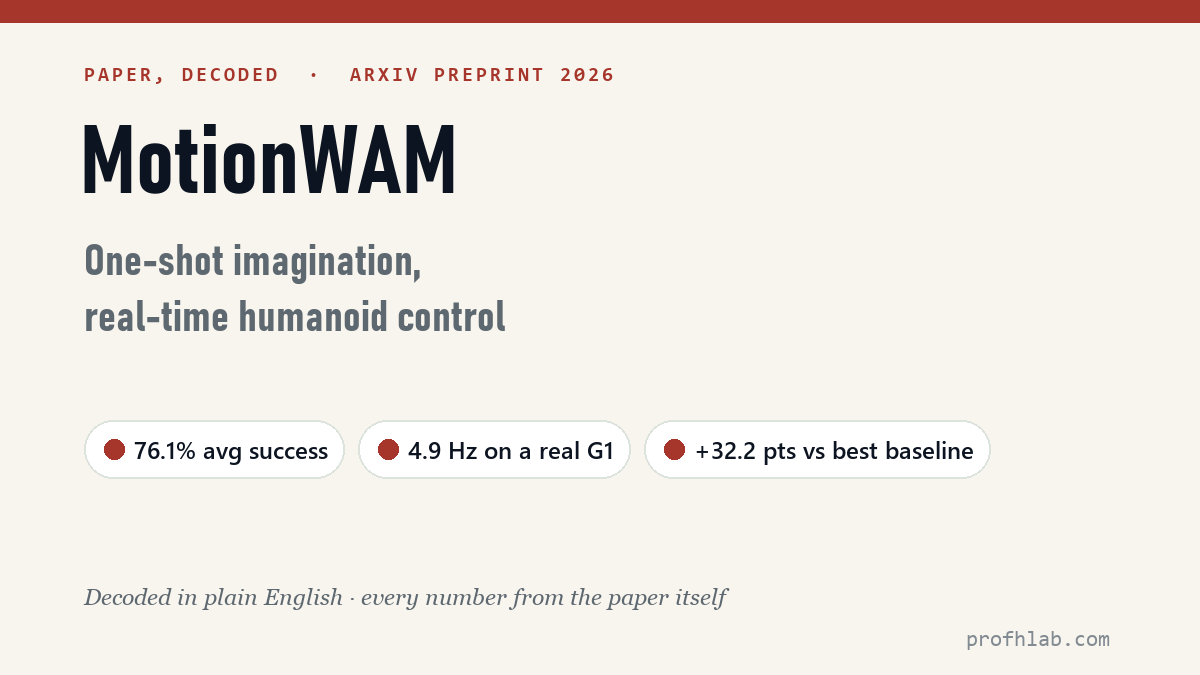
MotionWAM, released in June 2026, is the paper that broke that wall of slowness. Instead of repeating the imagination over and over, it finishes in exactly one pass (one-shot) — and with that idea it succeeded at walking and manipulating in real time, at 4.9 Hz.
| Original title | MotionWAM: Towards Foundation World Action Models for Real-Time Humanoid Loco-Manipulation |
| Authors | Jia Zheng, Teli Ma, Yudong Fan, Zifan Wang, Shuo Yang, Junwei Liang |
| Affiliations | Mondo Robotics · HKUST (Guangzhou) · HKUST (Hong Kong University of Science and Technology) |
| Released | arXiv preprint, June 8, 2026 (before peer review) |
| Paper / DOI | arxiv.org/abs/2606.09215 |
| Robot | Unitree G1 humanoid (physical hardware) |
The core technique: peek at the sketch, skip the finished painting
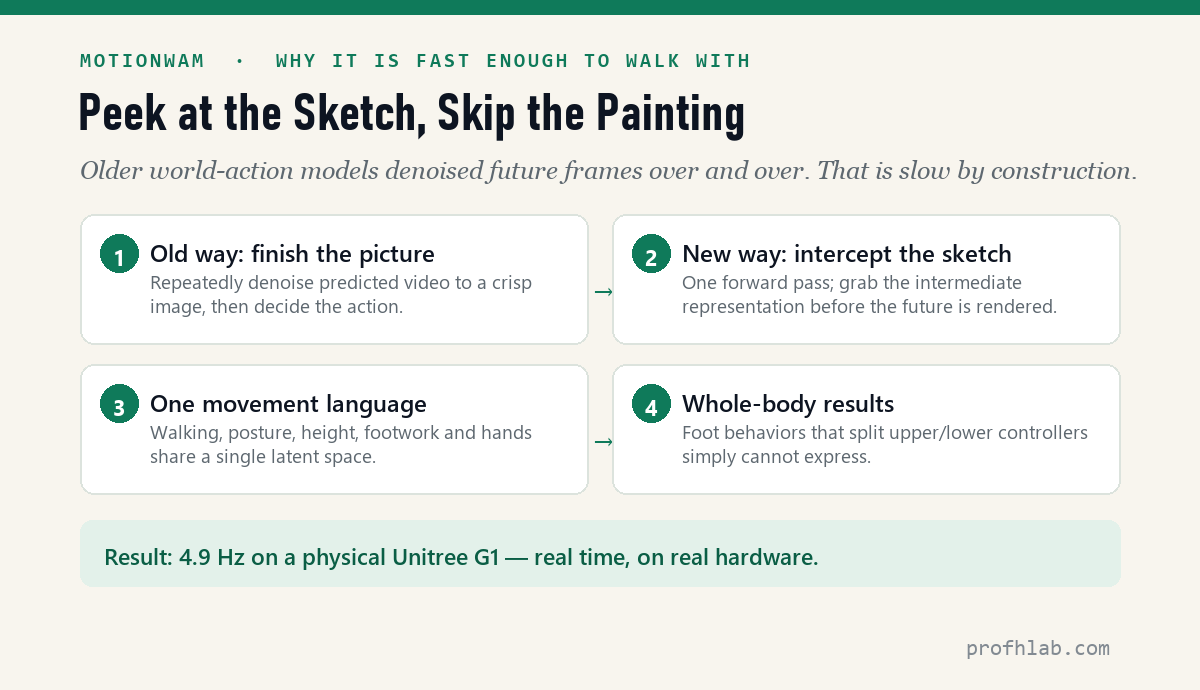
Existing world action models worked like video-generation AI: denoise the future frames repeatedly until they come out crisp, then look at that video to decide the action. That is painting the picture to 100% before lifting the brush — slow by construction.
MotionWAM’s idea is simple and clever. You do not need the finished painting. You only need to steal a glance at the painter’s mental sketch, at the moment the underdrawing forms. Concretely, the team places an interception point (a forward hook) on one specific layer of the video-generation network (a Video DiT) and pulls out the intermediate representation (activations) from the stage before the future is fully rendered — in a single forward pass. That sketch feeds straight into the action-generation network (a Motion DiT) and becomes muscle commands. With iterative denoising gone, the speed jumps.
Source: arxiv.org/abs/2606.09215
The theory in plain words: one “movement language” for upper and lower body
The second key is a unified motion latent space. Humanoid control has usually been split — lower body owns walking, upper body owns arm manipulation — and trained separately. The problem: motions where the whole body must cooperate, like pushing a cart with a foot or lowering the body to pick something up, simply cannot be expressed by that division of labor.
MotionWAM packs walking, upper-body posture, height adjustment, foot interaction, and hand manipulation into one latent representation, conducting the upper and lower body as a single instrument. The paper reports that this enables “task-driven foot behaviors that decoupled policies cannot reach.”
Training stacks up in three stages: ① first-person video pretraining (about 2,136 hours of human- and robot-viewpoint footage) to absorb how the world moves → ② cross-embodiment action post-training to attach behavior fitted to the Unitree G1’s body → ③ whole-body fine-tuning from 200 teleoperated demonstrations per task.
Source: arxiv.org/abs/2606.09215
Real-world results: lowering the bar for robots that work while walking
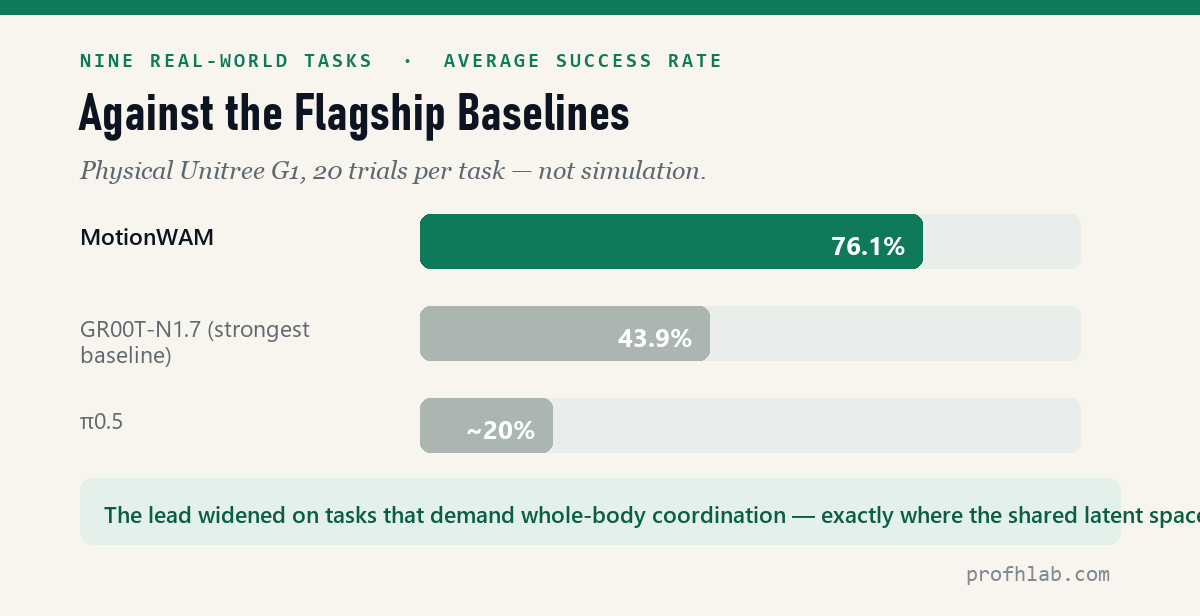
The experiments ran not in simulation but on a physical Unitree G1, across 9 real-world tasks: kicking a soccer ball, pushing a cart, retrieving objects, wiping a blackboard, handling laundry, and more. Average success rates over 20 trials per task came out as follows.
| Model | Avg. success, 9 tasks | Real-time inference (A100) |
| MotionWAM | 76.1% | 4.9 Hz |
| GR00T-N1.7 (strongest baseline) | 43.9% | 6.5 Hz |
| π0.5 | ~20% | — |
| Cosmos Policy | — | 0.7 Hz (7× slower) |
MotionWAM led the strongest baseline by 32.2 percentage points, and the gap widened on tasks demanding whole-body coordination. The first candidates are workplaces where movement and manipulation must happen at once — a robot hauling carts through a logistics warehouse, or carrying laundry around a home. The limits deserve an honest look too: 4.9 Hz sits near the lower bound of real time, an A100-class high-end GPU is required, and per-task demonstration data still has to be collected by people.
Source: arxiv.org/abs/2606.09215
Why it matters: signals for the humanoid and robot ecosystem
The current carries real implications for hardware-strong robot makers — including the Korean companies our home lab tracks closely. For Rainbow Robotics (the humanoid RB-Y1 and others) and Doosan Robotics, the next axis of competition becomes how to couple this “video imagination + action” software stack to their machines. For the camp aiming at appliance and home robots — Samsung and LG among them — it is a milestone for gauging how technically mature the “do chores while moving” scenario really is.
The paper also took flagship VLA (Vision-Language-Action) models — NVIDIA’s GR00T and π0.5 — as its baselines and beat them, which shows the robot foundation-model race expanding from “language → action” to “video imagination → action.”
Source: arxiv.org/abs/2606.09215
Who should care
- If you invest: the humanoid bottleneck is not just the “body” but the “real-time brain.” Read this as a signal that demand for inference optimization and dedicated silicon to run world models in real time will grow alongside. (Informational only — not a recommendation to buy any particular stock.)
- If you study or engineer: reusing an “intermediate representation” instead of a “finished prediction” is a design pattern that travels to other fields. It pays to learn the knack of using a heavy model while extracting only the part you need.
- If you build products: the redesign of split upper/lower-body control pipelines into “whole-body integration” has begun. Data pipelines and teleoperated-demonstration capacity are becoming the competitive edge.
The 3–5 year view: robots that think while they walk
The direction MotionWAM opened is: “take a large model that imagines the future, and strap it onto a body in real time.” If, within three to five years, this sketch-peeking style of imagination runs above 30 Hz on onboard chips and data accumulates automatically, then humanoids that judge and use their hands while walking could cross over from demo reels into actual use across logistics, homes, and industry. How far the time gap between “imagining” and “acting” shrinks will set the speed at which robots enter people’s daily lives.
Is 76.1% low? Not next to a 43.9% baseline
How is a World Action Model different from a VLA?
A VLA mainly wires “language instruction → action.” A WAM adds a world model that imagines future video, giving the robot the ability to picture consequences before it acts. MotionWAM’s differentiator is finishing that imagination in one shot, which is what secures real-time performance.
Isn’t 76.1% still low?
It is the average over 9 hard, real-hardware tasks in which a humanoid manipulates while walking. Considering the strongest baseline scored 43.9%, lifting the success rate by more than 1.7× under identical conditions is a meaningful advance.
MotionWAM pulled the “imagination too slow to use” down into real time, lowering by one notch the bar for humanoids that work while they walk. Next on this shelf: papers on onboard lightweight inference (edge inference) for humanoids, or on automatic data collection for robot foundation models.
This article reinterprets published research for a general audience; for full details, see the original paper. The rest of the decoded-papers shelf lives on the Physical AI page.
A 29-minute primer on world models and why robots need them
Full index
Every guide in the Physical AI library — 27 of them, grouped so you can find the one you need.
Start here
- Physical AI Foundations: World Models, Robot Foundation Models, and Sim2Real — From Zero
- Physical AI Explained: Why a Chatbot Knows the Cup Falls but a Robot Doesn’t
- The Physical AI Toolbox: Six Free Simulators, a $249 Hardware Ladder, and What the 2026 Papers Admit
Research papers, decoded
- RoboVLMs, Explained: What Actually Makes a Robot Foundation Model Work
- Ψ0 (Psi-Zero), Explained: The Humanoid Foundation Model That Learns From Human Video
- ▸ MotionWAM, Explained: One-Shot Imagination Brings Real-Time Humanoid Loco-Manipulation (you are here)
- XHugWBC, Explained: One Policy That Drives 12 Different Humanoids
- Vision-Tactile Pretraining, Explained: A Robot Hand Learns Human-Like Dexterity From a Webcam
- TouchWorld, Explained: A Robot Hand That Predicts Touch Before Making Contact
- HOUND and APT-RL, Explained: One Transformer Brain for Walking, Running, and Jumping in the Wild
Machines, priced
- Tesla Optimus V3 Release Date, Price and Specs: What Tesla Has Confirmed
- Buying a Humanoid Robot in 2026: What a Unitree R1 Really Costs, Retail vs Import
- Robot Dog Prices in 2026: From ≈$2,900 to ≈$71,000 — and Spot Still Has No Price Tag
- Tesla FSD Goes Subscription-Only in Korea — and the ‘5-Year Break-Even’ Everyone Quotes Is Wrong
Home robots, tested
- Narwal Freo Z10 Ultra Review: 18,000Pa, a 75°C Mop Wash, and Three Honest Drawbacks
- 22,000Pa vs 240 Air Watts: Robot Vacuum Suction Numbers, Decoded (2026)
- Robot Vacuum or Stick Vacuum? I Split Housework Into 10 Tasks — Only One Truly Overlaps
- The Sour Smell Isn’t the Mop: Robot Vacuum Odor by Zone, and a 7–9x Consumables Gap
- Drain Height Decides Your Robot Vacuum: Samsung 0.4 m, Roborock 50 cm, LG 1.5 m
- Robot Vacuum Repair Costs 2026: A $140 Fix and a 56.5% Resolution Rate
- Robot Vacuum Subscription vs Buying: What iRobot Select Really Costs
- Are Window-Cleaning Robots Worth It? The Break-Even vs Hiring a Pro
- Smart Speakers in 2026: The Hardware Is $99 — the Assistant Is the Real Price
- Serving Robot Costs in 2026: $399 a Month, and Why 73.3% Saw No Change
Chips & companies
- HBF and zHBM, Explained: Samsung and SK Hynix Give Opposite Answers to the Same Memory Problem
- Korea’s Chip Equipment Makers, Compared: Profits Fell 68% — So Why Did Pay Jump 29%?
- Samsung DS vs DX: One Company, a $450,000 Bonus Gap — and Why the Simple Story Is Wrong
- ASML Korea’s Starting Pay Is $31K — or $46K: Anatomy of a 2.15x Salary-Data Gap
Looking for the other library? Generative AI — tools, tested →
Prof.’s H Newsletter
One short email a month, with the numbers in it
What actually moved in AI hiring, AI prices, and the scams aimed at older Americans. Counted here, dated, and linked to the source. One email a month, and your address goes nowhere else.