Vision-Tactile Pretraining, Explained: A Robot Hand Learns Human-Like Dexterity From a Webcam
A robot twisting a bottle cap or sharpening a pencil — dexterity — is far harder than walking or carrying boxes. The many finger joints make the control variables explode, and the fingers keep blocking the camera’s view (occlusion), so there are constant moments when the object simply cannot be seen.
In this edition’s paper, published in Science Robotics by a team at Zhejiang University, the way humans acquire manual skill — watch, then imitate — is transplanted directly into a robot, attacking the problem head-on. What makes it worth attention: no expensive sensors. One ordinary webcam, plus a binary touch signal that says only “touching / not touching,” produced hand skills approaching the human level.
| Item | Details |
| Original title | Visual-tactile pretraining and online multitask learning for humanlike manipulation dexterity |
| Authors / affiliation | Qi Ye, Qingtao Liu, Siyun Wang, Jiming Chen, et al. — Zhejiang University |
| Journal / date | Science Robotics, Vol. 11, eady2869 — February 2026 |
| DOI | 10.1126/scirobotics.ady2869 |
Source: science.org/doi/10.1126/scirobotics.ady2869
The core technique
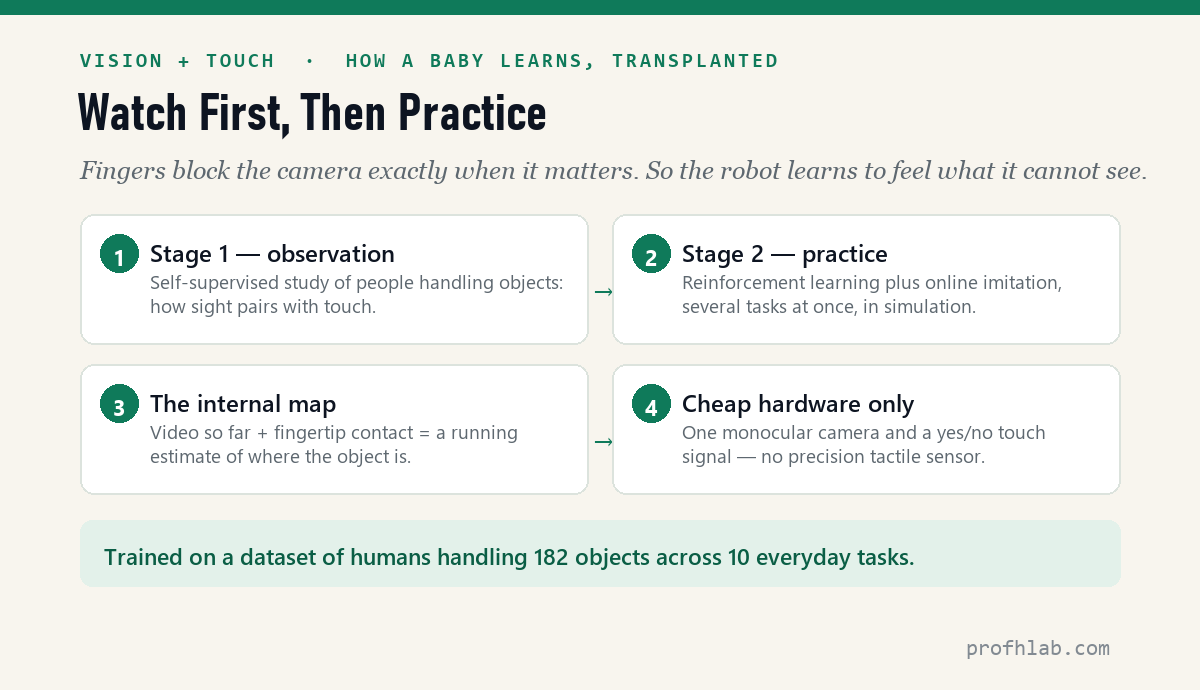
The core idea is two-stage learning: observation, then practice — exactly how a baby first watches adults handle objects to get a feel for it, and then learns by touching things itself.
- Stage 1 (observation): the robot’s AI brain watches a large volume of video of people handling objects bare-handed and wearing gloves, and teaches itself how what the eyes see (vision) pairs with what the fingertips feel (touch). This is self-supervised learning — no answer labels, only the structure of the data.
- Stage 2 (practice): carrying that pretrained brain, the robot practices several tasks at once inside a virtual simulation, combining reinforcement learning (trial and error on its own) with online imitation learning (copying an expert) — acquiring multiple hand skills together rather than one at a time in sequence.
An analogy: instead of a cooking school teaching knife work, measuring, and heat control as separate drills, you learn them all at once by actually cooking.
Source: techxplore.com/news/2026-02-robot-approaches-human-dexterity-visual.html
The theory in plain words
The mathematical key of this work is an integrated visual-tactile representation. Even at the moments when the fingers occlude the object and the camera cannot see it, fusing the video up to that point with the fingertip contact signals into one “internal map” lets the robot keep estimating where the object is and in what state. It is the same principle by which you find the key in your pocket by touch alone, without looking.
To make this possible, the team built a vision-tactile dataset of humans handling 182 objects across 10 everyday tasks — described in the paper as the first vision-tactile dataset for learning complex robotic manipulation skills. And because the inputs are so simple — a monocular (single-camera) image and a binary touch signal — the approach can be reproduced on low-cost hardware without expensive precision tactile sensors. That is its theoretical and practical strength at once.
Source: science.org/doi/10.1126/scirobotics.ady2869
Real-world results
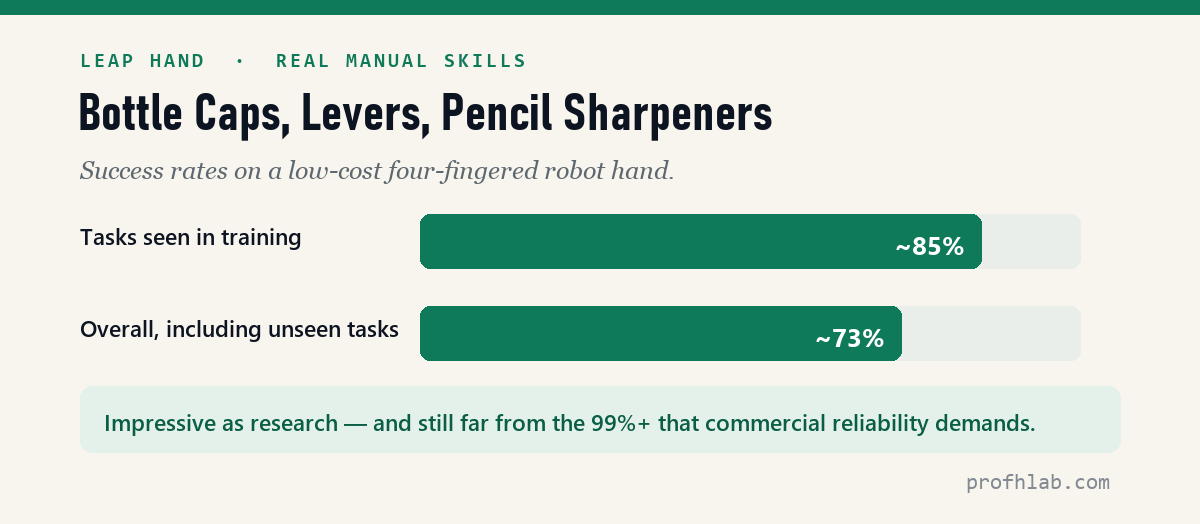
The experiments ran on the LEAP Hand, a low-cost four-fingered robot hand, performing real manual skills: twisting bottle caps, pushing levers, sharpening pencils, loosening screws. Performance came out as follows.
- Tasks used (seen) in training: about 85% success
- New (unseen) tasks not in training: mostly successful — generalization confirmed
- Overall combined success rate: about 73%
This connects directly to home robots (opening lids, using tools), precision assembly in logistics and manufacturing, and tool handling by service robots. That said, a 73% success rate is still far from commercial reliability (typically 99% or higher), and a signal as simple as binary touch has limits for detecting fine slippage or breakage risk. The accurate reading is that several more years of improvement separate this from commercialization.
Source: techxplore.com/news/2026-02-robot-approaches-human-dexterity-visual.html
Why it matters
- Low-cost hardware for everyone: if dexterity can be learned from a webcam plus binary touch, the entry barrier tied to expensive sensors falls, and manipulation research opens up to startups and small labs.
- For robot makers: humanoid developer Rainbow Robotics, collaborative-robot maker Doosan Robotics, and appliance-robot players LG and Samsung all sit on the same trajectory — fine motor skill from cheap sensors. End-effector cost is a core commercialization bottleneck, so research like this is an opening for robot-hand and gripper component suppliers.
- Data-centric competition: as the phrase “first vision-tactile dataset” hints, the coming gap in manipulation ability may be decided less by hardware than by who holds quality visual-tactile data.
Source: science.org/doi/10.1126/scirobotics.ady2869
Who should care
- If you invest: performance came not from an expensive tactile sensor but from the learning method — a sign that software and data capability are gaining weight in the robotics value chain.
- If you study or research: self-supervised pretraining combined with online multitask learning is on track to become the standard recipe in manipulation research. It is worth studying alongside sim-to-real transfer.
- If you build products: the answer may be “better data and training pipelines,” not “better sensors.” How well you collect your own task datasets is the competitive edge.
The 3–5 year view
Three to five years out, home and service robots equipped with nothing fancier than a webcam and simple contact sensors could be opening bottles and gripping tools — competently, if not flawlessly. Just as human dexterity grows out of the coordination of eye and hand, this paper shows that robot dexterity, too, comes out of representation learning that weaves vision and touch into one. A robot that knows how to touch is the key to the last gate between the logistics warehouse and our kitchens.
Touch as on or off, and whether 73% success is good enough
What is a binary touch signal?
Unlike expensive sensors that measure pressure and texture precisely, it is the simplest possible tactile signal, reporting only two states: touching or not touching. This work shows that even that bare signal is enough to learn dexterity.
Is a 73% success rate actually usable?
As a research-stage result it is impressive, but it does not yet reach commercial reliability. Its larger significance is that it clearly shows which direction works.
Next on this shelf: a Tactile World Model that predicts contact state before it happens — read it here: the TouchWorld edition.
This article reinterprets published research for a general audience; for full details, see the original paper. The rest of the decoded-papers shelf lives on the Physical AI page.
Meta FAIR walks through Sparsh and the Digit 360 touch sensor
Full index
Every guide in the Physical AI library — 27 of them, grouped so you can find the one you need.
Start here
- Physical AI Foundations: World Models, Robot Foundation Models, and Sim2Real — From Zero
- Physical AI Explained: Why a Chatbot Knows the Cup Falls but a Robot Doesn’t
- The Physical AI Toolbox: Six Free Simulators, a $249 Hardware Ladder, and What the 2026 Papers Admit
Research papers, decoded
- RoboVLMs, Explained: What Actually Makes a Robot Foundation Model Work
- Ψ0 (Psi-Zero), Explained: The Humanoid Foundation Model That Learns From Human Video
- MotionWAM, Explained: One-Shot Imagination Brings Real-Time Humanoid Loco-Manipulation
- XHugWBC, Explained: One Policy That Drives 12 Different Humanoids
- ▸ Vision-Tactile Pretraining, Explained: A Robot Hand Learns Human-Like Dexterity From a Webcam (you are here)
- TouchWorld, Explained: A Robot Hand That Predicts Touch Before Making Contact
- HOUND and APT-RL, Explained: One Transformer Brain for Walking, Running, and Jumping in the Wild
Machines, priced
- Tesla Optimus V3 Release Date, Price and Specs: What Tesla Has Confirmed
- Buying a Humanoid Robot in 2026: What a Unitree R1 Really Costs, Retail vs Import
- Robot Dog Prices in 2026: From ≈$2,900 to ≈$71,000 — and Spot Still Has No Price Tag
- Tesla FSD Goes Subscription-Only in Korea — and the ‘5-Year Break-Even’ Everyone Quotes Is Wrong
Home robots, tested
- Narwal Freo Z10 Ultra Review: 18,000Pa, a 75°C Mop Wash, and Three Honest Drawbacks
- 22,000Pa vs 240 Air Watts: Robot Vacuum Suction Numbers, Decoded (2026)
- Robot Vacuum or Stick Vacuum? I Split Housework Into 10 Tasks — Only One Truly Overlaps
- The Sour Smell Isn’t the Mop: Robot Vacuum Odor by Zone, and a 7–9x Consumables Gap
- Drain Height Decides Your Robot Vacuum: Samsung 0.4 m, Roborock 50 cm, LG 1.5 m
- Robot Vacuum Repair Costs 2026: A $140 Fix and a 56.5% Resolution Rate
- Robot Vacuum Subscription vs Buying: What iRobot Select Really Costs
- Are Window-Cleaning Robots Worth It? The Break-Even vs Hiring a Pro
- Smart Speakers in 2026: The Hardware Is $99 — the Assistant Is the Real Price
- Serving Robot Costs in 2026: $399 a Month, and Why 73.3% Saw No Change
Chips & companies
- HBF and zHBM, Explained: Samsung and SK Hynix Give Opposite Answers to the Same Memory Problem
- Korea’s Chip Equipment Makers, Compared: Profits Fell 68% — So Why Did Pay Jump 29%?
- Samsung DS vs DX: One Company, a $450,000 Bonus Gap — and Why the Simple Story Is Wrong
- ASML Korea’s Starting Pay Is $31K — or $46K: Anatomy of a 2.15x Salary-Data Gap
Looking for the other library? Generative AI — tools, tested →
Prof.’s H Newsletter
One short email a month, with the numbers in it
What actually moved in AI hiring, AI prices, and the scams aimed at older Americans. Counted here, dated, and linked to the source. One email a month, and your address goes nowhere else.