Physical AI Foundations: World Models, Robot Foundation Models, and Sim2Real — From Zero
The short version: Physical AI is artificial intelligence with a body — systems that see, decide, and act in the real world. To read any robotics paper or product announcement in 2026, you only need five ideas: the world model, the robot foundation model (VLA), simulation, sim2real, and the data problem that connects them all. This page explains each one from zero, with no math, and links every idea to a real 2026 paper you can read next — decoded on this site in plain English.
Why trust this: I’m a professor of AI and robotics and a former Samsung researcher. This is the first lecture I give students — rewritten for everyone.
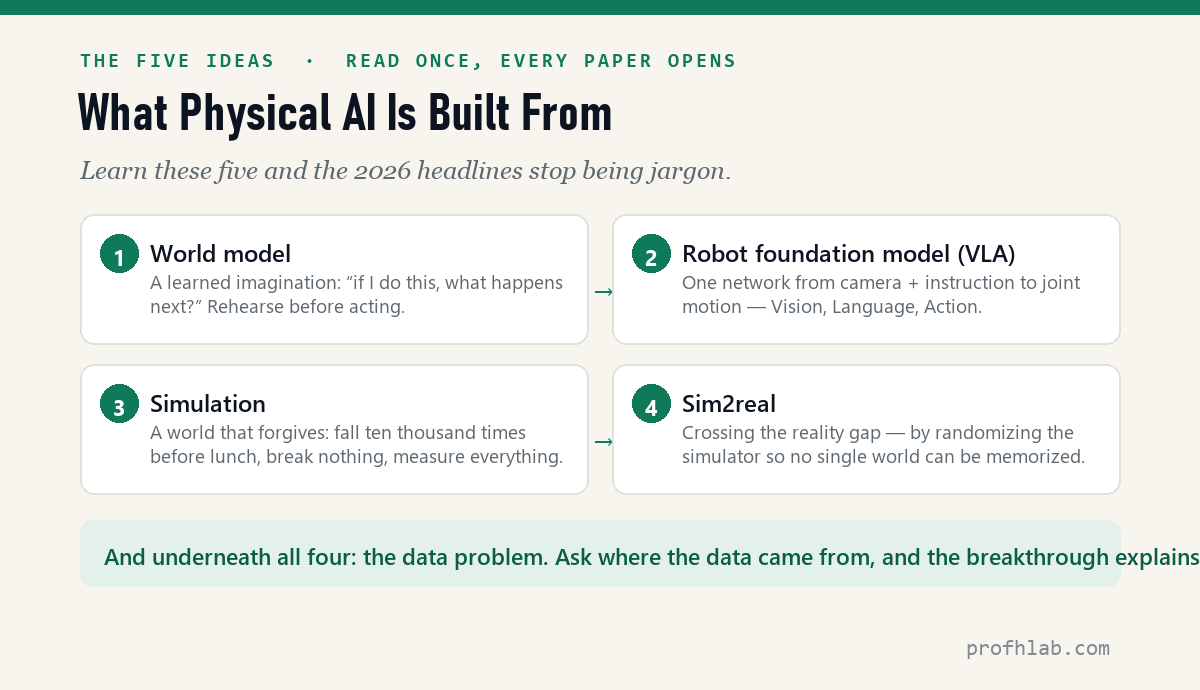
First, the one-sentence map
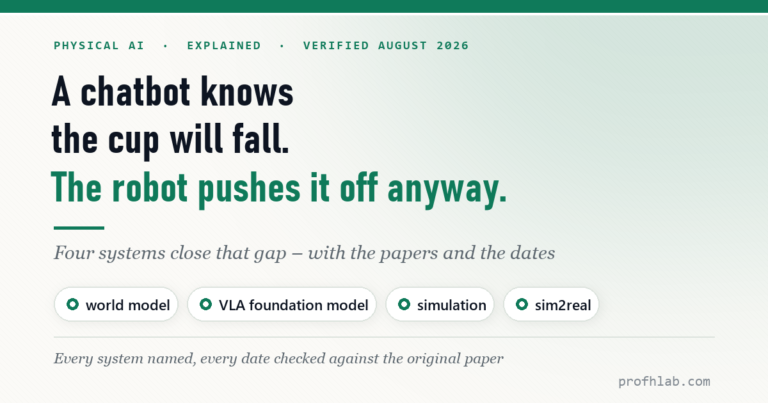
A chatbot answers with words. A physical AI answers with motion — and motion is unforgiving. Words can be vague; a hand reaching for a cup cannot. Everything below exists to solve one problem: how does a machine learn to act in a world it can break?
1. The world model — an imagination for machines
Before you pick up an egg, you already know what will happen: squeeze too hard and it breaks, tilt it and it rolls. You run a tiny movie of the future in your head. A world model is exactly that movie, built into software: a neural network that predicts “if I do this, what happens next?”
Why does that matter? Because a robot with a world model can rehearse before it acts. Instead of learning only from real crashes and spills, it imagines outcomes and picks the action whose imagined outcome looks best. When the term is world foundation model, it means the same idea trained at enormous scale — on so much video of the world that one model can imagine physics for many situations, not just one lab table.
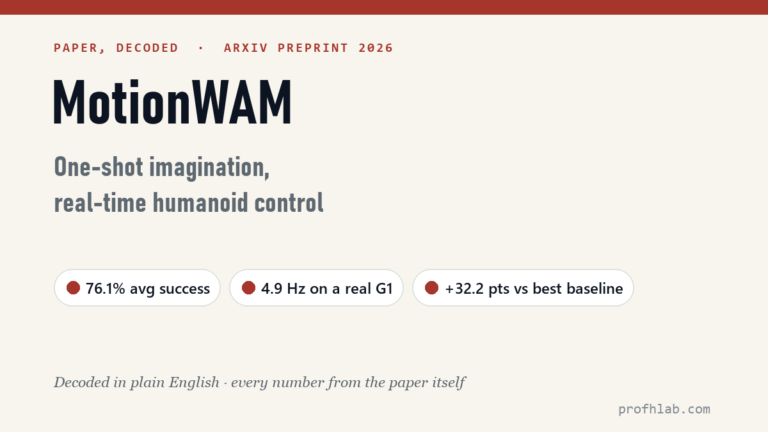
See it in action: MotionWAM lets a humanoid glance at its own imagination in a single pass, fast enough to walk with; TouchWorld extends the imagination to touch — the robot predicts what its palm is about to feel before contact.
2. The robot foundation model — one brain, many jobs (VLA)
Modern language AI showed that one giant pretrained model can handle a thousand tasks. Robotics is now importing that recipe. A robot foundation model starts from a model that already understands images and language, then adds a third ability: producing actions — actual joint movements. That trio has a name you’ll see everywhere: VLA — Vision, Language, Action.
Say “put the cup on the shelf,” and a VLA sees the cup, understands the sentence, and moves the arm — one network, end to end. The open questions are exactly what the papers on this shelf measure: which pretrained backbone works best, how actions should be represented, how much history the model should remember. RoboVLMs ran 600+ experiments to answer precisely those questions, and XHugWBC shows the “foundation” idea reaching the body itself — one policy driving twelve different humanoids.
3. Simulation — a world that forgives
Real robots are slow, expensive, and breakable. So the field trains where none of that is true: inside a physics simulator — a video-game-like world with real physical laws, where a robot can fall ten thousand times before lunch and nothing is dented.
Simulation gives three gifts: speed (thousands of copies of the robot practice in parallel, faster than real time), safety (failure costs nothing), and data (perfect measurements of every joint at every instant — things no real sensor gives you for free). This is where reinforcement learning lives: the robot tries, fails, gets a score, and slowly climbs toward behavior that works. And simulation can even write the textbook: in HOUND, the team generated 15.5 hours’ worth of ideal gait data in 8 minutes by computing optimal motions mathematically — no motion capture at all.
4. Sim2real — crossing the reality gap
Here is the catch, and it deserves its famous name: the reality gap. A robot that is flawless in simulation often stumbles in the real world, because no simulator is perfect — real floors are slipperier, real motors are laggier, real light is messier than any model of them.
Sim2real (“simulation to reality”) is the craft of crossing that gap. The workhorse technique is beautifully counterintuitive: domain randomization. Instead of making the simulator more perfect, you make it deliberately varied — during training you keep shuffling the friction, the weights, the lighting, even the robot’s own body proportions. The AI, never allowed to rely on one exact world, is forced to learn habits that survive in any world — including ours. XHugWBC pushes this to the extreme: it randomizes the robot’s whole morphology, which is why one policy transfers across twelve bodies and onto seven real machines.
5. The data problem — the real bottleneck
Language models feast on the internet’s text. Robots have no such buffet: the gold-standard data — a person tele-operating a robot, one demonstration at a time — is brutally slow and expensive to collect. Every important 2026 result is, underneath, an answer to this shortage:
- Learn from human video instead. Ψ0 studied 800 hours of first-person human footage and needed only 30 hours of robot data on top — beating a rival trained on ten times more.
- Learn from cheap sensors. The vision-tactile hand reached real dexterity with one webcam and a yes/no touch signal — no exotic hardware.
- Manufacture the data. HOUND computed its own perfect demonstrations inside the simulator.
When you read a robotics headline, ask one question first: where did the data come from? The answer usually explains both the breakthrough and its limits.
The honest caveats that make you a smart reader
- Success rates are averages in chosen settings. A “96.7%” is real — inside the benchmark it was measured on. Homes are messier than benchmarks.
- Preprint ≠ settled. Papers on arXiv are shared before peer review; numbers can shift. The decodes on this shelf always say which is which.
- Demos are highlight reels. A one-minute video shows the best run, not the average one. The papers’ own “limitations” sections — which we always translate — are where the truth lives.
Glossary — the ten terms that unlock everything
| Physical AI | AI that acts in the physical world through a body — robots, vehicles, machines. |
| World model | A learned “imagination”: predicts what happens next if an action is taken. |
| World foundation model | A world model trained at massive scale, general across many environments. |
| VLA | Vision-Language-Action: one network from camera + instruction to motion. |
| Policy | The decision-maker: the function mapping what the robot senses to what it does. |
| Reinforcement learning | Learning by trial, error, and a score — the engine of simulation training. |
| Teleoperation | A human driving the robot to record demonstrations — precious, slow data. |
| Sim2real | Making skills learned in simulation survive in reality. |
| Domain randomization | Deliberately varying the simulator so the AI can’t overfit to one world. |
| Reality gap | The stubborn difference between simulated and real physics. |
Your reading path
Read the shelf in this order and each paper builds on the last: RoboVLMs (what makes a robot brain work) → Ψ0 (where the data comes from) → XHugWBC (one brain, many bodies) → MotionWAM (imagination in real time) → Vision+Touch and TouchWorld (the fingertips) → HOUND (all of it, sprinting through a forest).
Is Physical AI just robotics, and do you need the math?
Is Physical AI the same as robotics?
Robotics is the body-building discipline — motors, joints, sensors. Physical AI is the mind that has recently arrived for those bodies: learned models instead of hand-written rules. The 2026 wave exists because the two finally met.
How is a world model different from ChatGPT?
ChatGPT predicts the next word. A world model predicts the next moment — what the camera will see and even what the hand will feel. Same underlying trick, aimed at reality instead of text.
Why not just train robots in the real world?
Cost and breakage. A real robot learning by trial and error destroys itself and its surroundings long before it learns. Simulation gives millions of safe attempts; sim2real carries the lesson across.
Do I need math to follow this field?
Not to follow it. The five ideas on this page are the vocabulary; every decode on this shelf translates the math into consequences. Curiosity is the only prerequisite.
What should I read first?
The reading path above — start with RoboVLMs. One paper in, the headlines start making sense.
Part of the Physical AI library — research decoded and machines compared, in plain English: profhlab.com/physical-ai.
NVIDIA explains world foundation models for Physical AI
Full index
Every guide in the Physical AI library — 27 of them, grouped so you can find the one you need.
Start here
- ▸ Physical AI Foundations: World Models, Robot Foundation Models, and Sim2Real — From Zero (you are here)
- Physical AI Explained: Why a Chatbot Knows the Cup Falls but a Robot Doesn’t
- The Physical AI Toolbox: Six Free Simulators, a $249 Hardware Ladder, and What the 2026 Papers Admit
Research papers, decoded
- RoboVLMs, Explained: What Actually Makes a Robot Foundation Model Work
- Ψ0 (Psi-Zero), Explained: The Humanoid Foundation Model That Learns From Human Video
- MotionWAM, Explained: One-Shot Imagination Brings Real-Time Humanoid Loco-Manipulation
- XHugWBC, Explained: One Policy That Drives 12 Different Humanoids
- Vision-Tactile Pretraining, Explained: A Robot Hand Learns Human-Like Dexterity From a Webcam
- TouchWorld, Explained: A Robot Hand That Predicts Touch Before Making Contact
- HOUND and APT-RL, Explained: One Transformer Brain for Walking, Running, and Jumping in the Wild
Machines, priced
- Tesla Optimus V3 Release Date, Price and Specs: What Tesla Has Confirmed
- Buying a Humanoid Robot in 2026: What a Unitree R1 Really Costs, Retail vs Import
- Robot Dog Prices in 2026: From ≈$2,900 to ≈$71,000 — and Spot Still Has No Price Tag
- Tesla FSD Goes Subscription-Only in Korea — and the ‘5-Year Break-Even’ Everyone Quotes Is Wrong
Home robots, tested
- Narwal Freo Z10 Ultra Review: 18,000Pa, a 75°C Mop Wash, and Three Honest Drawbacks
- 22,000Pa vs 240 Air Watts: Robot Vacuum Suction Numbers, Decoded (2026)
- Robot Vacuum or Stick Vacuum? I Split Housework Into 10 Tasks — Only One Truly Overlaps
- The Sour Smell Isn’t the Mop: Robot Vacuum Odor by Zone, and a 7–9x Consumables Gap
- Drain Height Decides Your Robot Vacuum: Samsung 0.4 m, Roborock 50 cm, LG 1.5 m
- Robot Vacuum Repair Costs 2026: A $140 Fix and a 56.5% Resolution Rate
- Robot Vacuum Subscription vs Buying: What iRobot Select Really Costs
- Are Window-Cleaning Robots Worth It? The Break-Even vs Hiring a Pro
- Smart Speakers in 2026: The Hardware Is $99 — the Assistant Is the Real Price
- Serving Robot Costs in 2026: $399 a Month, and Why 73.3% Saw No Change
Chips & companies
- HBF and zHBM, Explained: Samsung and SK Hynix Give Opposite Answers to the Same Memory Problem
- Korea’s Chip Equipment Makers, Compared: Profits Fell 68% — So Why Did Pay Jump 29%?
- Samsung DS vs DX: One Company, a $450,000 Bonus Gap — and Why the Simple Story Is Wrong
- ASML Korea’s Starting Pay Is $31K — or $46K: Anatomy of a 2.15x Salary-Data Gap
Looking for the other library? Generative AI — tools, tested →
Prof.’s H Newsletter
One short email a month, with the numbers in it
What actually moved in AI hiring, AI prices, and the scams aimed at older Americans. Counted here, dated, and linked to the source. One email a month, and your address goes nowhere else.