Serving Robot Costs in 2026: $399 a Month, and Why 73.3% Saw No Change
Where these numbers come from
Prices are US, from authorised resellers, verified August 11, 2026. The outcome data is different: no US agency has surveyed restaurant operators who deployed these robots, so the 73.3% figure below comes from a Korean government survey — the only large public dataset that exists. The machines are the same ones sold here, which is why it transfers; the subsidy programme behind it does not.
Walk into enough American restaurants and you will meet one: a wheeled tray on a set route, carrying plates from the pass to table twelve while a server carries the rest. Five years ago these machines cost a thousand dollars a month. Today the number is closer to four hundred, and that collapse is the most interesting thing about them.
Here is what they actually cost in the US right now, what the price drop means, and the uncomfortable finding from the only large survey ever run on operators who bought one.
What a serving robot costs in the US, August 2026
| Model | Purchase | Monthly (robot-as-a-service) | Included |
|---|---|---|---|
| Bear Robotics Servi | $11,990 | $399 on a 36-month term | Installation, mapping, staff training, software updates, support |
| Bear Robotics Servi Plus | $13,990 | $293 | Hardware, installation, training, updates, support |
| Pudu BellaBot Pro | Quote | $335 | Varies by reseller |
Two things jump out. First, the monthly rate and the purchase price do not line up the way you would expect: at $399 a month, 36 months comes to $14,364 — more than the $11,990 purchase price. You are paying roughly $2,400 for installation, training, updates and the guarantee that a broken robot is somebody else’s problem.
Second, and less obviously: the Servi Plus is the more expensive machine at purchase and the cheaper one per month. Do not assume the ranking carries across payment methods — price both ways for the exact model you want.
$999 to $399: the price collapsed, and that is the real story
An early US adopter in 2021 leased a Servi for $999 a month, installation and support included. The same category now leases from $293 to $399. That is roughly a 60% drop in five years, on hardware that got better rather than worse.
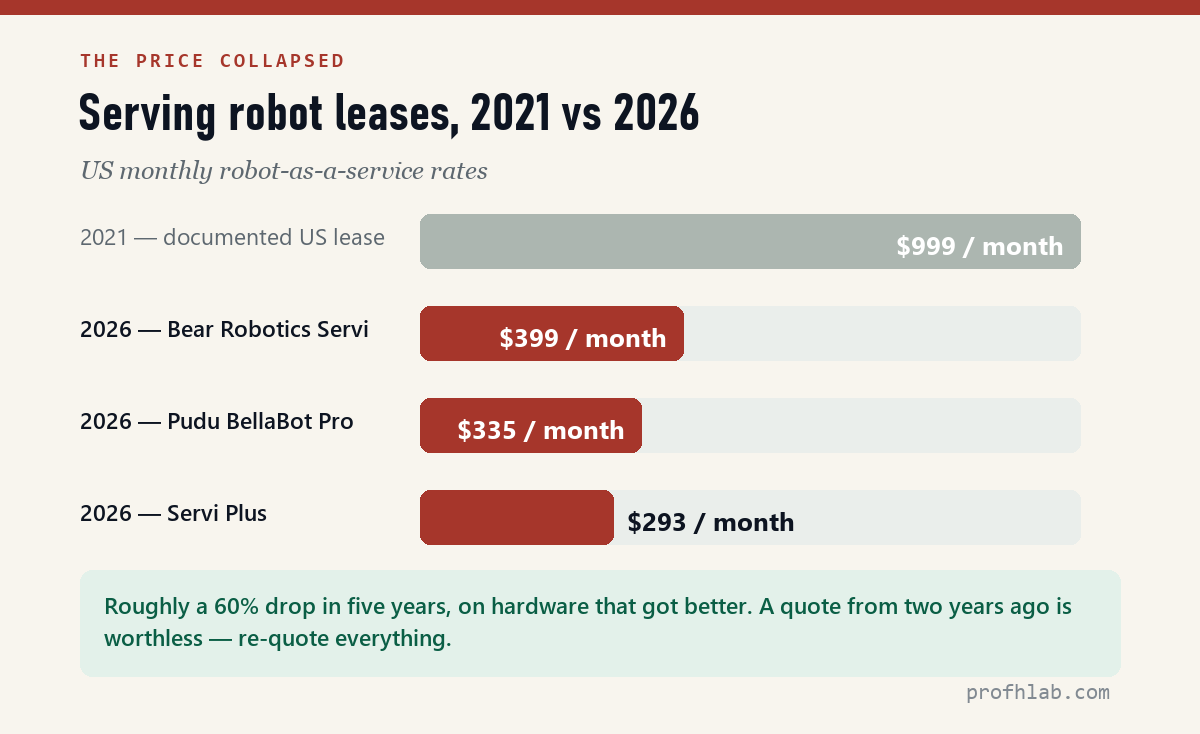
Two forces did it: manufacturing scale out of Asia, and competition — Bear Robotics, Pudu, Keenon and others all chasing the same restaurants. For an operator, the practical consequence is simple and rarely stated: a quote you got even two years ago is worthless. Re-quote everything, and use a competing quote when you negotiate.
Against one person: the comparison every operator actually makes
$399 a month works out to about $13 a day for a machine that runs every shift and never calls in sick. In most states that is under an hour of one server’s wage.
Which makes it sound like an obvious yes — and that is exactly the trap. A serving robot does not replace a server. It replaces trips: the walk from the pass to the table with a heavy tray. It does not take orders, read a table, handle a complaint, refill water without being asked, or notice that the family in the corner is ready for the check.
So the honest comparison is not “robot versus employee.” It is: how many trips per shift does your floor plan actually generate, and what would you do with the hours those trips give back? If the answer is “more tables turned” or “one fewer person on a short shift,” the machine pays. If the answer is a shrug, it will not.
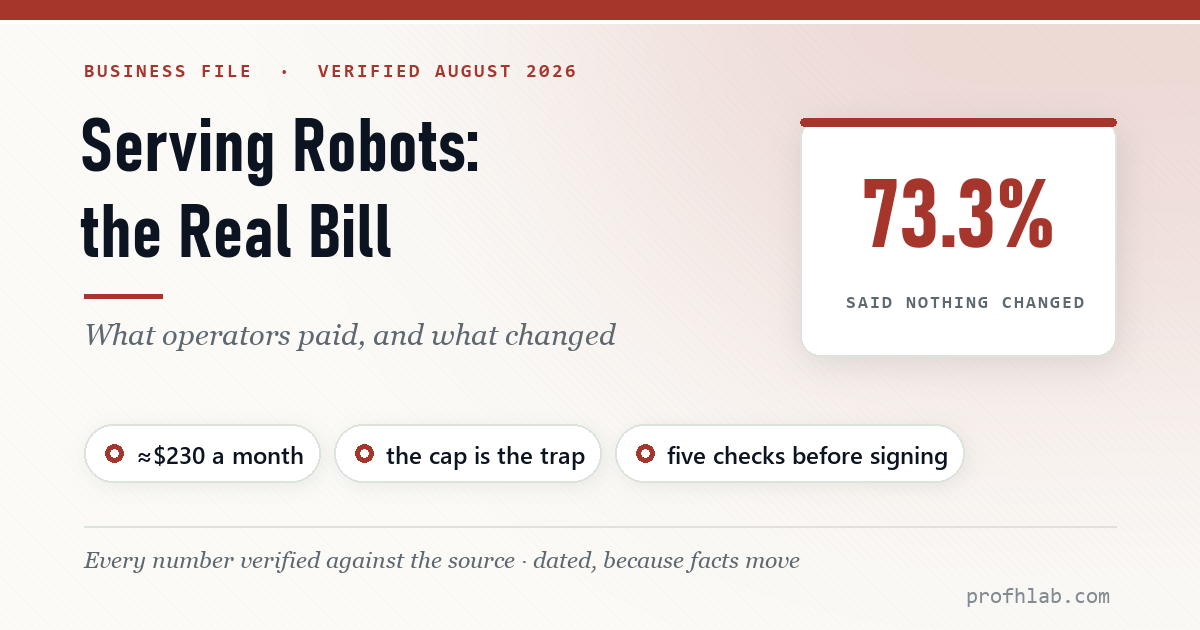
73.3% of operators said nothing changed
This is the number I keep coming back to, and it comes from the only place that has ever run the survey at scale.
Korea deployed serving robots into restaurants at national scale, with a government subsidy behind it, and then its agriculture and food ministry surveyed the operators who took part. 73.3% reported that nothing meaningfully changed in their business after installing one. No US agency has run an equivalent study, and no vendor is going to publish one.
Before you dismiss it as somebody else’s market: the machines are the same. Bear Robotics is a US company; Pudu sells the same BellaBot on both continents. Aisle widths and table layouts differ more between two restaurants on the same street than between countries.
The useful question is what separated the quarter it worked for from the three quarters it did not. From the same survey and from operator interviews, three things recur:
- They measured the aisles first. A robot that cannot pass two seated guests without someone standing up gets parked within a month. This is the single most common cause of an abandoned machine.
- They changed the workflow, not just the equipment. Buying the robot and running the floor exactly as before produces exactly the previous result, minus the lease payment. The gain comes from redeploying the saved trips deliberately.
- They ran a high-volume, long-run floor. Serving robots pay in restaurants with long carries and constant turnover. In a small room where the pass is six steps from every table, there is nothing to automate.
Five checks before you sign — four of them free
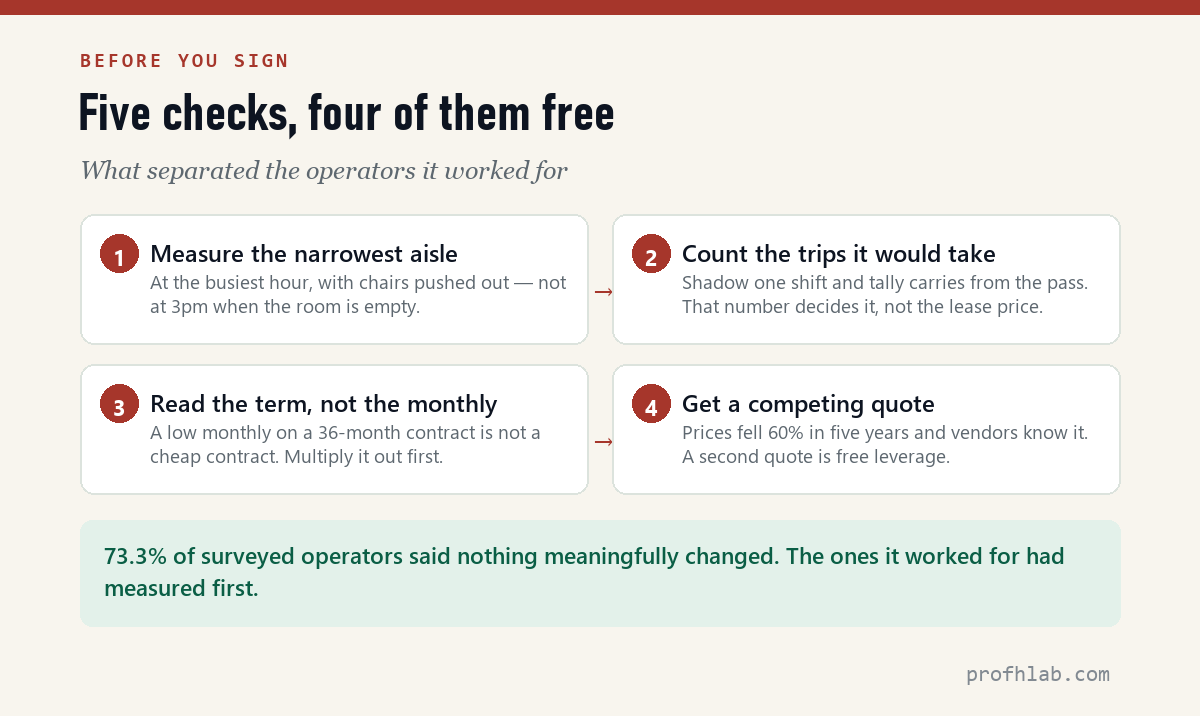
- Measure your narrowest aisle, at the busiest hour, with chairs pushed out. Not at 3pm when the room is empty. That is the width the robot has to live with.
- Count the trips it would actually take. Shadow one shift and tally carries from the pass. That number, not the lease price, tells you whether this pays.
- Read the term, not the monthly. A low monthly on a 36- or 39-month contract is not a cheap contract. Multiply it out before you react to the headline figure.
- Ask who pays for repairs, in writing. Bundled service is the difference between two quotes that look identical. It is also the main thing you are buying when you lease instead of purchase.
- Get a competing quote. Prices in this category fell 60% in five years and vendors know it. A quote from a second supplier is the cheapest negotiating tool you will ever hold.
Lease or buy, and will a robot actually replace a server?
Q. Is it cheaper to buy or to lease?
Over 36 months, leasing a Servi at $399 comes to $14,364 against a $11,990 purchase — about $2,400 more. That premium buys installation, mapping, training, updates and repairs. If you have no in-house technical help, it is usually worth it. If you run several locations and can support them yourself, buying wins.
Q. Will it replace a server?
No. It replaces trips. Operators who bought it expecting a headcount reduction are heavily represented in the group that said nothing changed.
Q. What happens when it breaks?
On a robot-as-a-service contract, the vendor handles it — that is the core of what you are paying for. On a purchase, you are dependent on the reseller’s service agreement, so read it before you buy rather than after something fails during a Friday dinner rush.
Q. Do customers like them?
Reporting from US restaurants running them describes a split: customers, and especially children, react positively, while staff reactions are more mixed and include real anxiety about what the machine means for their jobs. Both reactions are worth planning for before the robot arrives, not after.
Measure the aisle and count the trips, then decide
At $293 to $399 a month, a serving robot is no longer an expensive decision. That is precisely why it deserves a careful one: cheap enough to buy on impulse is exactly how three quarters of operators ended up reporting that nothing changed.
Measure the aisle. Count the trips. Then decide.
Sources: US reseller pricing for Bear Robotics Servi and Pudu BellaBot Pro, verified August 11, 2026; a documented 2021 US lease rate for the same product line; the operator survey conducted by Korea’s Ministry of Agriculture, Food and Rural Affairs, the only large-scale public dataset on serving-robot outcomes; and US local television reporting from restaurants running these machines.
Inside a restaurant that runs food with a robot
Full index
Every guide in the Physical AI library — 27 of them, grouped so you can find the one you need.
Start here
- Physical AI Foundations: World Models, Robot Foundation Models, and Sim2Real — From Zero
- Physical AI Explained: Why a Chatbot Knows the Cup Falls but a Robot Doesn’t
- The Physical AI Toolbox: Six Free Simulators, a $249 Hardware Ladder, and What the 2026 Papers Admit
Research papers, decoded
- RoboVLMs, Explained: What Actually Makes a Robot Foundation Model Work
- Ψ0 (Psi-Zero), Explained: The Humanoid Foundation Model That Learns From Human Video
- MotionWAM, Explained: One-Shot Imagination Brings Real-Time Humanoid Loco-Manipulation
- XHugWBC, Explained: One Policy That Drives 12 Different Humanoids
- Vision-Tactile Pretraining, Explained: A Robot Hand Learns Human-Like Dexterity From a Webcam
- TouchWorld, Explained: A Robot Hand That Predicts Touch Before Making Contact
- HOUND and APT-RL, Explained: One Transformer Brain for Walking, Running, and Jumping in the Wild
Machines, priced
- Tesla Optimus V3 Release Date, Price and Specs: What Tesla Has Confirmed
- Buying a Humanoid Robot in 2026: What a Unitree R1 Really Costs, Retail vs Import
- Robot Dog Prices in 2026: From ≈$2,900 to ≈$71,000 — and Spot Still Has No Price Tag
- Tesla FSD Goes Subscription-Only in Korea — and the ‘5-Year Break-Even’ Everyone Quotes Is Wrong
Home robots, tested
- Narwal Freo Z10 Ultra Review: 18,000Pa, a 75°C Mop Wash, and Three Honest Drawbacks
- 22,000Pa vs 240 Air Watts: Robot Vacuum Suction Numbers, Decoded (2026)
- Robot Vacuum or Stick Vacuum? I Split Housework Into 10 Tasks — Only One Truly Overlaps
- The Sour Smell Isn’t the Mop: Robot Vacuum Odor by Zone, and a 7–9x Consumables Gap
- Drain Height Decides Your Robot Vacuum: Samsung 0.4 m, Roborock 50 cm, LG 1.5 m
- Robot Vacuum Repair Costs 2026: A $140 Fix and a 56.5% Resolution Rate
- Robot Vacuum Subscription vs Buying: What iRobot Select Really Costs
- Are Window-Cleaning Robots Worth It? The Break-Even vs Hiring a Pro
- Smart Speakers in 2026: The Hardware Is $99 — the Assistant Is the Real Price
- ▸ Serving Robot Costs in 2026: $399 a Month, and Why 73.3% Saw No Change (you are here)
Chips & companies
- HBF and zHBM, Explained: Samsung and SK Hynix Give Opposite Answers to the Same Memory Problem
- Korea’s Chip Equipment Makers, Compared: Profits Fell 68% — So Why Did Pay Jump 29%?
- Samsung DS vs DX: One Company, a $450,000 Bonus Gap — and Why the Simple Story Is Wrong
- ASML Korea’s Starting Pay Is $31K — or $46K: Anatomy of a 2.15x Salary-Data Gap
Looking for the other library? Generative AI — tools, tested →
Prof.’s H Newsletter
One short email a month, with the numbers in it
What actually moved in AI hiring, AI prices, and the scams aimed at older Americans. Counted here, dated, and linked to the source. One email a month, and your address goes nowhere else.