Are Window-Cleaning Robots Worth It? The Break-Even vs Hiring a Pro
Every Thursday, a queue forms at the Noeun 3-dong community service centre in Yuseong District, Daejeon. What residents fill in a form for and carry home is a window-cleaning robot — the centre lends out seven of them. Residents proposed the scheme themselves and got it into the district budget, so the hire fee is zero and each loan runs six days.
It is a thoroughly practical answer to a question a lot of people have quietly asked: does buying a machine just to clean a few windows really make sense?
If you are standing in front of the same question in the US, take the conclusion first — and know that the neighbourhood-lending option above does not exist here. There is no meaningful rental market for window robots in the US. You buy one, or you hire someone. Measured against what a professional visit actually costs, buying overtakes hiring on about the third visit — but only if the robot replaces the whole job. It usually does not, and the gap between those two numbers is what this article is about.
How this was checked
Every price here is US retail, verified August 11, 2026 on ECOVACS’ own US store. The professional cleaning figures come from published US cost surveys, dated in the caption. The opening story is from Korea, where these machines reached ordinary households first — it is there because the question it raises is the same one you are asking, not because the prices transfer.
What hiring a pro actually costs in the US
Start with the number you are trying to beat, because almost nobody looks it up before buying a robot.
Professional window cleaning in the US runs $8 to $40 per window, and a typical whole-house visit lands like this:
| Windows in the house | Cost per visit |
|---|---|
| 5–6 | $100–$120 |
| 8–10 | $160–$200 |
| 13–15 | $260–$300 |
| 18–20 | $360–$400 |
| 23–25 | $460–$500 |
Now the split that decides everything, and the one the robot ads never show you. Priced separately, exterior cleaning runs about $6.40 to $12.80 per window. Interior runs about $1.60 to $3.20.
Read that twice. Four fifths of what you pay a professional is for the outside of the glass — the ladder, the pole, the risk, the second story. The inside is nearly free by comparison.
And the inside is the part a window robot is genuinely good at. Most companies will not even quote interior-only work as a standalone job; when they do, a minimum call-out charge usually applies. So the honest framing is not “robot versus pro.” It is: the robot takes over the cheapest part of the job.
US buyers should also know what does not exist here. In some markets you can rent a window robot by the day, or borrow one from a community program. In the US there is no meaningful consumer rental market for these — the choice is buy it or hire someone.
The break-even table — how many visits before buying wins
Two break-evens, because there are two honest ways to count. The optimistic one assumes the robot replaces an entire visit. The realistic one assumes it replaces only the interior half — which is what actually happens in a two-story house.
| Model | US price | Suction | If it replaced a whole visit | If it replaces interior only |
|---|---|---|---|---|
| ECOVACS WINBOT mini | $239.99 | 7,500 Pa max (3,200 Pa moving) | 2 visits | 8–15 visits |
| ECOVACS WINBOT W2S | $399.99 | 8,000 Pa | 3 visits | 13–25 visits |
| ECOVACS WINBOT W2S OMNI | $599.99 | 8,000 Pa + wash station | 4 visits | 19–37 visits |
| ECOVACS WINBOT W3 OMNI | $699.99 | Wash station, 130 min runtime | 4 visits | 22–44 visits |
At two cleanings a year, the optimistic column pays back in one to two years. The realistic column pays back in four to twenty years — longer than the machine will last.
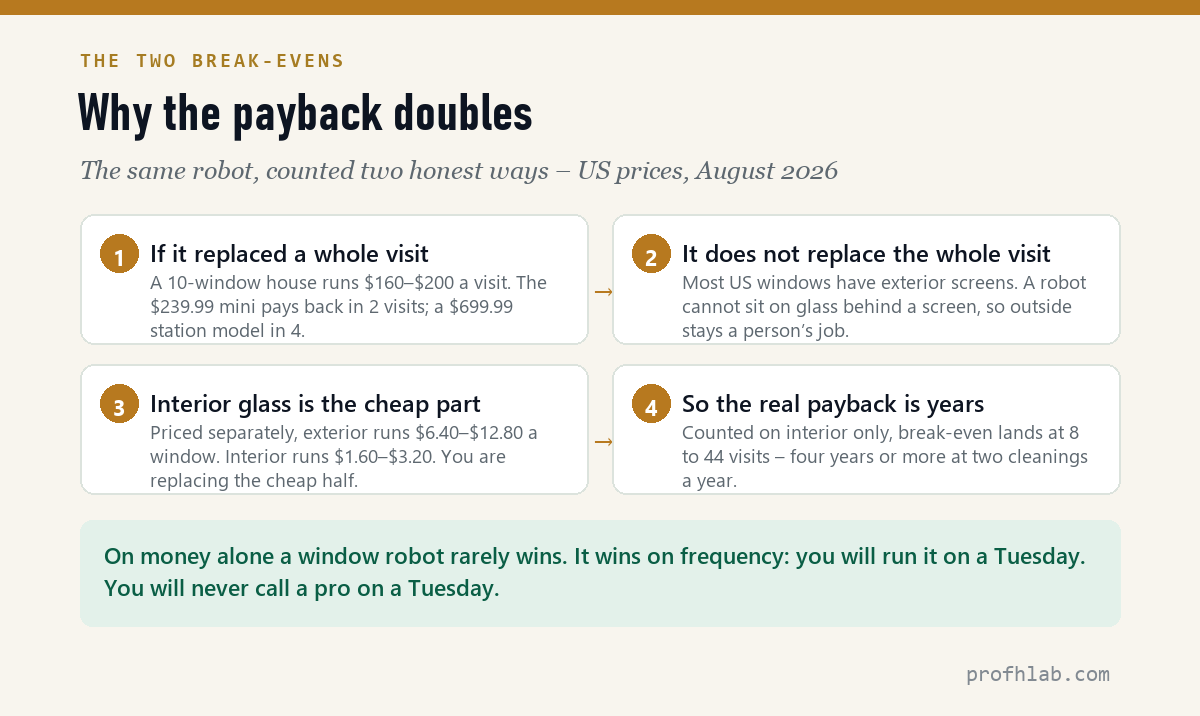
That is the finding, and it is not the one I expected. On money alone, a window robot rarely wins. It wins on frequency: you can run it on a Tuesday because the glass looks smudged, which is something you will never call a professional to do. Buy it for that, and the math stops mattering. Buy it to save money, and check the interior-only column first.
Before you buy — will it even fit your window?
There is something to check before price, and in US homes it is usually the deciding factor: exterior screens. Most American double-hung windows carry a screen on the outside, and a robot cannot sit on glass behind a screen. On those windows it is an interior-only device, full stop. Add storm windows, deep sills, lattice or grille panes, and frosted or textured glass, and the machine fails on dimensions rather than performance far more often than buyers expect.
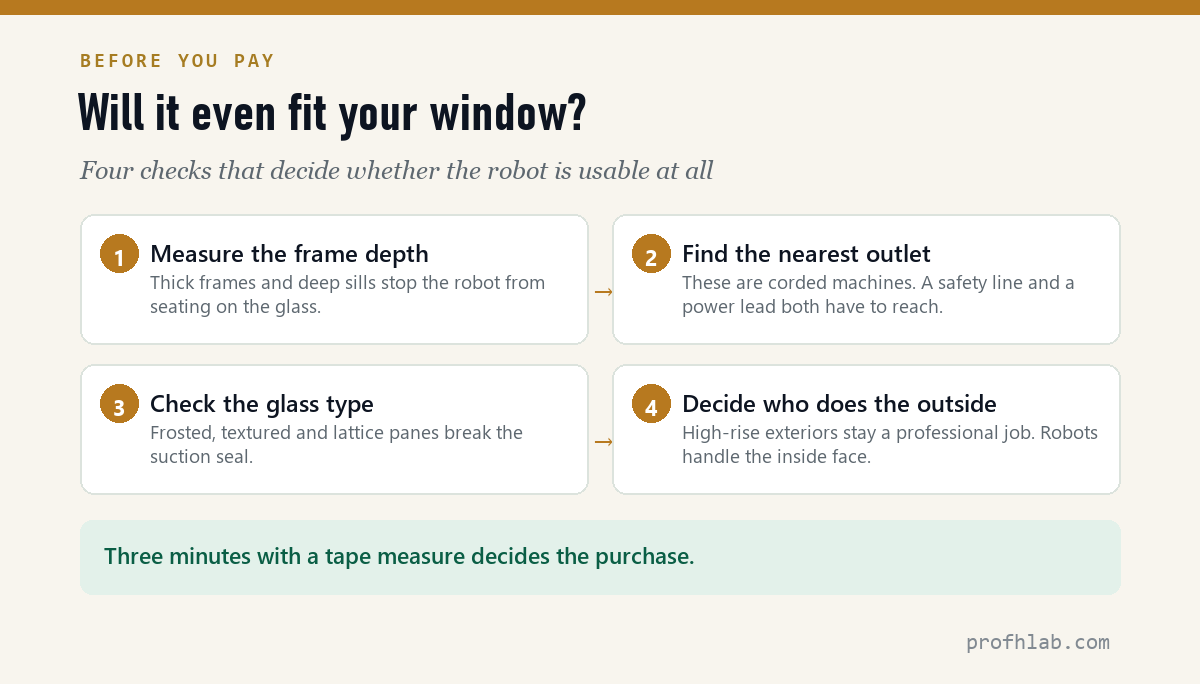
Anywhere with double glazing, grilles, insect screens or narrow sashes, the same trap applies. Four questions and a tape measure settle it in five minutes.
- ① Thickness clearance — is the gap between the grille or railing and the glass comfortably bigger than the machine’s thickness? Measured thicknesses: Winbot Mini 55mm, CleanWow OCZ-WS770 70mm, Winbot W3 Omni 76mm. The narrower the window, the more a slim body is the answer.
- ② Pane width — is one pane of glass at least three times the machine’s width (215–270mm)? Small divided windows leave the robot nowhere to turn.
- ③ Frame step — is the step at the window frame 3cm or less? Most models quote 3cm as the height they can clear.
- ④ Inner-window opening — with the inner window opened fully, can you place the machine anywhere on the outer glass? If it only reaches half, it only cleans half.
If even one of those four snags, start with the $239.99 WINBOT mini rather than a $700 station model. It is the cheapest way to find out whether your windows and your habits suit a robot at all — and if they do not, you are out the price of one professional visit, not four.
So which one should you buy?
Four machines are actually worth considering in the US, and they sort cleanly by what you are trying to solve.
- Start here — ECOVACS WINBOT mini, $239.99. The cheapest way to find out whether you will actually use one. 7,500 Pa at rest, 3,200 Pa while moving, 1.3 kg, and over 30 minutes of power-loss protection if suction fails. Light enough to move between windows without resenting it, which matters more than any spec here.
- The sensible pick — ECOVACS WINBOT W2S, $399.99. 8,000 Pa, TruEdge scrubbing that reaches within about a millimetre of the frame, and roughly 1 minute 45 seconds per square metre. The edge reach is the upgrade you notice: cheap robots leave a visible border of dirt the eye goes straight to.
- If you hate wringing cloths — W2S OMNI, $599.99, or W3 OMNI, $699.99. The station washes the pad between passes instead of you doing it. The W3 adds Vortex Wash, WIN-SLAM 5.0 path planning and up to 130 minutes on battery. Worth it only if you have a lot of glass; on six windows you are buying a station you barely use.
- Do not overpay for suction alone. Every model here holds the glass fine. What separates them is edge reach, pad washing and how heavy the thing is in your hand.
Temper expectations before you order. Gizmodo’s review of the W3 OMNI ran under the headline that window-cleaning robots “have a long way to go,” and that is a fair read of the whole category: they do a decent job on flat, accessible glass and struggle everywhere else. Prices verified August 11, 2026 on ECOVACS US.
Do not buy one if…
- Your windows have dense security grilles or are divided into small panes — the machine physically cannot get in, whatever the specs say.
- You clean the windows once a year, if that. Even the $239.99 mini needs four or more years to pay for itself on interior glass alone. Hire someone.
- You want to clean the outer pane on a rainy day — most models are not rated for it, and the wheels slip on wet glass.
- You want the corners perfect — round-pad models leave the edges. The finishing wipe stays a human job.
- You are sensitive to noise — the vacuum-suction motor is at least as loud as an ordinary robot vacuum, often louder.
Suction, safety ropes and power cuts: will it fall off the glass?
Q. Won’t it fall off a high-rise window?
Falling during normal operation is unlikely. Reviews consistently describe the suction as strong enough that the machine feels solid the instant it locks onto the glass. Even so, there is a reason every manufacturer puts a safety rope in the box. Check whether the model carries a backup power supply (UPS) for a power cut, and always clip the rope to a fixed point inside the window frame. The rope’s real job is to remove any chance of the machine coming down on the glass of the flat below.
Q. Should I start cheap or buy the good one straight away?
Start cheap. The $239.99 mini answers the only question that matters — will a robot attach to your windows, and will you actually run it? If the answer is yes, the money is not wasted: a light single-room unit stays useful for the bathroom and the balcony door after you upgrade. If the answer is no, you found out for less than the cost of one professional visit.
The last word
I try to imagine the sentence the Noeun 3-dong residents wrote on that budget proposal. It was probably closer to “we would rather no neighbour got hurt cleaning a window.” That, in the end, is what a window-cleaning robot is. Before it is a machine that saves time, it is a machine that keeps you from leaning your weight on a high balcony railing.
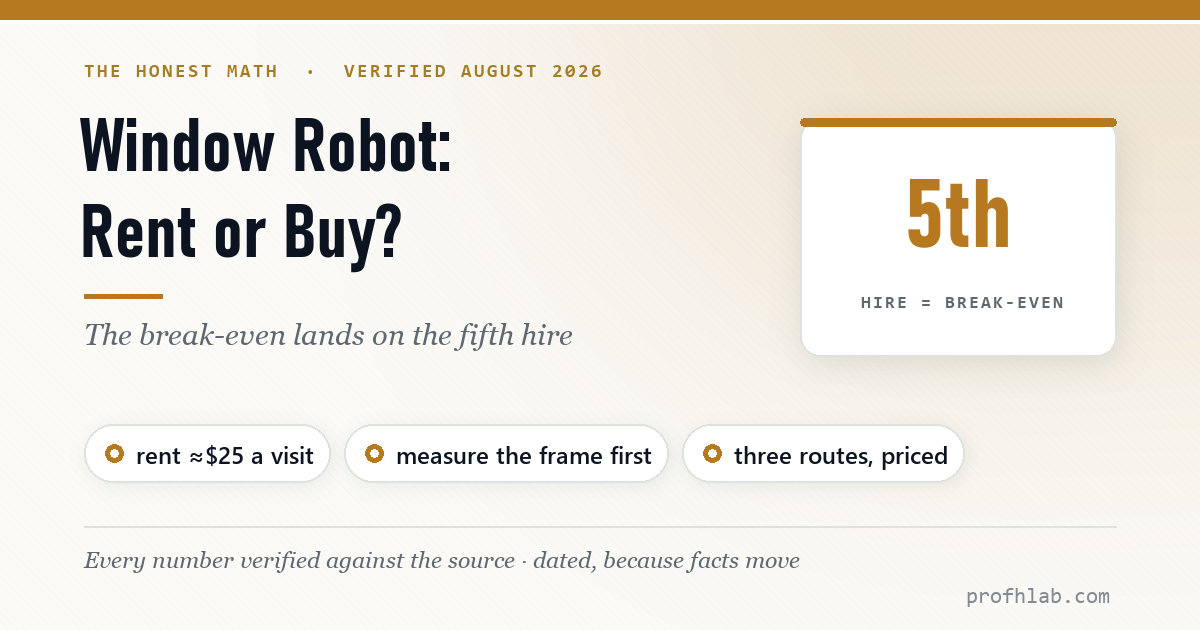
So today’s decision needs only this sequence. One phone call to the community centre. Five minutes with a tape measure at the window frame. And the break-even number five. If you still want to buy after all three, that is not an impulse. It is arithmetic.
Sources: ECOVACS US product pages for the WINBOT mini, W2S, W2S OMNI and W3 OMNI, verified August 11, 2026; US window-cleaning price data from This Old House, drawing on Fixr and HomeGuide estimates, updated March 27, 2026; Gizmodo’s review of the W3 OMNI. The neighbourhood-lending scheme described at the top is run by the Noeun 3-dong community service centre in Yuseong District, Daejeon.
Part of the Physical AI library — research decoded and machines compared, in plain English: profhlab.com/physical-ai.
An Ecovacs Winbot W2 Pro Omni tackles big and small real windows
Full index
Every guide in the Physical AI library — 27 of them, grouped so you can find the one you need.
Start here
- Physical AI Foundations: World Models, Robot Foundation Models, and Sim2Real — From Zero
- Physical AI Explained: Why a Chatbot Knows the Cup Falls but a Robot Doesn’t
- The Physical AI Toolbox: Six Free Simulators, a $249 Hardware Ladder, and What the 2026 Papers Admit
Research papers, decoded
- RoboVLMs, Explained: What Actually Makes a Robot Foundation Model Work
- Ψ0 (Psi-Zero), Explained: The Humanoid Foundation Model That Learns From Human Video
- MotionWAM, Explained: One-Shot Imagination Brings Real-Time Humanoid Loco-Manipulation
- XHugWBC, Explained: One Policy That Drives 12 Different Humanoids
- Vision-Tactile Pretraining, Explained: A Robot Hand Learns Human-Like Dexterity From a Webcam
- TouchWorld, Explained: A Robot Hand That Predicts Touch Before Making Contact
- HOUND and APT-RL, Explained: One Transformer Brain for Walking, Running, and Jumping in the Wild
Machines, priced
- Tesla Optimus V3 Release Date, Price and Specs: What Tesla Has Confirmed
- Buying a Humanoid Robot in 2026: What a Unitree R1 Really Costs, Retail vs Import
- Robot Dog Prices in 2026: From ≈$2,900 to ≈$71,000 — and Spot Still Has No Price Tag
- Tesla FSD Goes Subscription-Only in Korea — and the ‘5-Year Break-Even’ Everyone Quotes Is Wrong
Home robots, tested
- Narwal Freo Z10 Ultra Review: 18,000Pa, a 75°C Mop Wash, and Three Honest Drawbacks
- 22,000Pa vs 240 Air Watts: Robot Vacuum Suction Numbers, Decoded (2026)
- Robot Vacuum or Stick Vacuum? I Split Housework Into 10 Tasks — Only One Truly Overlaps
- The Sour Smell Isn’t the Mop: Robot Vacuum Odor by Zone, and a 7–9x Consumables Gap
- Drain Height Decides Your Robot Vacuum: Samsung 0.4 m, Roborock 50 cm, LG 1.5 m
- Robot Vacuum Repair Costs 2026: A $140 Fix and a 56.5% Resolution Rate
- Robot Vacuum Subscription vs Buying: What iRobot Select Really Costs
- ▸ Are Window-Cleaning Robots Worth It? The Break-Even vs Hiring a Pro (you are here)
- Smart Speakers in 2026: The Hardware Is $99 — the Assistant Is the Real Price
- Serving Robot Costs in 2026: $399 a Month, and Why 73.3% Saw No Change
Chips & companies
- HBF and zHBM, Explained: Samsung and SK Hynix Give Opposite Answers to the Same Memory Problem
- Korea’s Chip Equipment Makers, Compared: Profits Fell 68% — So Why Did Pay Jump 29%?
- Samsung DS vs DX: One Company, a $450,000 Bonus Gap — and Why the Simple Story Is Wrong
- ASML Korea’s Starting Pay Is $31K — or $46K: Anatomy of a 2.15x Salary-Data Gap
Looking for the other library? Generative AI — tools, tested →
Prof.’s H Newsletter
One short email a month, with the numbers in it
What actually moved in AI hiring, AI prices, and the scams aimed at older Americans. Counted here, dated, and linked to the source. One email a month, and your address goes nowhere else.